
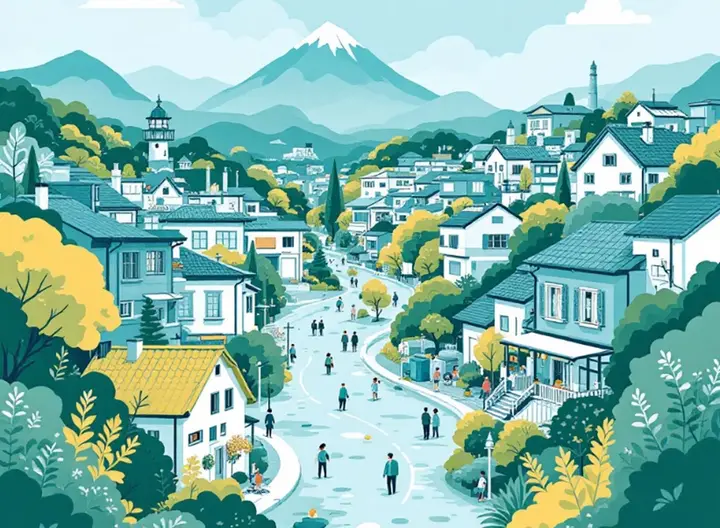
What is Regional Revitalization?
Regional revitalization, a term originating from Japan in 2014, is a strategic response to issues such as population decline, excessive concentration in urban areas, and imbalanced urban-rural development. It emphasizes a "local-first" approach, actively discovering and utilizing local history, culture, industries, and social networks to create development models with both local characteristics and sustainable development potential.
Its core concepts include revitalizing local resources, building local identity and sense of belonging, using design and innovation to create new economic models and lifestyles, and cultivating long-term sustainability and self-reliance. Looking at these characteristics, we can see that unlike traditional subsidies, it goes beyond simple project-based intervention to build a complete self-sufficient system like an ecosystem. Its success depends on the synergy between human capital, natural resources, local enterprises, cultural heritage, and governance structures, highlighting the importance of circularity, interdependence, and resilience. This directly aligns with ESG's holistic concept in environmental, social, and corporate governance aspects, where each pillar supports the others to achieve overall sustainability.
How Does Regional Revitalization Policy Connect with ESG? Understanding Development Trends from Taiwan's Framework
Taiwan's government, facing multiple social issues such as population decline, excessive urban concentration, and imbalanced urban-rural development, has actively promoted regional revitalization policies since 2019. Through establishing youth empowerment workstations across regions, building diverse application channels, matching central government resources, and guiding private investment, it strongly supports local youth rooting and shared prosperity initiatives.
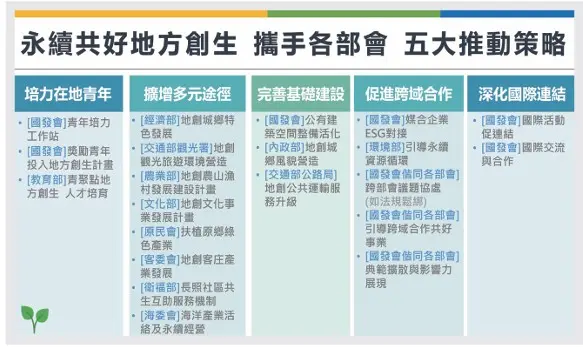
According to current policy planning, Taiwan entered a new phase with the "Creating Sustainable Shared Prosperity Regional Revitalization Plan (2025-2028)" in 2025. The National Development Council, together with 10 ministries, plans to invest NT$6 billion over the next four years, emphasizing three core values of "sustainability, public benefit, and shared prosperity," with five strategies: "empowering local youth," "expanding diverse pathways," "improving infrastructure," "promoting cross-domain cooperation," and "deepening international connections," fully integrating ESG concepts to drive local and specialty industry upgrades.
From a policy perspective, Taiwan's regional revitalization is gradually developing, progressively aligning with international standards through planning, construction, and empowerment, while emphasizing ESG connections. Additionally, as resource integration and planning systems mature, the threshold for regional revitalization is gradually lowering, becoming part of local industry planning.
How to Effectively Integrate Local Elements into ESG Sustainability Concepts?
Local specialty industries refer to industries whose uniqueness stems from the cultural, historical, natural, or human resources of a specific region, such as traditional agriculture and handicrafts, innovative services, and ecotourism. How to utilize these industries is key to regional development. Through revitalized and innovative industrial development, new economic value can be created for localities and stable local employment opportunities provided. To effectively integrate local elements into ESG sustainability concepts, it's necessary to balance environmental, social, and governance dimensions while combining local resources, culture, and community characteristics to give sustainable development clear local practical value. Common categories include local natural resources and ecology, local culture and historical elements, and supply chain and local procurement.
Through these inherent local value connections, a genuine value foundation is provided for ESG concepts, constructing their ESG narrative to stand out in the market. For example, the environmental aspect can be integrated through green product design, sustainable procurement, waste reduction, and circular economy to enhance value; the social aspect can further enhance industry value through cultural preservation and heritage, fair labor practices; the governance aspect can improve market trust through integration of ethical standards, stakeholder collaboration, and transparent operations.
This combined approach, by integrating local characteristics with ESG concepts, transforms inherent "goodwill" into recognized and valuable assets in the modern market, connecting intrinsic value with broader ESG narratives.
What Challenges Do Local Industries Face in Adopting ESG? What Government Assistance is Available?
Many local industries and enterprises have visions and expectations for regional revitalization but often face the challenge of "capability-expectation gap." Although the necessity of ESG is increasing annually, and expectations from regulators and large customers are high, many local specialty industries' actual capabilities in practicing and integrating these principles are limited by their inherent constraints. For example, facing issues of limited financial, human, and technical resources, lack of understanding of ESG concepts, assessment methods, and implementation strategies—various difficulties in implementing ideas limit the development of regional revitalization combined with ESG.
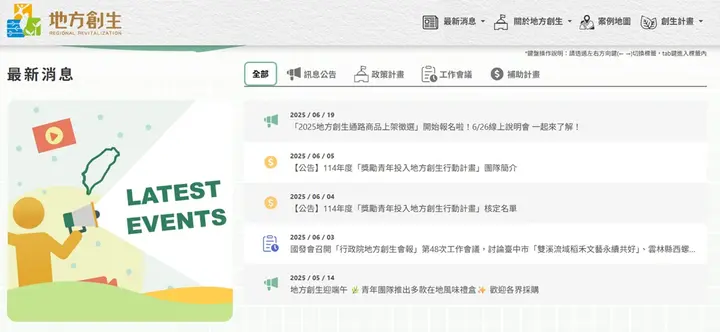
The government has established the "Regional Revitalization Information Sharing and Exchange Platform," providing resources including administrative information, databases, case sharing, subsidy programs, etc., for youth, local industries, civic groups, and others to use.
Regional Revitalization Information Sharing and Exchange Platform
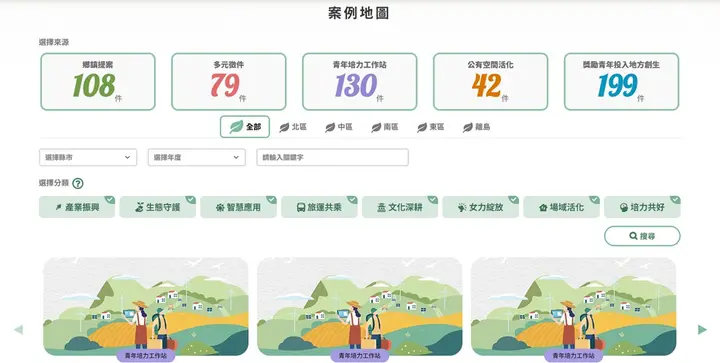
On the website's case map, suitable cases can be found based on source, region, and type
Successful Cases of Regional Revitalization
Japan's Sado Island: Culture, Environment, and Sustainable Coexistence
Sado Island's most representative cultural asset is the "Sado Gold Mine" with nearly 400 years of mining history, which was officially registered as a World Cultural Heritage site last year. The gold mine not only witnessed the development of mining technology during the Edo period but is also the core of the island's cultural memory. Local government and residents actively preserve mine relics, old buildings, and traditional tools from various eras. Additionally, Sado preserves Noh theater, tarai-bune (tub boats), and other cultural elements, developing cultural sustainable tourism. Local government works with residents and businesses to develop diverse guided tours, specialty dining, experiences, and cultural activities, strengthening local brands, increasing employment, and attracting young people to return home, driving the local economy.
On the natural front, Sado Island is committed to wild crested ibis conservation and developing sustainable agriculture and fisheries. Local agriculture's multi-functional management and organic cultivation have earned World Agricultural Heritage and Japan Geopark certifications, forming a sustainable model of production, life, and ecology.

Indigenous Tribes and "Under-Forest Economy":
"Under-forest economy" differs from traditional logging or cultivation. It uses forest resources for high-value-added production without disturbing forest land. Crops must have economic value and meet market demand to form a local production and consumption support system. From raising bees in the forest to collect precious forest honey, to growing shiitake mushrooms and Anoectochilus formosanus under forest shade, these industries bring stable and considerable income to tribal residents. Economic improvement not only enhances residents' quality of life but has become a key factor in attracting youth to return home. For example, according to a July 2025 report, the Kaosi Tribe Youth Association in Pingtung has 22 members, ranging from junior high students to those in their 30s, with 11 being returning youth—quite rare in tribal areas experiencing population outflow.

Development in mountainous areas often faces strong natural and biological pressures, and under-forest economy has also improved this issue. According to statistics from the Forestry and Nature Conservation Agency, illegal harvesting in Taiwan's national forest lands has dropped 80% over the past decade, partly due to the rise of tribal forest economies. As local residents can benefit from it, they value the forest land more and strengthen supervision against illegal harvesting.
This approach directly increases local income and encourages youth to return home, making it a successful case of shared prosperity among economic development, environmental protection, and social welfare.
From the above cases, we can see that starting from "local characteristics," combining with "sustainable development," and effectively generating "economic value" can successfully drive local development and sustainable operations, responding to the core issues that regional revitalization aims to solve.
How Can Enterprises Integrate Regional Revitalization?
In recent years, enterprises no longer use financial donations as the main form of social participation but further consider how to use their industrial resources and professional advantages to go deep into local fields and co-create value chains with long-term impact with local teams.
Many enterprises have begun to view regional revitalization as an important part of their corporate sustainability strategy, providing comprehensive support to local industries from human resources, technical support, product development, channel expansion to brand marketing. They also collaborate with local youth to cultivate local entrepreneurial momentum, promote cultural preservation and innovation, and revitalize local economies. Such investment not only strengthens corporate social impact but also opens opportunities for cross-domain innovation and new market development.
The following will introduce two specific cases to help understand how enterprises combine their core business advantages to actively participate in regional revitalization actions and practice the sustainable development concept of "shared prosperity."
MediaTek
Since 2018, MediaTek has held the "Genius for Home" digital social innovation competition, encouraging the public to provide solutions to hometown problems and using its industry resources to provide two years of post-competition mentoring and grants to support finalist teams in implementing their proposals. Over six years, more than 2,000 innovative proposals have been gathered, covering diverse topics such as environmental sustainability, aging population, long-term care and medical care, urban-rural gaps, and traditional industry innovation. This not only inspires participants' attention and action on local issues but also practically promotes the implementation of regional revitalization.
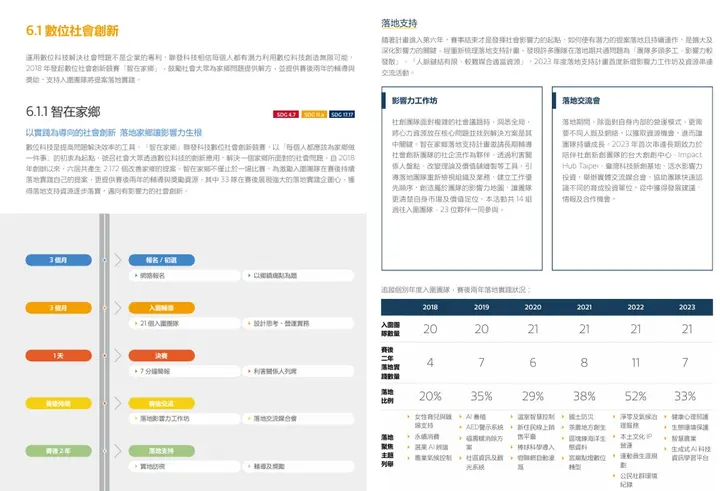
Source: MediaTek 2023 Sustainability Report
E.SUN Financial Holding
E.SUN has been investing in regional revitalization since 2018, supporting local industry innovation and transformation. Leveraging its financial expertise, E.SUN provides financial consulting based on enterprise development stages, helping businesses successfully obtain funding. Additionally, through regional revitalization digital platform interviews with team growth stories, it enhances brand visibility, helps regional revitalization enterprises expand their business, and strengthens sustainable development momentum.
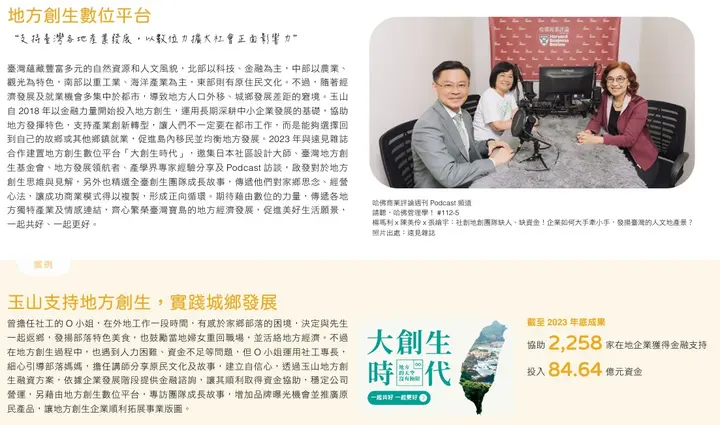
Source: E.SUN Financial Holding 2023 Sustainability Report
Future Challenges for Regional Revitalization
From international to Taiwan, successful cases have emerged in recent years, and regional revitalization seems to have become a common concept in daily life, with major sustainability awards also including related content as evaluation criteria. However, there is still a big step forward before regional revitalization reaches mature development. The 2025 United Nations Sustainable Development Report indicates that global progress is "severely off track," with only 17% of SDG sub-targets expected to be achieved by 2030. This stark reality highlights the urgent necessity of accelerating action at all levels, especially at the local level. It shows that even though there are many cases currently, the scale and speed of development are still far from expectations. How to deepen existing projects, incorporate sustainability concepts, and accelerate the introduction of new projects is a challenge that regional revitalization must face.
In the future, for regional revitalization to successfully integrate with ESG, it needs to deepen local innovation, technology adoption, long-term collaboration, information transparency, and international alignment to build local economies and societies with sustainable competitiveness.