
Global Sustainable Investment Accelerating, but Financial Institutions Face ESG Data Supply-Demand Imbalance
Sustainable investment has approached nearly thirty trillion US dollars (OECD), driving financial institutions to strengthen sustainable risk management. However, the gap between ESG data supply and demand is rapidly widening, and the disparity in sustainability information between financial institutions and enterprises is affecting the quality of decisions in credit, investment, and supply chain finance.
According to DBS Bank's Catalysts-of-Sustainability report:
In Asia, SMEs account for 96% of enterprises. SME supply chain ecosystems typically include large enterprises, so they face increasing pressure to become "greener." Banks also believe they have a responsibility to support SME customers by providing sustainable finance and ecosystem solutions.
SMEs Face Challenges: Generally Low ESG Readiness
Many SMEs lack the capital, technology, and expertise needed to invest in sustainable development. SMEs acknowledge the need for more sustainable business models and supply chains but struggle to develop and implement ESG strategies.
In this context, financial institutions need more than just tools that display ESG scores—they need a "complete digital solution" that can truly fill data gaps, enhance information transparency, and support regulatory requirements. The SustainAI Sustainable Finance Analytics Module launched by Sustaihub is designed precisely to address these three major pressures, using AI, automated data integration, and high-transparency assessment frameworks to help financial institutions comprehensively enhance their sustainable risk management capabilities.
SustainAI: Five Key Features to Comprehensively Enhance Financial Institutions' Sustainable Risk Management Capabilities
To help financial institutions fill ESG data gaps and address regulatory requirements, SustainAI's core design focuses on "data depth, comparability, transparency, and risk identification."
1. Over One Million ESG Data Points Integrated, Building the Most Complete Sustainable Information Perspective
SustainAI integrates over one million ESG data points from global sustainability reports, news, regulatory filings, and public data, enabling financial institutions to grasp key sustainability performance even when corporate proprietary data is insufficient, providing complete and up-to-date risk insights.
2. Portfolio and Industry Comparison Settings for More Precise, Quantifiable Assessment
The platform supports company screening and weight adjustment settings, allowing comparison of enterprises against industry averages based on portfolio structure. This enables financial institutions to effectively grasp relative risks, identify anomalous behavior, and establish comparable sustainable analysis benchmarks.
3. AI-Driven Sustainability Scoring, Converting Complex Data into Actionable Decision Metrics
SustainAI uses AI models to convert large amounts of unstructured data into comparable, quantifiable sustainability scores, enabling financial institutions to quickly identify advantageous enterprises and high-risk enterprises when facing large enterprise lists, significantly improving analysis efficiency.
4. Transparent, Traceable Scoring Process, Meeting Regulatory and Audit Requirements
Each ESG score comes with its source, reasoning logic, and rationale, providing financial institutions with: traceability, explainability, and auditability.
5. Real-Time Identification of High-Risk Issues, Enabling Quick Portfolio Risk Visualization
SustainAI provides a High-Risk Issues List that can instantly identify negative signals, controversial events, and major risks related to ESG, enabling financial institutions to understand potential sustainability impacts in their portfolios and take proactive response measures.
Helping Enterprises and Financial Institutions Connect ESG Data:
Taking a successful case in Taiwan as an example, Far EasTone Telecommunications is one of the nation's largest telecom operators and has long been committed to promoting supply chain sustainability management. Sustaihub helped Far EasTone collect carbon emissions and sustainability data from over 100 suppliers, dramatically reducing the data collection process that previously took more than half a year to just half the original time, improving supply chain information capture speed and strengthening data quality.
This complete and consistent ESG data subsequently became the foundation for Far EasTone's collaboration with Mizuho Bank to launch the "Sustainable Supplier Financing Program", enabling supply chain enterprises to apply for more advantageous financing terms based on concrete sustainability performance.
For Mizuho Bank, suppliers can provide more complete and verifiable ESG information when applying for financing, enabling the bank to more accurately assess SME sustainability risks and operational performance, improving loan security and sustainable finance promotion efficiency.
Therefore, when SMEs have stable and clear ESG data, financial institutions can improve their risk judgment capabilities and promote larger-scale, more impactful sustainable finance products.
Taiwan's Sustainability Technology Steps onto the International Stage
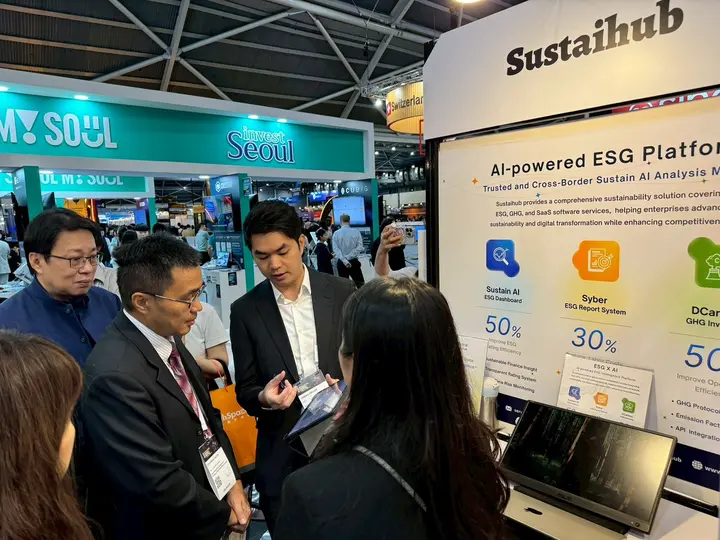
Singapore is Southeast Asia's important financial hub, placing high emphasis on ESG policies and regulations. Local financial institutions are increasingly focusing on portfolio sustainability and view corporate ESG performance as a core indicator for risk management. This exhibition is not only an excellent opportunity to expand into international markets but also demonstrates Taiwan's competitiveness in the two key areas of digital transformation and sustainable development. It holds profound significance for future market development, partnership building, and brand visibility.