
1. What Is Human Rights Due Diligence? [From International Advocacy to Regulatory Requirements]
Human Rights Due Diligence (HRDD) is a management process through which enterprises systematically identify, assess, prevent, and respond to actual or potential human rights impacts arising from their business operations and supply chains, in accordance with international human rights standards.
This concept has rapidly gained momentum in recent years, primarily because the EU has elevated human rights due diligence from a "voluntary initiative" to a "legally binding governance requirement." Taking the EU's Corporate Sustainability Due Diligence Directive (CSDDD, commonly referred to as the HRDD framework) as an example, it explicitly requires enterprises to establish verifiable, traceable, and continuously operational management processes for human rights risks across their entire value chains.
This legislative approach has created spillover effects across global supply chains. Even if an enterprise is not directly subject to EU regulations, as long as it forms part of the supply chain of EU companies, international brands, or Taiwan-listed companies, it may become subject to their human rights due diligence and supplier management requirements.
Therefore, for Taiwan's listed companies, human rights due diligence is no longer merely a concept or a disclosure option—it is progressively becoming an auditable governance capability and a competitive threshold for supply chain participation.
Human Rights Risk in ESG Reports | How Do TSMC and AUO Approach It?
TSMC:
TSMC independently publishes its "TSMC Human Rights Report," conducts a "Workplace Human Rights Climate Survey" across its global workforce, and offers human rights general education courses and training workshops.
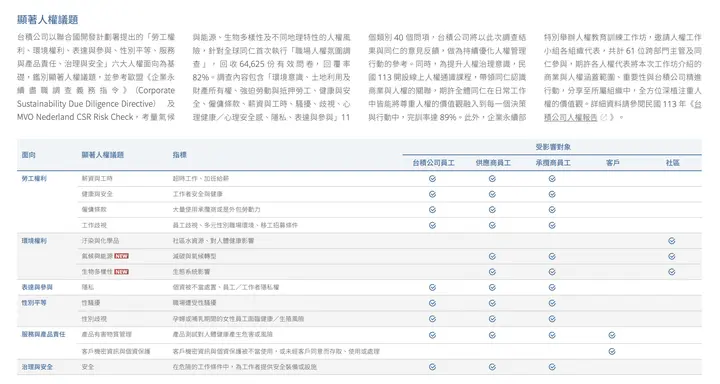
Source: TSMC FY2024 Sustainability Report
AUO:
AUO conducts a human rights risk questionnaire survey every two years, targeting not only all employees but also subsidiaries, tier-1 suppliers, subcontractors, and neighboring communities.
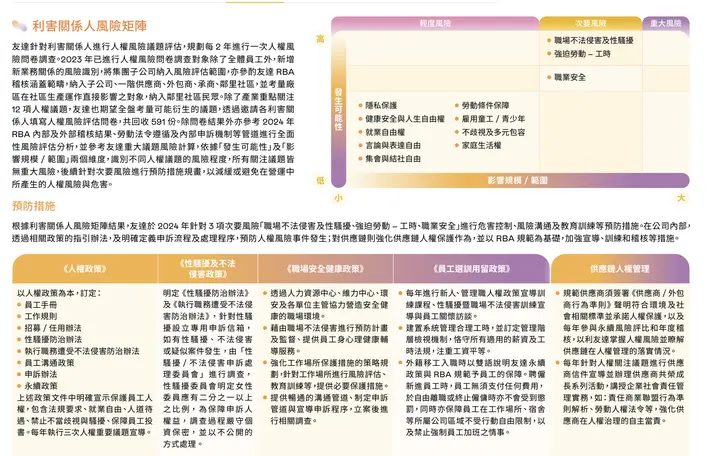
Source: 2024 AUO Sustainability Report
2. Why Should Enterprises Conduct Human Rights Due Diligence?
Most enterprises initially regard human rights due diligence as an issue exclusive to sustainability or ESG. In practice, however, its benefits extend far beyond sustainability report disclosure.
1️⃣ Enhanced Corporate Governance and Internal Control Maturity
Through human rights due diligence, enterprises can:
- Establish systematic supplier management and risk assessment processes
- Provide the board of directors with concrete evidence for overseeing non-financial risks
Human rights risks are no longer handled on a case-by-case basis but are integrated into corporate governance and internal control systems.
2️⃣ Supply Chain Stability and Operational Risk Management
In practice, human rights issues are often a high-risk source of supply chain disruptions and reputational disputes.
Through supplier risk identification and management, enterprises can:
- Identify high-risk suppliers proactively
- Reduce spillover risks from labor disputes and migrant worker incidents
- Minimize the impact of unforeseen events on operations and brand reputation
3️⃣ Improved Responsiveness to Investors, Clients, and ESG Ratings
In investor relations, ESG ratings, and supplier evaluations, commonly asked questions include:
- Do you conduct human rights risk assessments on your suppliers?
- What is the scope and coverage ratio?
- How do you handle high-risk suppliers?
Having a human rights due diligence system in place effectively improves response quality and reduces the likelihood of supplementary documentation requests or being classified as a high-risk enterprise.
Case Study: Far EasTone Telecommunications | Publishing a Supply Chain Sustainability Report
To deepen supply chain sustainability governance, Far EasTone Telecommunications launched an advanced data insights project for ESG due diligence in 2025,
leveraging the SustaiHub platform to strengthen risk identification, performance tracking, and strategy optimization capabilities.
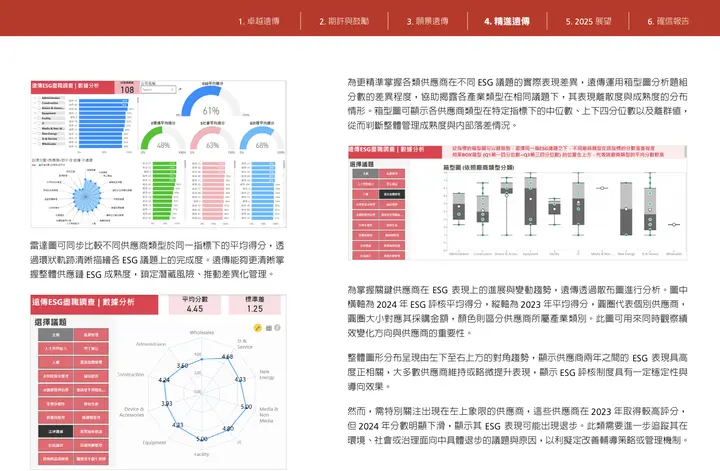
Source: Far EasTone Telecommunications "2025 Sustainable Supply Chain Report"
3. 🇪🇺🇺🇸 How Do the EU and the US Regulate Human Rights Issues?
Below is a summary of key human rights regulations currently in effect in Europe and the United States:
🇪🇺 Europe: Emphasis on "Due Diligence" and "Legal Liability"
- Corporate Sustainability Due Diligence Directive (CSDDD) — currently the most significant EU regulation
- EU Forced Labour Regulation (FLR)
🇺🇸 United States: Emphasis on "Border Enforcement" and "Criminal Liability"
- Uyghur Forced Labor Prevention Act (UFLPA)
- Section 307 of the Tariff Act of 1930 (Withhold Release Order, WRO)
- Federal Acquisition Regulation (FAR)
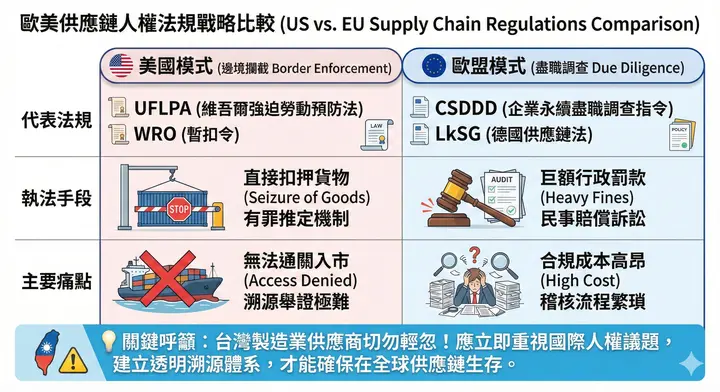
Comparison of EU and US supply chain human rights regulations (Source: SustaiHub compilation, chart by Gemini)
Even though the 2026 draft "Taiwan Enterprise Supply Chain Human Rights Respect Program" proposed by the Ministry of Economic Affairs does not apply to all listed companies, suppliers of EU companies, international brands, or multinational corporations, as well as Taiwan's listed companies and their suppliers, may all be substantially affected.
Given Taiwan's critical role in global supply chains, enterprises are often required by their clients and the market to comply with human rights governance and data disclosure requirements.
4. Risks Enterprises Face Without Human Rights Due Diligence
Failure to establish a human rights due diligence mechanism commonly leads to the following risks:
- Being classified as a high-risk supplier
- Being at a disadvantage in supplier selection or contract renewal processes
- Being deemed to have insufficient information in sustainability disclosures and ESG ratings
- Difficulty in demonstrating adequate management responsibility when labor disputes arise
Real Case | Malaysian Rubber Glove Manufacturer Hit by US Withhold Release Order (WRO)
Malaysia's Top Glove, the world's largest rubber glove manufacturer, saw orders surge during the pandemic. However, the US CBP issued a Withhold Release Order (WRO), alleging debt bondage, excessive overtime, and poor dormitory conditions at its factories. The company faced import bans and order cancellations, suffering losses of RM 3.6 billion (approximately USD 857 million) during the WRO enforcement period.
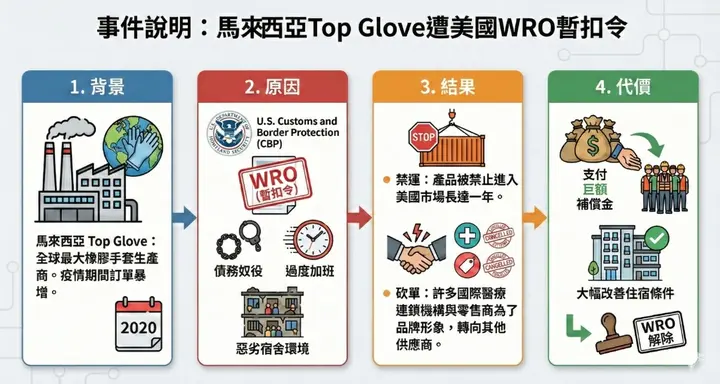
Top Glove ultimately paid substantial compensation to affected migrant workers and significantly improved housing conditions. After a thorough review of the evidence, the US Customs and Border Protection confirmed that Top Glove had addressed all indicators of forced labor and subsequently allowed imports to resume.
5. Human Rights Issues Are Broad — The Human Rights Risk Matrix Focuses on High-Risk Issues
The Human Rights Risk Matrix is a key tool used in human rights due diligence to prioritize and determine which issues require priority management.
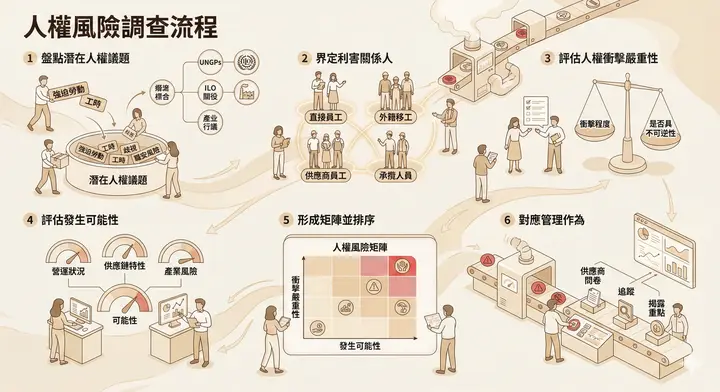
Human rights risk investigation process (Source: SustaiHub compilation, chart by Gemini)
Six Common Steps:
Step 1 | Inventory of Potential Human Rights Issues
Based on UNGPs, ILO conventions, industry characteristics, and supply chain structures, list potential issues such as forced labor, working hours, discrimination, and occupational safety risks.
Step 2 | Define Stakeholders
Identify affected parties, including direct employees, migrant workers, tier-1 suppliers, and subcontracted personnel.
Step 3 | Assess the Severity of Human Rights Impacts
Through questionnaires or interviews, assess:
- Severity of impact
- Number of people or scope affected
- Whether the impact is irreversible
Step 4 | Assess Likelihood of Occurrence
Based on actual operational conditions, industry characteristics, and supply chain specifics, determine the likelihood of risk occurrence.
Step 5 | Form the Matrix and Prioritize
Create a matrix based on "Impact Severity × Likelihood of Occurrence" to identify high-priority issues.
Step 6 | Implement Corresponding Management Actions
Incorporate high-risk issues into supplier questionnaires, tracking mechanisms, or sustainability disclosure priorities to ensure analytical results are actionable.
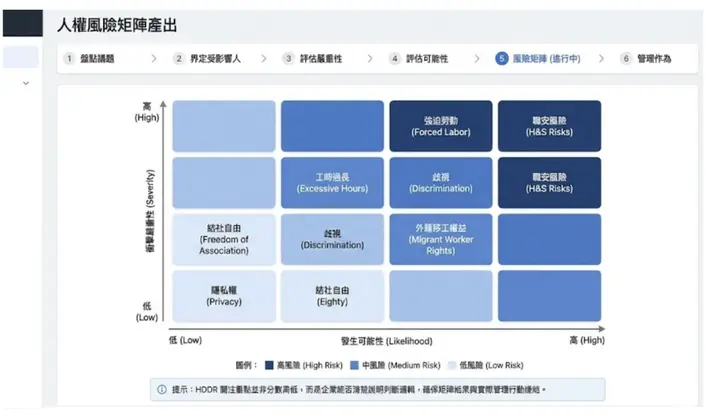
Human rights risk sustainability system illustration (Source: SustaiHub compilation, produced by Gemini)
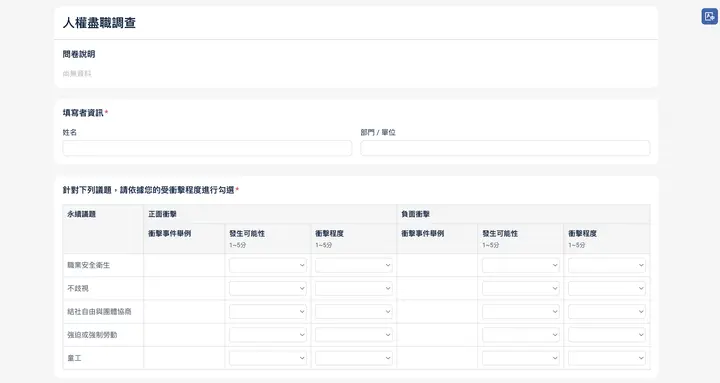
Online supplier human rights risk questionnaire (Source: SustaiHub Syber Sustainability Management System)
Human rights due diligence is not a one-time effort but a management process that can be progressively deepened.
The sooner enterprises begin with a supplier human rights due diligence questionnaire, the more room they have for adjustments and optimization before formal regulations take effect.
All of the above processes can be carried out through the Syber Sustainability Management System, which enables sending questionnaires to internal and external stakeholders (including commonly used supplier self-assessment questionnaires), generating human rights risk matrices, and directly linking results to sustainability report content.
👉 Want to learn how to launch supplier human rights due diligence?
If you would like to trial a human rights due diligence questionnaire and evaluate whether it meets Taiwan's latest regulations and sustainability disclosure requirements, register now for a consultation. Our specialists will help design a practical approach tailored to your enterprise's scale and supply chain structure.
Government reference website:
Taiwan Business and Human Rights Portal: https://investtaiwan.nat.gov.tw/bhr/index.php