Background Insights: Carbon Emission Reduction Pressures and Opportunities
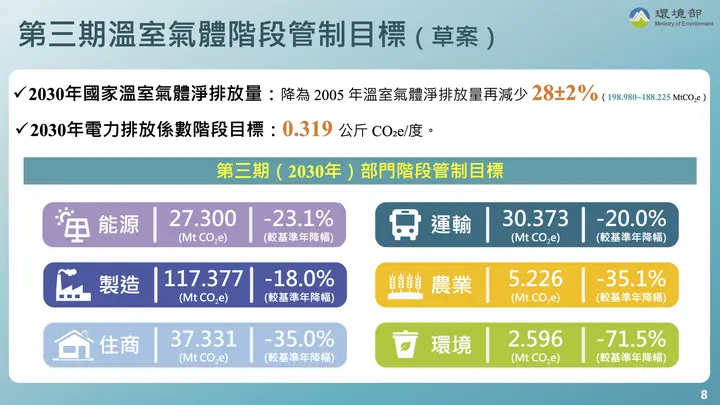
As the global wave of net-zero carbon emissions accelerates, how Taiwan positions itself in carbon emission reduction progress within the Asian region has become particularly important. The latest data shows that Taiwan's greenhouse gas emissions in 2022 decreased by 1.77% compared to the baseline year, but there is still a long road to the 2050 net-zero target. Compared to the carbon reduction targets of Asian neighboring countries, the new 2030 target announced by the Ministry of Environment this time, with a 28% reduction based on the baseline year 2005, is second only to Japan's 41%, demonstrating an active stance in the region, and setting a phased target for electricity emission factor of 0.319 kg CO2e/kWh by 2030. However, facing intense net-zero competition in the region, Taiwan still needs to continuously strengthen carbon reduction measures to consolidate its international status and sustainable development commitment.
Third Phase Target and Expanded Inventory Press Conference Briefing
Policy Implications: The Logic Behind the Third Phase Target
The formulation of this new 2030 emission reduction target is an important step for Taiwan under the "Climate Change Response Act." Progressively raising the carbon reduction threshold not only demonstrates the enhancement of Taiwan's international status but will also bring policy pressure and economic transformation opportunities to various domestic sectors. Meanwhile, the Ministry of Environment plans to propose more challenging NDC 3.0 targets in 2032 and 2035, making the progress of aligning with international standards more explicit.
Looking Ahead: Overall Strategy and Key Impacts
As the net-zero carbon deadline approaches, how to strengthen climate action to enhance international competitiveness has become an unavoidable issue for government and industry. "Expanding carbon inventory targets" will become a key trend that all industries need to closely monitor, and to achieve the new emission reduction targets, the scope of regulated entities will inevitably expand further in the future. The introduction of this policy, by comparing international progress in economic growth and carbon reduction, not only provides important reference for future strategy but also creates new opportunities for Taiwan's enterprises to accelerate their pace adjustments and embrace the opportunities and challenges brought by international carbon reduction regulations.
Expanding Carbon Inventory Targets to Achieve Goals
Third Phase Target and Expanded Inventory Press Conference Briefing
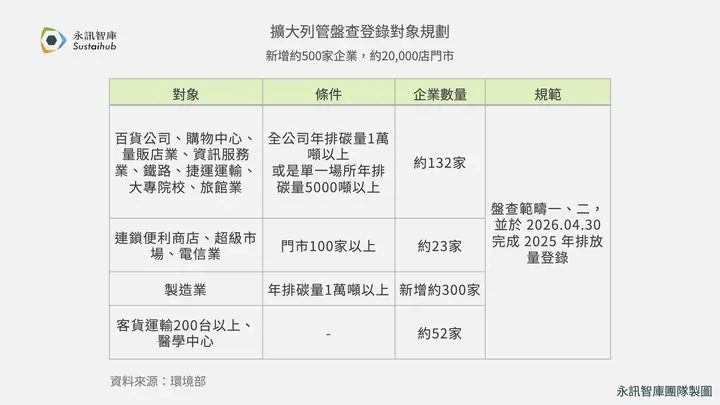
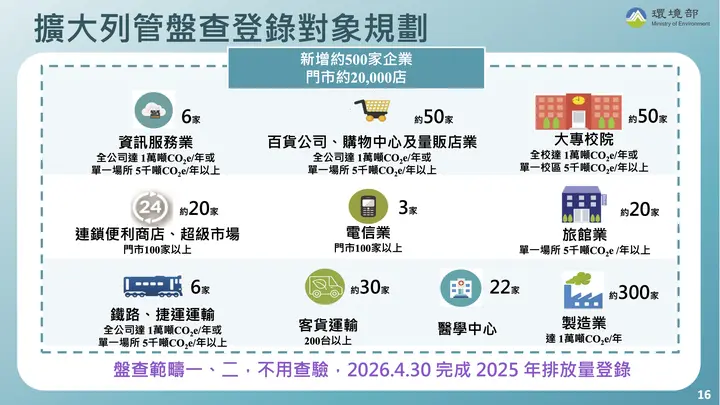
Expanded regulated inventory registration target planning:
1.
Targets: Department stores, shopping centers, hypermarkets, information service industry, railways, MRT transportation, universities and colleges, hotel industry
Conditions: Company-wide annual carbon emissions of 10,000 tons or more, or single facility annual carbon emissions of 5,000 tons or more
2.
Targets: Chain convenience stores, supermarkets, telecommunications industry
Conditions: 100 or more stores
3.
Targets: Manufacturing industry
Conditions: Annual carbon emissions of 10,000 tons or more
4.
Targets: Passenger and freight transportation with 200 or more vehicles, medical centers
A total of approximately 500 companies and about 20,000 stores are newly added, required to inventory Scope 1 and 2 but not required to undergo verification, completing the 2025 emissions registration by April 30, 2026.
How to Comply with the New Carbon Inventory Regulations?
The Ministry of Environment's Climate Change Administration plans to launch a series of measures to help enterprises cope with the expanded carbon inventory requirements, including holding relevant workshops, establishing greenhouse gas inventory manuals and disclosure platforms, and compiling carbon inventory guidelines for service industries, transportation industries, and medical institutions, providing clear implementation directions for different types of business entities. According to current planning, the draft for expanded carbon inventory will be announced by mid-January 2025 and is expected to be officially promulgated by the end of February 2025.
Before the official regulations and guidelines are released, enterprises should prepare in advance to reduce pressure during the subsequent adaptation period. We recommend that enterprises start the foundational work for organizational carbon inventory from the following aspects:
- Inventory emission sources: Clearly understand direct and indirect carbon emission sources within the organization and supply chain.
- Establish data foundation: Collect historical energy consumption data to provide a reliable foundation for carbon inventory.
- Identify responsible departments: Confirm the internal department and personnel responsible for carbon inventory to coordinate the collection and management of carbon emission data.
Additionally, to improve carbon inventory efficiency and meet future carbon reduction needs, adopting digital carbon inventory tools will become an inevitable choice. Such tools can help enterprises conveniently manage carbon emission data, conduct dynamic tracking, and quickly generate reports to meet upcoming disclosure requirements. At the same time, digital tools can also assist enterprises in analyzing emission trends and formulating more targeted carbon reduction strategies, thereby gaining an advantage in carbon emission management.
"Taking early action" not only allows enterprises to handle regulations more smoothly but also lays a solid foundation for future net-zero transformation.
Fill Out the Form and Get 14 Days Free Trial Now!
Carbon inventory is not only a necessary step for compliance but also an important milestone for enterprises to achieve sustainable operations. With the one-stop solution of Dcarbon Cloud Carbon System, enterprises can address complex challenges in sustainability management in a professional and efficient manner. This system can streamline the previously cumbersome carbon inventory process and complete carbon inventory quickly and compliantly. Apply for a 14-day free trial now to learn more about carbon management solutions and help your enterprise seize the lead in the carbon reduction era!
Reference: United Daily News (2024/12/31), 500 Companies Subject to Carbon Inventory, 2030 Emission Reduction Target Up to 30%