
Consultant Column
Popular Keywords:
There are 32 results for "Climate Change".
Jan 07, 2026
From COP30 and NDC 3.0 to CBAM: How Can Enterprises Navigate Carbon Transition and Plan Actionable Net-Zero Pathways?
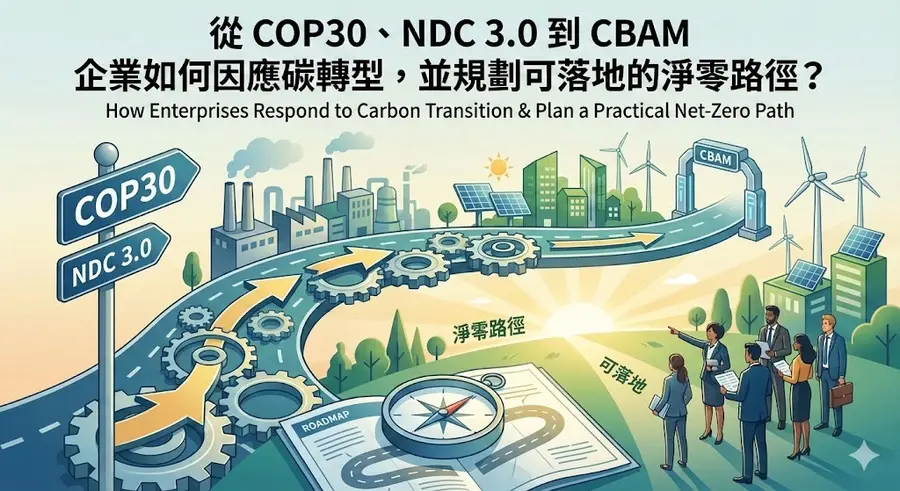
As global climate governance accelerates and carbon costs become increasingly internalized, enterprises no longer face just the question of 'whether to reduce emissions' but rather 'how to complete transformation ahead of time amid uncertain international consensus and increasingly clear regulatory frameworks.' This article explores international trends from COP30, NDC 3.0 emission reduction targets across countries, and the practical impacts of EU CBAM and Taiwan's carbon fee system, helping you understand the key aspects and strategic directions enterprises should focus on during carbon transition.

Sep 03, 2025
How is Green Electricity Defined Globally? A Complete Analysis of US and China Policies and Development (Part 1)
Despite broad global consensus on net-zero emission targets, there are significant differences among countries in defining "green electricity," reflecting their varying land resources, geopolitical considerations, and economic structures. The US tends to include nuclear and natural gas within the broader category of "clean energy," while China focuses on ultra-large-scale deployment of renewable energy. The EU, through its Sustainable Finance Taxonomy, defines nuclear and natural gas as "transitional" sustainable investments under strict conditions.
Jul 30, 2025
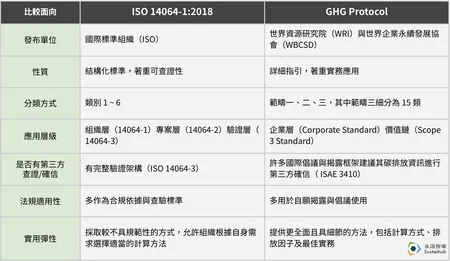
Which Standard for Corporate Carbon Inventory? ISO 14064 vs GHG Protocol Analysis and Recommendations
Companies preparing to start greenhouse gas inventory often discover two mainstream international standards: ISO 14064 and GHG Protocol. Which one meets Taiwan's regulatory requirements? Which is better suited for internal carbon management and sustainability report disclosure? If you are responsible for inventory or preparing sustainability reports, this article will clarify the differences between the two, how to use them together, and the latest IFRS S2 trends, helping you not only comply with regulations but also strengthen international communication and carbon reduction strategies.
Jul 16, 2025
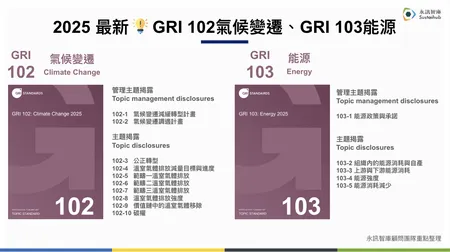
Effective 2027! Complete Guide to GRI 102, GRI 103 Latest Disclosure Standards: Climate Change and Energy Analysis
Sustainability reporting disclosure is moving from compliance to substantial governance management disclosure. With the release of the latest GRI Standards provisions in June 2025, including GRI 102 'Climate Change 2025' and GRI 103 'Energy 2025', companies must face more detailed disclosure requirements, from just transition, climate adaptation, to enhanced Scope 3 emission information transparency. This update is not just about changes in provisions, but a restructuring of organizational internal governance logic. This article will help you understand the background of GRI standards updates, key changes in GRI 102 and GRI 103, and where companies should start preparing to respond to the latest standards.
Jun 25, 2025
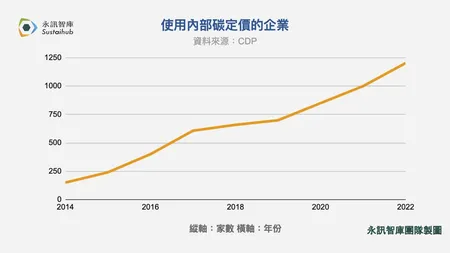
2025 Corporate Carbon Strategy Trends: Internal Carbon Pricing Drives Both Decarbonization and Competitiveness
As global attention to climate change continues to increase, businesses face not only external pressure but also the need for internal transformation. Internal carbon pricing serves as an important tool for corporate sustainable development, helping businesses consider carbon emission costs when formulating strategies, thereby driving the transition to a low-carbon economy. Despite its clear advantages, businesses face a series of challenges during implementation, including internal resistance, resource allocation, and market volatility. This article will explore how internal carbon pricing can help businesses succeed in green transformation and provide specific strategies and recommendations.
Jun 11, 2025
CCUS Carbon Capture Technology: Greenwashing Risks Businesses Must Know Before Procurement
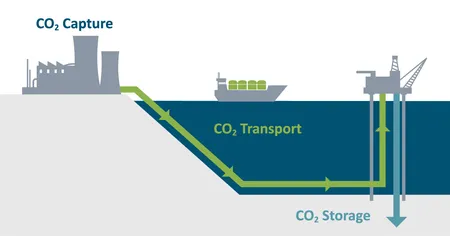
As the world moves toward net-zero emissions, businesses are seeking various carbon reduction solutions to achieve ESG goals. Among them, Carbon Capture, Utilization and Storage (CCUS) technology has been included in national carbon reduction strategies by many countries because it can directly handle carbon dioxide. However, controversy over this technology is growing, and businesses that hastily procure without adequate understanding may fall into 'greenwashing' risks.
May 28, 2025
Complete Guide to Global Carbon Market Systems: From Cap-and-Trade to Taiwan's ETS Pilot Program
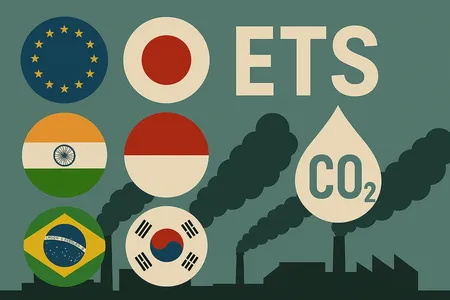
In 2025, Taiwan's carbon fee system officially launched, followed by a cap-and-trade emissions trading system (ETS) pilot program in 2026, moving toward a dual-track carbon pricing system aligned with global standards. Facing impacts from international regulations like CBAM, how can businesses position themselves ahead? This article provides an in-depth analysis of ETS system designs and implementation status in the EU, Japan, South Korea, and various emerging economies, helping businesses deploy corresponding strategies and actions in advance.
May 21, 2025
Corporate Governance Evaluation Results Released! Countdown to ESG Evaluation Transformation: 2025 Latest Evaluation Items and Regulations at a Glance
The 11th (2024) Corporate Governance Evaluation results have been officially announced, and the evaluation system is about to transform. This article will help you quickly grasp the key points of the transition between old and new systems, as well as the new indicator content for the next corporate governance evaluation.


Apr 30, 2025
From Trump's Paris Agreement Withdrawal to Taiwan's 2050 Net Zero Anchor: What Are the New Focus Points for Corporate Supply Chain Decarbonization?
In early 2025, Trump claimed he would withdraw from the Paris Agreement again, seemingly weakening global climate governance consensus. In reality, ESG has long become the operational culture of top international enterprises. Taiwan has also anchored its future at this time - President Lai Ching-te explicitly stated at the National Climate Change Response Committee meeting that Taiwan's 2050 net-zero target will not waver with international political developments. More noteworthy is that the Ministry of Environment plans to officially announce carbon sequestration regulations in mid-2025, which will be a turning point for corporate supply chain decarbonization and Scope 3 management. This article analyzes how enterprises should seize this transformation opportunity!