
Will I Be Penalized for ESG Reporting Errors? How Much?
ESG information disclosure has become an important legal obligation for Taiwan listed companies. Listed companies must complete ESG information reporting through the ESG Digital Platform by the end of June each year, and complete sustainability report submission by the end of August.
According to the latest regulations from TWSE and TPEx, if a company's ESG information disclosure contains errors, significant omissions, or fails to complete sustainability report submission within the prescribed period, it will be subject to penalties ranging from NT$30,000 up to a maximum of NT$1 million, and will be required to make corrections within a specified period; if corrections are not made by the deadline, penalties may continue to accumulate, and measures such as changing securities trading methods, suspending trading, requiring improvement plans and completion of education and training may be taken, and this will serve as a basis for deduction in corporate governance evaluation.
What to Do When ESG Data Errors Are Found? How to Make Corrections?
Once errors are discovered in submitted ESG information, officers need to submit a "Correction Application" on the ESG Digital Platform.
According to the "ESG Digital Platform Promotion Session" presentation published by TWSE/TPEx, the correction process includes the following steps:
Step 1: Click "Correction Application" in either of the following two locations
1. Upper right corner of the "Data Reporting" page
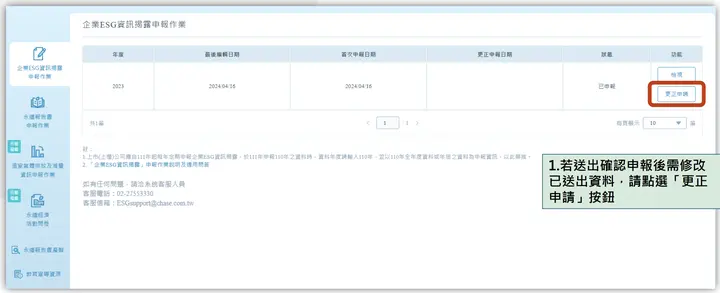
Source: "Corporate ESG Information Disclosure Reporting Operations" and "Sustainability Report Submission Operations"
2. Upper right corner of the "View Data" page
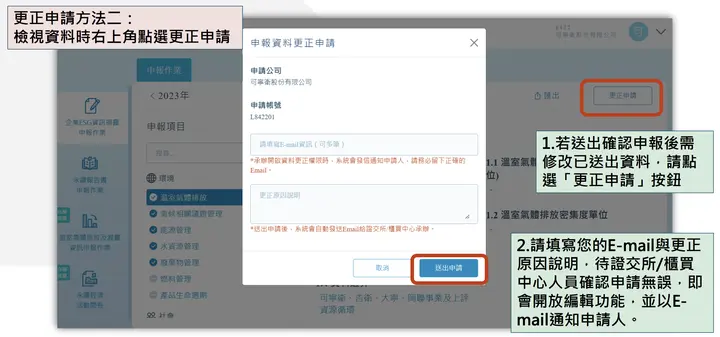
Source: "Corporate ESG Information Disclosure Reporting Operations" and "Sustainability Report Submission Operations"
Step 2: After clicking "Correction Application", fill in "Email" and "Reason for Correction"
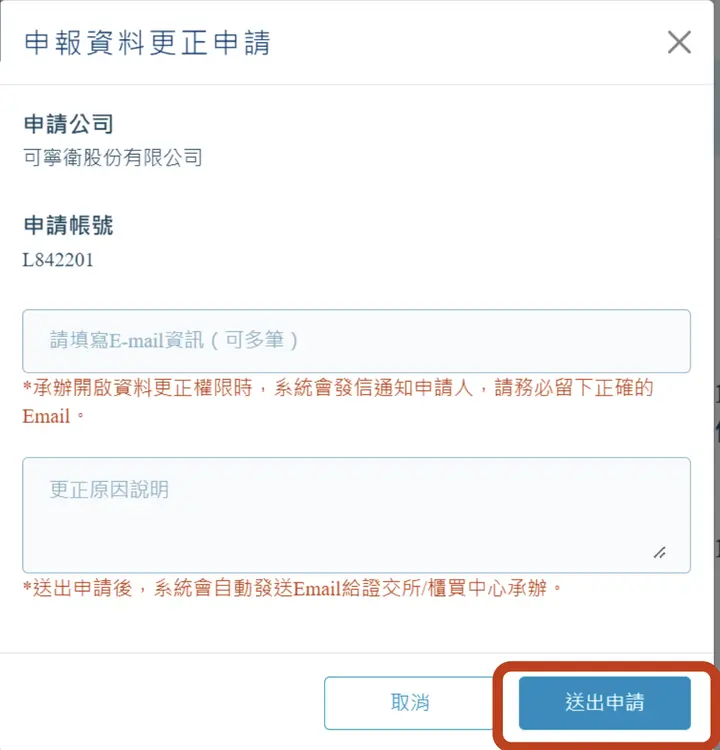
Source: "Corporate ESG Information Disclosure Reporting Operations" and "Sustainability Report Submission Operations"
Step 3: Once TWSE/TPEx staff confirms the application is correct, edit functions will be enabled and applicant will be notified by Email
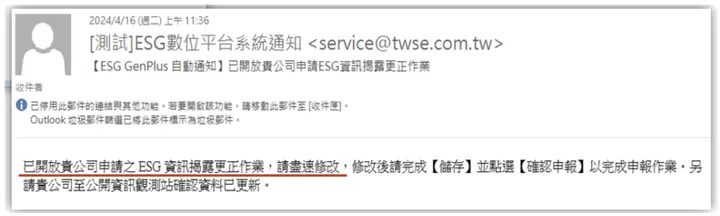
Source: "Corporate ESG Information Disclosure Reporting Operations" and "Sustainability Report Submission Operations"
Step 4: After receiving the notification that correction operations have been enabled, enter the system to make corrections, and after data modification is complete, click "Confirm Submission" again to complete the correction.
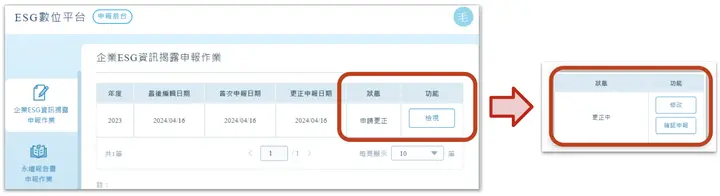
Source: "Corporate ESG Information Disclosure Reporting Operations" and "Sustainability Report Submission Operations"
How to Avoid ESG Reporting Errors? Three Key Recommendations
1. Establish Real-time Communication Systems
A well-established cross-departmental real-time communication mechanism and error reporting process can quickly identify problems and immediately initiate corrective actions, reducing the risk of information transmission delays and external misunderstandings.
2. Strengthen Internal and External Audit and Verification Mechanisms
Before ESG data submission, have internal audit units or external assurance and verification agencies review the data to ensure accuracy and compliance with disclosure requirements.
3. Implement Digital Management Tools to Strengthen Process Control
Adopt ESG digital report management systems to reduce manual errors, ensure information consistency, and maintain complete audit trail records, strengthening internal controls and compliance while further improving submission efficiency and credibility.
Strengthening Sustainability Information Internal Controls: Starting with Systematic Management
As disclosure requirements become increasingly stringent, compilation methods using Word and Excel make it difficult to manage data sources and lack change records, easily leading to data errors, information inconsistency, or unclear responsibility attribution.
Therefore, many companies have adopted digital system tools. Through permission settings, version control, and approval processes, they improve compilation efficiency while also strengthening information transparency and compliance, helping companies establish a foundation for sustainability information internal controls.
Three key features of Sustaihub's Syber Sustainability Management System help companies ensure the accuracy of sustainability information:
- History Records and Approval Processes: Improving Data Reliability
- Cross-departmental Data Integration and Real-time Updates: Solving Data Fragmentation Issues
- Multi-level Permission Control: Strengthening Sustainability Information and Data Security
Through Syber Sustainability Management System, companies can achieve compliance while improving internal efficiency without spending significant manpower and time, providing comprehensive support for sustainable development as the best sustainability report collaboration platform for enterprises.