
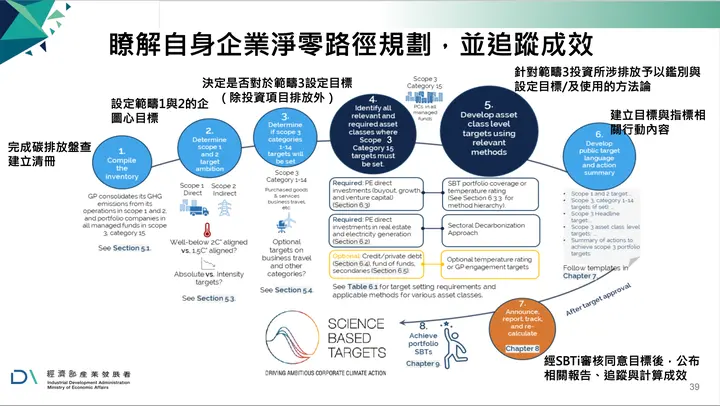
Facing the Challenges of Global Emission Reduction
On Earth Day 2021, Taiwan's government announced its commitment to "2050 Net-Zero Emissions," continuously launching the government-led "Taiwan 2050 Net-Zero Emission Pathway and Strategy Overview," promoting transformation in four major areas - energy, industry, lifestyle, and society - based on the two foundations of "technological R&D" and "climate legislation." In early 2023, the Climate Change Response Act was passed, and starting from 2025, operators must calculate the "Carbon Fee" based on the previous year's emissions by the end of May each year, fill out declarations on the competent authority's platform, print payment slips, and pay at designated financial institutions; this marks Taiwan's official entry into the era of "priced carbon emissions." (Extended reading: Carbon Fee Collection Method)
TSMC, as Apple's supplier, facing the pressure of 2030 carbon neutrality, is accelerating energy transition and green supply chain development. Enterprises need effective carbon management not only to reduce costs and enhance market competitiveness but also to strengthen consumer and investor trust, maintaining a leading position in the green transformation wave. (Extended reading: TSMC 1+N Carbon Management)
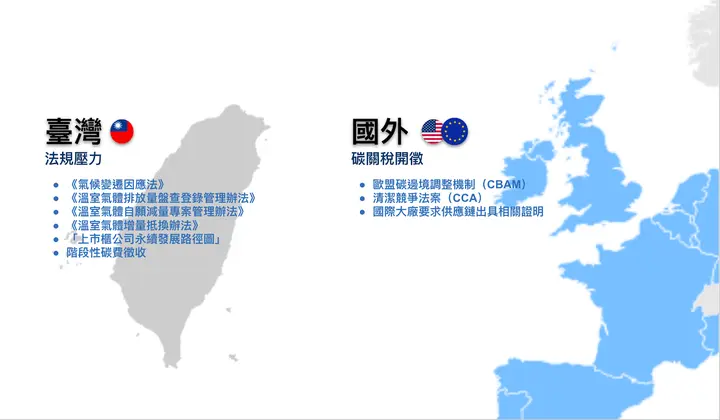
Taiwan's Domestic and International Emission Reduction Regulatory Pressure / Image source: Sustaihub.
(Extended reading: MOEA Net-Zero Emission Zone)
The Strategic Value of Carbon Management
- Impact of Carbon Management on Corporate Strategy
The implementation of carbon fees transforms environmental costs into direct financial burdens for enterprises, forcing companies to reassess their operational models and supply chain structures, promoting investment in innovative low-carbon technologies. Effective carbon management not only reduces environmental pressure but also helps attract more investor support and meets regulatory and market requirements for transparency and responsibility. (Extended reading: Internalizing External Costs)
- Economic Benefits of Carbon Management for Enterprises
Implementing carbon management strategies can help enterprises identify emission hotspots and fully utilize energy-saving and emission-reducing opportunities, lowering energy and raw material costs with high returns. Additionally, as demand for low-carbon products and services increases, enterprises can develop new profit growth points by launching green innovations. (Extended reading: Identifying Carbon Reduction Hotspots in the IT Hardware Industry)
- Impact of Carbon Management on Corporate Brand
In terms of brand image, proactive carbon management demonstrates a company's commitment to environmental responsibility, which not only enhances consumer trust and loyalty but also helps stand out in a competitive market, establishing the company's image as an industry leader. (Extended reading: What Marketers Should Think About)
From Theory to Practice: FET Collaborative Carbon Management
FET's self-developed energy management system integrates with Sustaihub's DCarbon system, collecting carbon emission data in real-time. Sustaihub's system also incorporates generative AI to assist in quickly generating GHG inventory reports, making it Taiwan's first one-stop service integrating EMS, carbon inventory, and generative AI.

FET Building Net-Zero Ecosystem / Image source: Business Today FET Net-Zero Ecosystem Report.
Sustaihub's DCarbon system effectively helps enterprises reduce report production costs by 30% and cut production time by 50%, attracting heavyweight clients such as FET Electronic Toll Collection, Taiwan Textile Research Institute, and Taichung Veterans General Hospital.
One-Stop Solution Introduction
The FSC's "Listed Company Sustainability Development Roadmap" and "Corporate Governance 3.0 - Sustainability Development Blueprint" not only require enterprises to set specific carbon reduction targets and strategies but also encourage enterprises to disclose comprehensive information including Scope 3 GHG emissions, demonstrating high requirements for corporate carbon management and transparency. (Extended reading: TWSE Corporate Governance Center)
The first challenge in advancing carbon management is carbon management-related knowledge, including emission source identification, inventory methodology, and responding to international standards. Even companies with consulting experience find it difficult to establish continuous carbon management strategies due to the broad scope of related knowledge (Extended reading: What is Organizational GHG Inventory?). Facing carbon management challenges, companies need not just a tool but a comprehensive solution that can simplify the inventory process and enhance data accuracy!
Twin transformation (Digital Transformation × Sustainability Management) strengthens corporate ESG commitment, enabling quick responses to compliance requirements, increasing investor confidence, and establishing competitive advantages in the market! (Extended reading: Digital Sustainability Twin Transformation) Sustaihub's one-stop solution is designed precisely to meet these needs - DCarbon System.
- Ease of Operation
When conducting GHG inventory, five principles must be followed: relevance, completeness, consistency, transparency, and accuracy. These are not only the core standards for GHG inventory but also the cornerstone guiding corporate climate action. The principles require organizations to collect data directly related to their business activities in a targeted manner; comprehensively record all types of GHG emissions; maintain consistency in methodology and measurement standards when conducting inventories at different times; maintain high transparency in data and methods used so all stakeholders can understand and evaluate; and ensure credibility of results by minimizing inventory errors.
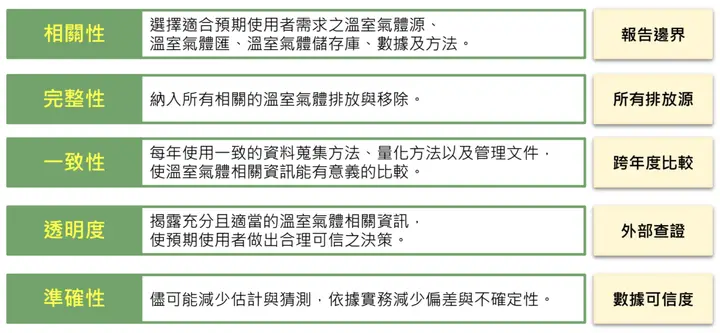
Five Principles of GHG Inventory / Source: Industrial Development Bureau, MOEA.
(Extended reading: Manufacturing Carbon Inventory and Carbon Footprint Workshop Materials)
Following the five principles, from data input to result analysis, from setting boundaries to selecting emission sources, the system's step-by-step guidance reduces knowledge burden and effectively improves data collection and analysis efficiency, reducing errors and time costs of manual operations. Ensuring you can complete the inventory process in the shortest time, it's simple and intuitive - even first-time carbon inventory users can easily get started!
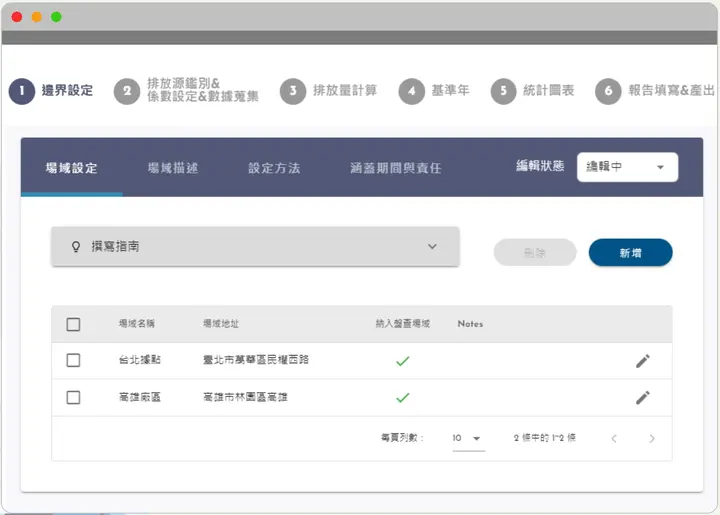
DCarbon System Six Steps to Complete Carbon Inventory / Image source: Sustaihub Official Website.
- Emission Factor Management
The difficulty in selecting emission factors comes from differences in activities and processes, with related data varying by region, energy source, production methods, and other factors. The complex selection process increases carbon inventory challenges. Additionally, when factors are updated without corresponding formula linkages, incomplete emission factor updates may occur.
The system has built-in emission factor data publicly released by Taiwan government agencies, with regular updates to emission factors and GWP databases, greatly reducing the complexity of finding and applying correct factors, enabling organizations to perform more accurate emission calculations. Additionally, considering that different enterprises may face unique emission source requirements, the system supports custom emission factors for maintaining independent coefficient data within the environment; and can provide emission factor lookup from the Ecoinvent international database, helping users quickly find the factors they need.
Common Emission Factor Data Sources:
- Ministry of Environment GHG Emission Factors
- Product Carbon Footprint Information Network
- Bureau of Energy Electricity Emission Factors
- Water Corporation Water Use Emission Factors
- Automated Report Generation
Preparing GHG inventory reports and producing inventory lists is time-consuming work, especially when large amounts of data and documents need to be processed manually. Improving report preparation efficiency is crucial for enterprises to save time and resources.
In addition to real-time system updates and production of "GHG Inventory Lists," enabling enterprises to obtain accurate carbon emission data more quickly for decision-making, the system provides templates complying with international GHG reporting standards and can import detailed inventory reports with one click, improving report professionalism and consistency. The system combines AI technology to assist in producing manuscripts, minimizing the preparation cost of GHG reports and inventory lists, allowing resources to focus on decision-making and strategic planning.
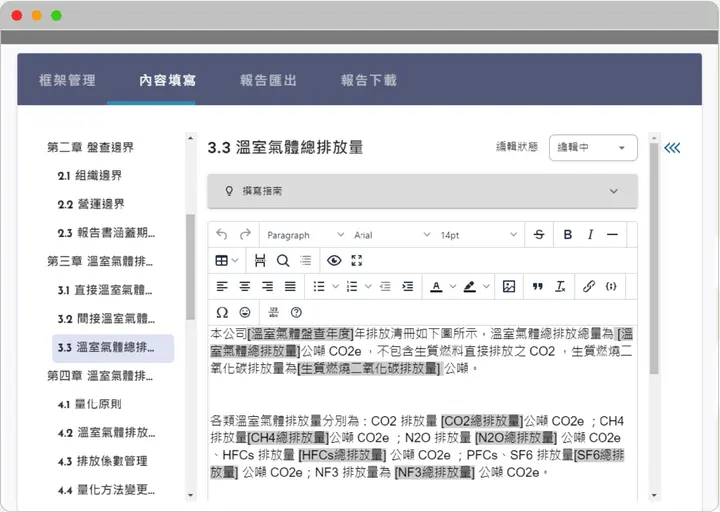
Figure: DCarbon System Report Structure Diagram / Image source: Sustaihub Official Website.
Overall, a digitalized carbon management system facilitates data integration, real-time monitoring, and management of carbon emissions, helping identify potential energy-saving and emission-reducing opportunities, assisting enterprises in achieving better sustainability performance management. Key advantages include:
- Improved Data Management Efficiency
Automatically integrates data from different departments and locations, reduces manual errors, facilitates tracking and verification, improves data processing efficiency and accuracy, and ensures data source, accuracy, and completeness. - Enhanced Communication and Transparency
Easy to share and access, helping enterprises effectively communicate carbon management results and strategies to internal and external stakeholders, enhancing corporate transparency and credibility. - Supporting Decision-Making
Detailed data analysis and visualization functions help enterprises better understand emission hotspots, key risk factors, identify emission reduction opportunities, and formulate scientific carbon reduction strategies. - Flexibility and Scalability
Digital tools can be customized and expanded according to specific enterprise needs, supporting enterprises in adjusting carbon management strategies as business develops, helping respond to current events and move from carbon anxiety to environmental management policy implementation.
Discover Enterprise Digital Management, Strengthen Sustainability Competitiveness!
Sustaihub's digital sustainability consulting team is dedicated to exploring how to effectively achieve corporate sustainability management goals!
Through the "DCarbon System" one-stop solution, jointly face complex and tedious sustainability management, effectively simplify inventory processes, provide accurate and efficient data processing capabilities, while seizing opportunities brought by carbon management. Regardless of what stage of sustainability management you are in, we can provide necessary support and resources to ensure knowledge and skills are passed on and applied within the enterprise, achieving more efficient and continuous carbon management, from carbon anxiety to carbon management.
The "DCarbon System" deeply understands the full picture of corporate carbon emissions as the basis for formulating effective carbon reduction strategies, quickly identifying key emission sources! Helping you from carbon inventory to net-zero emissions, simplifying and optimizing every step of the process.
Contact us to start your carbon reduction pathway:
Email: [email protected]
Phone: (02)7753-8680
LineID: @567hggve

Related articles:
- Challenges and Opportunities of Carbon Management: Using Innovation to Break Through GHG Inventory Difficulties
- Building a Green Supply Chain, Dispelling Seven Myths of Low-Carbon Transformation
- The Winning Strategy for Competitiveness and Sustainability: Digital × Sustainability Twin Transformation