
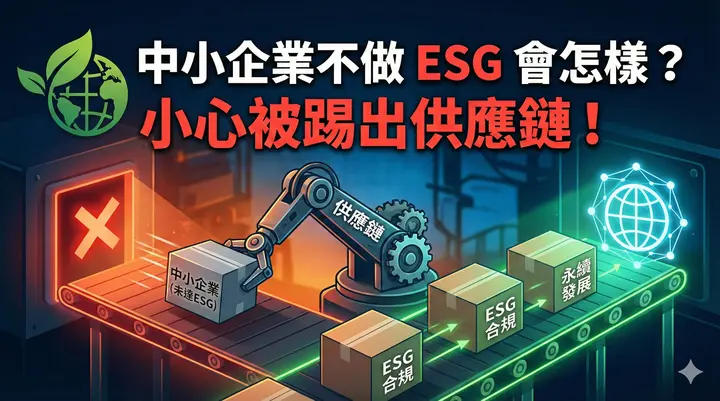
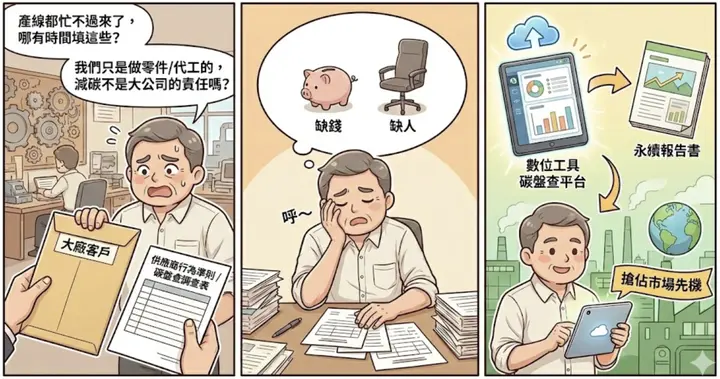
As a business owner in traditional manufacturing or OEM sectors, have you recently received a letter from a major domestic client? The content might be a dense "Supplier Code of Conduct" or "Carbon Inventory Survey." Perhaps your immediate reaction was: "We're too busy with the production line to fill these out!" or "We just make parts/do OEM work — isn't carbon reduction the big companies' responsibility?"
SMEs have limited resources, no dedicated sustainability department, and every dollar must be spent wisely. This article will show you how to use digital tools to quickly complete supply chain carbon inventory and report writing even with limited staff and budget, seizing market opportunities.
1. The Harsh Reality: Why Are Major Clients Pressuring Us?
You might feel that major clients are being difficult, but they too face enormous pressure.
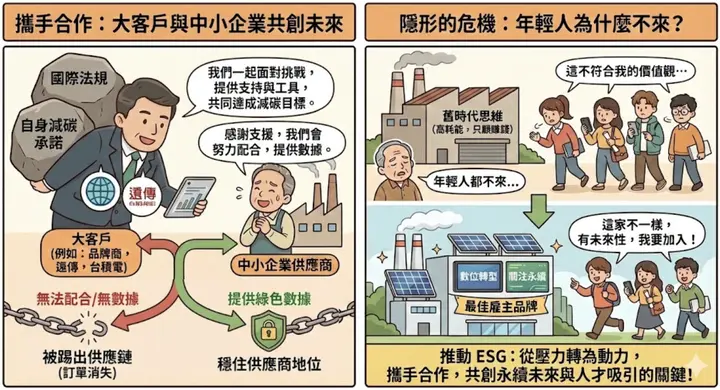
Whether it's brand companies or domestic leaders like Far EasTone and TSMC, they all bear the pressure of international regulations and their own carbon reduction commitments. According to the GHG Protocol, a company's Scope 3 emissions include "supply chain emissions." In other words, your carbon emissions are your major client's carbon emissions.
If your factory cannot provide carbon data or cooperate with carbon reduction, the only option for major clients to meet their targets is to "switch suppliers," turning to competitors who already have green data ready. This is not a threat — it is a supply chain restructuring already in progress. The most direct consequence of not doing ESG is: orders will slowly disappear until you're kicked out of the supply chain.
2. The Hidden Crisis: Why Don't Young People Want to Work for Us?
Beyond order pressure, I often hear traditional industry bosses sigh: "Young people these days just don't want to work in factories."
This is not just about the work environment — it's about "values." Gen Z job seekers place great importance on corporate social responsibility and image. If a company still feels like high-energy, high-pollution, profit-only old-school thinking, it's hard to attract quality young talent.
This is especially fatal for companies facing "generational succession" or "digital transformation."
By promoting ESG, it's not just about satisfying clients — it's an inside-out organizational upgrade. When companies start caring about sustainability, implementing digital management, and showing concern for the environment and society, this becomes the best employer brand. It makes young people think: "This traditional industry is different — this is a company with a future."
3. Breaking Through Resource Constraints: Leverage Digital Tools!
Facing the challenge of no staff, no budget, and no time, SMEs should not use brute-force methods for ESG. Leveraging digital tools is the only way to leapfrog.
Success Story: How Taiwan Xunlian Completed Its First Report in 1 Month?
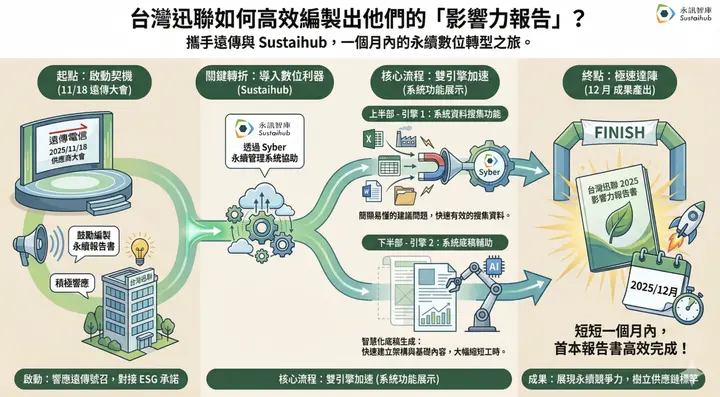
Let's look at a real case. Far EasTone Telecommunications held a supplier conference on November 18, 2025, explicitly requiring supply chain partners to produce sustainability reports. For suppliers with fewer resources than large enterprises, this was a daunting task.
However, Far EasTone's key supplier "Taiwan Xunlian" set a supplier benchmark. Instead of expanding headcount, they chose to complete the report through the "Sustaihub Syber Sustainability Management System."
- Framework & Templates: The system includes built-in frameworks and templates suitable for SMEs, solving the "don't know how to start" and "don't know what to write" problems.
- AI-Assisted Writing: AI technology assists content generation and data integration, significantly reducing documentation time.
- Impressive Results: Taiwan Xunlian efficiently completed its first sustainability report in just one month, by December 2025.
This proves that through digital tools, SMEs can produce high-quality reports at minimal cost and time, not only retaining orders but also setting an ESG benchmark in the supply chain.
View online: Taiwan Xunlian 2025 ESG Report
Conclusion: It's Never Too Late to Start Now
ESG is not a competition of who has more money, but a marathon of who acts faster and who has the right tools.
Facing demands from major clients, you have two choices: resist and delay, watching orders slip away; or follow "Taiwan Xunlian's" example, leveraging digital tools to demonstrate your sustainability competitiveness in the shortest time — not only retaining orders but also polishing your brand in the talent market.
Don't let tedious paperwork hinder your survival path. If you want to know how to efficiently produce a sustainability report in one month like Taiwan Xunlian, feel free to contact us.
👉 Find a more efficient approach through Syber Sustainability Management System, the best sustainability report collaboration platform for enterprises. Register for the free Lite version now to get access!
👉 Sustaihub provides comprehensive and flexible consulting services to help you quickly complete sustainability reports. Contact us to learn more!