
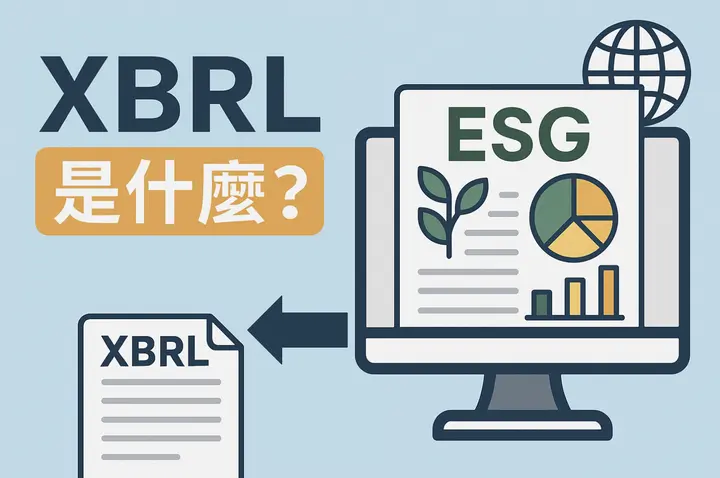
What is XBRL?
XBRL (eXtensible Business Reporting Language) is a language used for digitizing, standardizing, and exchanging financial and business information.
Its main function is to convert data into standardized formats, enabling automatic processing and analysis by computers. For example, numbers originally printed in PDF documents can be digitized through XBRL format, making data easier for computers and AI to process and analyze. XBRL enables businesses, governments, and other organizations to report and exchange financial, ESG, and other data in a unified manner, thereby improving report transparency and comparability, and facilitating data flow between different systems.
XBRL US also provides an ESG tool platform to help businesses convert greenhouse gas emission reports into XBRL format. Users can upload emission data Excel files in specified formats, and the system automatically generates XBRL format reports, enabling emission information to be automatically parsed by computers and AI systems, improving data usability.
As shown below, the left side displays uploaded GHG inventory data, while the red box on the right shows its XBRL format and tags.
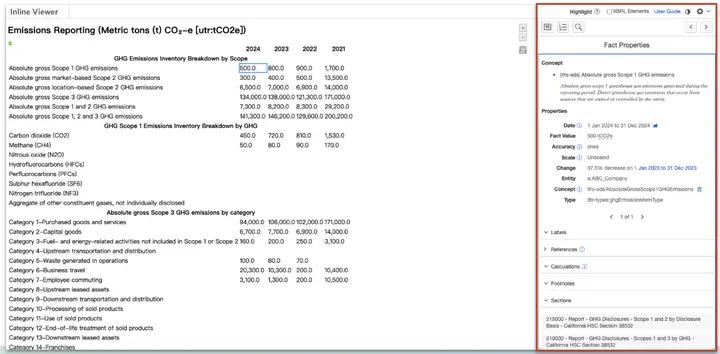
Data description and source:
Create a Digital Corporate GHG Emissions Report is used to create a machine-readable greenhouse gas emissions report. Download the template, fill in emission data, and upload the file to complete the report conversion.
What is the Progress of XBRL Adoption in Taiwan and Globally?
According to Taiwan Stock Exchange regulations, in 2010, regulatory authorities required all listed companies to submit their "financial reports" in XBRL format to improve financial report transparency and data comparability, promoting healthy capital market development.
XBRL usage is now not limited to financial reports. With increasing requirements for Environmental, Social, and Governance (ESG), XBRL is being increasingly applied to sustainability information disclosure.
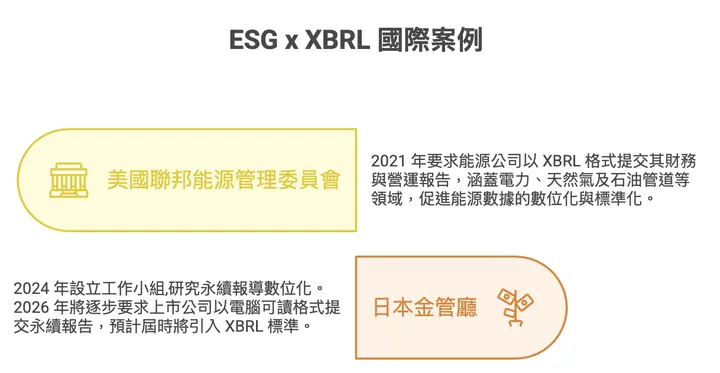
The US Federal Energy Regulatory Commission (FERC) has required energy companies to submit their financial and operational reports in XBRL format since Q3 2021, covering electricity, natural gas, and oil pipeline sectors, promoting digitization and standardization of energy data.
Additionally, Japan's Financial Services Agency established a working group in 2024 to study digitization of sustainability reporting to improve sustainability data comparability and transparency. According to plans, starting from fiscal year 2026, all listed companies will be gradually required to submit sustainability reports in computer-readable formats, with XBRL standards expected to be introduced.
How Do Major ESG Standards Apply XBRL?
With growing ESG reporting demand, digital transformation of ESG information disclosure has become a global trend, and XBRL has become a key tool for improving data transparency and comparability.
The two major global sustainability standards organizations—ISSB (International Sustainability Standards Board) and GRI (Global Reporting Initiative)—have both developed proprietary XBRL Taxonomies (data tagging structures) to help businesses convert ESG information into machine-readable standard formats.
ISSB released corresponding Taxonomies alongside the IFRS S1 and S2 standards, enabling investors and regulators to more effectively compare disclosure data across different companies; GRI launched the GRI Taxonomy, supporting businesses in presenting their environmental, social, and governance performance in a structured manner.
Although global mandatory requirements for businesses to use XBRL for ESG information disclosure do not yet exist, this technology has gradually become an important direction for future digital disclosure. Overall, mainstream standards like ISSB and GRI maintain a positive attitude toward XBRL application, viewing it as a core tool for improving ESG information transparency, comparability, and consistency. As international sustainability reporting demands continue to grow, XBRL will inevitably play an increasingly critical role in future sustainability information disclosure.
Digital Sustainability is an Irreversible Trend—What Should Be Companies' First Step?
As global sustainability development requirements increase, digital sustainability has become an irreversible trend. For companies to secure advantageous positions in this trend, the primary step is to begin adopting ESG tools. This not only helps companies improve report accuracy and transparency but also increases data processing efficiency and reduces the risk of human error.
Many companies have already adopted digital system tools. Through permission settings, history records, and review processes, they improve preparation efficiency while strengthening information transparency and compliance, helping companies establish a foundation for internal controls over sustainability information.
Sustaihub's Syber Sustainability Management System has three key features that ensure accuracy of sustainability information:
- History records and review processes: Improve data reliability
- Multi-level permission controls: Strengthen sustainability information and data security
- AI Assistant: Quickly prepare and generate sustainability reports
Through the Syber Sustainability Management System, companies can balance efficiency and information accuracy in sustainability digital management—the best collaboration platform for corporate sustainability reports.