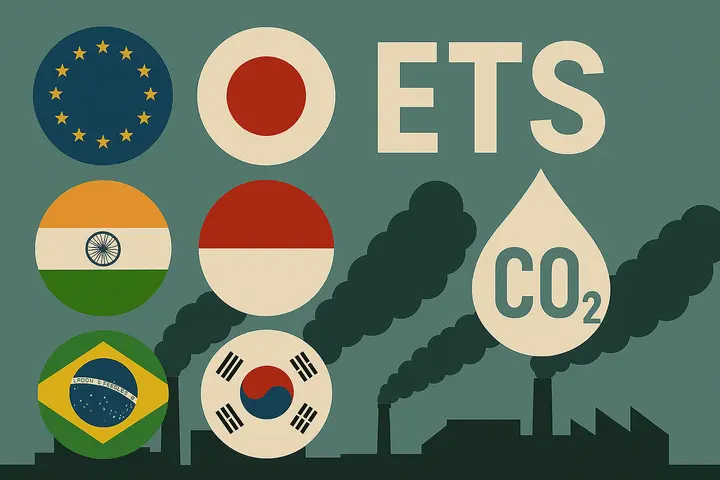
Overview of Global Cap-and-Trade Emissions Trading Systems (ETS)
1. EU ETS: The World's Most Mature Carbon Market Benchmark
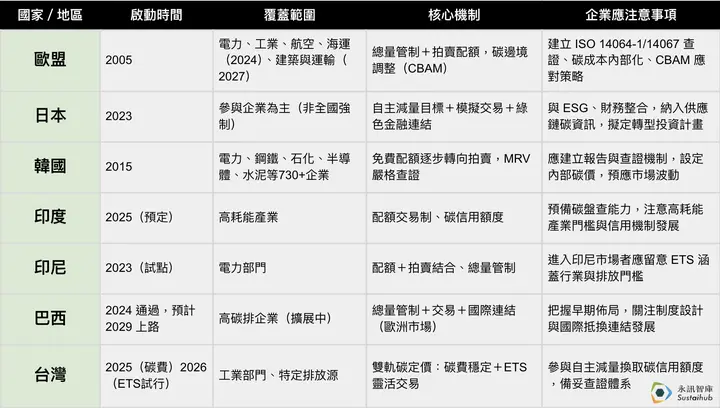
Since the EU launched EU ETS (Emissions Trading System) in 2005, it has gradually established the world's most comprehensive and influential carbon market system. The system is built around "cap-and-trade," guiding businesses to internalize carbon emission costs through the auction and allocation of emission allowances (EUA).
Currently in its fourth phase (2021–2030), coverage has expanded to include power, industry, aviation, and maritime transport added in 2024, with plans to extend to buildings and road transport (EU ETS 2) starting in 2027. The overall carbon market continues to tighten emission caps annually, driving up carbon credit prices.
For businesses, here are five key system details and risks to note:
(1) Allowance Allocation Mechanism Continues to Tighten
Industries with high carbon leakage risk can still receive a certain proportion of free allowances, but these decrease annually. If emissions exceed allowances, companies must purchase EUAs on the market to fulfill their obligations. Companies should establish carbon inventory systems and estimate emissions and carbon credit needs early to avoid annual financial impacts.
(2) Rapid Carbon Price Increases and Market Volatility Management
EU ETS operates primarily through auction-based market mechanisms, with carbon prices determined by supply and demand. In 2023, carbon prices broke through €100/ton with significant volatility. The EU has established the "Market Stability Reserve (MSR)" to balance prices. Companies are advised to implement internal carbon pricing mechanisms or establish trading risk management units to control cost volatility.
(3) Carbon Border Adjustment Mechanism (CBAM) Launch
The EU launched the CBAM transition period in 2023, with carbon taxes on imports starting in 2027, initially covering steel, cement, aluminum, hydrogen, fertilizers, and electricity. For Taiwanese exporters, without established carbon inventory and verification mechanisms, they cannot prove carbon fees have been paid and must pay the difference, creating substantial carbon cost pressure.
(4) MRV Mechanism and Compliance Requirements
EU ETS operations are built on a rigorous "MRV" system (Monitoring, Reporting, Verification). All regulated companies must follow standard formats for carbon inventory and data verification. This has become a baseline requirement for businesses seeking to work with European supply chains.
(5) Green Investment Incentives and System Complementarity
Companies investing in low-carbon transformation can apply for subsidies from programs like the EU "Innovation Fund." Additionally, carbon credit revenues support member states' domestic energy efficiency, renewable energy, and industrial transformation policies, creating a positive economic cycle.
💡 Key Reminder: If your company has supply chain relationships with the EU or exports products to Europe, we recommend immediately establishing ISO 14064-1 or ISO 14067 verification systems and monitoring CBAM and EUA market trends to proactively manage costs and response strategies.
References:
What is CBAM? CBAM May Be Delayed to 2027 - Impact on Taiwanese Businesses
European Commission – EU ETS Factsheet
CBAM Regulation – European Commission
2. Japan GX-ETS: A Voluntary Participation Green Transformation Scheme Combined with Financial Instruments
Japan officially launched GX-ETS (Green Transformation – Emissions Trading Scheme) in 2023, promoting carbon market development through voluntary participation. GX-ETS is not designed for mandatory emission reductions but rather drives industrial investment in low-carbon technology upgrades and transformation through voluntary corporate commitments, transparent disclosure, and financial incentives.
Here are five key system details that businesses should pay special attention to:
(1) Voluntary Reduction Target Disclosure Mechanism
Participating companies must set specific "medium and long-term carbon reduction targets" and publicly disclose them on the GX League official website platform. This enhances stakeholder (such as investors and supply chain partners) trust in corporate commitments and helps with ESG ratings and capital acquisition.
(2) Simulated Trading and Carbon Pricing Capability Building
GX ETS initially focuses on a "simulated trading market" where companies exchange and trade allowances based on actual emissions. Although this cannot be converted to monetary settlement, it trains corporate internal carbon accounting and carbon financial management capabilities, laying the foundation for future actual pricing or international integration.
Corresponding Strategy: Taiwanese companies can proactively simulate carbon inventory and emission allowance management processes to enhance international system integration capabilities.
(3) Transition Finance Product Integration Strategy
GX ETS is not just a carbon trading platform but is also linked with green financial instruments such as "Transition Bonds" and "Transition Loans." Companies presenting clear carbon reduction pathways and technology upgrade plans can obtain support funding from banks and investment institutions.
(4) Promoting Low-Carbon Technology and Supply Chain Collaboration
The GX Alliance emphasizes vertical supply chain integration for carbon reduction. Large companies collaborate with supply chains to promote carbon information exchange and low-carbon co-creation, forming "collective carbon reduction alliances" and jointly developing decarbonization technologies (such as hydrogen energy, biomass energy, CCUS, etc.).
Recommendation: SMEs should proactively disclose carbon footprint information to major customers to seek inclusion in Japanese companies' low-carbon procurement lists.
(5) Information Transparency and ESG Integration
GX ETS publishes participating companies' goals, trading records, and performance online, collaborating with ESG rating agencies and the financial sector to make carbon performance a factor in investment evaluation.
Recommendation: Corporate ESG teams should work with finance departments to develop carbon performance tracking reports as preparation for future capital market integration.
💡 Overall, GX-ETS is a system centered on "growth and carbon reduction in parallel", not adopting penalties and mandates but driving corporate behavior through market incentives, data transparency, and financial linkages. For Taiwanese companies with supply chain relationships with Japanese companies or planning to participate in the Japanese carbon market, GX ETS will become an important reference framework and practical benchmark.
References:
GX League
METI - Establishment of "GX Pioneer Declaration" to Support Companies Actively Working on GX Market Creation
3. South Korea Carbon Market System Insights: Challenges and Opportunities in Asian Carbon Trading from K-ETS Experience
South Korea launched K-ETS (Korea Emissions Trading Scheme) in 2015, covering industries spanning power, steel, petrochemicals, semiconductors, cement, and other high-carbon-intensive sectors. Currently in its third phase (2021–2025), it includes over 730 companies and institutions.
Although K-ETS is a mandatory system, its implementation has also exposed issues such as low market liquidity, unstable carbon prices, and high levels of government intervention, providing valuable lessons for other emerging markets. Here are five key details that Taiwanese companies should focus on:
(1) Allowance Allocation and Auction System Under Adjustment
Initially dominated by free allowances, the auction ratio has gradually increased since the third phase. Currently, the free allowance ratio for high-carbon industries is still as high as 90%, but the government has indicated it will accelerate the transition to full auctioning in the fourth phase.
Recommendation: Companies should assess carbon cost burdens when entering the auction market and establish internal carbon budgets and investment mechanisms early.
(2) Insufficient Market Trading Activity and High Price Volatility Risk
K-ETS trading market liquidity is relatively low, mainly due to overly generous allowance allocation, lack of diverse participants (such as financial institutions and third-party organizations), and lack of price stabilization mechanisms. This causes carbon prices to often hover at low levels, providing insufficient incentives for companies with high carbon efficiency.
Corresponding Strategy: Companies should include K-ETS carbon prices in carbon risk assessments and set internal reference carbon prices (shadow pricing) to avoid misleading low-carbon transformation judgments.
(3) Highly Complete and Rigorously Implemented MRV System
The Korean government has introduced an internationally aligned MRV (inventory, reporting, verification) system. All regulated companies must prepare inventory reports according to emission source classifications and pass third-party verification. Verification results affect allowance allocation and penalty determinations.
Recommendation: Taiwanese companies intending to participate in the Korean market or collaborate with Korean companies should establish emission reporting and verification mechanisms comparable to K-ETS requirements.
(4) High Requirements for Corporate Management System Transparency
The government annually publishes carbon emission data and allowance allocation status of regulated entities, enhancing social oversight. Some private ESG rating agencies also include this in their rating indicators, creating additional information disclosure pressure.
Recommendation: Taiwanese companies working with Korean brands and distributors should simultaneously establish voluntary disclosure systems to enhance supply chain cooperation trust.
(5) Frequent Policy Intervention and System Rolling Adjustments
Although K-ETS has a mature system, policies remain highly variable, including allowance readjustments, offset limit modifications, and price interventions, increasing strategic uncertainty for companies. The Korean government is also actively integrating K-ETS with ESG finance and green investment, expanding its policy instrument capabilities.
💡 Overall, while K-ETS has established legal and technical foundations, the system is still in a strengthening development phase. For export-oriented Taiwanese companies with supply chains involving Korea or competing with Korean companies, they should deeply understand K-ETS system context and carbon pricing pressure to plan ahead and build competitive advantages.
References:
K-ETS official site – Korea Environment Corporation (KECO)
International Carbon Action Partnership (ICAP) – ETS Detailed Information: Korea
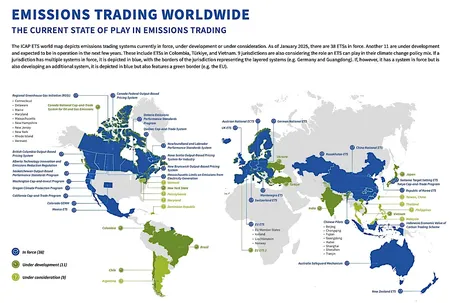
4. Emerging Economies: India, Indonesia, Brazil and Others Are Also Actively Deploying Carbon Markets
(1) India proposed the "Carbon Credit Trading Scheme (CCTS)" in 2023, led by the Ministry of Environment, to be implemented for specific high-energy-consuming industries starting in 2025.
(2) Indonesia passed carbon pricing legislation in 2021 and launched pilot trading in the power sector in 2023, initiating the first phase of a mandatory carbon trading system.
(3) Brazil passed legislation in November 2024 establishing the Greenhouse Gas Emissions Trading System (Sistema Brasileiro de Comércio de Emissões de Gases de Efeito Estufa, SBCE), expected to be fully operational within five to six years. It adopts a cap-and-trade system, allowing companies to offset emissions by purchasing carbon credits, with plans to establish links with the European carbon offset market.
References:
ICAP – Emissions Trading Worldwide 2024 Report
World Bank – State and Trends of Carbon Pricing 2024
Argus – India consults industries on emission intensity targets
Mt.Stonegate – Navigating Indonesia's Carbon Market: Progress, Policy, and Pathways Toward Net-Zero
ICAP – Brazil adopts cap-and-trade system
Taiwan's Current Situation: Carbon Fee Launch and ETS System Ready to Go
2025: Carbon Fee System Officially Launched
The Ministry of Environment will implement carbon fee collection under the "Climate Change Response Act," initially targeting emission sources with annual emissions exceeding 25,000 tons, with rates expected to start at TWD 300/ton. Carbon fees will be used for:
- Greenhouse gas reduction technology research and development
- Subsidizing low-carbon transformation costs
- Enhancing industrial green competitiveness
- Incentivizing greenhouse gas reduction efforts
2026 – 2028: Phased ETS Pilot System Launch
Taiwan will pilot "Taiwan ETS" in the second half of 2026, expected to officially launch in 2027 or 2028. Its core design includes:
- Dual-track carbon pricing: Carbon fee + emissions trading in parallel
The Ministry of Environment plans a dual-track carbon pricing policy running carbon fees and carbon trading systems in parallel, providing price stability through the carbon fee system while guiding companies toward cost-optimal carbon reduction behavior through the carbon trading market. - Establishing MRV, allowance allocation, review and verification systems
The Ministry of Environment is establishing a complete monitoring, reporting, and verification (MRV) system, designing review and verification mechanisms to ensure fairness and transparency in the carbon trading system. - Incorporating voluntary corporate carbon reduction programs to form a carbon credit market
The Ministry of Environment is promoting voluntary reduction programs, encouraging companies to reduce greenhouse gas emissions through measures such as switching to low-carbon fuels, adopting negative emission technologies, and improving energy efficiency, while issuing reduction credits to form a carbon credit market and expand reduction participation.
References:
Ministry of Environment – Carbon Fee Section
MOEA Small and Medium Enterprise and Startup Administration – 2026 Carbon Trading Pilot, 2027 Dual-Track System Launch!
Ministry of Environment Revises and Announces "Greenhouse Gas Certification Body and Verification Body Management Regulations"
United Daily News (2025/04/30) - Taiwan Carbon Solution Exchange and Taiwan Stock Exchange Partner with National Sun Yat-sen University for Seminar to Explore Taiwan ETS Development Path