
Why Green Talent Demand Is Surging in 2026: Policy, Trade and Finance Align
To understand record green job demand in 2026, look first at companies' compliance schedules. The report identifies three dimensions of Taiwan's net-zero transition aligning with international requirements in 2026:

Carbon fees, CBAM (the EU Carbon Border Adjustment Mechanism) and IFRS S1/S2 arriving in the same year mean carbon inventories, decarbonisation engineering and climate disclosures are no longer optional extras for sustainability departments; they affect costs, orders and capital market valuations. More precisely, the FSC adoption roadmap requires first application in 2026 of both IFRS S1, General Requirements for Disclosure of Sustainability-related Financial Information, and IFRS S2, Climate-related Disclosures, with a dedicated annual report chapter. First-year transition relief permits climate-only disclosure, which is why the Ministry × 104 timeline highlights IFRS S2. Companies need people who can calculate emissions, prepare disclosures and plan decarbonisation pathways—the structural reason green vacancies continue expanding.
The timeline is clear: the 2019 European Green Deal accelerated global regulation; Taiwan announced 2050 net zero in 2021; twelve key strategies and the Climate Change Response Act took shape in 2022; the Act and CBAM transition began in 2023; carbon fees were set in 2024 at NT$300 per tonne for an initial 500 major emitters; and trial carbon fee reporting began in 2025, leading to the three-dimensional alignment in 2026. The ten-year green jobs curve rises almost in parallel with this policy timeline.
A 10-Year High: 29,733 Monthly Vacancies and Over 4,000 Competing Employers
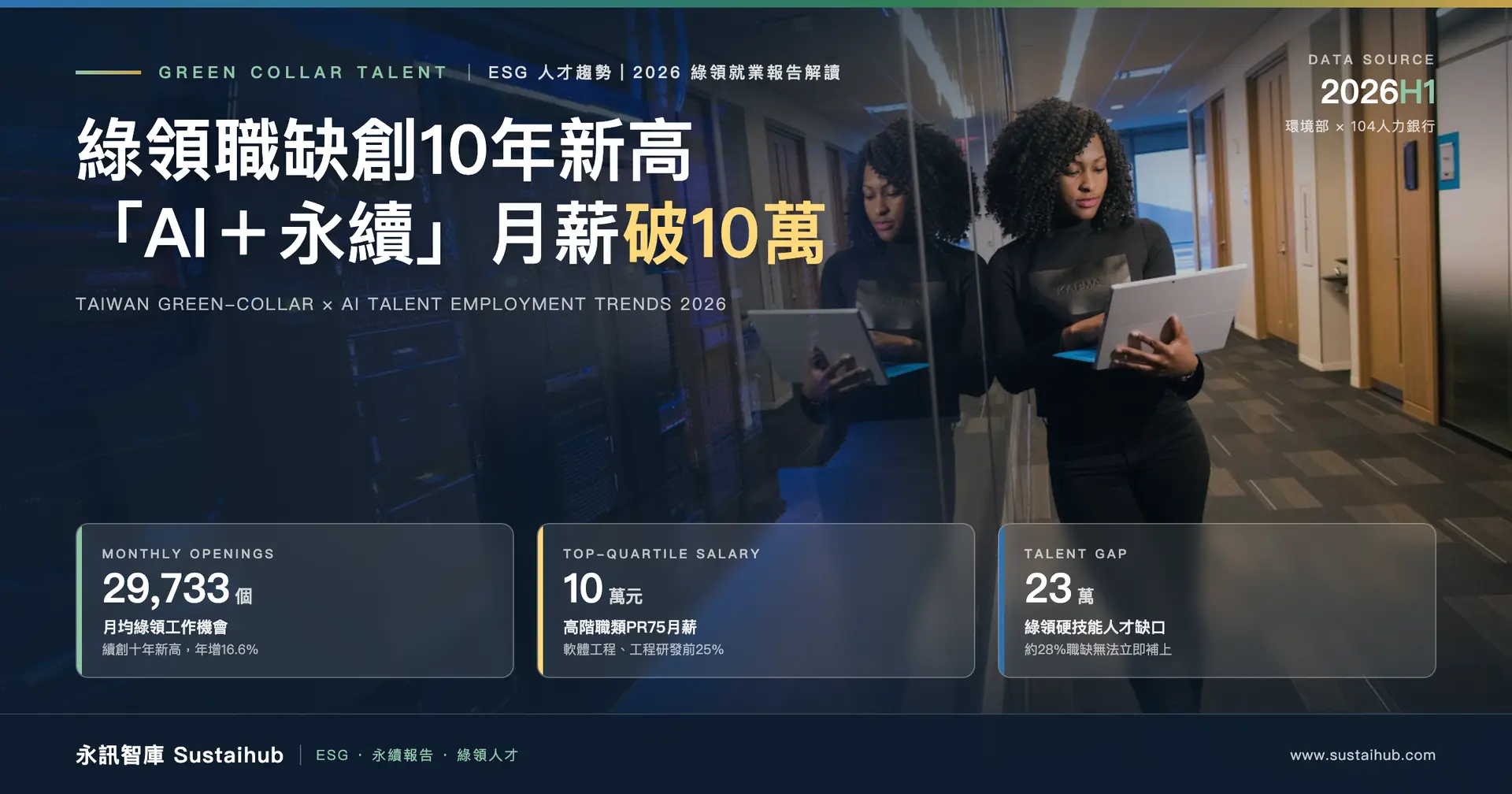
In H1 2026, monthly green opportunities averaged 29,733, with 4,299 recruiting companies—both continuing to set ten-year records. Opportunities increased 286% from H1 2017 and 16.6% from H1 2025.
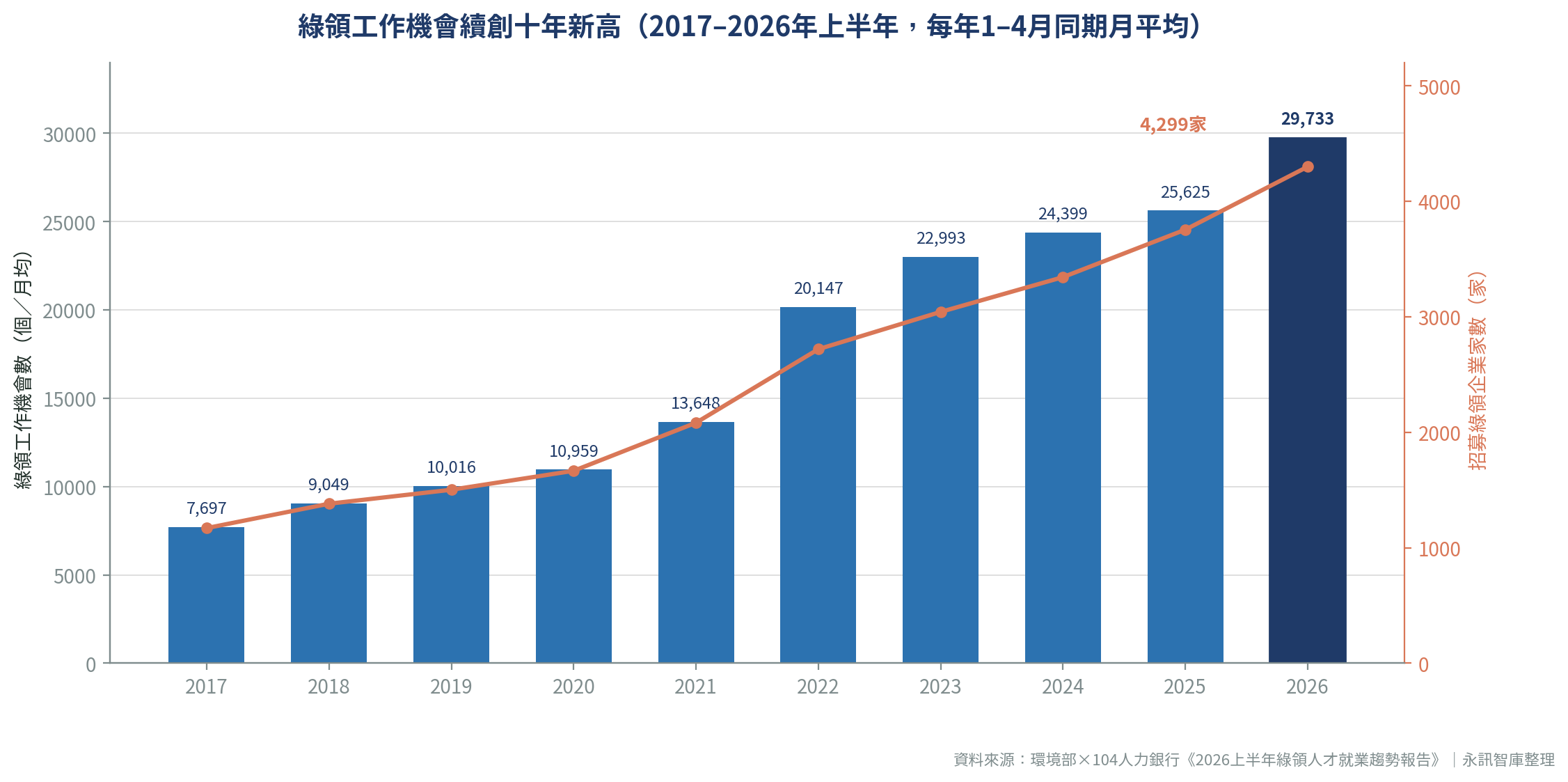
Over the same period, overall job opportunities grew just 1.2% annually and 66% over ten years. Green vacancy growth was thus over ten times the overall market's annual rate and over four times its ten-year rate. Green jobs now account for 2.6% of around 1.15 million opportunities, and green recruiters represent 7.8% of around 55,000 hiring companies.
By industry, electronics, information, software and semiconductors, together with general manufacturing, are the two main recruiting groups. Each sought over 6,000 green workers monthly in H1 2026—6,517 and 6,122 respectively. Electronics and manufacturing combined accounted for around 43%, consistently above 40% over the decade. As both Taiwan's industrial backbone and key transition sectors, their carbon management and environmental, health and safety needs underpin the green labour market.
By occupation, environmental, health and safety (EHS) has led green demand for years. The fastest-growing categories are four familiar roles: sales up 37%, quality assurance/control 24%, engineering R&D 23%, and technical operations 20%. As discussed in the AI-enabled jobs section, sustainability and AI are simultaneously reshaping these traditional roles.
A 230,000 Skills Gap: 820,000 Jobs Require Green Skills, with 28% Unfilled
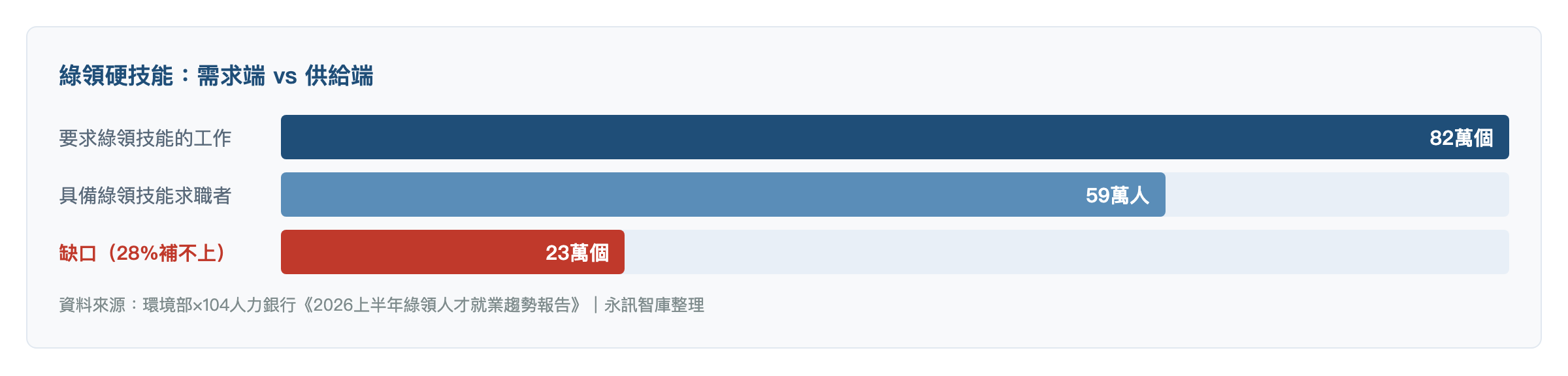
Record demand is accompanied by insufficient supply. The report estimates that in 2026, 820,000 opportunities require at least one professional skill shared with green roles, but only 590,000 jobseekers possess a corresponding skill, creating a green hard-skills gap of 230,000 opportunities, or around 28% (230,000÷820,000) of roles that cannot immediately be filled.
These definitions matter. The monthly 29,733 figure uses a narrow definition of green vacancies, with work directly matching net-zero or sustainability keywords. The 820,000 figure uses a broader skills definition across all 104 listings, counting roles requiring at least one hard skill shared with green jobs. The 230,000 gap and 28% therefore concern jobs requiring green skills, not 230,000 unfilled narrowly defined green jobs. Together, the figures show that green skill demand has spread beyond core sustainability positions into the wider labour market.
This gap has different implications for workers and employers. Jobseekers with green hard skills have an average 2.2 opportunities each, versus 1.5 without—skills provide bargaining power. Employers face longer recruitment cycles and higher salaries. The report also notes that semiconductors draw talent away from other sectors competing in the same pool.
📊 Insight | The Gap Is Not Simply a Shortage of Environmental Engineering Graduates
The 230,000 gap concerns green hard skills, not a particular degree. Green vacancies require job skills in 41% of cases, computer skills in 42% and certifications in 23%, all above overall averages of 32%, 27% and 14%. Companies need people who can conduct carbon inventories, understand regulations and operate tools. These skills can be developed through courses, qualifications and practice rather than a specific original degree.
Green Salaries: NT$57,000 Median, with Top-Quartile Senior Roles Above NT$100,000
Pay is the report's most discussed topic. Workers with green skills earned a median NT$57,000 monthly in their most recent job; the top-quartile threshold (PR75) exceeded NT$70,000, at NT$70,833. At TWSE/TPEx-listed companies, PR75 reached NT$76,667. Across experience levels, median pay for workers with green skills was 3%–5% above the overall workforce.
Differences by occupation are larger. The roles behind the report's NT$100,000 monthly salary headline are software engineering and engineering R&D green positions: both have PR75 pay of NT$100,000, with medians of NT$75,000 and NT$70,000 respectively. Project/product management and construction planning follow.
These labels do not include every software or R&D engineer. The report classifies green roles using 1,631 keyword sets from the twelve net-zero strategies and sustainability terms, matched against company names, job titles, duties, requirements and skills/certifications. Only roles involving net-zero or sustainability work—carbon management SaaS, energy management systems, AI carbon footprint analysis, process decarbonisation modelling, low-carbon materials R&D, renewables or environmental engineering—are included. Same-title jobs unrelated to emissions reduction, environmental management or sustainability transition are outside this definition.
| Green occupation | Median monthly salary (NT$) | Top-quartile (PR75) monthly salary (NT$) |
|---|---|---|
| Software engineering | 75,000 | 100,000 |
| Engineering R&D | 70,000 | 100,000 |
| Project/product management | 67,500 | 91,667 |
| Construction planning | 64,500 | 86,759 |
| Environmental, health and safety | 63,000 | 75,000 |
| Sales | 60,000 | 75,000 |
| Maintenance and technical services | 58,333 | 71,100 |
| Quality assurance/control | 57,000 | 75,000 |
| Technical operations | 49,185 | 58,333 |
Table 1 | Most recent monthly salary of jobseekers with green skills, by occupation. Source: Ministry of Environment × 104 Job Bank, H1 2026 Green Talent Employment Trends Report.
Employer offers are also rising. Salary ranges are disclosed in 64% of green vacancies, with median starting pay of NT$40,500—5% above the overall NT$38,700. Construction planning has the highest starting-pay premium at 12%, followed by quality assurance/control at 7%. Another 36% list salary as negotiable (above NT$40,000 monthly), more than twice the overall 16%. Negotiable salaries reach 71% in software engineering and 51% in engineering R&D, indicating room to negotiate for specialist talent.
The report highlights a mismatch: green-skilled jobseekers' median NT$57,000 salary is 41% above the NT$40,500 median advertised starting salary. Against the 230,000 talent gap, its recommendation is direct: raise pay or specify more detailed salary ranges to improve recruitment appeal.
AI Green Jobs Surge: Employers and Vacancies Up by Over 2 Times the Baseline in Five Years
If green employment defines the past decade, AI green jobs are the steepest-growing trend in the 2026 report. These roles combine net-zero or sustainability work with explicit AI skills or tools. The report describes explosive growth: 812 employers, or 19% of green recruiters, and 4,315 monthly opportunities, or 15% of green jobs. Compared with 2022, employer numbers increased by 2.2 times the baseline and opportunities by 2.1 times over five years.
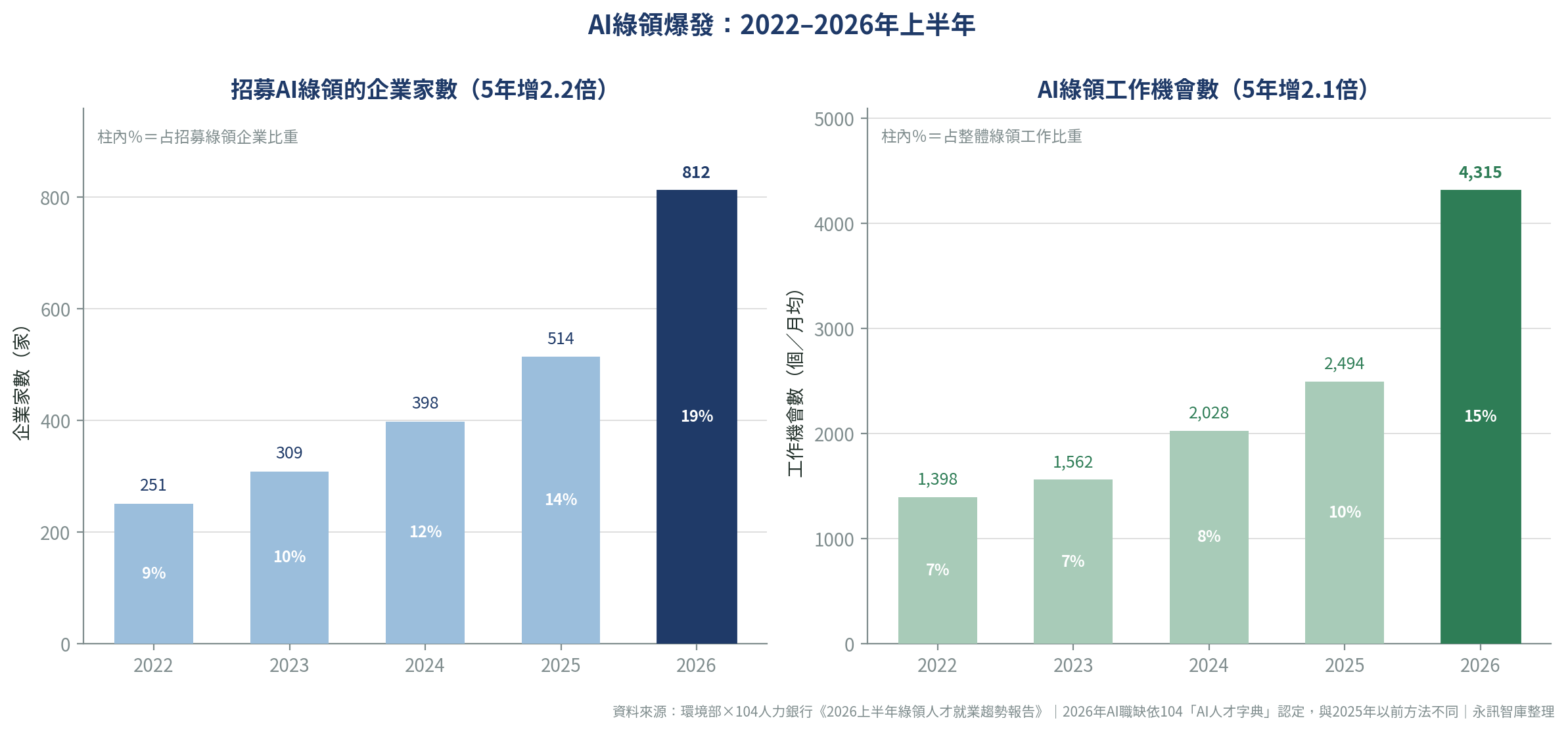
The report divides AI green talent into AI research, development and application, consistent with the AI Industry Talent Identification Guidelines. In 2026, annual vacancy growth exceeded 100% for the first time in three categories at once:Engineering R&D up 110%, maintenance and technical services up 107%, and project/product management up 104%.
These figures mean more than simply strong AI demand. The report describes a twin transition—digital and sustainability. Companies face carbon fees, CBAM and IFRS S1/S2 compliance alongside AI-driven productivity changes. These transitions intersect in demand for people who understand sustainability and can use AI tools. The report also identifies AI First as a driver of B2A (Business-to-Agentic) business models. Software engineering and engineering R&D—the roles with PR75 pay at the NT$100,000 level—are also where AI green demand is concentrated. Combined AI and sustainability capability currently offers the highest salary ceiling in the green market.
Jobs Are Becoming AI-Enabled: Familiar Roles Gain a Green Purpose
AI green growth is not simply creating new occupations; it is transforming existing work through sustainability and AI together. The report describes familiar roles gaining a green purpose: sales sells solar rooftops, storage solutions and carbon inventory SaaS; quality teams check supplier footprints and CBAM filings; R&D models process emissions and develops low-carbon materials; and technical operations runs renewable plants and wastewater treatment equipment.
AI adds another layer of changes to titles and skills. The report lists six emerging AI-enabled green roles:
| Original occupation | AI-enabled green job title |
|---|---|
| Technical operations | Smart energy system coordination controller |
| Quality assurance/control | AI carbon footprint quality specialist |
| Maintenance | Smart diagnostics for green energy equipment |
| Project/product management | Generative AI green product manager |
| Construction planning | AI digital twin green building planner |
| Process planning | AI process optimisation architect |
Table 2 | Six examples of AI-enabled green job titles. Source: Ministry of Environment × 104 Job Bank, H1 2026 Green Talent Employment Trends Report.
The report also describes work before and after AI. In carbon management within project/product roles, departments previously submitted raw electricity, fuel and travel data, which staff manually converted using Ministry of Environment factors. After AI adoption, carbon management SaaS pulls data directly from ERP and equipment, and AI flags anomalies such as “This department's figure differs significantly from last quarter; please confirm.” Maintenance shifts from fault-code tables and experienced technicians' judgement to LLMs plus equipment knowledge bases that provide root causes and troubleshooting sequences. Engineering R&D moves from manual modelling and hours waiting for each parameter set to AI acceleration generating and testing hundreds of alternatives simultaneously.
✅ Key Point | Five Capabilities for AI Green Talent
The report identifies five capabilities: AI application literacy, AI tool use, AI programming language use, AI model training and AI service development. The first two are common requirements across green occupations; the last three are concentrated in high-paying software engineering and R&D, helping explain their high salaries and negotiable-pay shares.
Becoming AI × ESG Talent: Qualifications and Experience Matter More Than Degree Subject
Entry barriers are lower than many expect. Nearly 90% of green roles require a bachelor's degree or below, and more than half impose no experience threshold. Degree requirements are split: engineering roles favour electrical/electronic, mechanical, environmental, civil and computer engineering, while sales (76%), finance professionals (67%), technical operations (59%) and project/product management (52%) each have a majority without subject restrictions, welcoming varied backgrounds.
Employers focus on skills and qualifications. Certifications are required in 23% of green roles versus 14% overall. Among roles requiring environmental certifications, environmental regulation accounts for 50%, carbon management 37%, and ESG sustainability 13%:
| Certification category | Purpose | Representative qualifications (top 3 in category) |
|---|---|---|
| Environmental regulation (50%) | Traditional regulatory credentials and basic green-career entry requirements | Wastewater treatment specialist, air pollution control specialist, Class B waste clearance technician |
| Carbon management (37%) | Emissions quantification and verification—core net-zero transition skills | GHG inventory, ISO 14064-1 GHG inventory verifier, product carbon footprint inventory |
| ESG sustainability (13%) | Corporate sustainability and green transition—emerging cross-disciplinary credentials | ESG sustainability manager, corporate sustainability manager, basic sustainability competency assessment |
Table 3 | Three environmental certification categories requested in green vacancies. Source: Ministry of Environment × 104 Job Bank, H1 2026 report.
Government training channels are also established. The Ministry of Environment launched the Net-Zero Green Talent Training Alliance on 28 March 2025 (ROC year 114); the 2026 report lists 37 member universities. The 48-hour programme covers climate change and GHG management (18 hours), GHG inventories (12), voluntary reductions and credits (9), and product carbon footprints (9). Tuition is NT$12,000, with half-price fees for students under 30 and full subsidies for low-income and lower-middle-income households and people with disabilities. Registration for the first class opened on 1 April 2025, and the Premier awarded the first certificates on 25 September that year.
Early employment data is available. By 30 April 2026, more than 2,000 people had obtained the Ministry's Net-Zero Green Talent Training Certificate. Among approximately 250 actively job-seeking 104 members observed, 39% of those previously receiving no employer interview invitations began receiving them within a week of adding the certificate to their CV. The sample remains small, but official green training is becoming a recognisable signal on applications.
⚠️ Note | A Certificate Opens the Door; It Does Not Set Your Ceiling
The data distinguishes entry credentials from the combined capabilities associated with top salaries. Environmental regulation certificates provide a foundation, and carbon management credentials support core net-zero work. Roles with PR75 pay above NT$100,000 require carbon expertise combined with AI programming, models and tools. Treat certification and AI skills as two parts of one learning plan, not alternatives.
From Systems to People: Sustaihub's AI × ESG Practice
The report's central tension is that three-dimensional sustainability compliance arrives in 2026, while people who understand sustainability and use AI remain scarce, with a gap of 230,000. In practice, two routes can narrow it: smarter tools that lower the skills barrier, and people learning to use those tools.Sustaihub is one Taiwanese startup pursuing both.
On the tools side, Sustaihub develops AI × ESG systems that turn the report's post-AI workflows into usable platforms:
- Syber sustainability reporting system: Digitises chapter assignments, progress tracking and approval workflows. AI supports organising, writing and translating, while changes and sources remain traceable for every passage, supporting IFRS, GRI and other reporting frameworks.
- DCarbon carbon inventory system: Centralises activity data across sites, retains factor versions and calculation bases, and integrates evidence attachments with inventory results in one workflow, supporting audit requirements for carbon fee reporting and verification.
- SustainAI sustainability report search database: Searches over 8,000 public sustainability reports and compares disclosures by company, industry and topic, reducing days of manual peer-report searches to minutes.
On talent, Sustaihub's consulting is also on-the-job development. Sustainability strategy advisers, sustainability managers and carbon inventory managers provide hands-on guidance, alongside ESG workshops and training, helping companies retain inventory, disclosure and decarbonisation planning capabilities internally rather than outsource indefinitely. Of the five AI green capabilities, application literacy and tool use are naturally learned during system implementation. Sustainability staff using AI daily to organise data, generate drafts and check anomalies simultaneously build the skills required for the twin transition.
Green opportunities up 286% over ten years, AI green jobs up by over 2 times the baseline in five years, and a 230,000 green-skills gap all point to the same shift: the net-zero bottleneck is moving from willingness to capability. Early tool adoption and internal talent development are practical responses for employers. For individuals, official statistics place sustainability expertise plus AI among today's fastest-growing career paths with the highest salary ceilings.
Manage Sustainability Information in One Place with Sustaihub
Sustaihub provides a platform specifically designed for Taiwan's TWSE/TPEx-listed companies: a sustainability information management platform. It integrates corporate governance evaluations, sustainability report editing, ESG data collection and third-party verification workflows in one system.
Book a free 30-minute consultation →Frequently Asked Questions
Q1. What Is Green Talent, and What Jobs Are Included?
Green talent broadly covers work related to net zero, sustainability and environmental management. The Ministry of Environment × 104 H1 2026 report uses 1,631 keyword sets from twelve net-zero strategies and sustainability terms, such as net zero, decarbonisation, environmental engineering and hydrogen, matched to company names, titles, duties, requirements and skills/certifications. Common occupations include EHS (the largest demand), engineering R&D, software engineering, quality assurance/control, sales, technical operations, construction planning, project/product management, and maintenance and technical services. H1 2026 averaged 29,733 monthly opportunities from 4,299 employers.
Q2. How Much Do Green Jobs Pay? Is NT$100,000 a Month Realistic?
The report gives a median most-recent monthly salary of NT$57,000 for green-skilled workers, 3%–5% above the overall workforce. PR75 pay exceeds NT$70,000 and reaches NT$76,667 at TWSE/TPEx-listed companies. The NT$100,000 headline concerns green software engineering and engineering R&D: both have PR75 pay of NT$100,000, with medians of NT$75,000 and NT$70,000 respectively. It does not cover all software or R&D roles, only those whose duties, conditions or skills match net-zero/sustainability keywords, such as carbon management, energy management, AI footprints, process decarbonisation, low-carbon materials or renewable R&D. NT$100,000 is an upper-range salary in advanced green occupations, not the average across all green workers.
Q3. What Are AI Green Jobs, and How Do They Differ?
AI green roles combine sustainability work with explicit AI skills or tools. The 2026 report uses 104's AI Talent Dictionary, covering research, development and application. In H1 2026, 812 companies recruited AI green talent, 19% of green recruiters, with 4,315 monthly opportunities, 15% of green jobs. Both employers and vacancies grew by over 2 times their original levels in five years. These roles typically require AI literacy, tools, programming languages, model training or service development. Engineering R&D, maintenance and technical services, and project/product management all saw annual AI green vacancy growth above 100% in 2026.
Q4. Can People Without Environmental Degrees Move into Green Careers?
Yes. Nearly 90% of green vacancies require a bachelor's degree or below, and more than half impose no experience threshold. Degree subject is unrestricted in 76% of sales roles, 67% of finance professional roles, 59% of technical operations and 52% of project/product management. Engineering and EHS roles more often specify electrical/electronic, mechanical, environmental or computer engineering. Other graduates can target unrestricted roles or build hard skills through training and certification: green-skilled jobseekers have 2.2 opportunities each on average, versus 1.5 without.
Q5. Which Green Certifications Are Most Commonly Required?
Certifications appear in 23% of green vacancies versus 14% overall. Among environmental credential requirements, 50% concern environmental regulation, such as wastewater treatment and air pollution control specialists, providing entry foundations; 37% concern carbon management, such as GHG inventories, ISO 14064-1 and product carbon footprints, supporting core net-zero work; and 13% concern ESG sustainability, including ESG sustainability manager, corporate sustainability manager and basic sustainability competency assessments, representing emerging cross-disciplinary credentials.
Q6. Is the Ministry of Environment's Net-Zero Green Talent Programme Worth Taking?
This is a central-government green training programme. The Ministry formed its alliance on 28 March 2025 (ROC year 114), with 37 universities listed in the 2026 report. The 48-hour course covers climate change and GHG management, inventories, voluntary reductions and credits, and product carbon footprints. Tuition is NT$12,000, with concessions for students and disadvantaged groups. By 30 April 2026, more than 2,000 people had qualified. Among around 250 job-seeking 104 members who listed it, 39% of those previously receiving no invitations began receiving interviews within a week. The sample is small, but the credential is a recognisable official signal. Registration details are on the Ministry's Green Talent Information Platform.
Q7. How Can Employers Address the Green Talent Gap?
The report estimates 820,000 vacancies requiring at least one green hard skill but only 590,000 qualified jobseekers: a gap of 230,000, or around 28% (230,000÷820,000). Jobseekers' median NT$57,000 monthly pay is also 41% above advertised median starting pay of NT$40,500. Employers can act in three ways: adjust compensation by raising pay or clearly specifying ranges, as the report recommends; introduce AI × ESG tools to reduce dependence on scarce staff, such as automated activity data collection and AI-assisted reporting; and develop existing staff through official courses, certification subsidies and consulting support rather than competing only for external hires.
Further Reading
- IFRS S1/S2 Sustainability Disclosure Standards Adoption Guide
- GHG Inventory Basics: Scope 1/2/3 Boundaries and Processes
- The 12th Corporate Governance Evaluation Results Explained
Official Sources
- Ministry of Environment Green Talent Information Platform | Employment Trends Reports — Download the H1 2026 Green Talent Employment Trends Report and earlier editions
- Ministry of Environment Green Talent Information Platform — Net-zero green talent training and employment information
- Ministry of Environment — Authority responsible for net-zero transition and carbon fee policy