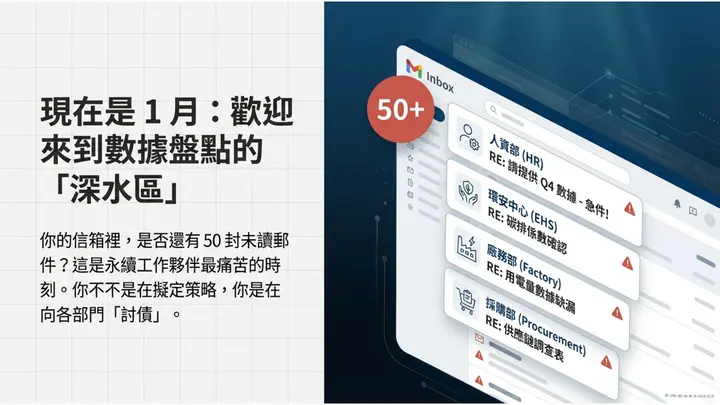
It's January, and many sustainability practitioners are deep in the trenches of 2025 data collection. Is your inbox still flooded with 50 unread emails from HR, EHS, plant operations, and procurement, all with the subject line: "RE: Please provide Q4 data"? If you're facing the same situation right now, this article has the solution for you.
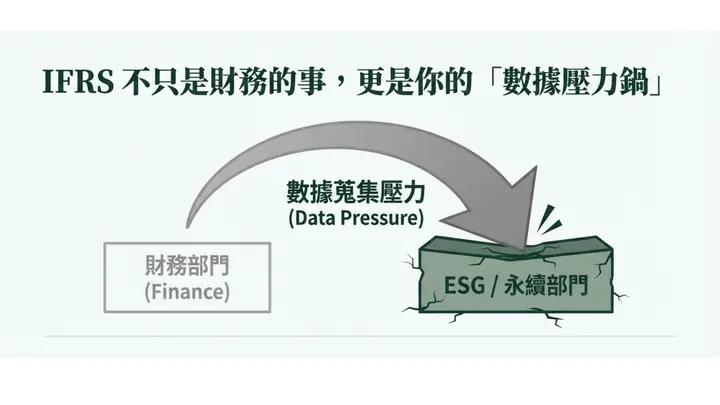
As the IFRS Sustainability Disclosure Standards officially enter their trial preparation period in 2026, many companies harbor a major misconception: IFRS is an accounting standard, so it's the finance and accounting departments' problem, right? In reality, the moment the finance department takes over, the pressure cooker of "data collection" is about to swing right back at you—the person responsible for the sustainability report.
When the annual report and sustainability must be synchronized, can your process withstand the test?
In the past, sustainability reports were typically finalized in June and published in August, while annual reports were released by the end of March. The months-long gap in between served as a precious buffer period for sustainability practitioners. However, under the IFRS framework, the ultimate goal is "simultaneous disclosure of sustainability information and financial reports."
Think about it: you used to have six months to gradually collect data from various departments, organize Excel spreadsheets, and go back and forth to verify figures. Now, that cycle is compressed to completing the majority within the first quarter. This isn't just a matter of speed—it's about the precision of internal communication and data collection. How do you get all departmental colleagues to submit their data in such a short timeframe? Regular email reminders or phone calls to chase them down? And we haven't even discussed data quality and version control yet—it's truly no easy feat.
The limits of manual files are the limits of your overtime
We deeply understand the pain of frontline sustainability practitioners. During this peak data collection season, your time is often not spent on developing sustainability strategies, but consumed by tedious paperwork and data transfers:
The "black hole" of version control: You send a file to 10 departments and receive back 10 files with different names. You need to manually copy and paste everything into a master spreadsheet. What if you accidentally paste into the wrong column? Or what if a department sends an "updated version" and you miss it? Data errors are born right there. Incorporating an outdated version and failing to update to the latest data can be a disaster.
The "gap" in data consolidation: HR counts headcount, plant operations tracks utility readings, and general affairs tracks waste. Everyone uses different units (mixing kilograms, metric tons, and cubic meters). You set up countless formulas in Excel for conversions, but if someone enters the wrong unit at the front end, the entire carbon emissions calculation at the back end is wrong. And when it comes to collecting employee benefits data alone, with factories in mainland China, Vietnam, North America, and offices in Taiwan—how much time does it take to organize all of that?
The "disappearance" of supporting documentation: Data is entered, but where are the photos of utility bills? They might be scattered across LINE group chats, email attachments, or buried deep in some shared folder. When assurance time comes, they're nowhere to be found. For the employee welfare committee's year-end reports, which photos belong to which event? For risk assessment and analysis, how do you manage flowcharts, policy documents, and progress tracking documents?
In 2026, relying on manual processes and Office documents to handle massive volumes of data that require assurance is like using an abacus to run AI computations—it's not impossible, but the risk is far too high and the efficiency is extremely low.
Facing the pressure of IFRS and the tight first-quarter timeline, "digitalization" is no longer an option—it's the only way forward.
Efficiency upgrade: The secret weapon for completing Q1 on time
The system can set automated schedules that automatically send notifications to department managers when it's time to fill in data. You no longer need to play the role of "debt collector"—the system dashboard lets you see at a glance who hasn't submitted yet. What used to take six months for data collection can be dramatically shortened to just a few weeks.
Management optimization: "Foolproof" mechanisms for massive data
The system comes with built-in standardized data fields and submission formats. Each department can only fill in data within the prescribed framework, with mandatory data collection conditions, configurable required or optional fields, and customizable submission deadlines and review workflows. This organizes the entire process at the source, avoiding endless rounds of back-and-forth corrections—everything is automated.
Compliance defense: Compliance and audit trails
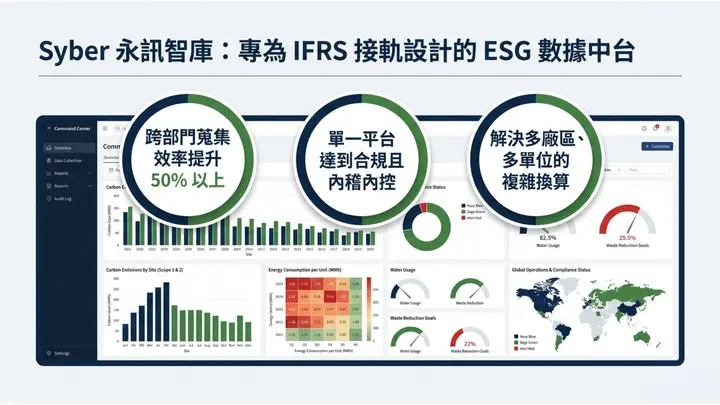
Achieving compliance and internal audit control on a single platform is the core value of the system. Who modified which number, on what date, at what exact time? The system records everything with crystal clarity. When an audit comes, just open the system—it's your strongest shield.
The Syber Sustainability Management System by TEC is an ESG data platform designed specifically for Taiwanese enterprises. Book a demo now to experience how cross-departmental data collection efficiency can be improved by over 50%, making your IFRS transition smoother!