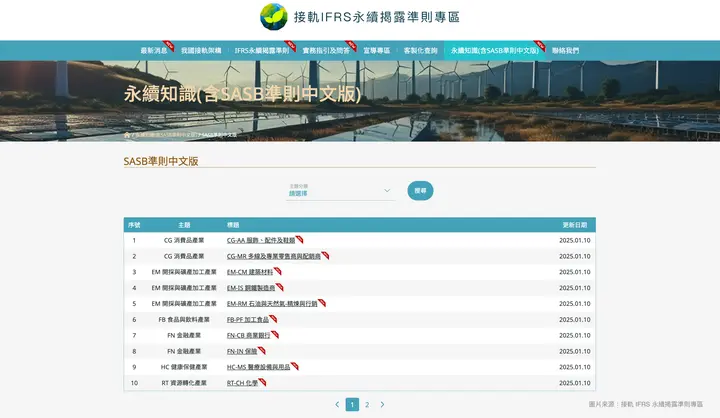
To help Taiwanese companies more accurately apply SASB standards, SASB has recently launched Chinese-language guidance, ensuring companies can clearly understand each disclosure requirement. This update lowers the barrier to language comprehension and helps companies align more effectively with international standards.
Introduction to SASB
SASB (Sustainability Accounting Standards Board) divides corporate sustainability disclosure requirements into 77 industry standards based on industry characteristics, covering five key sustainability topics:
- Environment: How companies manage environmental impacts such as climate change, resource use, and pollution.
- Social Capital: Corporate relationships with consumers and communities, including product quality, safety, and information security.
- Human Capital: Employee management, occupational safety, and labor rights issues.
- Business Model & Innovation: How sustainability supply chains, product design, and circular economy impact corporate finances.
- Leadership & Governance: Corporate governance, ethical behavior, and risk management indicators.
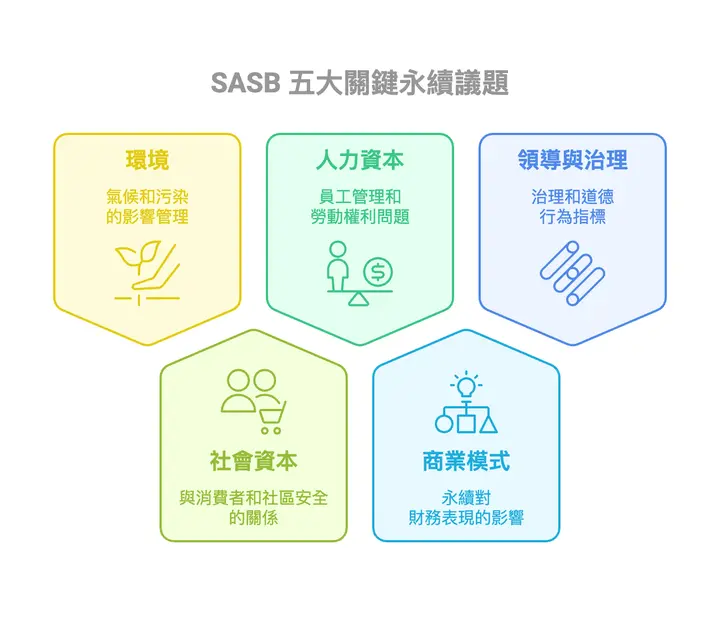
SASB (Sustainability Accounting Standards Board), founded in San Francisco, specifically provides information investors need to see, aiming to encourage companies to disclose information with "financial materiality" beyond financial performance. Through these five areas, SASB standards help companies make financially relevant ESG disclosures on material issues specific to their industries, ensuring sustainability reports have transparency and decision-making value.
SASB Standards and ESG Relevance
1. Latest Requirements of the Sustainability Report Operating Rules
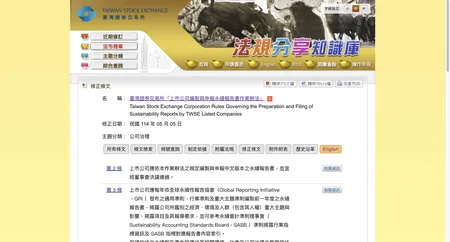
According to the Taiwan Stock Exchange's "Operating Rules for Listed Companies to Prepare and File Sustainability Reports," listed companies must ensure report content is complete and specifically references SASB standard industry disclosures, indicator information, and SASB indicator-to-report content indexing.
2. Communicating Key ESG Risks and Opportunities
SASB standards have become an important basis for global investor decision-making, particularly when focusing on corporate financially-related sustainability issues. SASB provides industry-specific disclosure requirements, mostly disclosed in sustainability report appendices showing annual SASB-related quantitative data and management practices, enabling companies to effectively communicate key ESG risks and opportunities to investors.
3. Comparing Industry-Specific Indicators
The unique aspect of SASB standards lies in their Industry-Specific Focus, dividing companies into 11 industry categories and then into 77 industry standards, defining the most financially material ESG issues for different industries. This ensures disclosed information directly reflects business models and operational risks while improving international comparability of corporate reports and meeting investor requirements for sustainability disclosure.
4. SASB Disclosure Integration with IFRS S2
IFRS S2 [1] focuses on climate-related financial disclosures and references SASB disclosure indicators to provide industry-specific disclosure requirements. S2 requires disclosures on climate-related matters including transition plans, carbon offset programs, climate scenario analysis, Scope 3 greenhouse gas emissions, and incorporates industry-specific indicators (SASB). Companies implementing SASB industry-specific indicators early ensure reports comply with the latest international standards.
IFRS S2 [1]: The International Sustainability Standards Board (ISSB) under the IFRS Foundation leads international sustainability disclosure frameworks toward integration, further improving information disclosure quality and credibility. In 2023, it released IFRS S1 "General Requirements for Disclosure of Sustainability-related Financial Information" and S2 "Climate-related Disclosures."
Official SASB Standards Query Resources
Companies can obtain the latest SASB standards information and guidance through the following channels:
- SASB Official Website - Search by "Company Name" to find corresponding industry classification and download original documents.
- Taiwan Regulatory Authority IFRS Sustainability Disclosure Standards Integration Zone
Transparent Sustainability Information Disclosure Enhances Corporate Competitiveness
With the latest SASB Chinese version guidance, companies can more easily understand standard requirements and ensure report content meets global investor expectations. Master SASB standards and sustainability report appendix writing techniques to ensure compliance with sustainability report operating rules, enhance corporate transparency and investor trust!
International framework updates for reports are complex and frequent. Sustaihub's report management system can customize connections to international frameworks like GRI, SASB, TCFD, and IFRS S1/S2. Click here to see how ESG digitalization can help solve your report management challenges.