
Sustaihub in Vietnam: Our Ho Chi Minh City Pitch and Six Takeaways
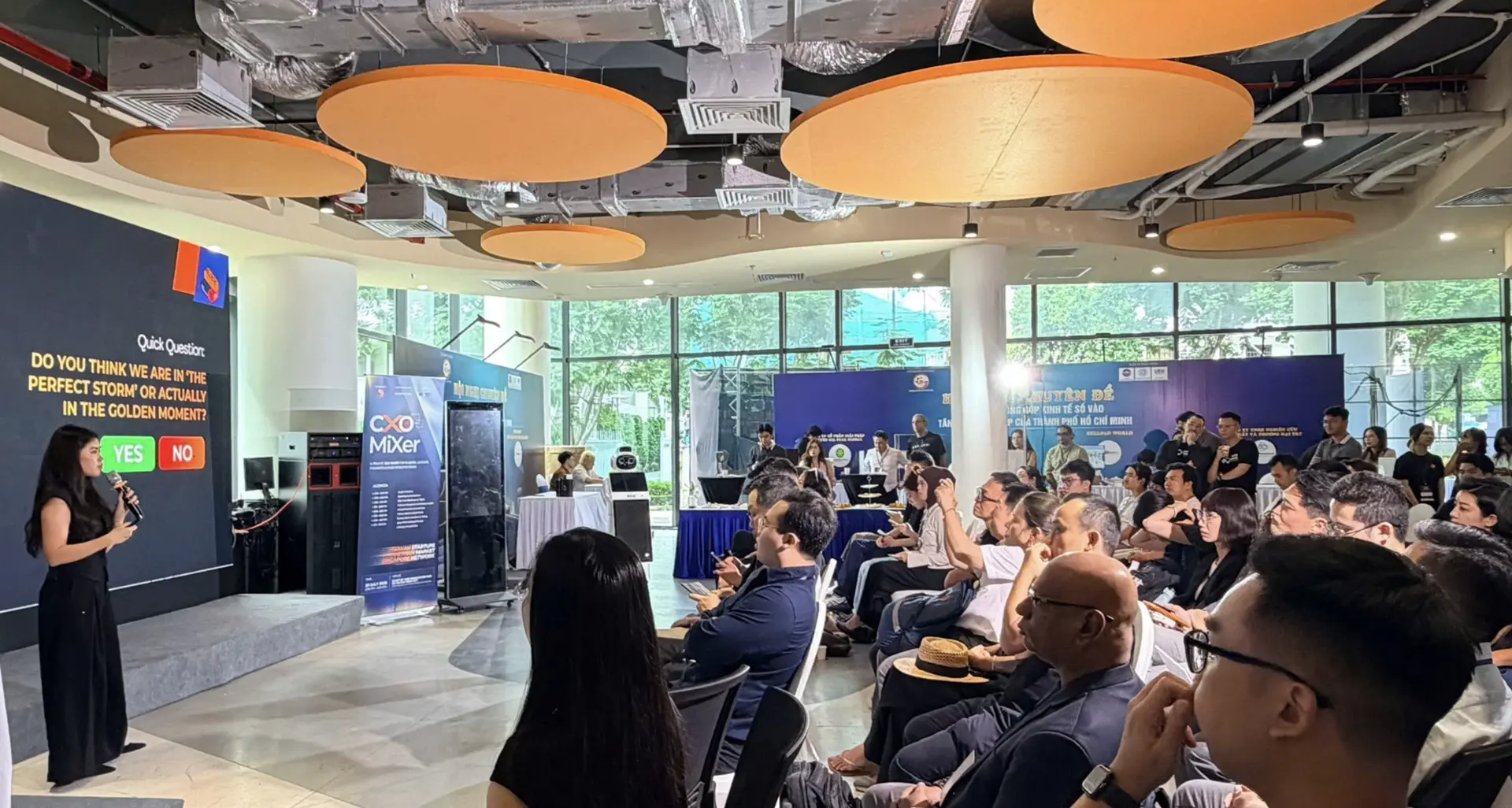
On July 30, 2026, Sustaihub attended two events in Ho Chi Minh City: Taiwan Tech Solution Day, hosted by Startup Island TAIWAN, where Sustaihub pitched in the AI solutions session; and BLOCK71 Vietnam's CXO Mixer, where we met nearly 200 local founders, corporate representatives and investors. That same day, Vietnamese financial media outlet VietnamFinance devoted a section of its coverage to Sustaihub. The purpose of the trip was not to measure how much we could sell, but to see whether the approach we have developed over ten years in Taiwan would also work in Vietnam. Here is what we saw, what people asked us, and the six conclusions we brought home.
What to decide after reading If you are still researching, first decide whether you need reporting, carbon inventory, peer disclosure search, or software selection.
Table of Contents
- Key Takeaways
- Why Sustaihub Went to Ho Chi Minh City
- Two Events in One Day: Pitching and Business Matchmaking
- Taiwan Tech Solution Day
- CXO Mixer
- What We Shared on Stage
- How Vietnamese Media Covered the Visit
- Six Conclusions We Brought Home
- 01 The Ecosystem Is Moving from Early Development to Scale
- 02 Capital Has Not Left; It Has Become More Selective
- 03 Users Are Ready; Enterprise Tools Are Not Yet There
- 04 AI Adoption Resembles a Doctor–Patient Relationship More Than a Sales Transaction
- 05 Projects Without a Risk Owner Will Remain Stalled
- 06 Do Not Enter Alone
- What This Trip Means for Sustaihub
- Product
- Market
- Strategy
- Partner with Us
- If This Is the Kind of Work You Want to Do
- Frequently Asked Questions
- Why Is Sustaihub Entering the Vietnamese Market?
- Why Do Vietnamese Exporters Need ESG Data Governance?
- What Kinds of Companies Are Suitable Overseas Partners for Sustaihub?
- Sources and Notes
Key Takeaways
- Sustaihub pitched in the AI solutions session at Taiwan Tech Solution Day in Ho Chi Minh City and participated in the CXO Mixer business matchmaking event that same day.
- Vietnamese financial media outlet VietnamFinance featured Sustaihub in a dedicated section.
- We brought back six conclusions covering the ecosystem's development, capital flows, practical barriers to AI adoption and market entry.
- For Sustaihub, the trip validated one point: our platform addresses globally applicable standards, rather than a problem unique to Taiwan.
On July 30, 2026, Sustaihub attended two events in Ho Chi Minh City: Taiwan Tech Solution Day, hosted by Startup Island TAIWAN, where Sustaihub pitched in the AI solutions session; and BLOCK71 Vietnam's CXO Mixer, where we met nearly 200 local founders, corporate representatives and investors. That same day, Vietnamese financial media outlet VietnamFinance devoted a section of its coverage to Sustaihub. The purpose of the trip was not to measure how much we could sell, but to see whether the approach we have developed in Taiwan would also work in Vietnam. Here is what we saw, what people asked us, and the six conclusions we brought home.
Why Sustaihub Went to Ho Chi Minh City
For years, our work has been deeply rooted in Taiwan: helping companies gather sustainability data scattered across departments, conduct inventories, align it with international standards and ultimately produce reports that stand up to verification.
Yet the reasons this work matters in Taiwan are not unique to Taiwan. The real driver is disclosure requirements across global supply chains, and those requirements are moving further along the same chains. Vietnam is a major manufacturing base in Southeast Asia. Electronics, systems integration and textiles are core local industries—and the three sectors in which Sustaihub has the deepest experience in Taiwan.
So when Startup Island TAIWAN launched its Vietnam market expansion programme, we decided to visit in person. Before deciding what to sell, we wanted to establish whether Taiwan's solutions would work in Vietnam.
Two Events in One Day: Pitching and Business Matchmaking
Taiwan Tech Solution Day
Themed “Bridging Taiwan to the World”, the event was hosted by Startup Island TAIWAN, co-organised by FPT Smart Cloud and Phu My Hung, with venue support from Fulbright University Vietnam. Sustaihub took the stage in the AI solutions startup pitch session.
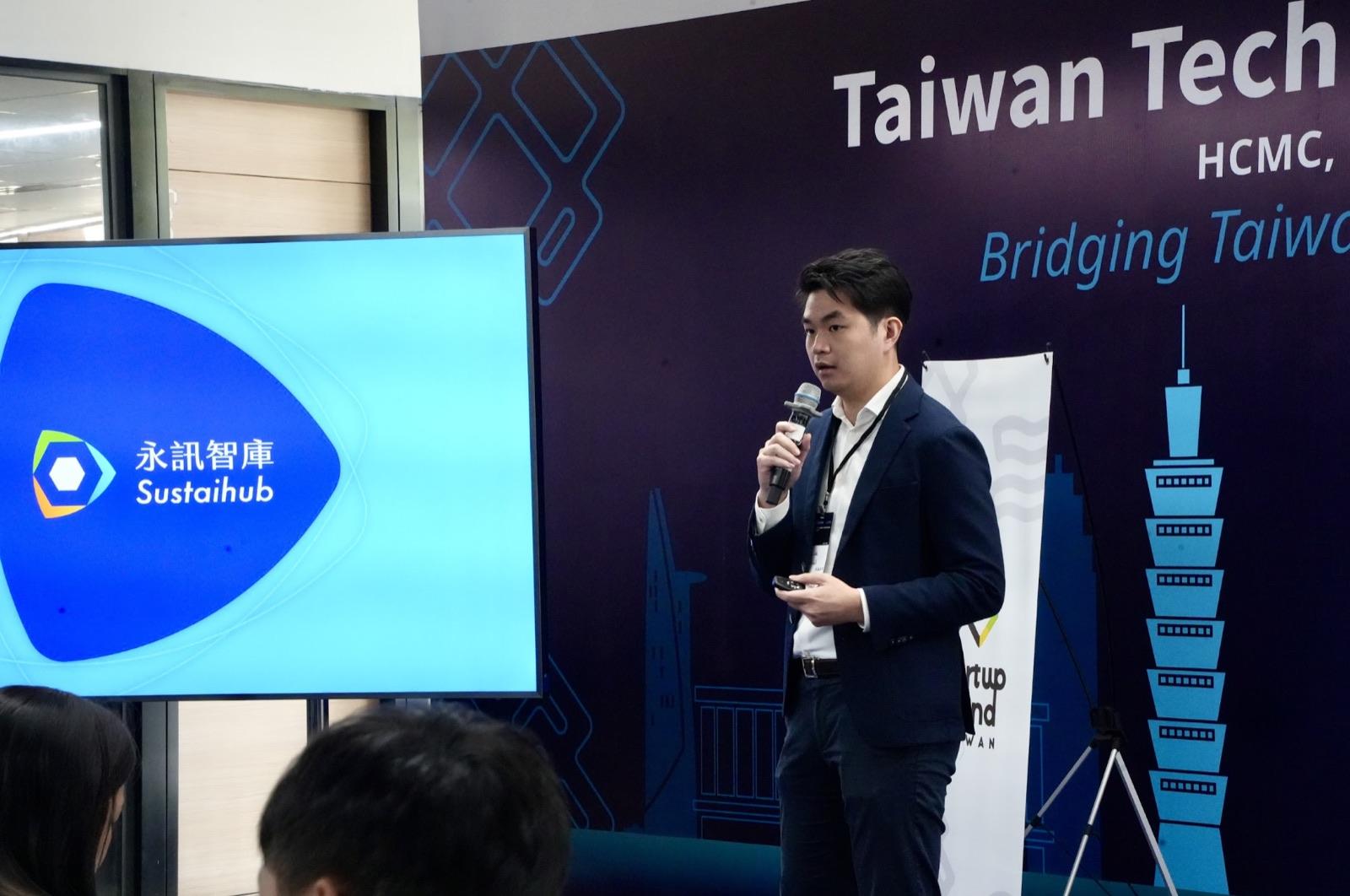
Sustaihub introduced its platform to Vietnamese companies and investors during the AI solutions pitch session at Taiwan Tech Solution Day.
At the event, Ms. Hai Trinh, Director of FPT AI Factory, shared developments in Vietnam's local AI infrastructure. The subsequent panel, “The Adoption Challenge: Connecting AI Innovators with Corporate Realities”, was moderated by Chi Ko, Executive Director of Global Strategic Partnerships at Startup Island Taiwan. Panellists included Hieu Thai, Head of AI, G.APX at CMC Global; Nathan Alexander of AppWorks; and Truc Tran, Investment Manager at Do Ventures. Several conclusions in the second half of this article draw on this panel and the on-site presentations.
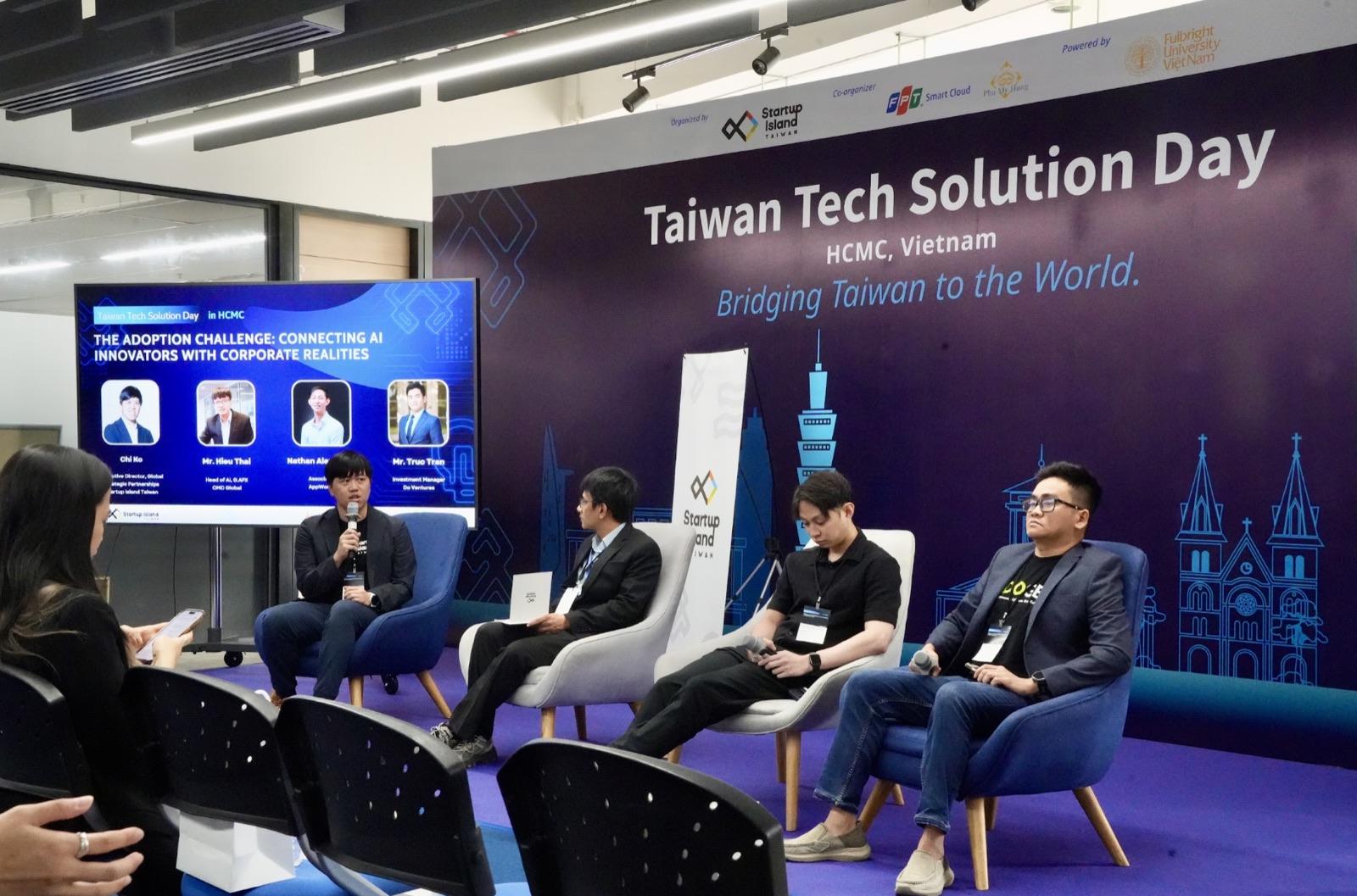
The panel explored the gap between AI startups and the realities of corporate adoption, with perspectives from an accelerator, a systems integrator and venture capital.
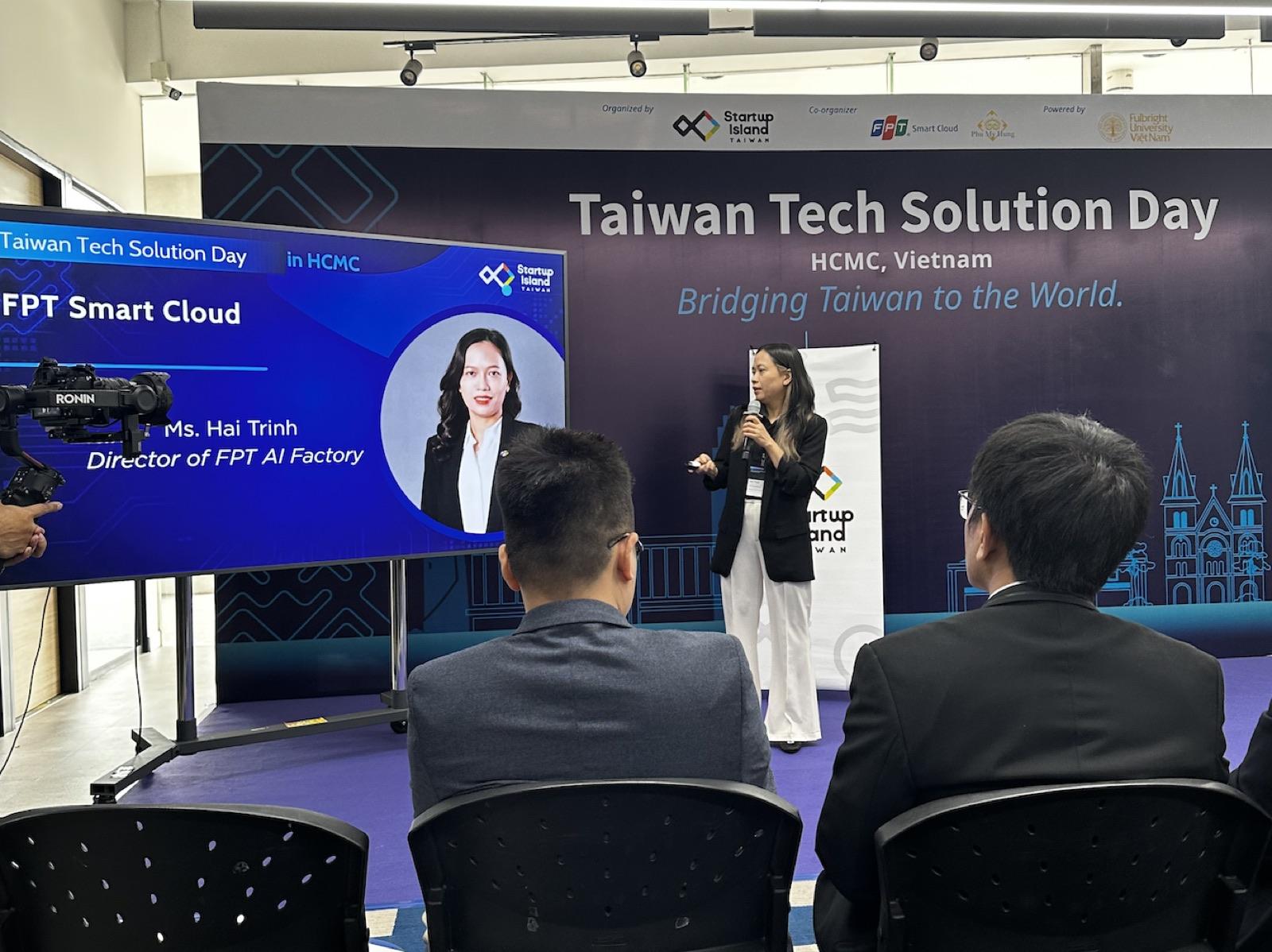
Ms. Hai Trinh, Director of FPT AI Factory, shared the current state of local AI infrastructure development in Vietnam.
CXO Mixer
The business matchmaking session that day was co-hosted by BLOCK71 Vietnam and Startup Island TAIWAN, drawing nearly 200 founders, corporate representatives and investment fund representatives. According to a VietnamFinance report, nearly 40 in-depth consultations with local experts took place in just around one hour, generating hundreds of business connections.
In the report, Liên Lê, Programme Development Manager at BLOCK71 Vietnam, said the event aimed to shorten the distance between proof-of-concept (PoC) testing and actual business partnerships, enabling Vietnamese companies to use established international technologies to improve operational efficiency and competitiveness quickly.
What We Shared on Stage
Sustaihub makes ESG simpler through an AI platform covering everything from carbon inventories to sustainability reports. Its core capabilities address ESG data governance and greenhouse gas inventories, aligned with international disclosure standards such as GRI, IFRS S1/S2 and TCFD, as well as ISO greenhouse gas inventory standards. It can also present performance against the SDGs.
- Over 10,000: ESG reports processed by the platform to date
- 1.5 million: accumulated data points
- From 6 months to 3 months: time required to prepare a report
Sustaihub currently serves more than 50 listed companies and approximately 100 SMEs across 20 industries, primarily electronics, systems integration and textiles.
The difference between our prepared presentation and the audience's response was revealing. We had devoted considerable space to explaining “why ESG matters”, but people actually asked how to collect data, standardise definitions across sites and provide the evidence verifiers require. The level of these questions was itself a signal: the market had already moved beyond “Should we do this?” to “How do we get it done?”
How Vietnamese Media Covered the Visit
VietnamFinance placed the Taiwanese startups' visit squarely in the context of Vietnam's two national goals—green transition and a digital economy—and devoted a section to Sustaihub's positioning.
The policy benchmarks cited in the report were clear: Vietnam's government aims for the digital economy to contribute 30% of GDP by 2030, equivalent to US$90 billion to US$200 billion, while advancing its pathway to net-zero emissions by 2050.
The report positioned Taiwanese startups as partners that can help Vietnamese manufacturers and exporters rapidly improve operational performance, ESG management and energy optimisation through hardware–software integration and edge AI applications, without rebuilding infrastructure on a large scale.
Source: VietnamFinance, July 30, 2026
One phrase in the report deserves attention: ESG data governance and greenhouse gas inventories were described as “becoming mandatory for many export businesses”. This assessment came from local Vietnamese financial media, rather than an external supplier's marketing language. Other Taiwanese teams named in the coverage included ekoXense, AIM and Optiqb.
Read the Original Vietnamese Media Report
Startup Đài Loan đổ bộ Việt Nam tìm cơ hội chuyển đổi xanh - số tỷ USD (VietnamFinance | July 30, 2026 | Reporter: Thiên Ân | In Vietnamese)
Six Conclusions We Brought Home
01 The Ecosystem Is Moving from Early Development to Scale
This year, Vietnam entered the top 50 in the global startup ecosystem rankings for the first time, up 5 places from 2024. It ranks 5th in Southeast Asia, with approximately 4,000 startups.
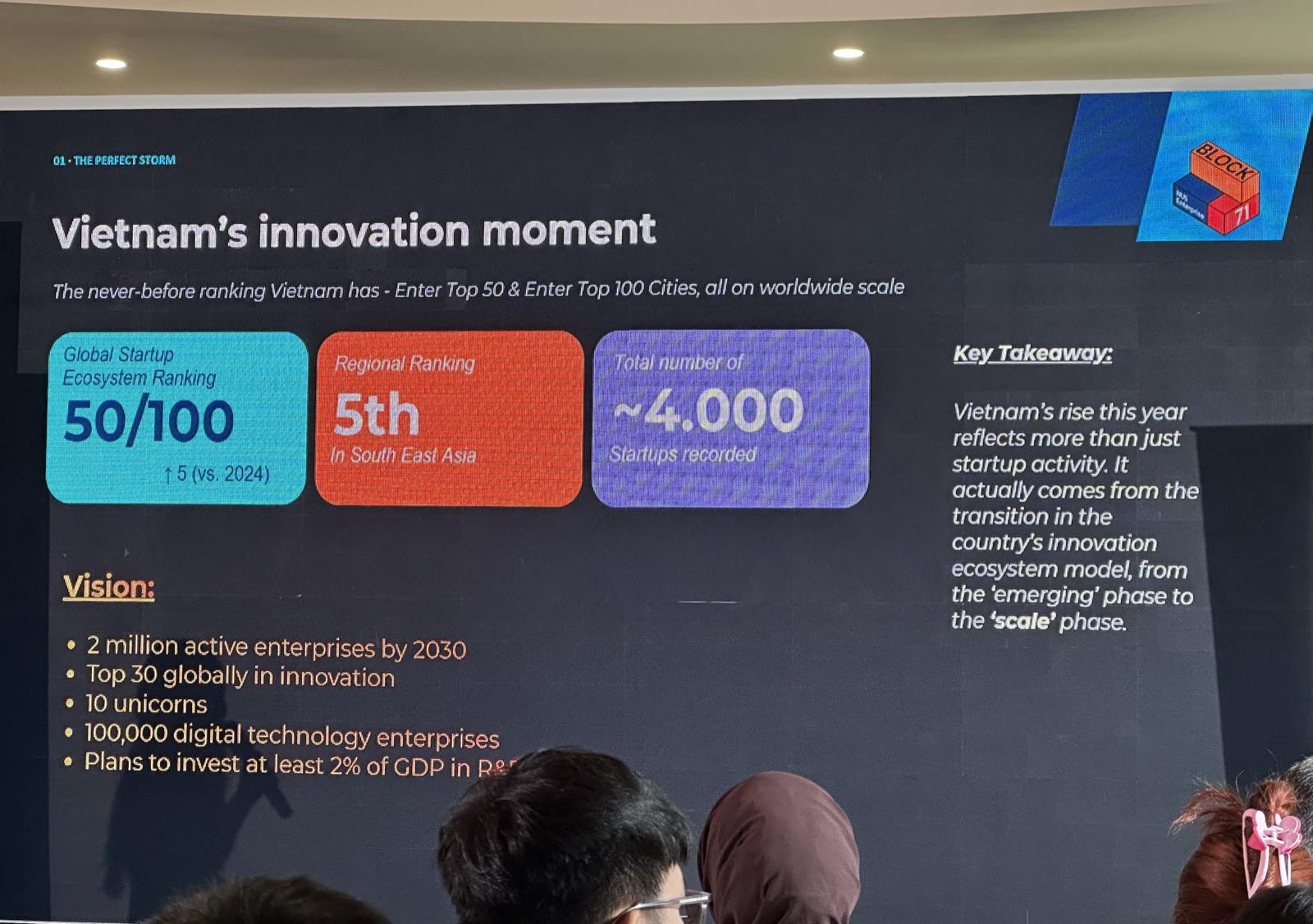
BLOCK71's on-site presentation noted that Vietnam's rise in the rankings this year reflects a shift in the ecosystem itself, from early development to scaling.
This assessment is supported by a national vision for 2030: 2 million active businesses, a place among the world's top 30 for innovation, 10 unicorns, 100,000 digital technology companies, and R&D investment of at least 2% of GDP. For overseas businesses, the market may mature faster than generally expected, requiring a corresponding reassessment of entry timing.
02 Capital Has Not Left; It Has Become More Selective
Investment in 2025 shifted visibly towards essential needs. Healthcare rebounded to US$170 million, close to its 2023 peak; retail grew 81% to US$67 million; and Climate Tech, the sector most relevant to sustainability, grew 52% to US$35 million.
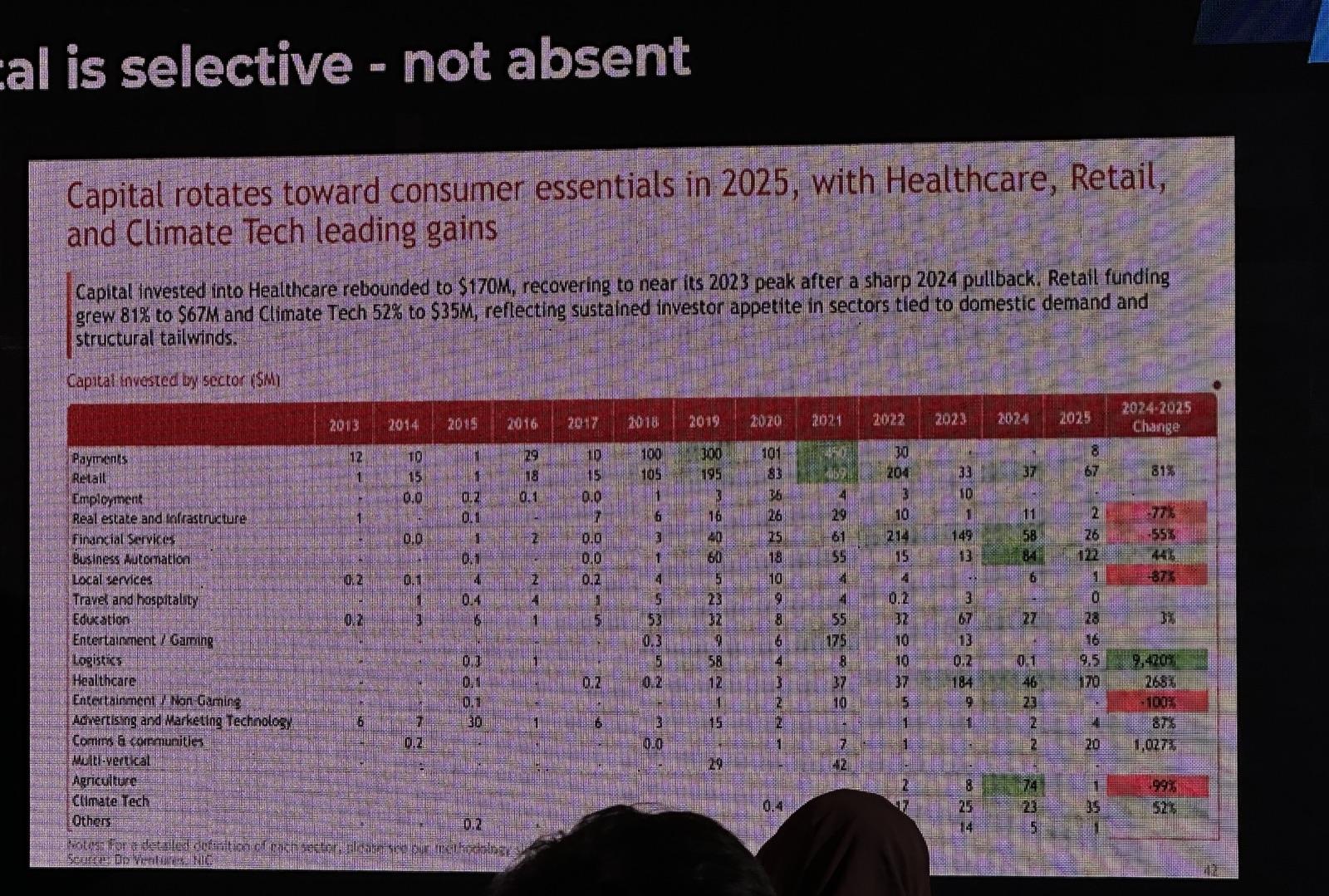
Sector investment figures show that capital has not left Vietnam; it has become more selective. Sources: Do Ventures, NIC.
Climate Tech's growth has direct significance for Sustaihub: it shows that sustainability solutions are attracting tangible attention from Vietnamese investors, beyond policy statements. Capital inflows also tend to signal that corporate willingness to pay is emerging.
03 Users Are Ready; Enterprise Tools Are Not Yet There
Vietnam is already a major manufacturing base in Southeast Asia, but digital transformation at many local factories and SMEs remains at an early stage. Meanwhile, Vietnamese consumers have the highest AI engagement in Southeast Asia: 81% use AI daily, and 96% are willing to share their data for personalised services. Video commerce has grown fivefold in 3 years and now accounts for approximately 25% of total e-commerce transaction value.
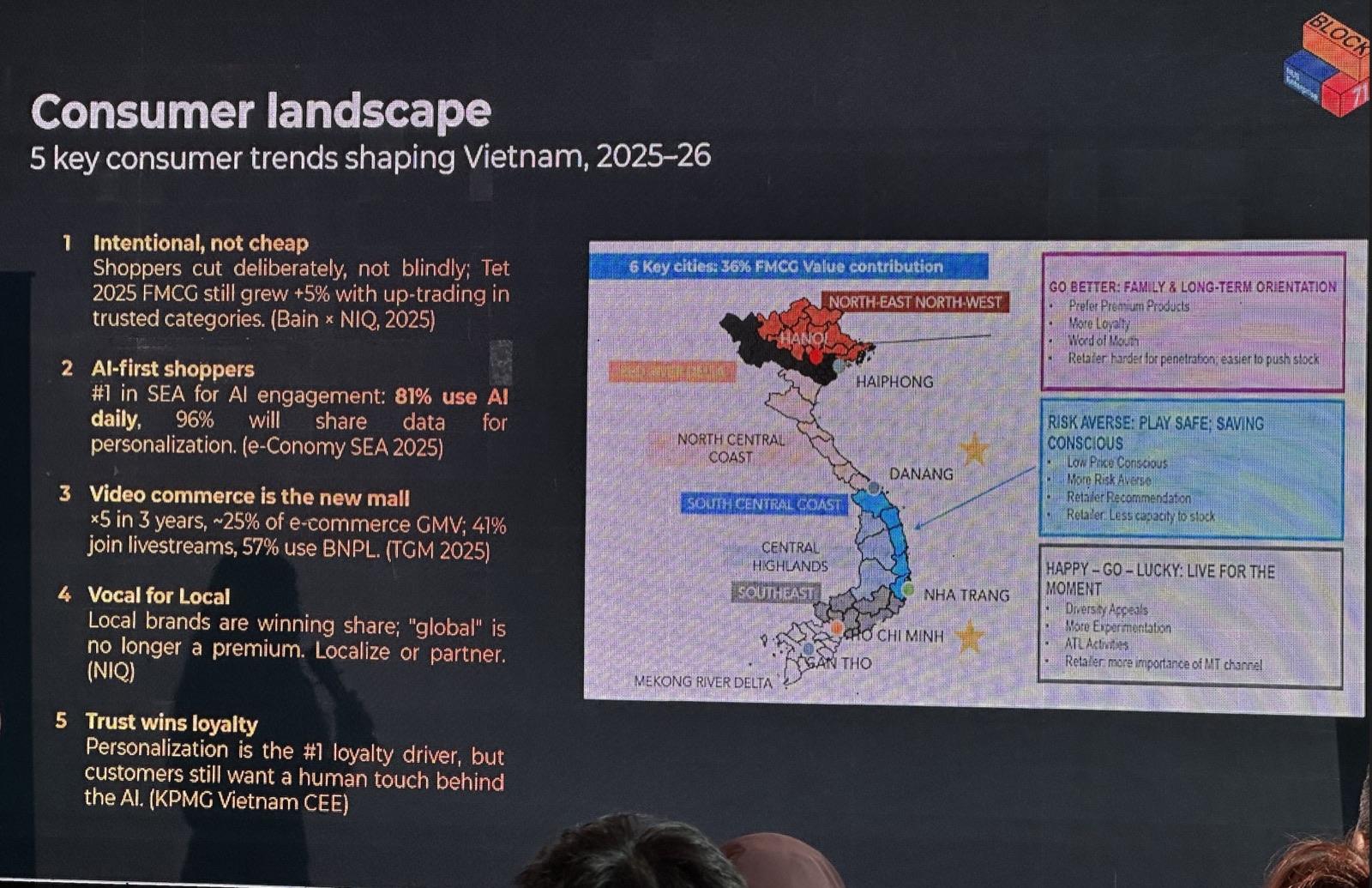
Five consumer trends in Vietnam. Users are already receptive to AI; the opportunity lies in the shortage of enterprise tools.
In other words, barriers to digital tool adoption among Vietnamese companies arise less from user acceptance and more from the availability of tools suited to local needs.
04 AI Adoption Resembles a Doctor–Patient Relationship More Than a Sales Transaction
Enterprise AI adoption is not “plug and play”. Several panellists shared the same experience: successful adoption depends on in-depth conversations about actual pain points. Suppliers must first understand customers' operations and constraints before proposing solutions that can truly be implemented.
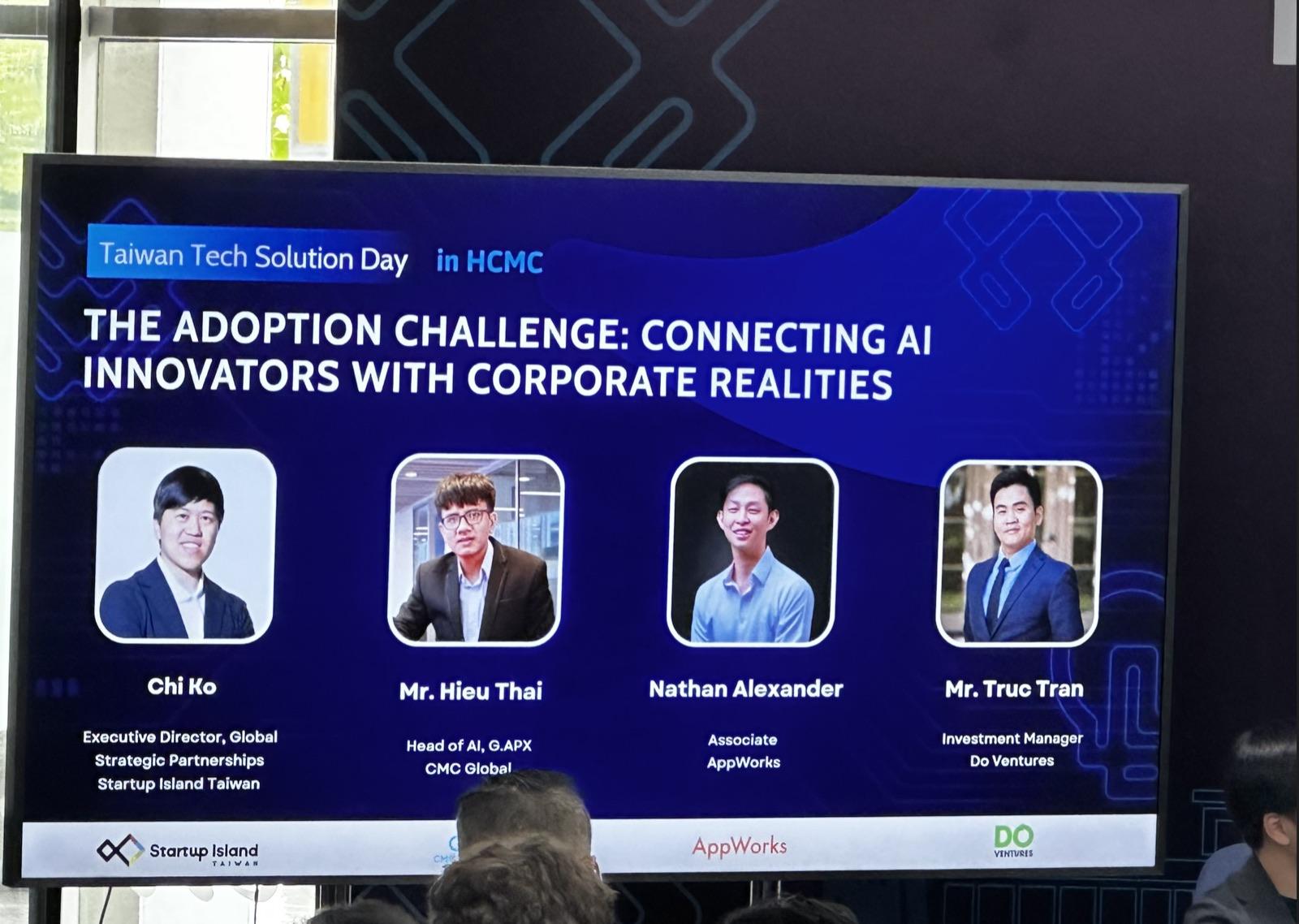
Despite representing accelerators, systems integrators and venture capital, the panellists largely agreed on the causes of the adoption gap.
This is particularly clear in ESG projects, which involve data collection across departments rather than a single department's software purchase. It also explains why a platform cannot entirely replace Sustaihub's advisory role.
05 Projects Without a Risk Owner Will Remain Stalled
In many organisations, no one is willing to take responsibility for an AI project's risks. Such projects are rarely rejected outright, but approval never arrives either. Recognising this situation early can prevent months of unproductive back-and-forth.
In practice, this means identifying early who in the decision chain bears the risk and who controls the budget, rather than simply identifying who is interested in the solution.
06 Do Not Enter Alone
Local investors consistently advised against entering the market alone. Working with established local businesses and investors is essential for foreign companies to build trust and credibility in Vietnam. This is even more critical in ESG, where sustainability data involves sensitive business information and customers' trust threshold is inherently higher than for ordinary software purchases.
Another consumer trend highlighted in the presentations pointed in the same direction: in Vietnam, an “international brand” alone no longer commands a premium; localisation or collaboration with local partners does.
What This Trip Means for Sustaihub
Product
The GRI, IFRS S1/S2, TCFD, ISO and SDGs frameworks supported by Sustaihub apply globally. This means the product's core logic does not need to be rewritten for each market. What needs localisation is language, regulatory mapping and service delivery—a relatively sound starting point for international expansion.
Market
Vietnamese companies' questions have shifted from “Should we do this?” to “How do we get it done?”, while growth in Climate Tech funding indicates emerging willingness to pay. The local gap is in tools and methodologies aligned with international standards, rather than motivation.
Strategy
Sustaihub does not intend to enter alone. Our next priority is to build partnerships with local systems integrators and ESG consultancies, enabling local companies to start with ready-made digital solutions rather than build from scratch.
For a company that grew from a Taiwanese market base, taking a product into another country tests more than technology: it tests how quickly we can understand local regulations, industry structures and working practices. This trip confirmed that the problem is relevant; the next step is to work through the implementation details.
Partner with Us
Sustaihub is seeking partners in Vietnam, particularly systems integrators (SIs) and ESG consultancies. If your company serves Vietnamese manufacturers or export-oriented businesses and would like to add digital ESG capabilities for your customers, please contact us. Customers and partners in Taiwan are also welcome to use the same channel.
Enquire About Products and Partnerships | Explore the Syber Sustainability Reporting System | Explore the DCarbon Carbon Inventory System
If This Is the Kind of Work You Want to Do
Taking a sustainability management methodology to another market requires more than familiarity with GRI or carbon inventories. It requires people willing to understand unfamiliar industries and regulations, and able to explain complex matters clearly. Sustaihub's overseas expansion is just beginning. If this work appeals to you, take a look at the roles we are recruiting for.
Thank you to Startup Island TAIWAN, FPT Smart Cloud, Fulbright University Vietnam, BLOCK71 Vietnam and all the panellists for the exchange.
Frequently Asked Questions
Why Is Sustaihub Entering the Vietnamese Market?
Vietnam is a major manufacturing base in Southeast Asia. Electronics, systems integration and textiles are core local industries and the three sectors in which Sustaihub has the deepest experience in Taiwan. These businesses face the same global supply chain disclosure requirements, making the methodology developed in Taiwan transferable. Vietnam's Climate Tech investment grew 52% in 2025, indicating emerging local willingness to pay for sustainability solutions.
Why Do Vietnamese Exporters Need ESG Data Governance?
Export-oriented businesses face disclosure requirements from overseas customers and supply chains, not just local regulations. VietnamFinance described ESG data governance and greenhouse gas inventories as “becoming mandatory for many export businesses”. The practical challenge is usually not whether to disclose, but inconsistent data definitions across sites, scattered evidence and compressed verification schedules.
What Kinds of Companies Are Suitable Overseas Partners for Sustaihub?
Our current priority is local systems integrators (SIs) and ESG consultancies in Vietnam. The former bring experience implementing enterprise systems and customer relationships; the latter understand standards and verification processes. Both can help local companies start with ready-made digital solutions instead of building from scratch. Taiwanese partners are also welcome to contact us through our website.
Sources and Notes
- Event information: Taiwan Tech Solution Day, HCMC, Vietnam, July 30, 2026. Hosted by Startup Island TAIWAN; co-organised by FPT Smart Cloud and Phu My Hung; venue support from Fulbright University Vietnam.
- Ecosystem and consumer trend data: BLOCK71 on-site presentation. Original consumer data sources cited in the slides: e-Conomy SEA 2025, TGM 2025, NIQ, Bain × NIQ 2025 and KPMG Vietnam CEE.
- Investment by sector: on-site presentation; original sources credited in the slides: Do Ventures, NIC.
- Panel insights: on-site notes from the Taiwan Tech Solution Day panel, “The Adoption Challenge: Connecting AI Innovators with Corporate Realities”.
- CXO Mixer figures and quotations: Thiên Ân, “Startup Đài Loan đổ bộ Việt Nam tìm cơ hội chuyển đổi xanh - số tỷ USD”, VietnamFinance, July 30, 2026.Report Link
- Photographs in this article were taken by Sustaihub at the event.
FAQ
View AllWhat is ESG?
ESG stands for Environmental, Social, and Governance, the three key factors for evaluating a company's sustainability and ethical practices. Environmental factors include carbon emissions and resource use; social factors cover employee relations and community impact; governance involves leadership, ethics, and transparency.
What ESG reporting software options are available in Taiwan?
Common options for Taiwan companies include local reporting systems, international SaaS, consulting projects with Excel, and fully manual workflows. Compare TWSE formats, GRI / IFRS / TCFD framework support, Traditional Chinese and English collaboration, data retention, review records, and year-over-year reuse.
How do you choose a carbon inventory system, and what should you look for?
When choosing a carbon inventory system, first check support for ISO 14064-1, GHG Protocol, Scopes 1-3, emission factor versions, activity data collection, supporting evidence management, review records, and third-party verification preparation.
Choose the ESG task you want to complete first
Still researching? See how peers write in the report database, or compare Syber and DCarbon.
How to decide the next stepStart by deciding what you need: an answer, regulations, peer examples, or a tool?