
Taiwan ESG Filing Guide: 2026 Deadlines, Digital Platform Instructions and Common Reporting Gaps
Taiwanese TWSE/TPEx-listed companies must file sustainability reports by 31 August each year as required. This article explains the latest ESG filing system, digital platform functions, key deadlines and common errors to help companies complete the task smoothly, on time and in compliance.
What to decide after reading If you came for IFRS, SASB, TCFD, GRI, or ESG reporting requirements, the next step is to turn disclosure items into data collection, section assignments, and review workflows.
Table of Contents
- 1. Key Sustainability Information Filing Deadlines
- 2. How to File Through the ESG Digital Platform
- (2) Sustainability Report Filing Instructions
- 3. Three Common Sustainability Reporting Gaps and Solutions
- (1) Which GRI Standards Most Frequently Show Non-Compliance?
- (2) Incomplete Climate and Greenhouse Gas Disclosures
- (3) Industry Sustainability Indicator Gaps: Incomplete Disclosure Under the Appendices and Missing CPA Assurance

Updated on 6 October 2026. Updated the 2026 filing schedule, platform indicators and review findings for 2024 sustainability reports.
1. Key Sustainability Information Filing Deadlines
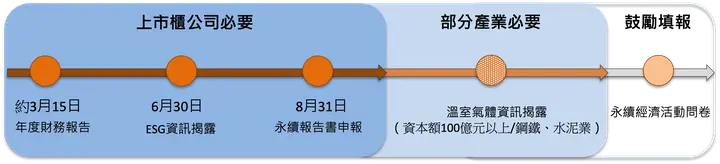
ESG information for the 2026 filing cycle must be submitted by 30 June. Sustainability reports must be filed by 31 August each year; filings in 2026 cover 2025 information. The image above illustrates the filing process. When filing, follow the 2026 Corporate ESG Information Disclosure Filing Instructions and 2026 Sustainability Report Filing Instructions, and use the Market Observation Post System Filing System (SII) to submit.
Turn this article into your next step
If this article touches disclosure, carbon inventory, or report preparation, use the system or database to check how peers handle it.
2. How to File Through the ESG Digital Platform
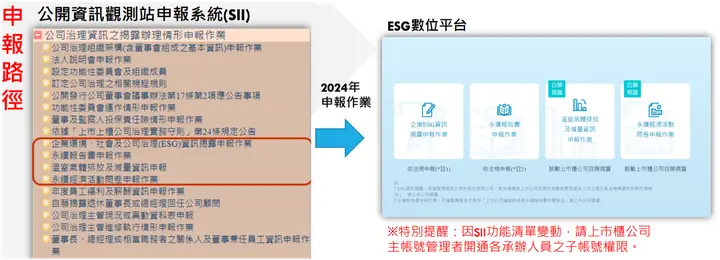
Source: Corporate ESG Information Disclosure Filing Instructions and Sustainability Report Filing Instructions
Log into the Market Observation Post System filing system (SII) within the filing period, then select the relevant platform from the filing items in the left-hand menu.
(1) ESG Information Disclosure Filing
The appendix to the 2026 filing manual lists 103 total indicator items. New or adjusted content for 2026 includes greenhouse gas assurance reports, Scope 2 calculation methods (market-based/location-based) and the corporate governance information section. Whether disclosure is mandatory or encouraged depends on industry, capital and platform fields; not every company must complete all industry indicators. Source: 2026 Corporate ESG Information Disclosure Filing Instructions, pages 4, 9–20 and 60–67.
Companies must complete ESG Digital Platform filings by the end of June each year. They can download an EXCEL file from the filing page and use the batch import function in the upper-right corner. Imported indicator data can still be edited. Once complete, remember to click “Confirm Filing”.
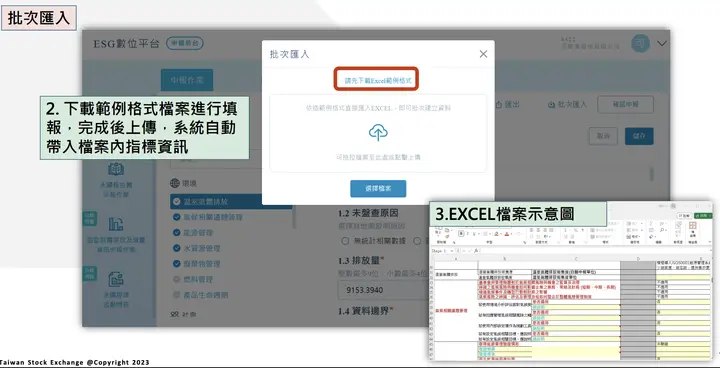
Source: Corporate ESG Information Disclosure Filing Instructions and Sustainability Report Filing Instructions
To correct information after confirming a filing, select the correction request option on the filing page and provide an email address and explanation. After Taiwan Stock Exchange (TWSE) or Taipei Exchange (TPEx) staff confirm the request, the applicant will receive an email and editing will be enabled.
ESG Information Disclosure FAQs
Q1: How should information be entered if complete prior-year data is not yet available when filing?
A1: If an emission factor has not been updated, estimate using the previous year's factor and request a correction once it is updated. If third-party verification is pending, enter the currently calculated data and indicate that it is unverified, then request a correction after verification is obtained.
Q2: If different calculation bases result in two or more intensity figures in the annual or sustainability report, how should they be presented?
A2: Enter one intensity calculation and explain the other calculation standards and results in an available text field.
Q3: Can different departments enter their respective information separately?
A3: Internal departments can enter data separately, but should avoid simultaneous use to prevent saved data from being overwritten.
(2) Sustainability Report Filing Instructions
Companies must file sustainability reports through the ESG Digital Platform by 31 August each year. Reports may be in Chinese or English; English is not mandatory but can earn evaluation points. Select the language version and confirm the reporting year before filing.
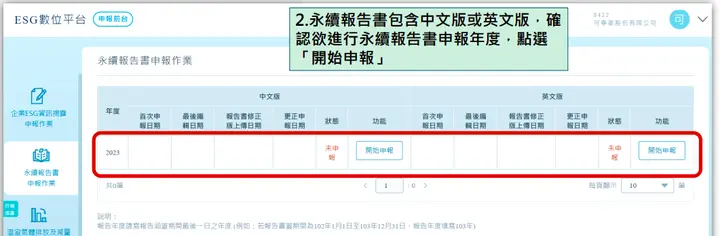
Can the Electronic File Be Updated After Filing?
If the electronic file needs adjustment after filing is confirmed, companies may upload a revised version at any time; revised sustainability reports do not require TWSE/TPEx approval.
If changes concern information such as whether the report has been assured or submitted to the board, please request a correction and provide an email address and explanation. Once TWSE/TPEx staff confirm the request, the applicant will be notified by email and editing will be enabled.
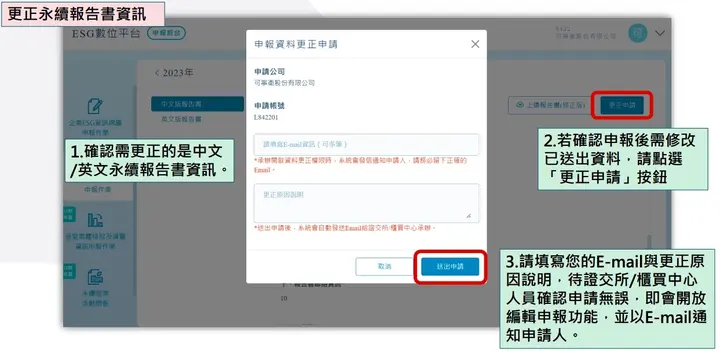
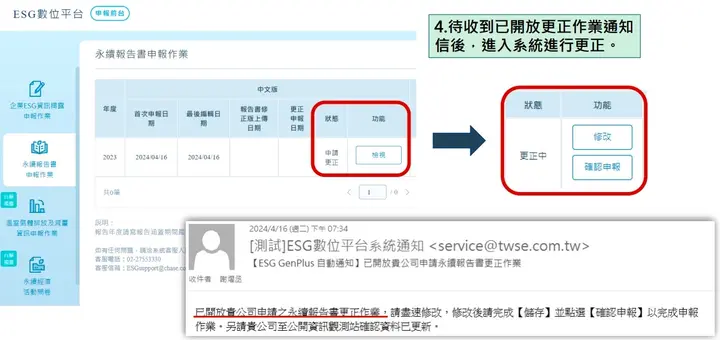
Source: Corporate ESG Information Disclosure Filing Instructions and Sustainability Report Filing Instructions
3. Three Common Sustainability Reporting Gaps and Solutions
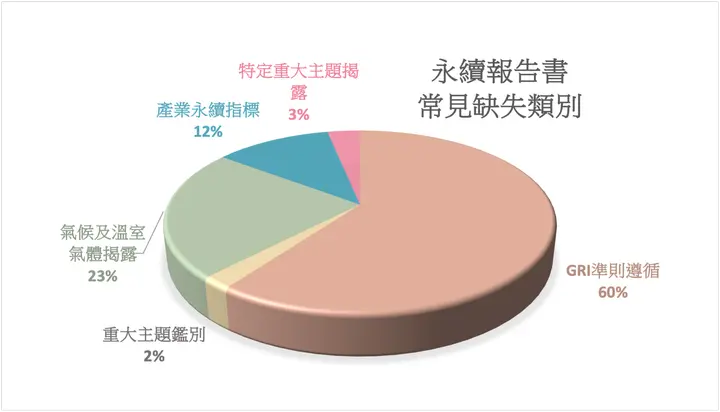
Source: Review Report on TWSE/TPEx-Listed Companies' 2023 Sustainability Reports and Assurance Providers' Working Papers; chart by Sustaihub
The following review priorities have been updated based on the TWSE and TPEx publication released in May 2026, 2024 Sustainability Report Review Results and Disclosure Recommendations. For a full analysis, see A Complete Guide to the TWSE's 2024 Sustainability Report Review Results.
(1) Which GRI Standards Most Frequently Show Non-Compliance?
The 2024 review recorded 137 instances of deficiencies in GRI 2-19 Remuneration policies, 129 in GRI 2-21 Annual total compensation ratio, and 102 in GRI 2-30 Collective bargaining agreements. Companies should check links between remuneration policies and sustainability performance, compensation ratio formulas, and working conditions for employees not covered by collective bargaining agreements.
(2) Incomplete Climate and Greenhouse Gas Disclosures
Check that climate information follows Appendix 2 of the reporting rules and includes climate risks, scenario analysis, emissions reduction targets, greenhouse gas inventories and assurance information. Avoid describing policies without concrete data. Companies that have adopted IFRS Sustainability Disclosure Standards and included a sustainability section in their annual reports may qualify for the exemption under Article 4-1, Paragraph 6; confirm eligibility first. Sources: 2024 Review Results, Article 4-1 of the Reporting Rules.
(3) Industry Sustainability Indicator Gaps: Incomplete Disclosure Under the Appendices and Missing CPA Assurance
Under Article 4 of the reporting rules, applicable companies in food, chemicals, finance and insurance, and companies deriving 50% of revenue from food and beverage services, must obtain CPA assurance on industry sustainability indicators. Companies that have adopted IFRS and disclosed SASB industry metrics in their annual reports may qualify for the exemption under Paragraph 5. Beyond these industries, a digital sustainability management system can help review enhanced industry-specific indicator disclosures for plastics, steel, cement, semiconductors, computers and peripherals, optoelectronics, communications and networking, electronic components, electronic distribution and other electronics. It can also manage all supporting materials for verification and assurance in one place, improving report data quality and preparing for future sustainability performance.
For more information, visit: https://www.sustaihub.com/
Sustainability Reporting Compliance Made Easier: Three Priorities
1. Meet GRI Standards Requirements:
Pay particular attention to the mandatory disclosures in GRI 2 and GRI 3. (Further reading: Corporate Governance Evaluation Results: Preparing for ESG Evaluation and the Latest ROC Year 114 Scoring Criteria and Rules)
2. Complete Information Disclosure:
Review the GRI disclosures associated with each material topic individually, identifying available data and gaps. This indicator review also helps identify areas where the company can improve.
3. Accurate Sustainability Information:
A report with incorrect data cannot pass regulatory review, however polished its format. Standardise data entry formats, units and review processes systematically to prevent errors in manual consolidation.
To complete a sustainability report efficiently and in compliance, contact us. Our Syber sustainability management system includes current domestic and international frameworks such as GRI, SASB, TCFD and IFRS S1 & S2, with AI collaboration to complete your sustainability report in one place.
Common Sustainability Report Gaps MOPS ESG Indicator Reporting ESG Filing System Sustainability Report Filing
FAQ
View AllWhat is the deadline for ESG information disclosure filings?
ESG information disclosure filings must be completed by the end of June each year. The 2026 manual's appendix lists 103 total indicator items. Mandatory or encouraged disclosure depends on industry, capital and platform fields.
What is the sustainability report filing deadline?
TWSE/TPEx-listed companies must file sustainability reports by 31 August each year. Filings in 2026 cover the 2025 report. Select the correct reporting year and language version when filing.
What were the most common GRI deficiencies in the 2024 sustainability report review?
The results published in May 2026 recorded 137 instances for GRI 2-19 Remuneration policies, 129 for GRI 2-21 Annual total compensation ratio, and 102 for GRI 2-30 Collective bargaining agreements. Companies should prioritise checking remuneration links to sustainability performance, compensation ratio formulas and complete collective bargaining disclosures.
Turn Sustainability Disclosure into a Collaborative Workflow
Use Syber to manage section ownership, metric data, review records, and disclosure progress, turning IFRS, SASB, and GRI requirements into a team workflow.
How to decide the next stepTurn the disclosure requirements in the article into sections, data sources, and owners first. If collaboration, version control, or verification is involved, then evaluate whether a reporting workflow is needed.