

What Does a TWSE Review Actually Check?
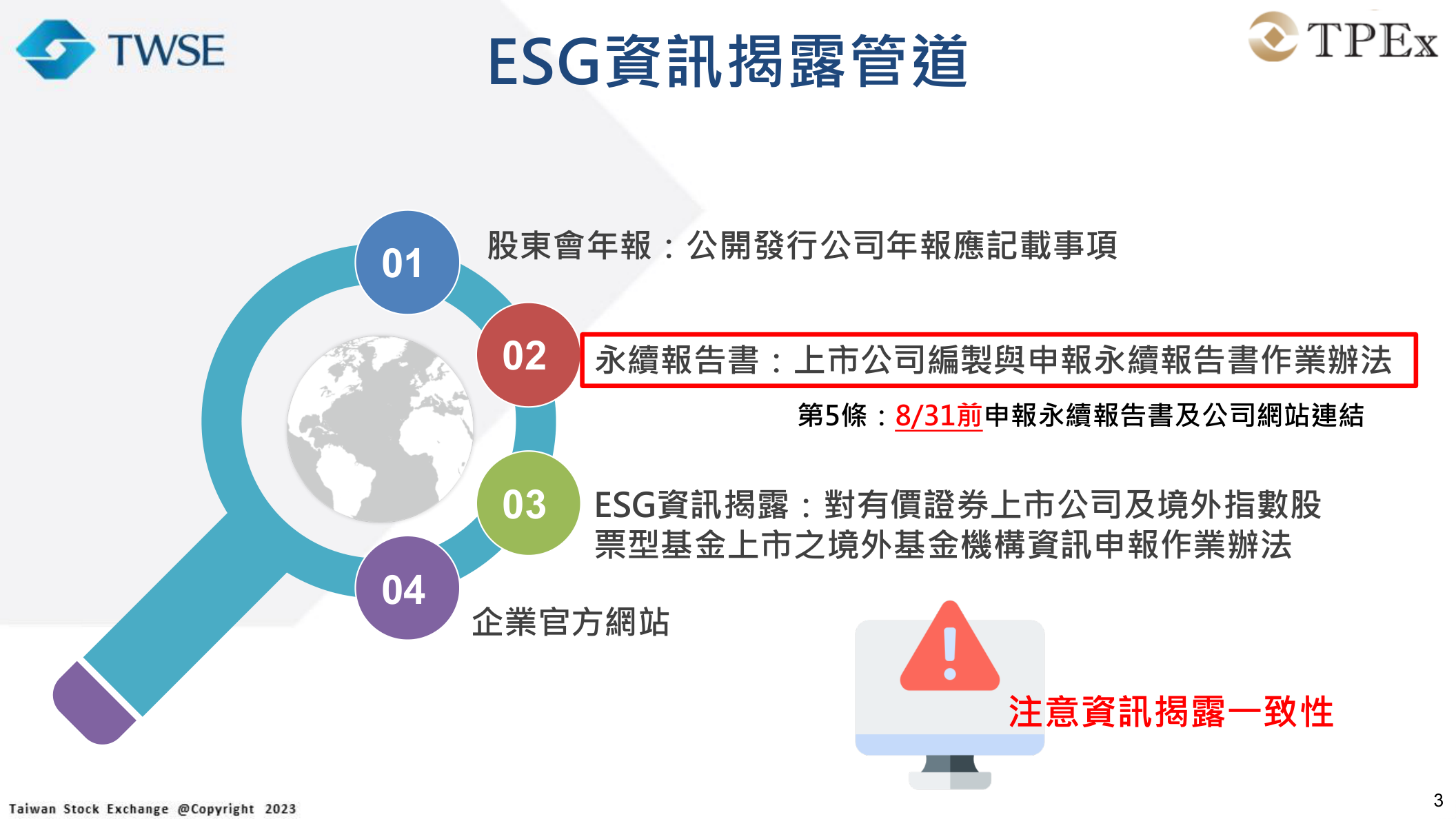
Under the Rules Governing the Preparation and Filing of Sustainability Reports by TWSE-Listed Companies, all TWSE/TPEx-listed companies are generally required to prepare sustainability reports and file them by 31 August each year, with a report link on their website. Companies newly listed during the year may omit the filing under the Q&A. Information must remain consistent across sustainability reports, annual reports to shareholders, corporate websites and the ESG disclosure system. TWSE also checks annual report appendices against sustainability reports.
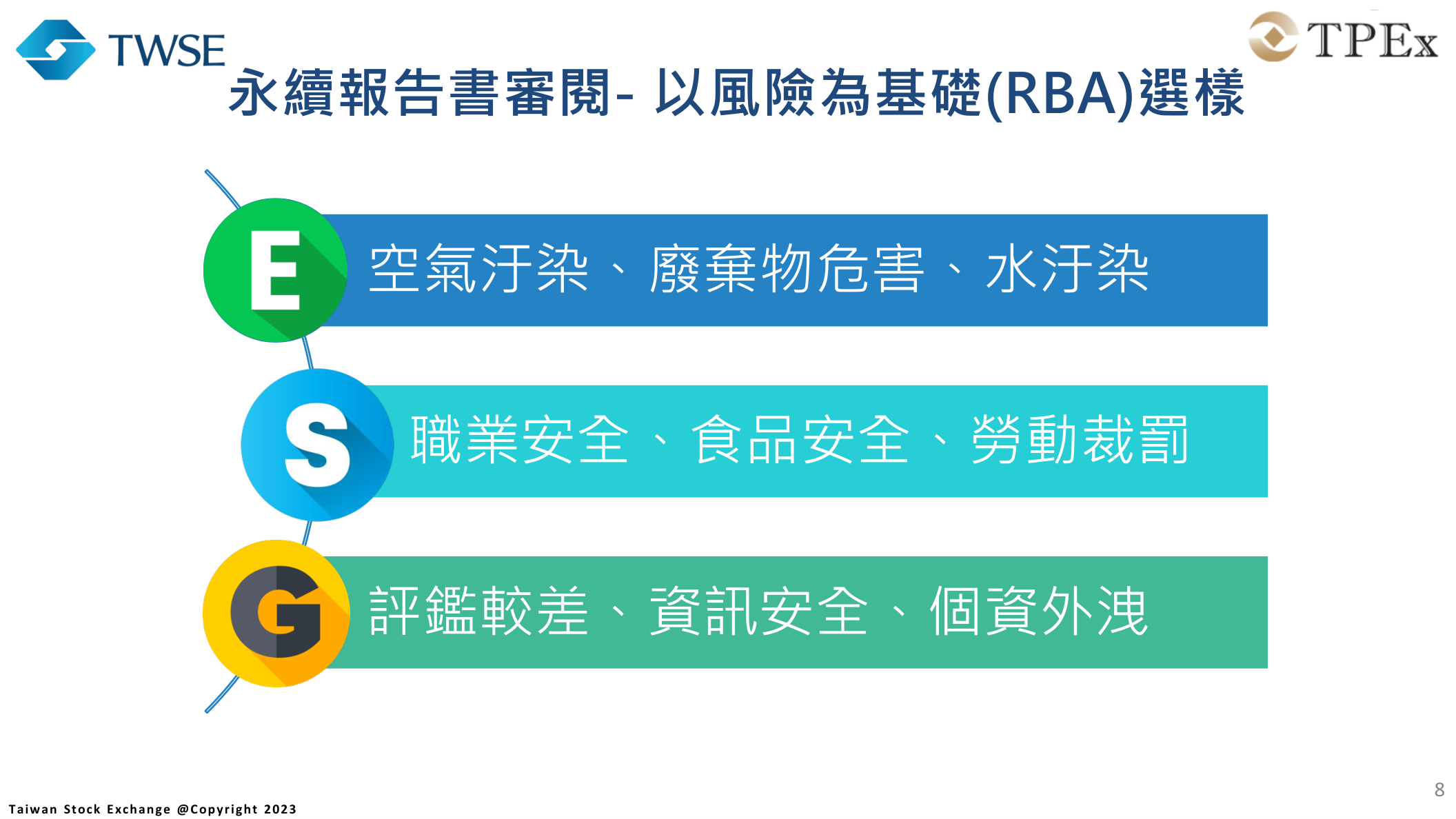
The review does not inspect every company every year. The rules require each TWSE/TPEx-listed company to be selected for review at least once every five years. TWSE uses a Risk-Based Approach (RBA), prioritising companies with higher ESG risk signals. Factors include air pollution, hazardous waste, water pollution, occupational safety, food safety, labour penalties, weak evaluations, cybersecurity and personal data leaks. Companies with environmental, safety, labour rights or cybersecurity incidents, or weaker external evaluation results, are therefore more likely to be selected.
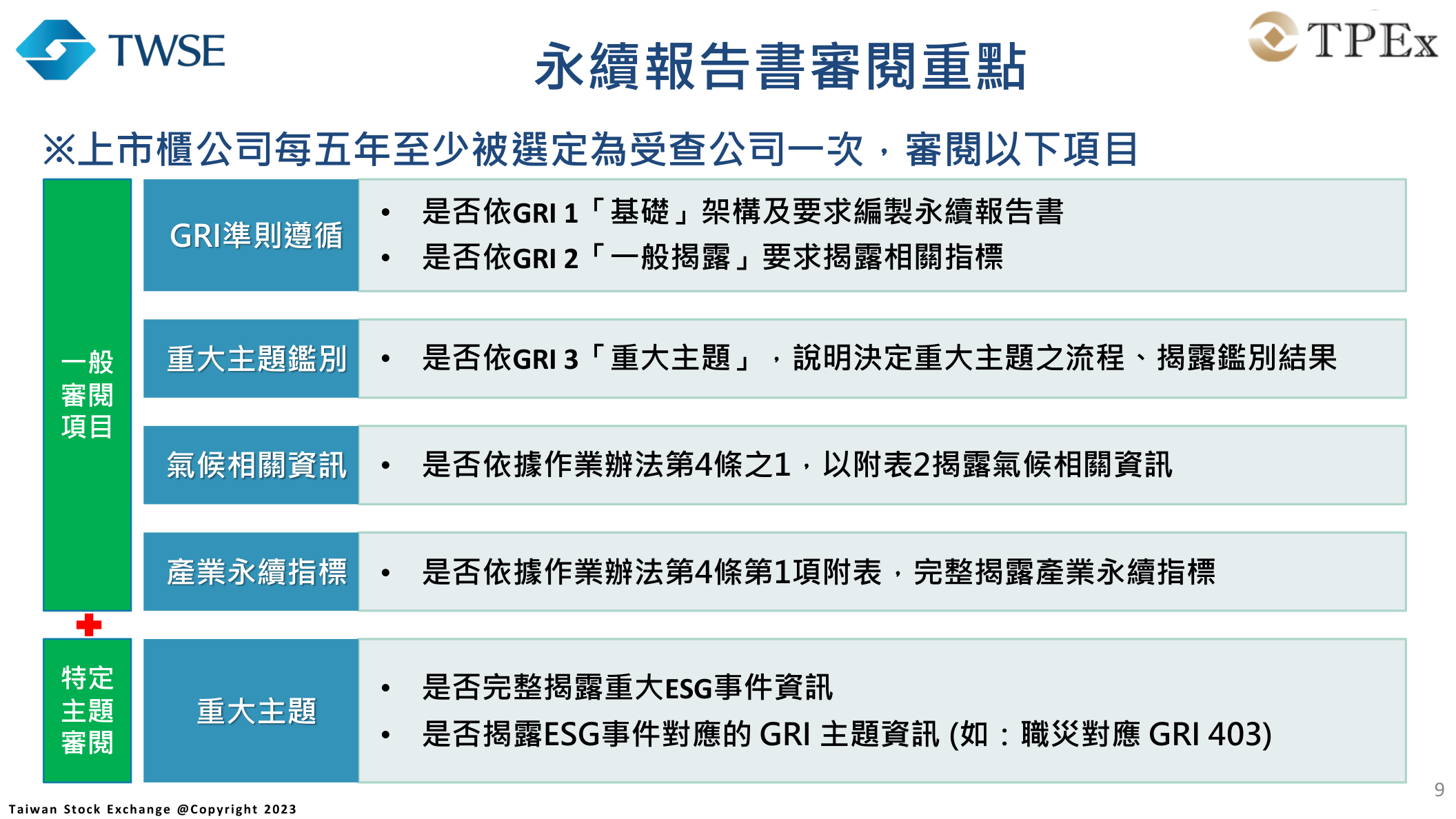
Once selected, companies undergo general and topic-specific reviews. General reviews cover four areas: GRI compliance (GRI 1: Foundation and GRI 2: General Disclosures), material topic identification (the process and results under GRI 3: Material Topics), climate-related information (Appendix 2 disclosures under Article 4-1), and industry sustainability indicators (complete disclosures under Article 4, paragraph 1 appendices). Topic-specific reviews focus on major ESG incidents, checking complete disclosure and alignment with the appropriate GRI topic, such as GRI 403 for occupational accidents.
Reviews use sampling, but disclosure obligations generally apply to all TWSE/TPEx-listed companies. These published findings reveal what TWSE sees as the most common non-compliant disclosures. Even if your company is not selected this year, using this list for self-assessment is a direct way to reduce future correction risks.
Nine GRI General Disclosure (GRI 2) Gaps: Remuneration and Labour Conditions Lead
One of the most useful sections is the statistics on non-compliance with GRI 2 General Disclosures. TWSE ranks the items flagged during the year by frequency in a bar chart.Disclosure 2-19 Remuneration Policies leads at 137 instances, followed by 2-21 Annual Total Compensation Ratio at 129 and 2-30 Collective Bargaining Agreements at 102. Next are 2-7 Employees (95), 2-27 Compliance with Laws and Regulations (93), 2-14 (43), 2-17 (38), 2-4 (36) and 2-5 (30).
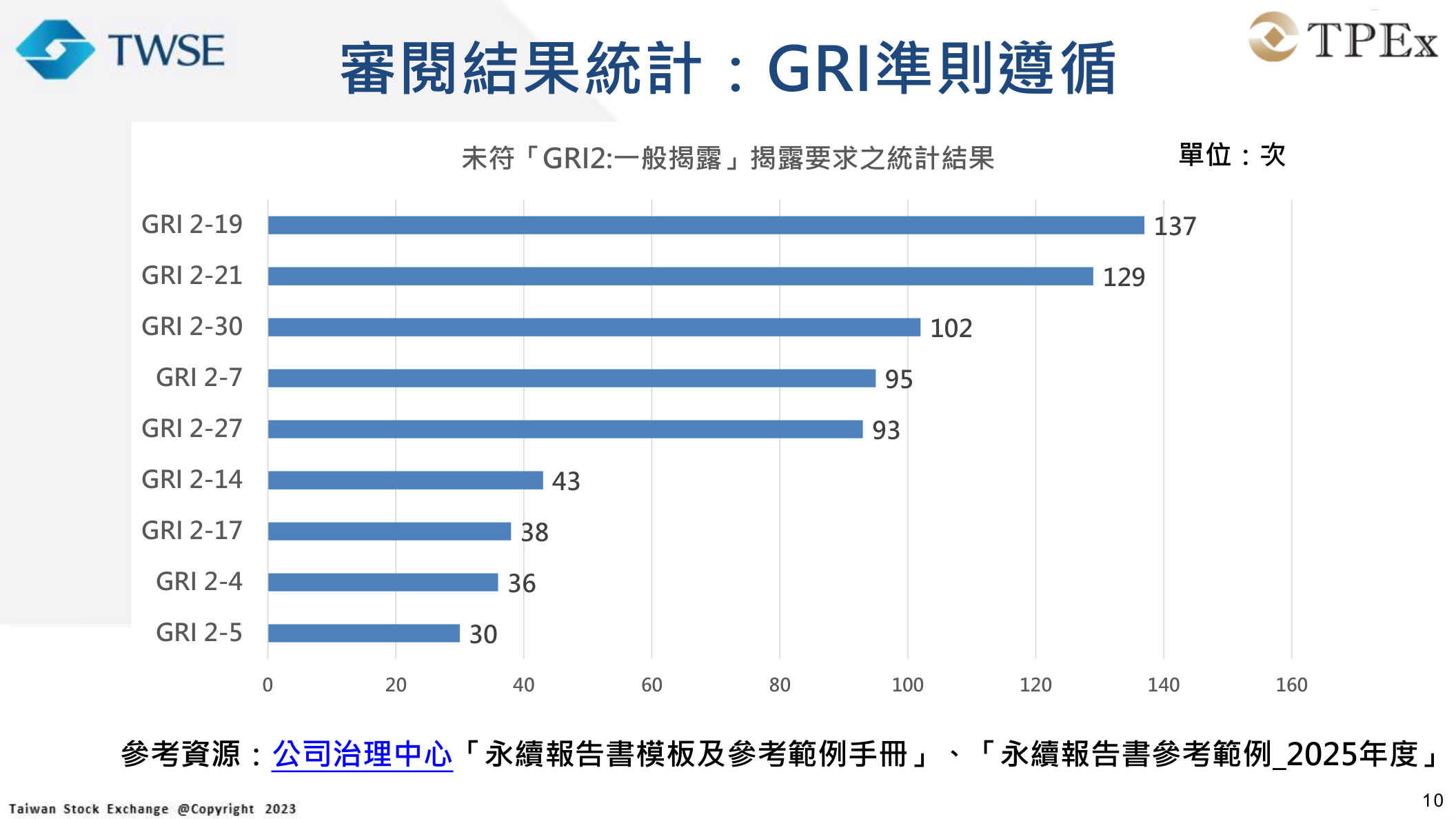
The leading findings are concentrated in remuneration and labour conditions. Reporting teams should therefore prioritise remuneration, employees and legal compliance as the most frequently flagged GRI 2 gaps:
The table below maps the nine findings to the specific problems identified by TWSE for item-by-item self-assessment:
| GRI disclosure | Number of findings | Main gap identified by TWSE |
|---|---|---|
| 2-19 Remuneration policies | 137 | No explanation of how remuneration policies relate to sustainability performance |
| 2-21 Annual total compensation ratio | 129 | Calculations do not use the GRI formulas |
| 2-30 Collective bargaining agreements | 102 | No disclosure of whether agreements exist or how employment terms are set for employees not covered |
| 2-7 Employees | 95 | No explanation of significant fluctuations in employee numbers |
| 2-27 Compliance with laws and regulations | 93 | No statistics on violations of laws and regulations |
| 2-14 Role of the highest governance body in sustainability reporting | 43 | No disclosure of whether the board approves the sustainability report |
| 2-17 Collective knowledge of the highest governance body | 38 | No disclosure of board sustainability training |
| 2-4 Restatements of information | 36 | No disclosure of whether prior-period information was restated |
| 2-5 External assurance | 30 | No disclosure of whether the sustainability report obtained third-party assurance |
Item-by-Item Analysis: The Most Common GRI 2 Gaps
Statistics show where errors occur; TWSE's examples show how to improve the wording. Below, four frequently flagged items—2-19, 2-30, 2-27 and 2-5—are explained with original slides, followed by a highlighted note on the 2-21 compensation ratio calculation.
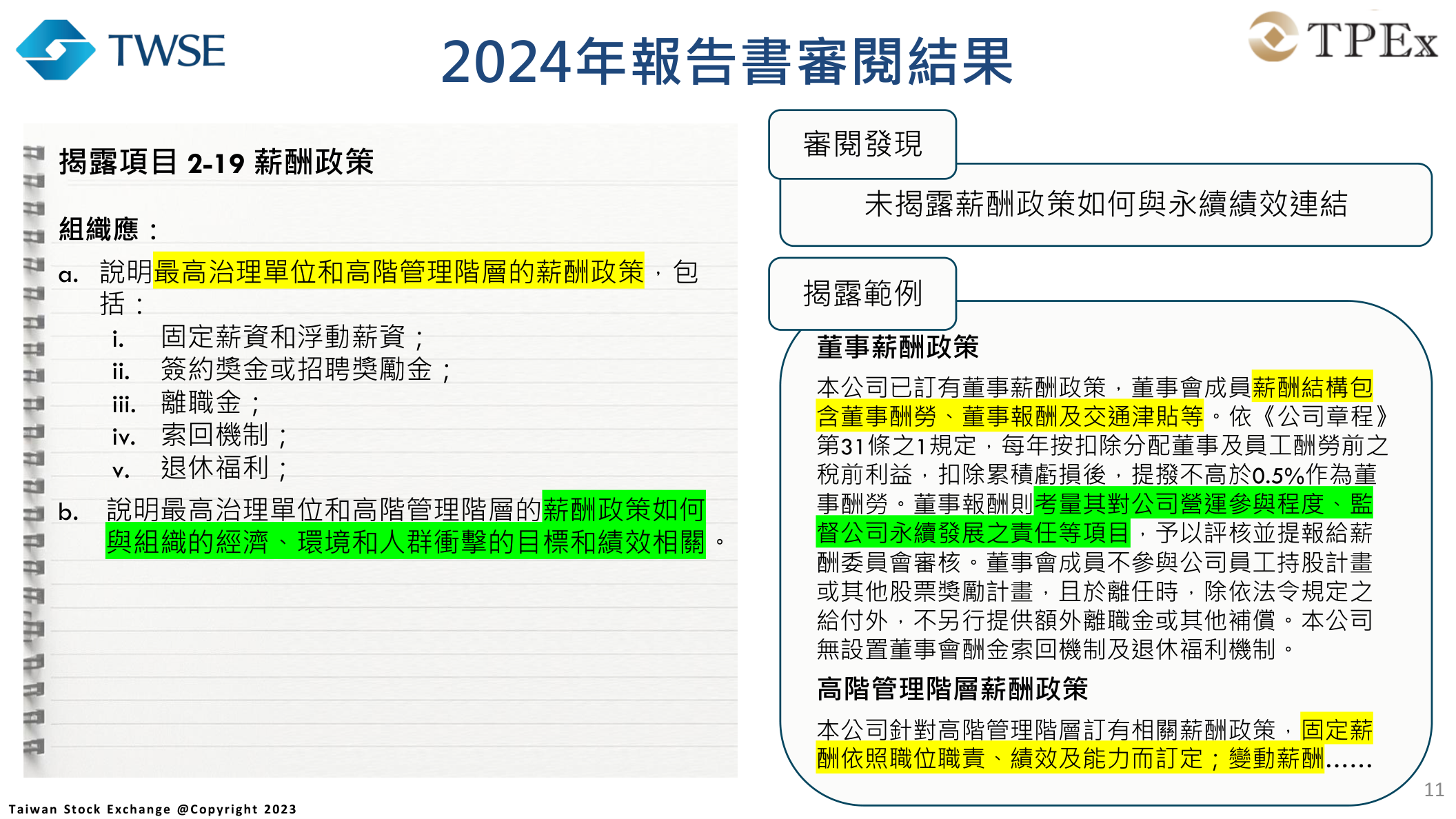
2-19 Remuneration Policies: Describing the Structure Without Linking Sustainability Performance
GRI 2-19 requires remuneration policies for the highest governance body and senior executives, including fixed and variable pay, sign-on bonuses, termination payments, clawbacks and retirement benefits. It also requires an explanation of how these policies relate to objectives and performance concerning the economy, environment and people, including human rights. Most companies clearly describe directors' remuneration allocations and pay structures but omit the final link between remuneration and sustainability performance—the main reason 2-19 was flagged 137 times.
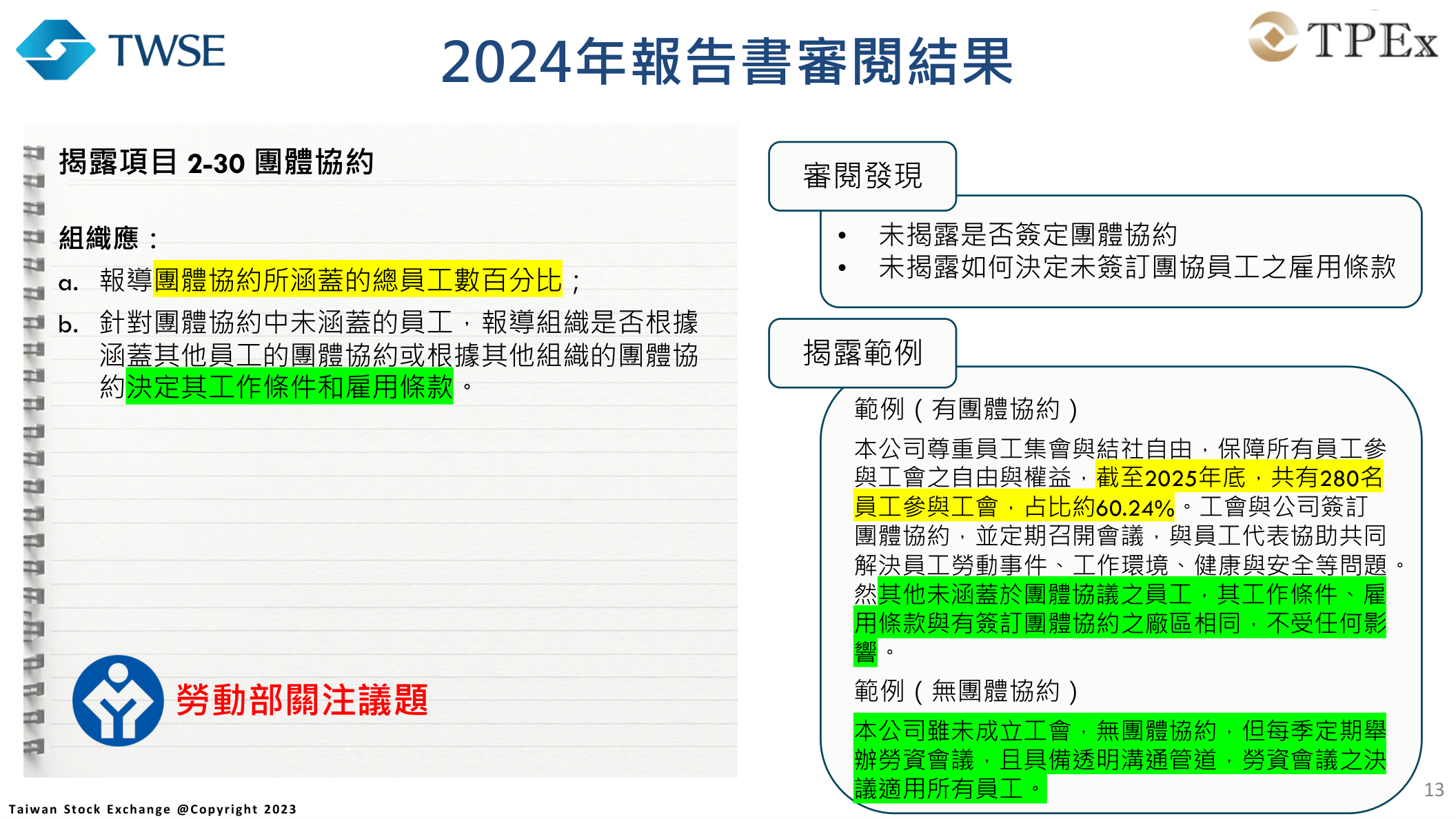
2-30 Collective Bargaining Agreements: Two Common Omissions in a Ministry of Labor Priority
GRI 2-30 requires the percentage of employees covered by collective bargaining agreements and an explanation of how working conditions and employment terms are set for those not covered. TWSE specifically identifies this as a Ministry of Labor concern. Two common gaps are:Failing to state whether the company has collective bargaining agreements, and failing to explain how employment terms are set for employees not covered. The presentation gives examples for companies with and without such agreements. A company without a union might describe regular labour-management meetings and resolutions applying to all employees.
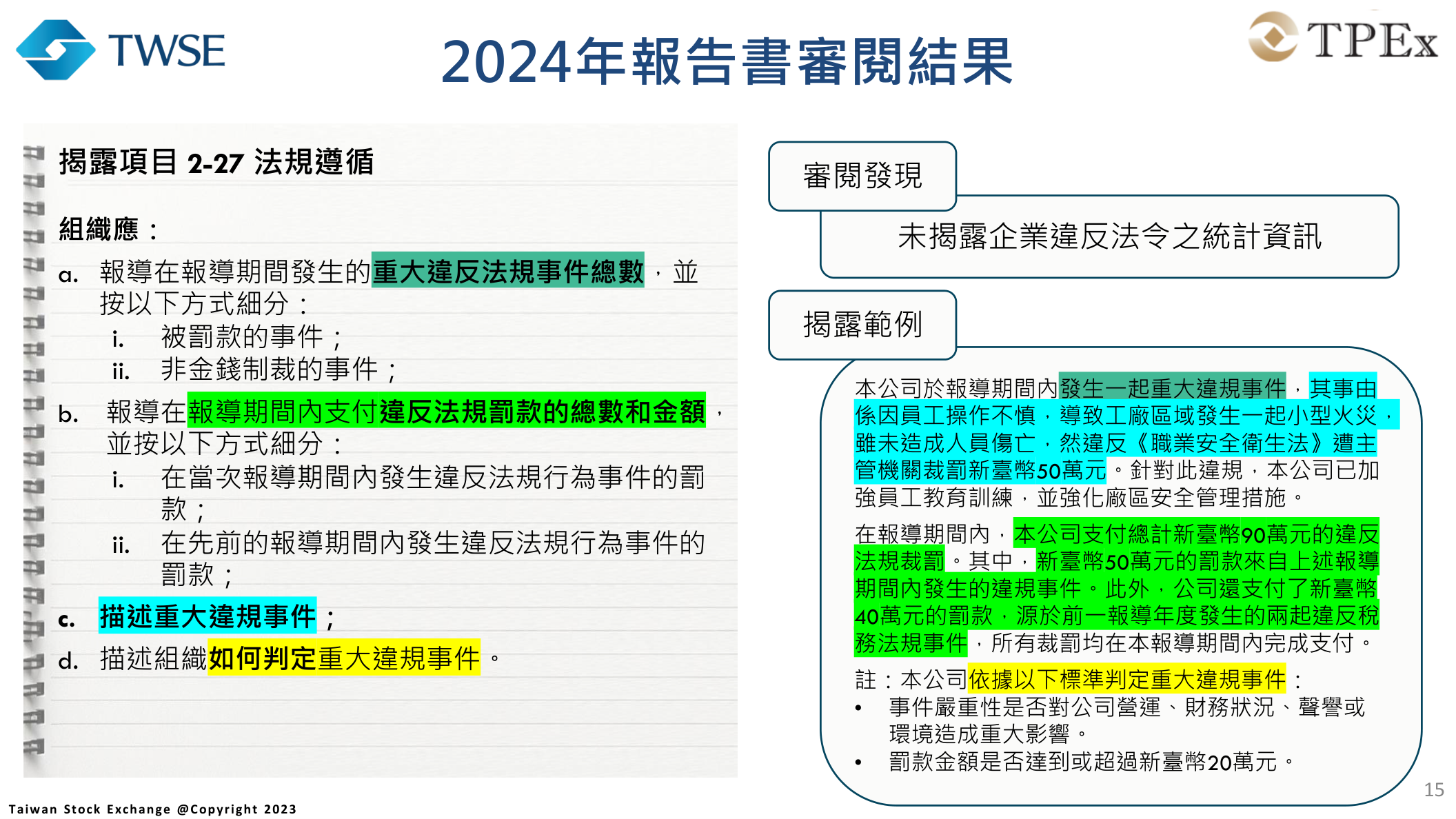
2-27 Compliance with Laws and Regulations: Statistics, Not Just a Single Incident
GRI 2-27 requires the total number of significant instances of non-compliance during the reporting period, separated into fines and non-monetary sanctions, plus total fines paid, distinguishing current-period from prior-period incidents. Companies must also explain how they determine significance. A common omission is describing one penalty without complete statistics. The presentation gives a clear example: one current-period occupational safety violation fined NT$500,000, plus two prior-period tax violations totalling NT$400,000, for NT$900,000 overall, with fines of NT$200,000 or more defined as significant.
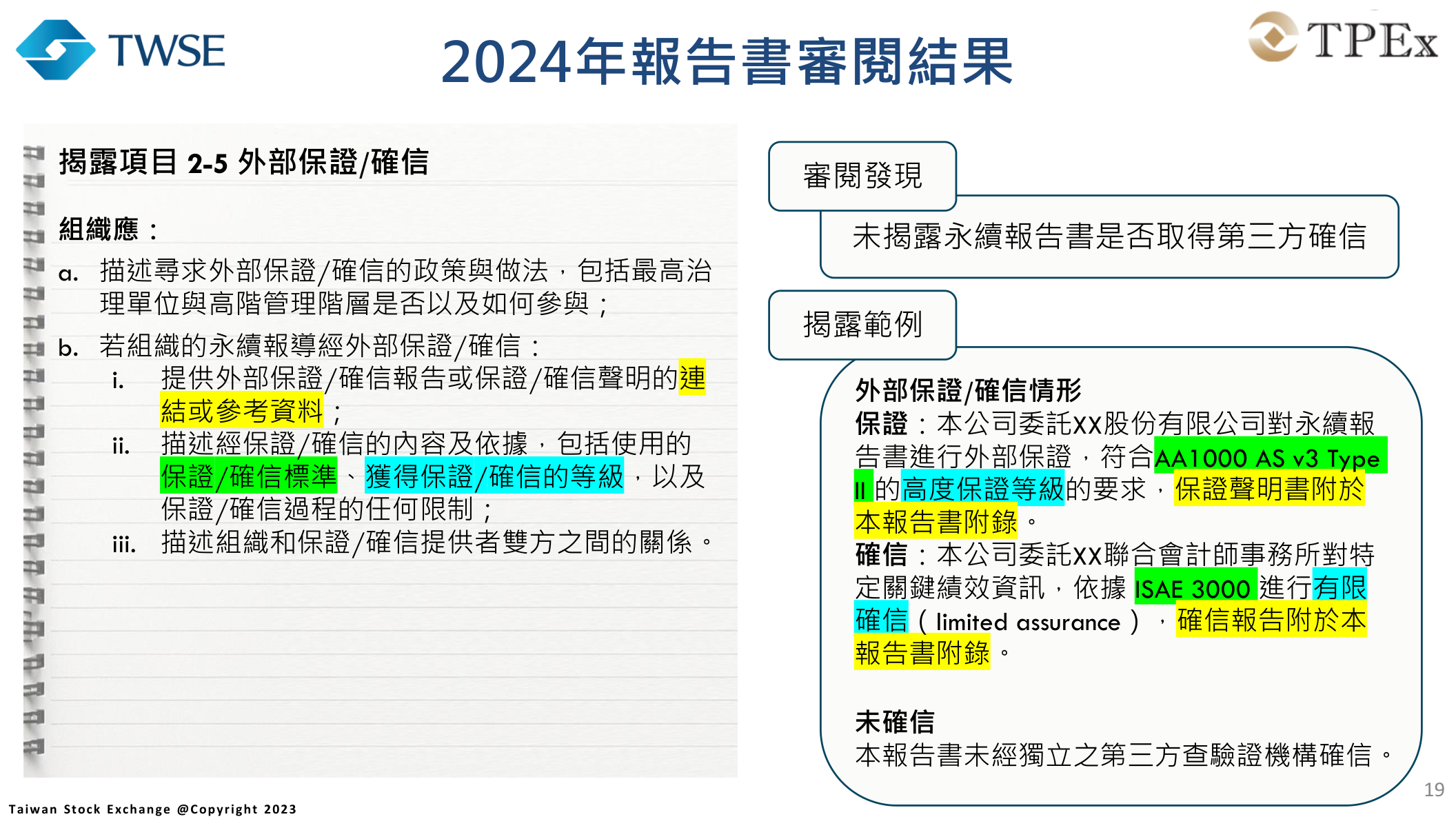
2-5 External Assurance: State Explicitly If There Is None
GRI 2-5 requires policies and practices for seeking external assurance. If assured, provide a link to the report or statement, the scope and basis, standards used, assurance level, and the relationship between the company and assurance provider. TWSE flagged failure to disclose whether third-party assurance was obtained. The key is:Even if a company chooses not to obtain assurance, it must explicitly state, “This report has not been assured by an independent third-party verification body”, rather than omit the issue. The presentation provides examples for AA1000 AS v3 high assurance, ISAE 3000 limited assurance and no assurance.
2-21 Annual Total Compensation Ratio was flagged 129 times, mainly for not using the GRI formulas. GRI requires the ratio of the highest-paid individual's annual total compensation to the median for all other employees (excluding that individual), and the ratio of that individual's percentage increase in annual total compensation to the median percentage increase for all other employees (excluding that individual). Using a mean, or including the highest-paid individual in the median, does not meet GRI's definition. The presentation illustrates correct reporting with a Taiwan compensation ratio of 25.10 and an increase ratio of 3.24.
Material Topics (GRI 3): Management Under 3-3 Is the Largest Gap
GRI 3 has three parts: 3-1 Process to Determine Material Topics, 3-2 List of Material Topics, and 3-3 Management of Material Topics. The review found that 3-3 was flagged 32 times, far more than 3-1 at 5 and 3-2 at 7. Most companies can describe their identification process and list material topics; the real weakness is explaining how each topic is managed in practice.
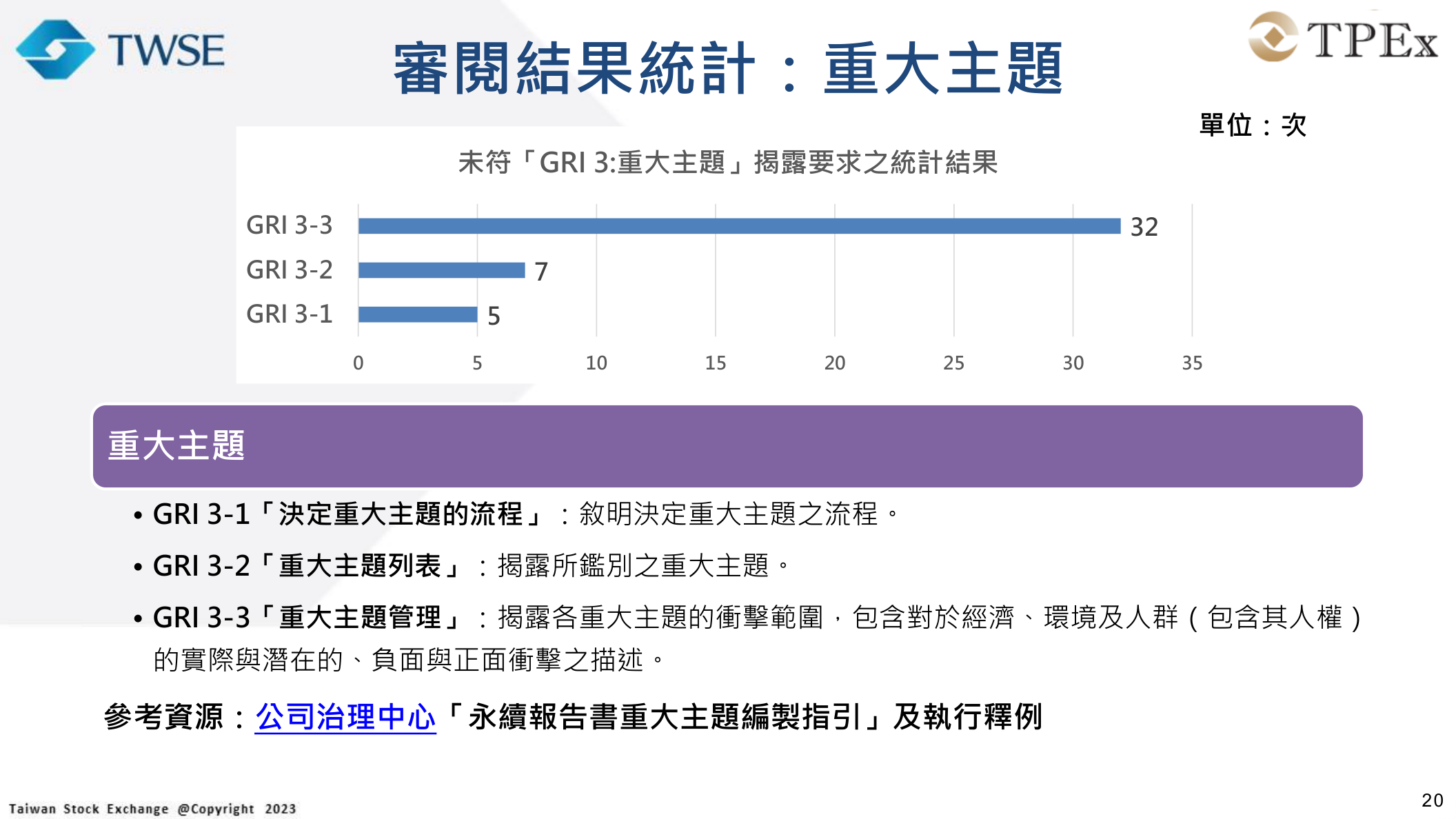
GRI 3-3 requires disclosure of impacts for each material topic, including actual and potential, negative and positive impacts on the economy, environment and people, including human rights. Companies often provide policy slogans or targets without explaining where impacts occur, whether they are positive or negative, how they are managed and the results. Align each topic with a complete chain of impact identification, management approach, specific actions, targets and results, and the relevant Topic Standards, avoiding a disconnect between the material topic list and subsequent chapters.
Climate-Related Information: Eight Gaps and TWSE's Recommendations
Climate-related information receives the most detailed treatment in this review. Under Article 4-1, TWSE/TPEx-listed companies must disclose it using the Appendix 2 format. Scope 1 and Scope 2 inventories and assurance are phased in by capital size and industry. The framework follows TCFD's four pillars—governance, strategy, risk management, and metrics and targets—and matches annual report Appendix 2-2-3, with which it must remain consistent.
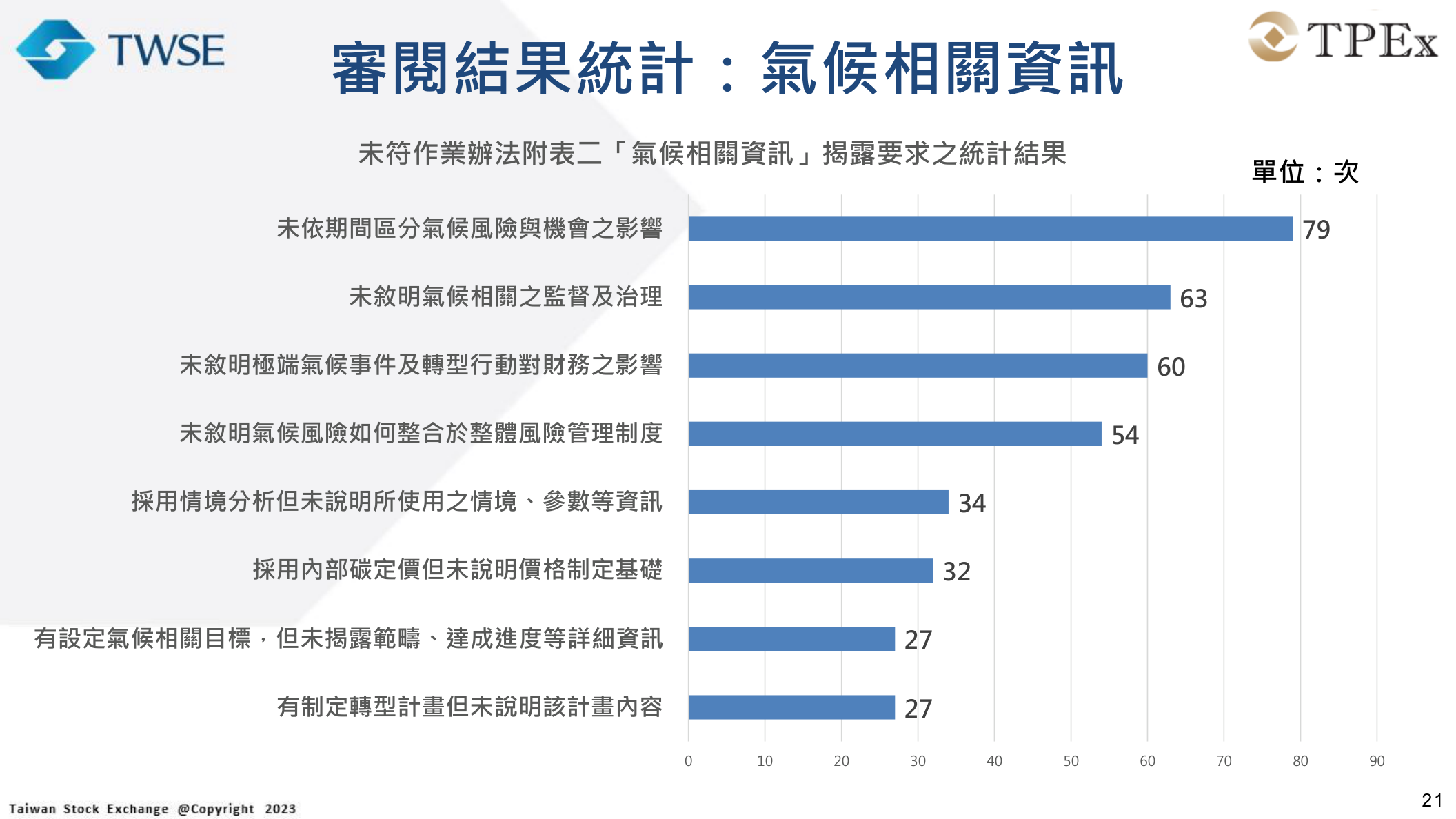
Among the eight categories of findings, failure to distinguish climate risk and opportunity effects by time horizon leads at 79 instances, followed by missing climate oversight and governance explanations (63), missing financial effects of extreme weather and transition actions (60), and missing integration of climate risks into overall risk management (54). More advanced items—scenario analysis, internal carbon pricing, climate targets and transition plans—were mostly undertaken but inadequately explained.
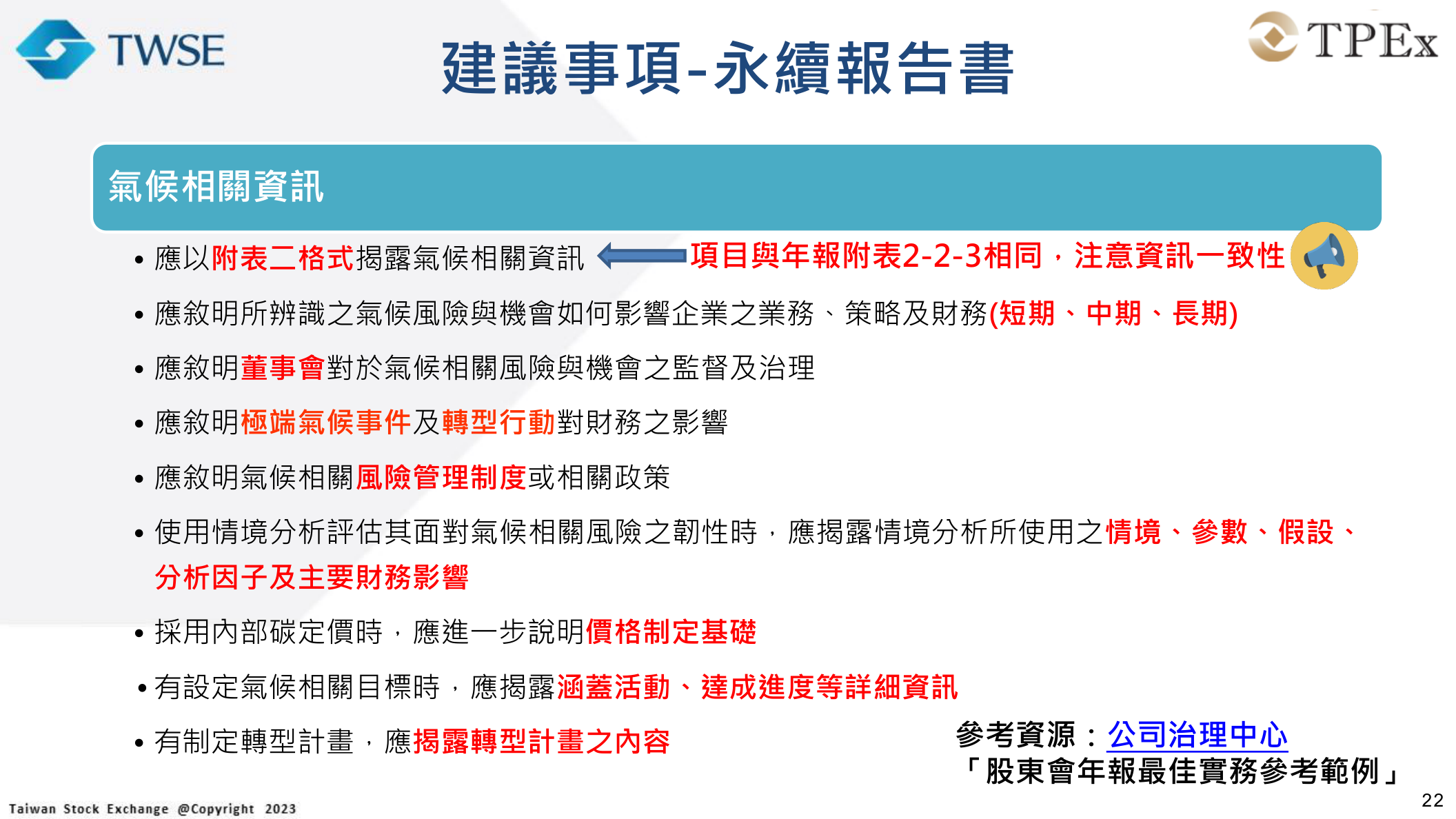
TWSE's recommendations provide a climate chapter checklist: use Appendix 2; explain how identified risks and opportunities affect the business, strategy and finances over the short, medium and long term; describe board oversight and governance; explain financial effects of extreme weather and transition actions; describe climate risk management systems or policies; disclose scenarios, parameters, assumptions, analytical factors and main financial effects when using scenario analysis; explain the pricing basis for internal carbon pricing; disclose covered activities and progress for climate targets; and disclose transition plan content where plans exist.
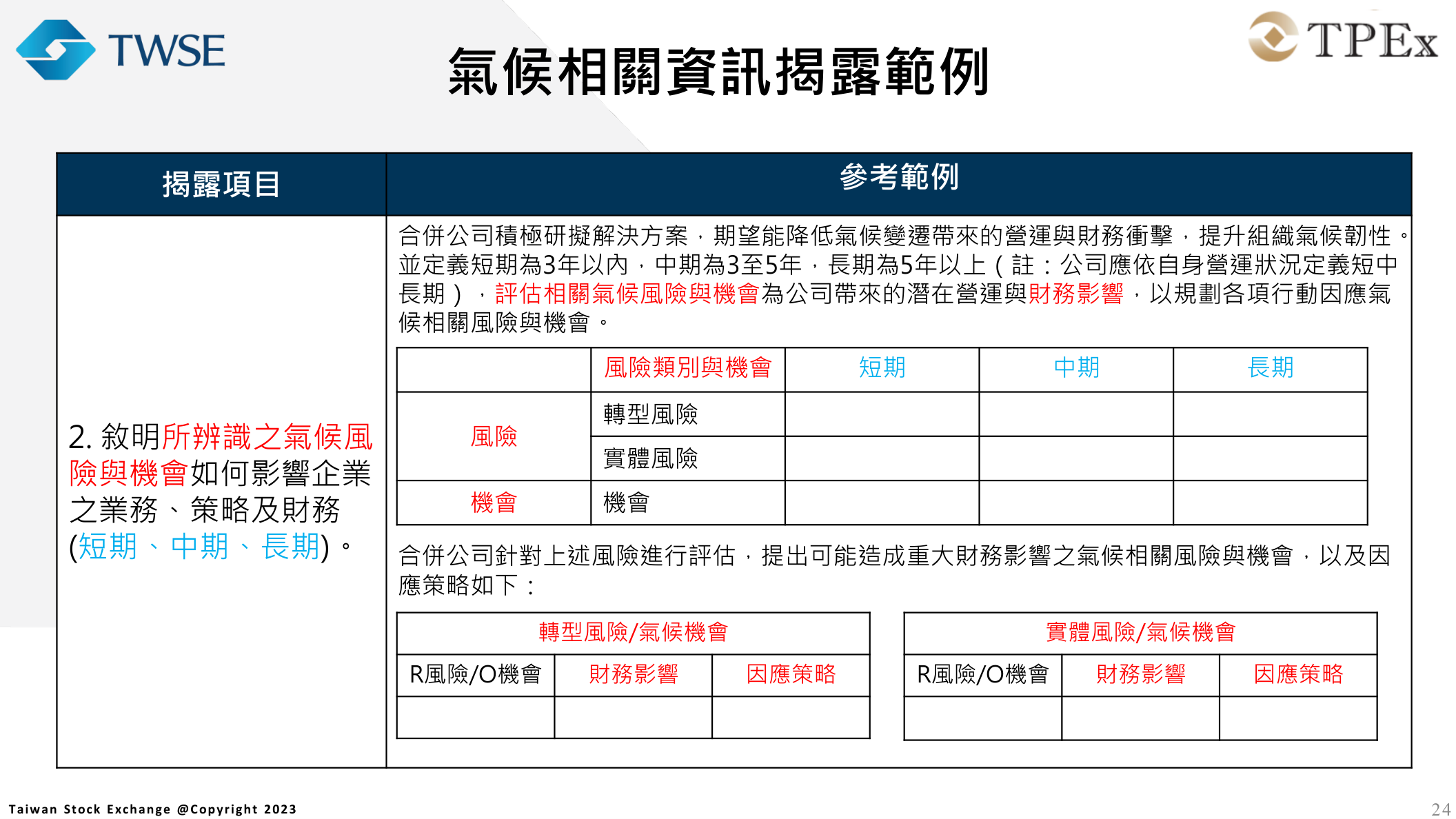
The presentation also provides complete examples covering governance structures, short-, medium- and long-term financial effects of risks and opportunities, scenario parameters, and transition plan metrics and targets. Its governance example clearly assigns climate responsibilities to the sustainability, audit and remuneration committees and integrates climate target achievement into executive performance and remuneration systems.
The last four climate findings—scenario analysis, internal carbon pricing, climate targets and transition plans—are all described as undertaken but unexplained. Companies have invested in the work but only state that they do it, omitting methods, parameters and progress. Adding methods and quantitative details to existing work can often turn these findings into compliant disclosures.
Sustainable Development Roadmap and IFRS Adoption: Inventory, Assurance and New GRI Timelines
The depth of climate disclosures directly relates to a company's position on the Sustainable Development Roadmap for TWSE/TPEx-Listed Companies. The roadmap phases in parent-company and consolidated-subsidiary GHG inventories and assurance by capital size and industry. Larger companies and the steel and cement industries start first, followed by smaller companies. The overall goal is consolidated GHG inventories for TWSE/TPEx-listed companies by 2027 and consolidated assurance by 2029.
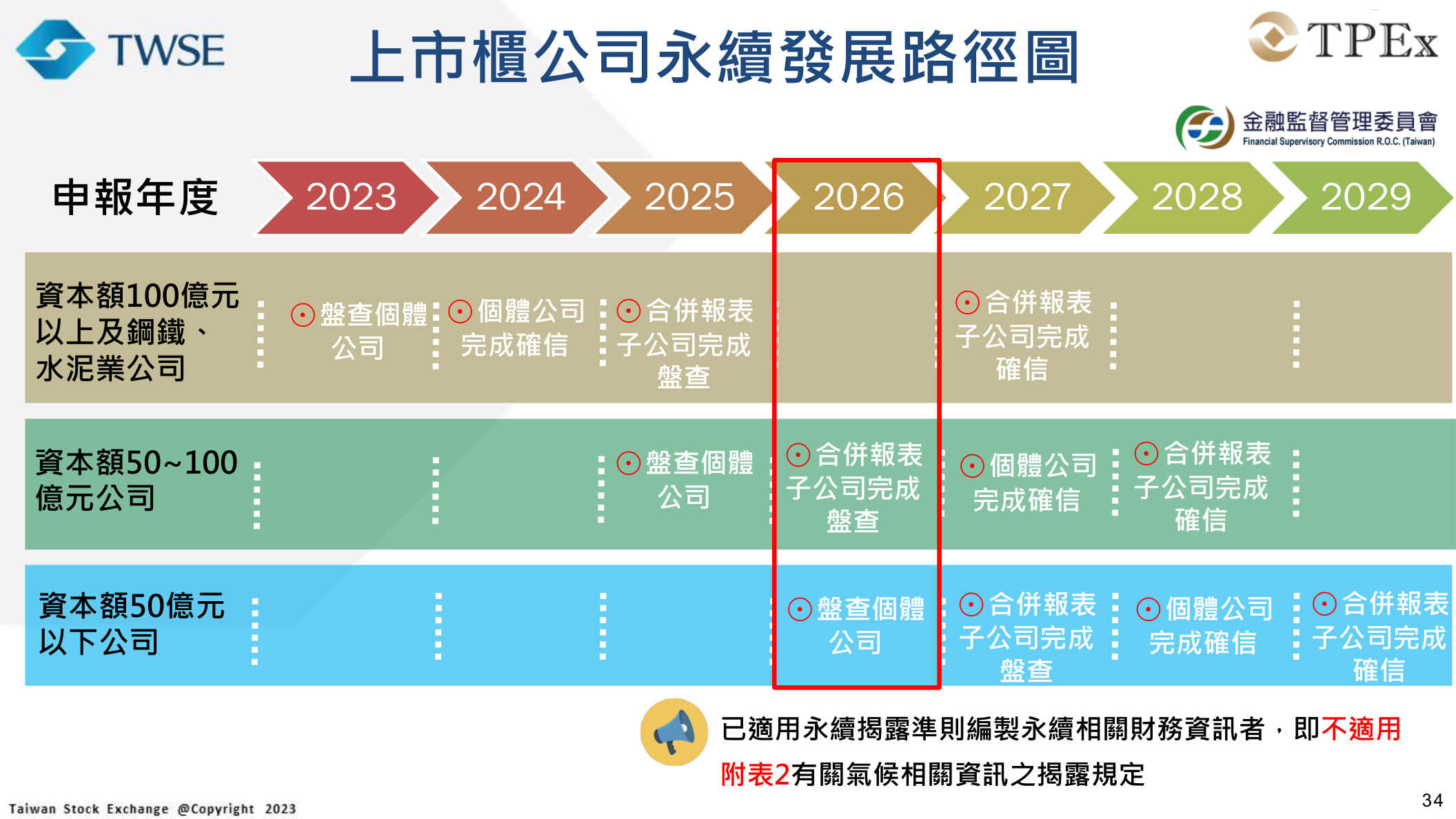
A key footnote at the bottom right states:Entities that already prepare sustainability-related financial information under the IFRS Sustainability Disclosure Standards are no longer subject to Appendix 2 climate-related disclosure requirements. Distinguish two exemptions in the rules: Article 4, paragraph 5 exempts industry sustainability indicators where IFRS Sustainability Disclosure Standards are applied and SASB industry metrics are disclosed in the annual report; Article 4-1, paragraph 6 exempts Appendix 2 climate information where the standards are applied and the annual report includes a sustainability-related financial information chapter. Taiwan's climate disclosures are thus moving from Appendix 2's TCFD framework towards IFRS S1/S2. Teams must check their applicable version and timing.
Three new GRI Topic Standards also take effect in sequence, changing the basis of sustainability reporting over the coming years:
| GRI Topic Standard | Effective date | Standard replaced | Applicable reporting year |
|---|---|---|---|
| GRI 101: Biodiversity 2024 | 1 January 2026 | GRI 304: Biodiversity | 2025 sustainability report |
| GRI 102: Climate Change 2025 | 1 January 2027 | GRI 305-1 to 305-5 and GRI 201-2 | 2026 sustainability report |
| GRI 103: Energy 2025 | 1 January 2027 | GRI 302: Energy | 2026 sustainability report |
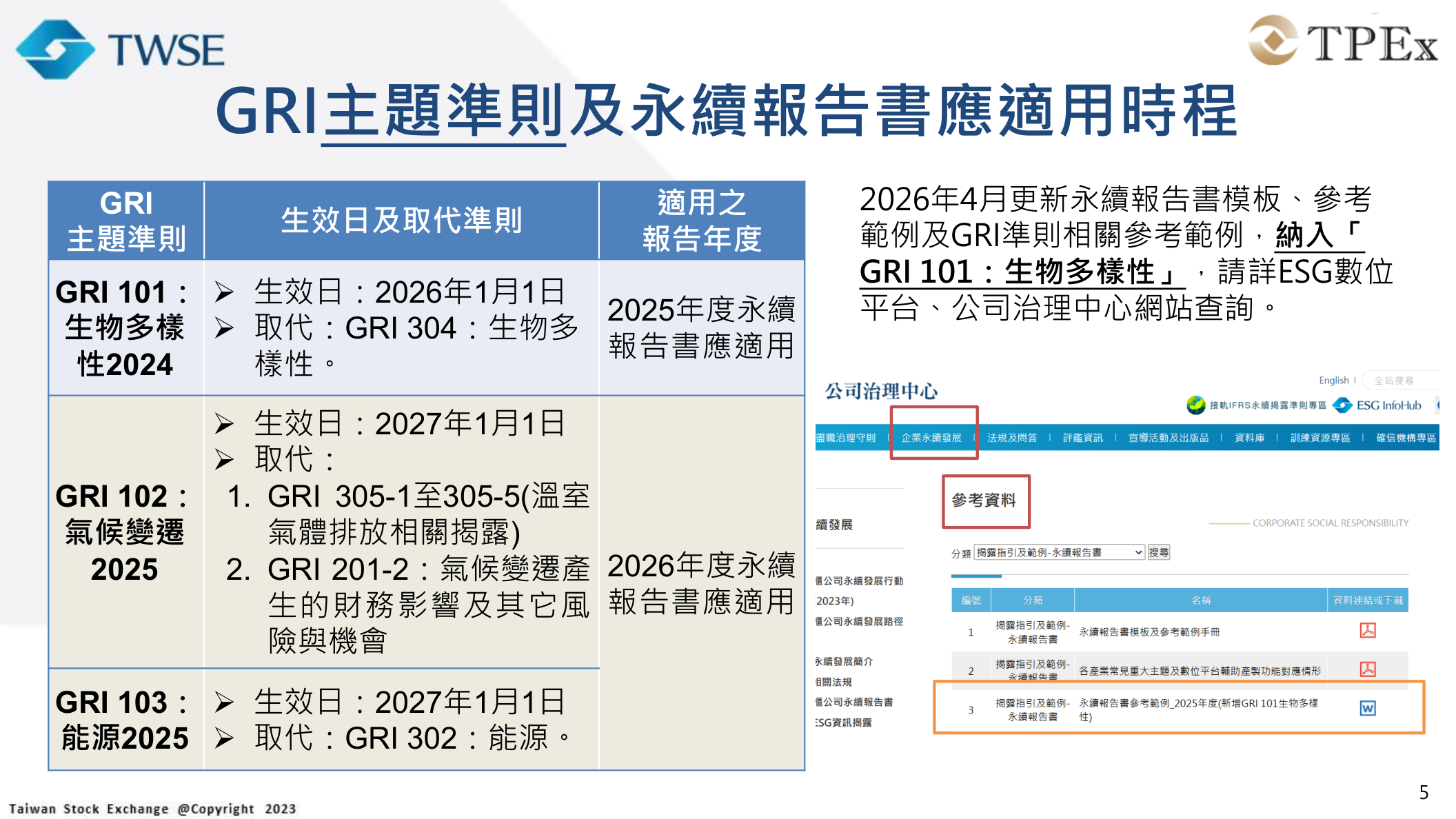
The Corporate Governance Center updated sustainability report templates, examples and GRI reference materials in April 2026 to include GRI 101: Biodiversity. These are available on the ESG Digital Platform and Corporate Governance Center website.
GHG inventory emission factors come from different authorities depending on scope. For Scope 1 fuel combustion and similar sources, use the Ministry of Environment's GHG Emission Factor Management Table; for Scope 2 purchased electricity, use the Energy Administration, Ministry of Economic Affairs's electricity emission factor published under the Electricity Act. This is a single national factor—for example, 0.474 kg CO₂e/kWh for 2024 (ROC year 113)—and must not be independently estimated or carried over from earlier years. Match inventory and assurance timing to your company's roadmap phase to avoid premature or delayed disclosure creating inconsistencies with annual report appendices.
Other Priorities: Do Not Overlook Labour Rights and Non-Managerial Pay
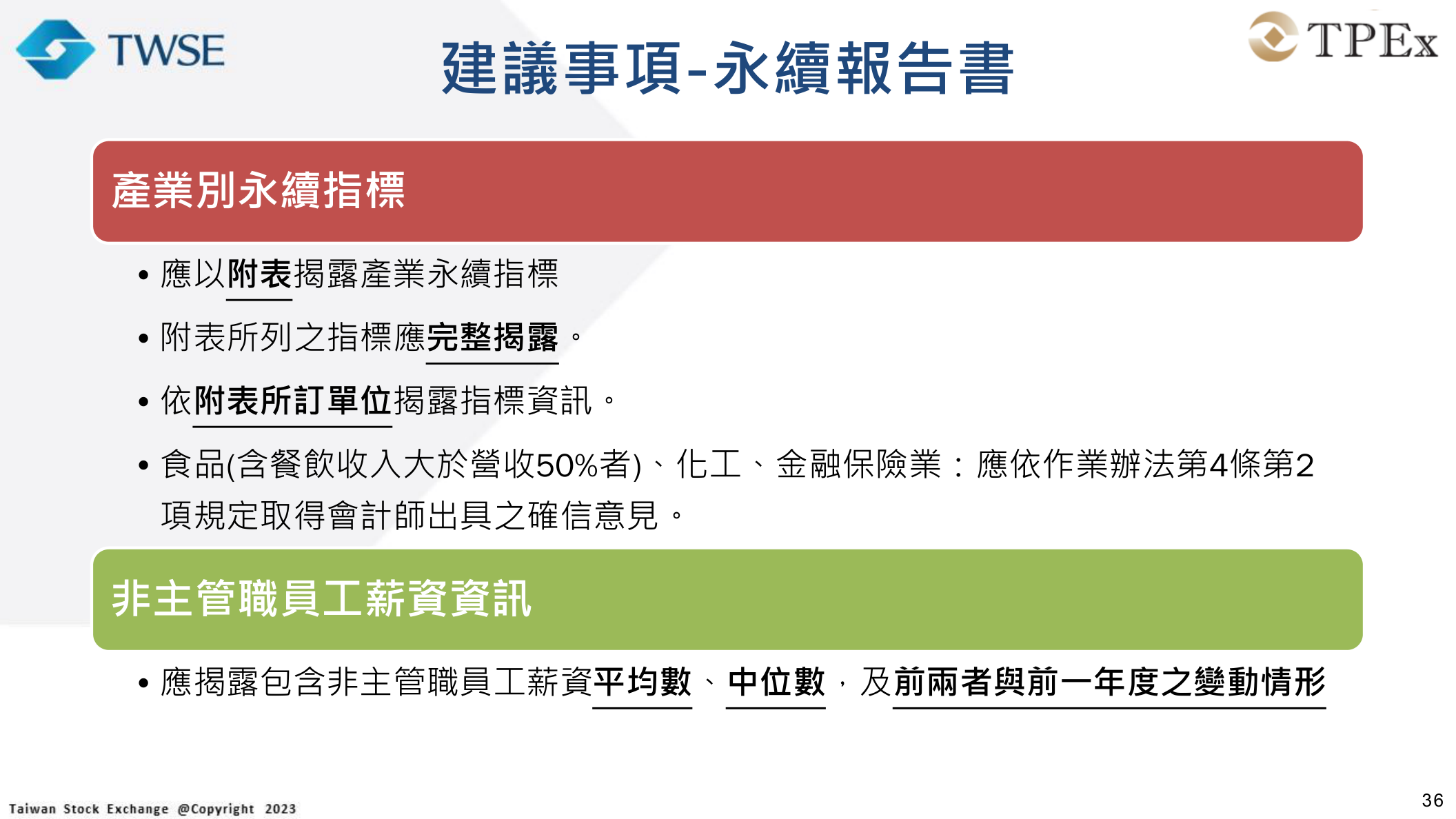
Beyond GRI and climate, the presentation highlights easily overlooked items explicitly required by the rules or prioritised by regulators. Industry sustainability indicators must be fully disclosed using the appendices and prescribed units. Food companies (including those deriving more than 50% of revenue from food services), chemicals companies, and financial and insurance businesses must obtain accountant assurance. The rules also require mean and median salaries of full-time non-managerial employees, and changes in both from the preceding year. These may be disclosed through cross-references, but cannot be omitted.
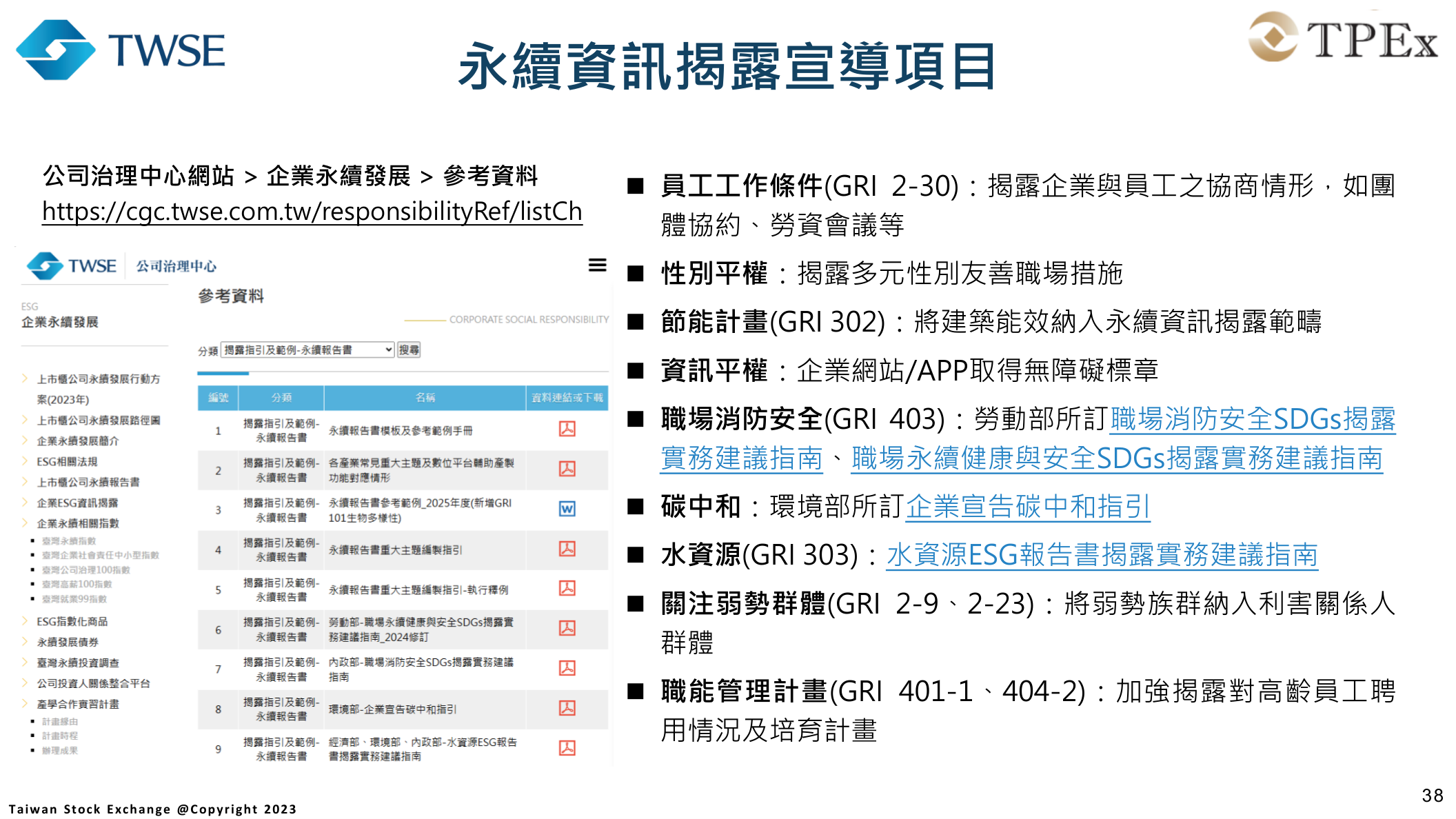
The presentation also identifies labour rights, equality and environmental disclosures with relevant GRI Standards: employee working conditions (GRI 2-30), gender equality, energy-saving plans (GRI 302), workplace fire safety (GRI 403), water resources (GRI 303), vulnerable groups (GRI 2-9, 2-23) and skills management programmes (GRI 401-1, 404-2). Employment of people with disabilities, benefits exceeding statutory requirements and supply chain prohibitions on forced labour also correspond to ESG Evaluation indicators S-15, S-16, S-17 and S-20, directly affecting evaluation performance.
Regulatory and Indicator Questions: Ask Syber AI and Sustain AI Directly
Most findings do not reflect unwillingness to disclose, but uncertainty about how to meet GRI and reporting rules. Traditionally, teams search the rules, original GRI texts and Corporate Governance Center templates and examples, then spend considerable time comparing them. In the Syber sustainability reporting platform, Sustaihub assigns this search and comparison process to AI so teams receive answers and examples while drafting.
Mapped against the findings in this article, these two tools address uncertainty about how to write disclosures:
| Common gap highlighted here | Questions to ask Syber AI / Sustain AI |
|---|---|
| 2-19: No link between remuneration and sustainability performance | “How can remuneration policies link to sustainability performance? Are there disclosure examples?” |
| 2-21: Compensation ratios not calculated using GRI formulas | “What are the GRI formulas and presentation requirements for 2-21 Annual Total Compensation Ratio?” |
| 2-30: Collective bargaining arrangements not explained | “Can you provide 2-30 disclosure examples with and without a union?” |
| 2-5: No disclosure of whether third-party assurance was obtained | “How should we state under 2-5 that no assurance was obtained?” |
| 3-3: Inadequate management of material topics disclosures | “How should we describe a material topic's impacts, management approach and results?” |
| Incomplete Appendix 2 climate disclosures | “Can you provide examples for climate governance, scenario analysis and transition plans?” |
Review findings reflect gaps in disclosure quality. With Syber AI online consulting and Sustain AI case Q&A inside Syber, teams can check what to disclose and how to meet requirements while writing, and immediately obtain reference examples. Time previously spent searching regulations and templates can go into the content itself.
A Final Check Before Publication: Try the AI Report Checker
TWSE samples reports after publication, but many flagged problems can be detected beforehand: contradictory numbers, incorrect terminology, inconsistent data across pages or potentially contentious wording. Sustaihub's AI Report Checker is designed for this pre-publication check. Upload a PDF or Word file, or paste a section of at least 300 characters. AI scans the content and identifies page numbers, original excerpts, issue descriptions and suggested corrections, then provides an overall score to help prioritise which pages need attention.
- Identify page numbers and original excerpts to locate exactly where changes are needed
- Detect contradictory numbers, incorrect terminology and contentious wording
- Receive an overall score; a low score suggests holding off on publication
Practical Checks for Sustainability Reporting Teams
Turn these review findings into actionable checks when preparing or reviewing your sustainability report:
First, address the four remuneration and labour conditions items. Add remuneration-to-sustainability links for 2-19, use GRI formulas for 2-21, state collective bargaining coverage and employment terms for uncovered employees under 2-30, and explain significant headcount fluctuations under 2-7. These four address most GRI 2 findings.
Second, present legal compliance (2-27) statistically. Compile current- and prior-period violations, fines and significance criteria rather than describing one incident.
Third, state external assurance and restatements explicitly. Even if there is no assurance or restatement, say so clearly in the report instead of omitting it.
Fourth, complete the disclosure chain for every material topic. Align impact identification, management approaches, targets and results with the Topic Standards, keeping the 3-2 list connected to subsequent chapters.
Fifth, align the climate chapter with the nine Appendix 2 recommendations. Prioritise short-, medium- and long-term financial effects of risks and opportunities, board oversight and governance, and financial effects of extreme weather and transition actions. Add parameters, pricing bases and progress to existing scenario analysis, internal carbon pricing, targets and transition plans.
Sixth, maintain consistency across documents. Data in the sustainability report, annual report Appendix 2-2-3, company website and ESG filing system must agree—one of the review's key cross-checks.
The review results reveal TWSE's priorities in advance. Using this list before submission and addressing common gaps improves readiness for sampled reviews and aligns disclosure quality more closely with reporting rules and GRI Standards.
Manage Sustainability Information in One Place with Sustaihub
Sustaihub provides a platform specifically designed for Taiwan's TWSE/TPEx-listed companies: a sustainability information management platform. It integrates corporate governance evaluations, sustainability report editing, ESG data collection and third-party verification workflows in one system.
Book a free 30-minute consultation →Frequently Asked Questions
Further Reading
- GRI Standards Structure and Key Sustainability Reporting Considerations
- IFRS Sustainability Disclosure Standards S1/S2 Adoption Guide
Official Sources
- TWSE Corporate Governance Center—Sustainability Report Review Results — Annual review findings and disclosure recommendations
- TWSE Corporate Governance Center—Corporate Sustainable Development References — Sustainability report templates and examples
- Rules Governing the Preparation and Filing of Sustainability Reports by TWSE-Listed Companies — Full text of the rules
- Sustainable Development Roadmap for TWSE/TPEx-Listed Companies (ISDS) — GHG inventory and assurance timelines