If you have read our previous articles, “Three Impacts of the New 2026 ESG Evaluation and How Companies Can Respond” and “2026 ESG Evaluation: The Final Review Window”, you should already be familiar with the 75 indicators, E 21% / S 31% / G 48%, the evaluation period of 1 January–31 December 2026 (ROC year 115), the sustainability report filing deadline of 2026/8/31, which is not the deadline for all evaluation materials, and the A/B/A+/AA categories.
This article will not repeat those basics.
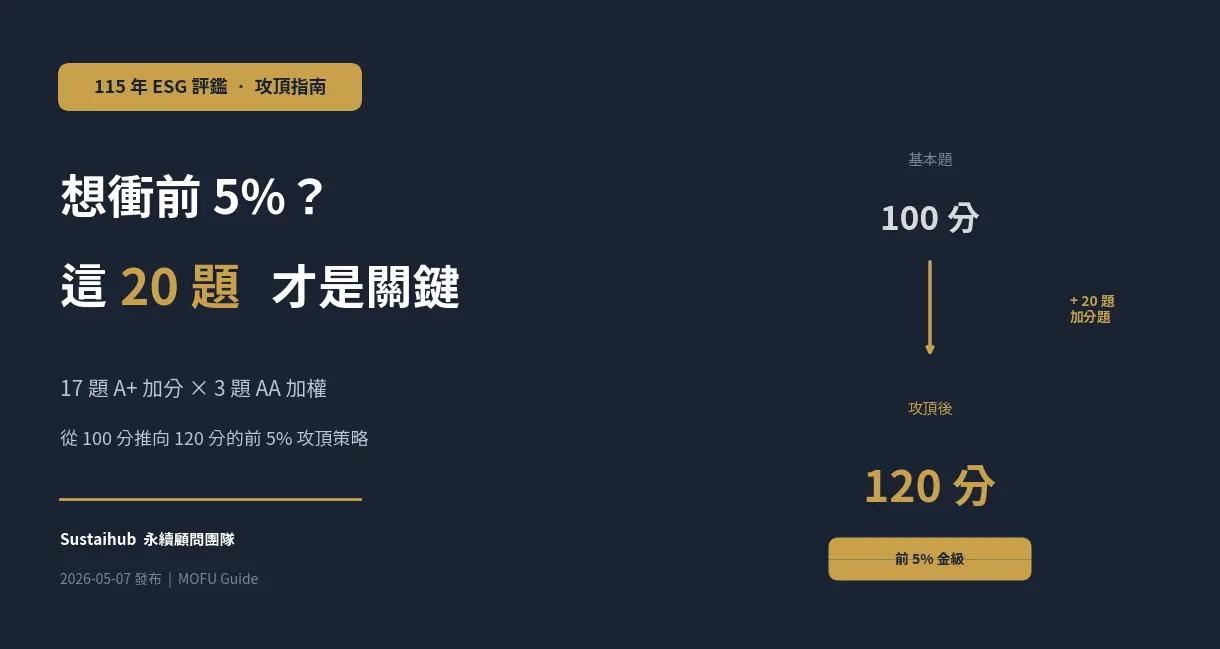
When reviewing client drafts this year, we have more often been asked, “What must we do to move from the middle of the rankings into the top 5%?” The answer lies in the 20 bonus indicators: 3 AA and 17 A+.
For each indicator below, I use three sections: “original requirements”, “market observations”, “estimated timeline”, focusing on whichever matters most for that indicator. The reason is simple: when the biggest obstacle is unwillingness to act, more explanation of requirements will not help.
Source Statement: All indicator requirements here are taken directly from the Taiwan Stock Exchange (TWSE) official 2026 (ROC year 115), First ESG Evaluation Indicators. Wording differences—“at least” versus “must”, or “once a year” versus “annual”—may affect compliance judgements. Before publication, cross-check the latest indicator table at the TWSE ESG Evaluation Portal.
Why Do the 75 Indicators Only Earn 100 Points? Start with the Scoring Formula
TWSE's scoring formula this year is:
Total score = [E score ÷ applicable E indicators × 21%
+ S score ÷ applicable S indicators × 31%
+ G score ÷ applicable G indicators × 48%] × 100
+ AA weighted points (up to +3)
+ A+ bonus points (up to +17)
± additional adjustments (added or deducted case by case, 1 point or more; deductions stop at 0)
Important: The denominator is the number of applicable indicators, not fixed values of 16/23/36. TWSE's 2026 (ROC year 115) example uses E=16, S=23 and G=35: one G indicator is inapplicable to that company, so 36−1=35. Actual denominators vary with inapplicable indicators.
The weighted percentage scores for the three dimensions total at most 100. Meeting all 20 AA and A+ indicators adds up to 20 more points, for a maximum of 120; additional bonus items are awarded case by case, and deductions cannot take the total below 0. These 20 bonus indicators make this evaluation more discriminating than earlier versions; bonus completion can create score differences exceeding 20 points.
A Concrete Numerical Comparison
Assume Companies A and B both meet all 75 basic indicators:
| Item | Company A (basic requirements only) | Company B (also targets 20 bonus indicators) |
|---|---|---|
| Basic 75-indicator dimension score | 100 points | 100 points |
| A+ bonus (up to 17 points) | 0 points | +12 points |
| AA weighting (up to 3 points) | 0 points | +3 points |
| Additional adjustments | 0 points | +2 points |
| Total | 100 points | 117 points |
| Estimated ranking band (general group, capital ≥ NT$10 billion) | 21–35% | Top 5% |
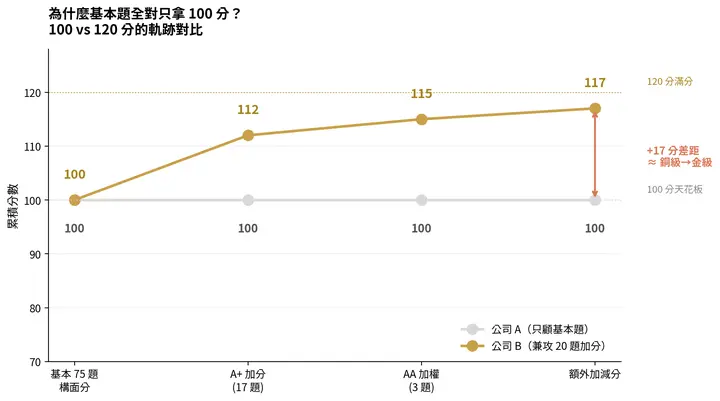
Both companies write the same environmental, social and governance sections, but B's 20 additional concrete actions move it up two ranking bands.
Key point: With limited resources, checking off these 20 bonus requirements can be more valuable than expanding one response from 800 to 1500 characters.
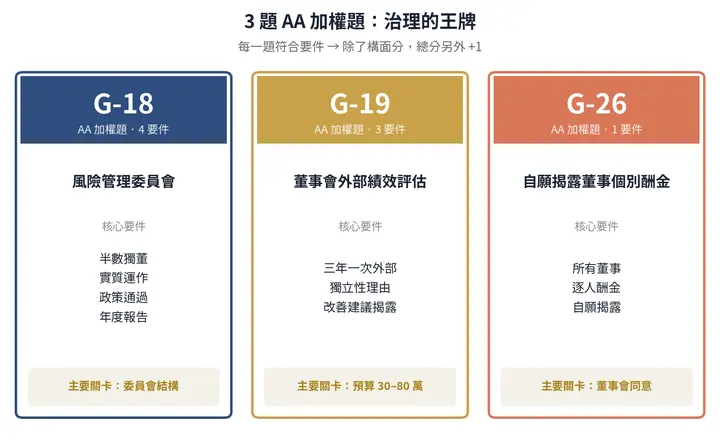
3 Weighted AA Indicators: G-18, G-19 and G-26—Three Keys to Governance Transparency
AA is this evaluation's most distinctive design: meeting the requirements earns dimension points plus 1 additional point in the total score. All three are in G, signalling that TWSE sees these actions as dividing lines in governance transparency.
G-18: Risk Management Committee Oversight
Original requirements (all 4 required; dimension points +1 total point):
- The audit committee or a board-level functional committee, such as a risk management committee, oversees risk management; it has at least 3 members, at least half of whom are independent directors
- 2. Risk management policies and procedures are board-approved and disclosed
- 3. Disclose the risk management structure, procedures and operations in 2026 (ROC year 115)
- 4. Disclose reporting frequency to the board (at least once a year) or the reporting date in the current year
Our Market Observations: Reviewing several TWSE/TPEx-listed clients in the first half, the most common issue was not the absence of a committee, but that “independent directors did not make up half the committee”, because of mid-year resignations, delayed replacement elections or counting supervisors. The next most common issue was assigning risk management to the audit committee without a separately identifiable risk item in its annual meeting minutes. Reviewers classify both as non-compliant.
Key point: G-18 tests both committee composition and whether it actually met to discuss risk during the year—not simply whether a committee exists.
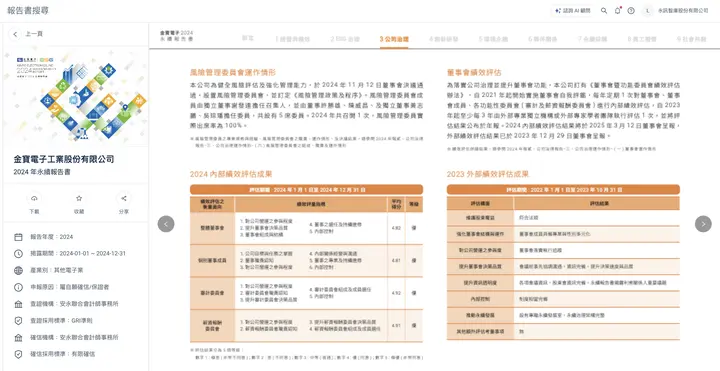
G-19: External Board Performance Evaluation
Original requirements (all 3 required; dimension points +1 total point):
- Board-approved performance evaluation rules explicitly require external evaluation at least once every three years
- 2. Disclose the evaluation date within the past three years (2024–2026, ROC years 113–115), external institution or lead expert, basis for independence, methods (questionnaire/site visit), assessment items and date results were reported to the board
- 3. Summarise results, including recommendations and future improvement plans
Choosing an External Evaluator: Market Fees and Assessment Frameworks
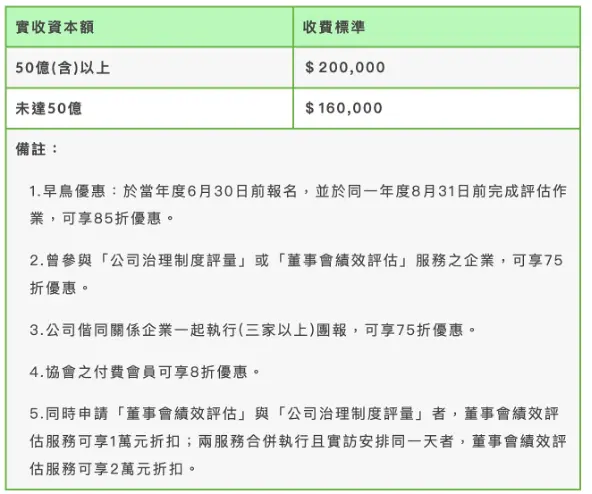
Companies undertaking their first external evaluation can refer to the “Taiwan Corporate Governance Association (CGA)”, whose publicly quoted basic fees are around NT$160,000–200,000, adjusted for size and detailed requirements. Large accounting firms or other external providers may charge around NT$300,000–800,000.
Professional institutions typically examine board effectiveness across five dimensions:
- Board composition and division of responsibilities: Are members' backgrounds diverse, and do committees fulfil their functions?
- Board direction and oversight: Does it effectively guide strategy and oversee management performance?
- Board delegation and risk management: Are delegated authorities clear and risk controls sound?
- Board communication and collaboration: Does information flow smoothly among directors and between the board and management?
- Board self-discipline and development: Directors' continuing education and implementation of ethical standards.
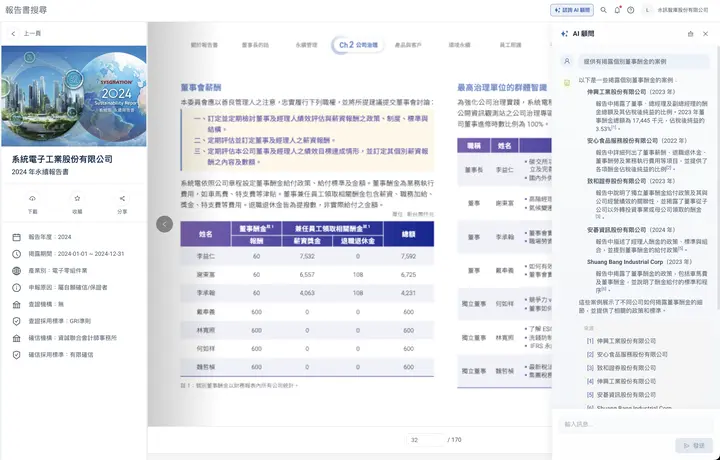
G-26: Voluntary Disclosure of Individual Director Remuneration
Original requirements (either condition qualifies; dimension points +1 total point)
- Voluntarily disclose every director's individual remuneration details
- After legally required disclosure for some directors, voluntarily disclose all remaining directors' individual remuneration details
This has the shortest requirements but is usually the hardest of the 3 AA indicators to implement. The obstacle is the board's attitude, not report wording.
We have encountered sustainability teams seeking full disclosure while boards—especially family businesses and major-shareholder directors—strongly object on grounds of personal data, peer comparisons or family privacy. That is precisely why TWSE values this indicator: companies willing to disclose demonstrate governance transparency a level above 90% of their peers, a powerful signal to foreign investors, sovereign wealth funds and ETF stock selectors.
Key Point: G-26 is the only AA indicator where “the disclosure barrier sits with the board, not the report”. Consider having the chair and independent directors disclose first, then extending to everyone.
Summary: None of the 3 AA indicators is solved simply by writing more. Committee composition may need changing, external evaluations need budgets, and remuneration disclosure needs board consent. Our rough assessment is that companies earning none of the 3 AA points and fewer than 10 A+ points have almost no chance of reaching the top 5% this year.
17 Tiered A+ Bonus Indicators: The Second Layer of E/S/G Requirements
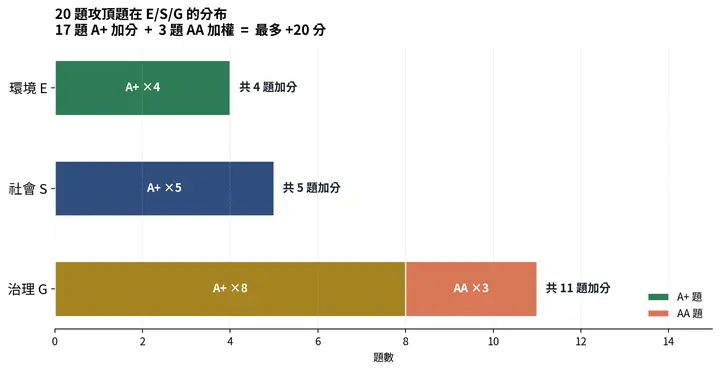
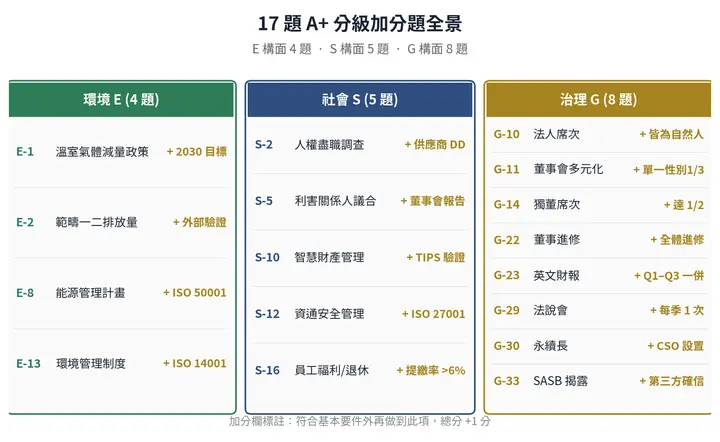
The A+ design is straightforward: Meet the basic requirements → earn dimension points; meet the additional requirement → gain 1 point in the total. The 17 indicators offer 17 points: 4 in E, 5 in S and 8 in G.
Key Point: Three environmental A+ indicators depend on external certification or verification, often taking six months to a year. Starting in April is generally too late for E-2 / E-8 / E-13 before the 8/31 filing deadline.
4 Environmental A+ Indicators
| Indicator | Basic requirement | Bonus requirement | Implementation cost |
|---|---|---|---|
| E-1 GHG reduction management policies | Set and disclose quantified future-year management targets and measures | Also set and disclose quantified 2030 targets, strategies and action plans | Medium |
| E-2 Scope 1 and 2 emissions over the past two years | Disclose annual Scope 1 and 2 emissions for 2024 and 2025 (ROC years 113, 114); the 2025 boundary must include the parent and subsidiaries in consolidated financial statements | External verification for both 2024 and 2025 (ROC years 113, 114) | High |
| E-8 Energy management plans | Disclose energy management plans and implementation | Obtain certification such as ISO 50001 and disclose validity covering 2026 (ROC year 115) | High |
| E-13 Environmental management systems | Disclose environmental management systems and implementation | Obtain ISO 14001, Oeko-Tex 1000 (textiles) or bluesign® (textiles) certification and disclose validity | Medium–high |
5 Social A+ Indicators
| Indicator | Basic requirement | Bonus requirement | Implementation cost |
|---|---|---|---|
| S-2 Human rights due diligence | Disclose the process, current-year scope, material issues and mitigation/remediation measures | Also disclose supplier human rights due diligence processes and implementation | Medium |
| S-5 Stakeholder identification and communication | Disclose stakeholders, topics, communication channels and responses | Regularly report stakeholder communication to the board | Low |
| S-10 Intellectual property management plans | Disclose IP management plans and reporting frequency to the board | Implement TIPS, ISO 56001 or a similar system with third-party verification | High |
| S-12 Information and communications security | Establish a cybersecurity risk framework and policy, and quantify resources invested | Implement ISO 27001 / CNS 27001 or equivalent with third-party verification | High |
| S-16 Employee benefits and retirement systems | List benefits and specific retirement arrangements; a statement that statutory contributions were made is insufficient | More than 10% of employees have an average employer contribution rate above 6% under Taiwan's new labour pension system during December 2025–November 2026 (ROC 114/12–115/11) | High (financial implications) |
8 Governance A+ Indicators
Governance has the most A+ indicators, divided into two very different groups: structural and disclosure requirements:
| Indicator | Basic requirement | Bonus requirement |
|---|---|---|
| G-10 Board seats held by a single legal entity | Representatives of a single legal entity and its subsidiaries may hold one-third or more of seats | All directors are natural persons, excluding legal-entity representatives |
| G-11 Board diversity | Set diversity policies and management targets, and disclose implementation | Directors of a single gender hold ≥ 1/3 of seats at evaluation year-end |
| G-14 Independent director seats | Independent directors hold at least 1/3 of seats at year-end | Independent directors hold at least 1/2 of seats at year-end |
| G-30 Sustainability committee | Establish a committee of at least 3 members, including 1 director, and disclose operations | A Chief Sustainability Officer (CSO) executes sustainability matters and reports to the board at least annually |
| Indicator | Basic requirement | Bonus requirement |
|---|---|---|
| G-22 Independent director training | Independent directors complete required training hours | All directors complete required training |
| G-23 English financial statements | Disclose 2025 (ROC year 114) English consolidated/individual financial statements 18 days before the annual shareholders' meeting | Also disclose 2026 (ROC year 115) Q1–Q3 English financial statements within two months after the Chinese filing deadline |
| G-29 Investor conferences | At least 2, with at least 3 months between the first and last of the year, plus audiovisual records | At least 1 each quarter, separately covering operations from Q4 2025 (ROC year 114) to Q3 2026 (ROC year 115) |
| G-33 SASB disclosures | Disclose 2025 (ROC year 114) industry metrics with reference to SASB Standards | Obtain third-party assurance of SASB industry metric information |
The 2×2 Effort–Differentiation Matrix: Which Indicators Should You Prioritise?
All 20 matter, but with only 3–6 months left, prioritise “low effort × high differentiation”. The ranking below draws on actual timelines from our work with listed clients over the past six months:
Top 5 High-Value A+/AA Indicators to Improve Within 3 Months
| Rank | Indicator | Why it is quick | Estimated investment |
|---|---|---|---|
| 1 | G-22 Training for all directors | Arrange courses before year-end to complete required hours | Low (below NT$50,000) |
| 2 | S-5 Report stakeholder engagement to the board | Add annual engagement results to one board meeting agenda | Low (agenda item only) |
| 3 | E-1 Quantified GHG reduction targets for 2030 | Extend existing reduction targets to 2030 | Medium (consulting fees) |
| 4 | G-26 Voluntary individual director remuneration disclosure | Board resolution and annual report update; the main cost is willingness to improve governance | Low (board consent required) |
| 5 | G-33 Third-party SASB assurance bonus | If ISAE 3000 assurance is already undertaken, extend its scope to SASB | Medium (additional assurance fees) |
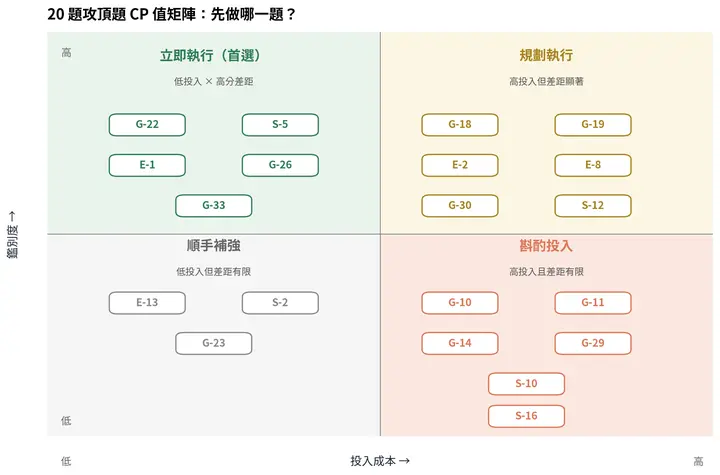
Advanced Items Requiring 6–12 Months of Planning
- E-2 External Scope 1 and 2 verification (SGS, BSI, DNV, BV; +3–6 months)
- E-8 ISO 50001 energy management certification (+6–9 months)
- E-13 ISO 14001 environmental management certification (many companies already have it; otherwise +6–9 months)
- S-12 ISO 27001 information security certification (+6–12 months)
- G-19 External board evaluation (CGA or consulting firm; +1–2 months for scheduling)
Board Resolutions and Long-Term Planning Required
- G-10 All directors are natural persons (next board election)
- G-14 Independent directors hold at least 1/2 of seats (next board election)
- G-18 At least half the risk management committee are independent directors (charter/committee composition)
- G-30 Appoint a CSO (board resolution establishing the position)
Conclusion: Moving from 100 to 120 Points Requires Systems, Not Last-Minute Supplements
Many companies start supplementing materials only three months before each evaluation. But ESG Evaluation is fundamentally about governance systems. The indicators test whether the company actually has a mechanism, not merely whether the report contains a paragraph about it.
Companies that move from 100 to 120 do three things: first reform governance structures (G-10/14/18/30), then disclose operating data fully (E-2/8/13, S-9/12, G-3/7/21), and finally secure verification/assurance (E-13, S-10, G-26). Start with systems, follow with data and complete quality checks; with this sequence, 120 points follows naturally.
Resources You Can Use Now
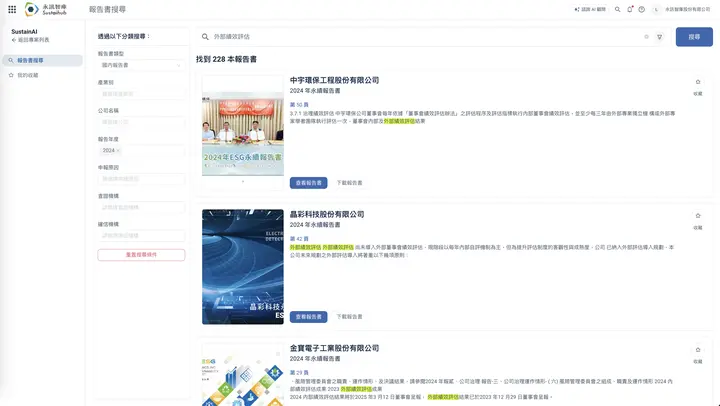
👉 Try the SustainAI case search database free→: Search terms such as Chief Sustainability Officer, external performance evaluation and individual director remuneration to compare disclosures by listed companies that have earned bonus points