
1. Key Points of the 2026 Updated Average Heating Values
To facilitate GHG emission inventory and registration for regulated entities, the Ministry of Environment has calculated weighted averages based on heating values and sales volumes provided by domestic fuel suppliers, and announced the following fuel heating values for the year 2025 (applicable to the 2025 GHG inventory):
🔹 Vehicle Fuels
- Motor gasoline lower heating value (LHV): 7,586 kcal/L
- Diesel lower heating value (LHV): 8,636 kcal/L
- Liquefied petroleum gas (LPG) lower heating value (LHV):
- 5,993 kcal/L
- 10,972 kcal/kg
🔹 Natural Gas (NG1 / NG2)
According to the 2006 IPCC Guidelines for National Greenhouse Gas Inventories, the lower heating value of gaseous fuels should be calculated as 90% of the higher heating value.
- NG1
- Higher heating value (HHV): 8,963 kcal/m³
- Lower heating value (LHV): 8,067 kcal/m³
- NG2
- Higher heating value (HHV): 9,698 kcal/m³
2. Key Updates to Motor Gasoline and Diesel Emission Factors
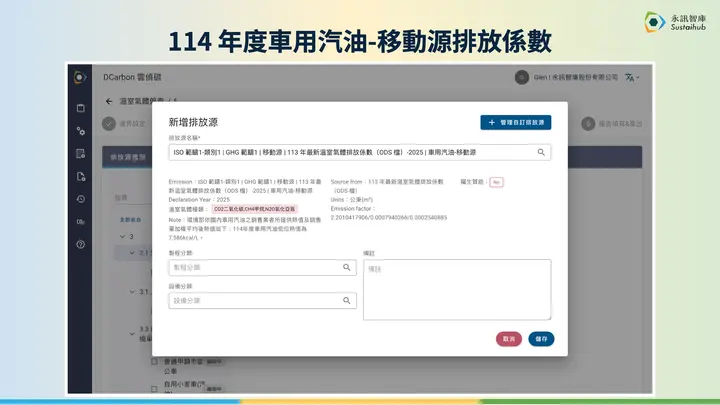
Recalculated using the updated lower heating values, the mobile source emission factors are as follows:
🚗 Motor Gasoline (Mobile Sources)
- CO₂: 2.2010417906
- CH₄: 0.0007940266
- N₂O: 0.0002540885
🚛 Diesel (Mobile Sources)
- CO₂: 2.6792488757
- CH₄: 0.0001084716
- N₂O: 0.0000216943
If a company still uses the previous year's emission factors, emissions from mobile sources such as company vehicles, logistics fleets, and forklifts will all be miscalculated.
Additional note:
The emission factors for motor gasoline and diesel used in stationary sources have also been updated, though they are not listed individually in this article. For complete emission factor data (including stationary sources and other fuel types), companies can use the DCarbon GHG Inventory System to query and apply the latest factors, avoiding the need to manually cross-reference official announcements.
3. Don't Overlook Category 4: Purchased Goods Emission Factors Also Updated
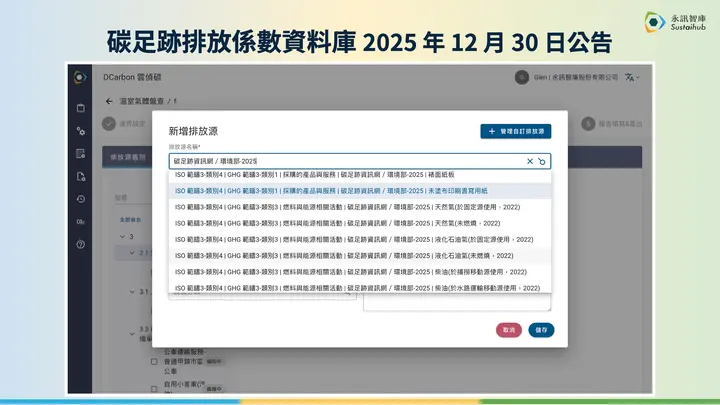
In addition to fuels, the carbon footprint data announced by the Ministry of Environment's Carbon Footprint Information Platform on December 30, 2025, also requires updating.
For example:
- Uncoated printing and writing paper: 1.377 kgCO₂e/kg
This emission factor is precisely the one commonly used by companies in their GHG inventory under "Category 4: Purchased Goods and Services" for copy paper.
In addition, this announcement also includes:
- Upstream energy emission factors
- Carbon footprint data for various products
If a company is conducting a Scope 3 inventory or product carbon footprint calculation, it is recommended to immediately verify whether the latest version has been adopted.
4. Three Most Common Emission Factor Risks
1️⃣ Outdated Factor Versions
Excel files carry over emission factors from previous years without realizing they have been updated.
2️⃣ Mixing Higher and Lower Heating Values
This is a common source of error for natural gas calculations.
3️⃣ Rounding Errors from Manual Recalculation
Minor differences in decimal places can accumulate to tens of tonnes of error in large-scale corporate inventories.
These issues are often only identified during the verification stage, at which point a complete recalculation is required.
5. How to Avoid Using Outdated Emission Factors?
Manually comparing official announcements, rebuilding formulas, and modifying data entries one by one each year is both time-consuming and error-prone.
If you want to:
- Directly apply the latest emission factors announced by the Ministry of Environment
- Integrate data from the Carbon Footprint Information Platform
- Automatically convert higher heating values to lower heating values
- Eliminate the risk of version mismatches
Consider adopting the DCarbon GHG Inventory System.
🔹 DCarbon Key Features
- Built-in latest emission factors from the Ministry of Environment and Carbon Footprint Information Platform
- Real-time version updates
- Supports stationary source, mobile source, and Scope 3 inventories
- Systematic calculation logic that reduces human error
- Historical version records for easy verification reference
When your manager asks: "Is this the latest emission factor?"
You can confidently respond: "The system is synchronized with the latest official announcement from the Ministry of Environment."
FAQ: Questions You May Be Thinking About
Q1: Is it mandatory to use the heating values announced by the Ministry of Environment?
For domestic GHG inventory registration, entities should in principle use the latest average heating values announced by the Ministry of Environment.
Q2: How do you distinguish between NG1 and NG2 natural gas?
This should be confirmed based on gas type data provided by the gas supply company.
In general practice:
- NG1: Predominantly distributed in northern regions
- NG2: Predominantly distributed in central and southern regions
Q3: Must the value 1.377 be used for Category 4 copy paper?
If supplier-specific carbon footprint data is not available, the values published on the Carbon Footprint Information Platform may be used as a priority.
Updating Emission Factors: The First Line of Defense
Updating emission factors annually may seem like routine work, but it fundamentally determines the credibility of your entire inventory report.
In an environment where carbon fees, sustainability disclosure, and verification pressures are all intensifying,
using the latest emission factors is no longer optional — it is a basic requirement.
Check now:
- Are your natural gas heating values based on the lower heating value (LHV)?
- Have you updated motor gasoline and diesel data to the latest year?
- Has Category 4 been updated with the latest carbon footprint data?
If you still rely on manual updates and calculations, inventory risks will scale up alongside your company's growth.
Now is the time to upgrade to digital inventory tools and systematize emission factor management —
not only to reduce errors, but also to improve overall carbon management efficiency.
DCarbon GHG Inventory System — making emission factor updates no longer a source of annual stress.
References
Ministry of Environment GHG Emission Inventory Related Announcements
https://ghgregistry.moenv.gov.tw/epa_ghg/News/NewsList.aspx?Type_ID=1
Ministry of Environment Carbon Footprint Information Platform
https://cfp.moenv.gov.tw/WebPage/WebSites/docx_detail.aspx?qparentid=b3735a81-482a-41e0-88b1-d2d51b5d8044
2006 IPCC Guidelines for National Greenhouse Gas Inventories
https://www.ipcc-nggip.iges.or.jp/public/2006gl/