
Updated on 6 October 2026. Historical results analysis is retained, with an added link to the ESG Evaluation framework and its new name.
This article retains the historical results analysis for the 10th–12th Corporate Governance Evaluations. From 2026 (ROC year 115), the programme transitioned to the ESG Evaluation. For the current framework and the timetable for first-round results, see the Taiwan Stock Exchange (TWSE) ESG Evaluation framework; for other historical information, see past Corporate Governance Evaluation results. Official information: TWSE Corporate Governance Center.
1. What Is the Corporate Governance Evaluation? History and Scoring
The Corporate Governance Evaluation is jointly organised by the Taiwan Stock Exchange (TWSE) and the Taipei Exchange (TPEx) and has reached its 12th round since its launch. The evaluation is administered by the Taiwan Corporate Governance Association (TCGA) to publicly compare governance standards at TWSE/TPEx-listed companies using quantitative indicators, encouraging companies to strengthen board effectiveness, improve transparency, protect shareholder rights and fulfil their responsibilities for sustainable operations.
The 12th-round evaluation indicators cover four dimensions:
| Dimension | Core Assessment Areas | Examples of Indicators |
|---|---|---|
| Protecting Shareholder Rights and Equitable Treatment of Shareholders | Shareholder meeting procedures, voting disclosures and institutional investor communication | Electronic voting at shareholder meetings, English meeting handbooks and shareholder proposals |
| Enhancing Board Composition and Operation | Proportion of independent directors, board diversity and functional committees | Proportion of female directors, board evaluations and remuneration committee independence |
| Increasing Information Transparency | Timely and complete disclosure of financial, governance and sustainability information | English annual reports, sustainability reports, IFRS S2 climate disclosures (building on the TCFD framework) and stakeholder webpages |
| Putting Corporate Social Responsibility into Practice | Integrated ESG management, decarbonisation commitments, human rights and supply chain management | SBTi science-based emissions reduction targets, human rights due diligence and supplier codes of conduct |
Evaluation results are published as ranking bands rather than absolute scores, ranging from the “top 5%” and “6%~20%” to “21%~35%” … through to “81%~100%”. Alongside the overall TWSE and TPEx lists, subcategories include finance and insurance, electronics with a market capitalisation of NT$10 billion or more, non-financial and non-electronics companies with a market capitalisation of NT$10 billion or more, companies with a market capitalisation of NT$5–10 billion, and companies below NT$5 billion, allowing comparisons among similar companies.
2. Participation and Ranking Bands Across the 10th–12th Rounds
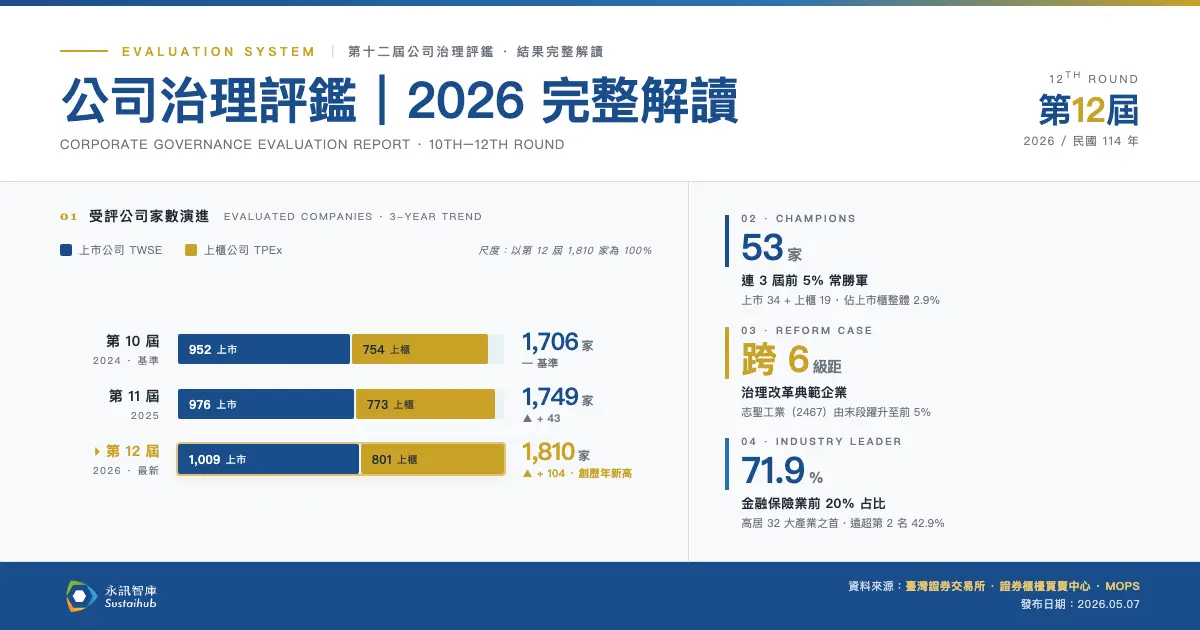
Changes in participation provide the most direct indicator of the overall governance landscape. Company counts across the three rounds are shown below:
| Category | 10th round | 11th round | 12th round | Change: 10th → 12th |
|---|---|---|---|---|
| TWSE-listed companies | 952 | 976 | 1,009 | +57 companies (+6.0%) |
| TPEx-listed companies | 754 | 773 | 801 | +47 companies (+6.2%) |
| Finance and insurance (evaluation subcategory) | 42 | 42 | 40 | −2 companies |
| Electronics: market capitalisation of NT$10 billion or more | 272 | 301 | 297 | +25 companies |
| Non-financial and non-electronics: market capitalisation of NT$10 billion or more | 263 | 280 | 271 | +8 companies |
| Market capitalisation of NT$5–10 billion | 313 | 328 | 329 | +16 companies |
| Market capitalisation below NT$5 billion | 816 | 798 | 873 | +57 companies |
Between the 10th and 12th rounds, the number of TWSE-listed companies evaluated grew by 6.0%, while TPEx-listed participation rose by 6.2%, reflecting more IPOs and broader evaluation coverage. Notably, finance and insurance participation fell from 42 companies to 40, affected by financial holding company mergers during the period (for example, Shin Kong Financial's integration into the Taishin Financial group, which was evaluated as “Taishin Shin Kong Financial” in the 12th round).
3. 53 Consistent Governance Leaders in the Top Tier for 3 Consecutive Rounds
Companies that ranked in the “top 5%” band for 3 consecutive rounds represent the most consistent governance leaders. Cross-round comparisons identified 25 TWSE-listed companies and 28 TPEx-listed companies meeting this condition, for a total of 53 companies, representing just 2.9% of all TWSE/TPEx-listed companies evaluated in the 12th round.
3-1 TWSE-Listed Companies: All 25 Top-5% Leaders for 3 Consecutive Rounds
| Stock Code | Company Short Name | Industry |
|---|---|---|
| 1605 | Walsin Lihwa | Electrical and Cable |
| 2006 | Tung Ho Steel | Iron and Steel |
| 2201 | Yulon Motor | Automobiles |
| 2204 | China Motor | Automobiles |
| 2301 | LITE-ON | Computers and Peripheral Equipment |
| 2303 | UMC | Semiconductors |
| 2308 | Delta Electronics | Electronic Components |
| 2330 | TSMC | Semiconductors |
| 2395 | Advantech | Computers and Peripheral Equipment |
| 2409 | AUO | Optoelectronics |
| 2412 | Chunghwa Telecom | Communications and Internet |
| 2454 | MediaTek | Semiconductors |
| 2633 | Taiwan High Speed Rail | Shipping and Transportation |
| 2801 | Chang Hwa Bank | Finance and Insurance |
| 2884 | E.SUN Financial | Finance and Insurance |
| 2885 | Yuanta Financial | Finance and Insurance |
| 2897 | O-Bank | Finance and Insurance |
| 3034 | Novatek | Semiconductors |
| 3036 | WT Microelectronics | Electronic Distribution |
| 3045 | Taiwan Mobile | Communications and Internet |
| 3231 | Wistron | Computers and Peripheral Equipment |
| 3702 | WPG | Electronic Distribution |
| 3714 | Ennostar | Optoelectronics |
| 4904 | Far EasTone | Communications and Internet |
| 9940 | Sinyi Realty | Other |
3-2 TPEx-Listed Companies: All 28 Top-5% Leaders for 3 Consecutive Rounds
| Stock Code | Company Short Name | Industry |
|---|---|---|
| 3088 | Axiomtek | Computers and Peripheral Equipment |
| 3105 | WIN Semiconductors | Semiconductors |
| 3218 | Universal Vision Biotechnology | Biotechnology and Medical Care |
| 3264 | Ardentec | Semiconductors |
| 4128 | Microbio | Biotechnology and Medical Care |
| 4743 | Oneness Biotech | Biotechnology and Medical Care |
| 4953 | Wistron ITS | Information Services |
| 5009 | Gloria Material Technology | Iron and Steel |
| 5209 | CTCI Advanced Systems | Other |
| 5309 | Sysgration | Electronic Components |
| 5347 | Vanguard International Semiconductor | Semiconductors |
| 5371 | Coretronic | Optoelectronics |
| 5483 | Sino-American Silicon Products | Semiconductors |
| 5536 | Acter* | Other Electronics |
| 5904 | POYA | Household Goods |
| 6023 | Yuanta Futures | Finance |
| 6147 | Chipbond | Semiconductors |
| 6263 | PLANET Technology | Communications and Internet |
| 6488 | GlobalWafers | Semiconductors |
| 6510 | Chunghwa Precision Test Tech. | Semiconductors |
| 6561 | Chief Telecom | Communications and Internet |
| 6613 | NOVA Technology* | Other Electronics |
| 6643 | M31 | Semiconductors |
| 6803 | ECOVE | Green Energy and Environmental Services |
| 8069 | E Ink | Optoelectronics |
| 8255 | Actron Technology | Electrical Machinery |
| 8415 | Ta Chen International | Iron and Steel |
| 8916 | Kwong Lung | Other |
Electrical and Cable / Shipping and Transportation / Information Services / Household Goods / Green Energy and Environmental Services / Electrical Machinery
Among the 53 consistent TWSE/TPEx governance leaders, 32 companies, or about 60%, are in electronics-related industries (semiconductors, computers and peripherals, electronic components, communications and internet, optoelectronics, electronic distribution and other electronics). This may reflect the larger listed-company population in these industries and their greater exposure to international capital markets. However, establishing whether electronics companies systematically have stronger governance than other industries requires a rigorous comparison controlling for variables such as industry population and market capitalisation.
4. Governance Reform Models: Companies Advancing Multiple Ranking Bands
The Corporate Governance Evaluation recognises consistent leaders while also recording the progress of companies that commit resources to governance reforms and achieve substantial results within three rounds. The following 5 companies made the largest gains between the 10th and 12th rounds. Their reform trajectories offer particularly useful examples for peers seeking to improve governance:
| Stock Code | Company Short Name | Industry | 10th-Round Band | 12th-Round Band Achieved | Improvement Over Three Years |
|---|---|---|---|---|---|
| 2467 | C Sun | Electronic Components | 81%~100% | Top 5% | Up 6 bands |
| 4109 | Jia Jie Biomedical | Biotechnology and Medical Care | 81%~100% | 6%~20% | Up 5 bands |
| 4722 | Qualipoly Chemical | Chemicals | 81%~100% | 21%~35% | Up 4 bands |
| 3520 | Hua Ying Electronics | Electronic Components | 81%~100% | 21%~35% | Up 4 bands |
| 3447 | Quanta Microsystems | Communications and Internet | 81%~100% | 21%~35% | Up 4 bands |
Over three years, C Sun (Electronic Components) pursued reforms including optimising board composition, preparing sustainability reports and obtaining third-party verification, completing English disclosures, enhancing stakeholder webpages, and participating in international initiatives such as SBTi and RE100. It rose to the top 5% band in the 12th round, becoming one of the most notable examples of successful governance reform.
4-1 C Sun's ESG Reforms in Depth: 5 Representative Cases
What exactly did C Sun do? The Sustaihub research team used the SustainAI cross-report search platform to retrieve and compile the following examples from C Sun's 2023 and 2024 sustainability reports. All specific figures and policies are cited with page references to C Sun's publicly disclosed sustainability reports. Readers can download the full reports from C Sun's investor relations website to cross-check them.
| # | ESG Dimension | Specific C Sun Example | Original Source |
|---|---|---|---|
| 1 | Corporate Governance | Board Diversity and External Evaluation | According to C Sun's 2024 sustainability report, the company established a board diversity policy in line with the Corporate Governance Best Practice Principles for TWSE/TPEx Listed Companies, covering gender, age, nationality, culture and professional background (law, accounting, industry, finance, marketing and technology). In 2024, the board had 7 seats (4 non-independent + 3 independent directors), with overall attendance of 92.31%. In 2024, it commissioned the Taiwan Integrity Management Society to conduct its first external board effectiveness evaluation, using interviews and questionnaires to assess four dimensions: board professional effectiveness, decision-making effectiveness, internal control oversight and commitment to sustainable operations. An independence statement was also issued. | C Sun 2024 Sustainability Report, P.17, P.23 C Sun 2023 Sustainability Report, P.25 |
| 2 | Environmental Sustainability | SBTi, RE100 and the Climate Roadmap | According to its reports, C Sun responds to the international SBTi science-based emissions reduction, RE100 and CDP initiatives, and conducts climate scenario analysis under IFRS S2 (building on the TCFD framework). It has set a clear pathway to reduce Scope 1 and 2 emissions by 42% and Scope 3 emissions by 37.5% by 2030, and achieve net-zero emissions by 2050. In 2025, it planned to introduce ISO 14067 product carbon footprint inventories for three equipment models, progressively implement a consolidated group greenhouse gas inventory and assess renewable electricity procurement. | C Sun 2024 Sustainability Report, P.34 C Sun 2023 Sustainability Report, P.48 |
| 3 | Material Topic Identification | GRI 2021 + 8 Topics | Using the GRI Universal Standards 2021, the company narrowed industry characteristics, domestic and international sustainability trends, and industry benchmarks into 12 initial sustainability issues. It used 31 internal questionnaires to quantify “impact severity × likelihood”, ultimately identifying 8 material topics: product technology innovation, corporate governance, customer service/quality, ethical business conduct, occupational health and safety, talent attraction and retention, talent development, and responding to climate change. | C Sun 2024 Sustainability Report, P.12 C Sun 2023 Sustainability Report, P.19 |
| 4 | Talent Development | 20 Hours of Annual Training per Employee | According to its reports, total training in 2023 reached 7,761.67 hours, or 20.27 hours per employee. New employees must complete 12 online general courses and pass the examinations within one week of joining. Within three months, they must complete three certifications covering ISO, ERP operations and the 50 Japanese kana sounds, and deliver a SWOT presentation. Work rules also follow international human rights standards, including the UN Universal Declaration of Human Rights, the UN Global Compact and those of the International Labour Organization (ILO). | C Sun 2023 Sustainability Report, P.97, P.112 C Sun 2024 Sustainability Report, P.71 |
| 5 | Product Innovation | High-Power Burn-In Test Equipment for AI Chips | Responding to trends in AI chips and advanced semiconductor packaging, the company launched a “high-power burn-in test pressure oven” in 2023 (supporting high-power AI ICs of 300W~1,000W), featuring distinctive high-pressure burn-in technology, a patented fan-array airflow design and ultra-high heat dissipation capabilities. In 2024, it also launched a “vacuum pressure defoaming oven” and a large-platform 64K-point electrical tester, integrating energy reuse and environmentally sustainable technologies into core R&D. | C Sun 2023 Sustainability Report, P.80 C Sun 2024 Sustainability Report, P.55, P.57 |
These 5 examples show that C Sun's reforms went beyond filling disclosure gaps: the company strengthened both substantive governance practices (external board evaluation and a higher proportion of independent directors) and disclosure quality (adopting international frameworks such as GRI 2021, IFRS S2 and SBTi). For companies currently in the 36%~100% bands seeking to improve in the first ESG Evaluation, C Sun provides a concrete, replicable reform roadmap.
The Sustaihub research team used the SustainAI cross-report search platform to retrieve and compile these 5 examples. The platform's sustainability database includes historical sustainability and CSR reports from TWSE/TPEx-listed companies across Taiwan, with the following search options:
• Search by company name: for example, entering “C Sun” returns all related reports and page references.
• Combined keyword + company searches: for example, “climate change + C Sun” narrows the results to specific pages.
• Multidimensional filters by industry, year and region
• One-click downloads of original PDFs to support research reports, client proposals and ESG investigations.
Whether you are a chief sustainability officer seeking benchmarks, an investor conducting corporate governance due diligence or an academic writing a sustainability paper, SustainAI can substantially reduce the time spent searching multiple PDFs.
5. Governance Trends: Overall Mobility and Industry Changes
Beyond consistent top performers and reform models, movement in governance rankings across the TWSE/TPEx-listed population is another key indicator of the evaluation landscape. This article compares 10th- and 12th-round ranking bands for the 1,674 companies with evaluation data in all three rounds. The findings are as follows:
5-1 Three-Round Comparison: Governance Ranking Mobility
| Type of Change | Company Count | Share | Interpretation |
|---|---|---|---|
| Higher band (governance improvement) | 423 companies | 25.3% | 1 in every 4 companies successfully improved its governance ranking |
| Unchanged band | 816 companies | 48.7% | Nearly half maintained stable governance standards across the three rounds |
| Down 1~2 bands | 429 companies | 25.6% | Modest declines, mostly natural fluctuations linked to indicator revisions or stronger peer competition |
| Down 3 or more bands | 6 companies | 0.4% | Substantial declines warranting review for structural problems in governance practices or disclosure |
Of the 435 companies that moved to a lower band, 98.6% (429 companies) fell by no more than 2 bands, usually due to normal factors such as revisions to evaluation indicators, stronger peer competition or adjustments to disclosure timing in a single year. Only 6 companies fell by 3 or more bands, accounting for less than 0.4% of the full sample. Overall, governance standards among Taiwan's TWSE/TPEx-listed companies showed strong stability, with 25.3% providing positive upward momentum.
5-2 Which Industries Have Stronger Improvement Momentum, and Which Have Room to Improve?
The article further groups these 1,674 companies by the industry categories published on the Market Observation Post System (MOPS), calculating each industry's proportions moving to higher and lower bands. Industry characteristics and the intensity of external regulation are closely associated with changes in governance rankings:
| Observation | Industry Examples | Trend Interpretation |
|---|---|---|
| Leading improvement momentum | Food, Electrical and Cable, Electrical Machinery, Trading and Consumer Goods, Automobiles | Average ranking-band scores improved by 4.7~6.9 points across three rounds, reflecting faster digital governance transformation in traditional industries and responses to international supply chain ESG requirements |
| Stable governance standards | Finance and Insurance, Semiconductors, Computers and Peripheral Equipment, Communications and Internet | Consistently high standards (more than 30% in the top 20%), with established governance advantages further reinforced in the latest round |
| Emerging industries with room to improve | Green Energy and Environmental Services, Sports and Leisure, Biotechnology and Medical Care, Digital and Cloud Services | Industries with many recent IPOs, where some companies have had less time to establish governance systems; key areas for future advisory support and evaluation indicators |
To maintain or improve your ranking band in the next round, review the indicators directly: (1) Are board diversity policies and external effectiveness evaluations complete? (2) Is the sustainability report prepared under current frameworks such as IFRS S1 (General Requirements for Disclosure of Sustainability-related Financial Information), IFRS S2 (Climate-related Disclosures) and the GRI Universal Standards 2021, with third-party assurance? (3) Are stakeholder webpages updated regularly and available in English? (4) Do functional committees (remuneration, audit, nomination, sustainability and risk) operate independently and disclose meeting records? (5) Are material information and corporate governance information disclosed promptly? These 5 features are shared by consistent leaders and governance reform models.
6. Industry Rankings: Which Sectors Have the Strongest Governance?
By joining evaluation data with industry categories in MOPS company profiles, this article regroups TWSE-listed companies by industry and calculates their “average ranking-band score”, “share in the top 20%” and “change over 3 rounds”. These measures represent governance standards, the concentration of leaders and the extent of improvement, respectively:
Scope note: In this section, “Finance and Insurance” refers to the 32 TWSE-listed companies classified under that MOPS industry category. This differs from the “finance and insurance” evaluation subcategory in Section 7, which includes 40 companies in the 12th round, including some TPEx-listed financial institutions.
6-1 Top 5 Industries by Number of Evaluated Companies
| Industry | Companies Evaluated in the 12th Round | Share in the Top 20% in the 12th Round | Average Ranking-Band Score |
|---|---|---|---|
| Electronic Components | 98 | 22.4% | 48.8 |
| Semiconductors | 87 | 29.9% | 39.6 |
| Optoelectronics | 67 | 11.9% | 56.5 |
| Computers and Peripheral Equipment | 60 | 30.0% | 42.8 |
| Building Materials and Construction | 55 | 10.9% | 58.2 |
6-2 Top 5 Industries by Governance Standards (Share in the Top 20%)
| Rank | Industry | Companies Evaluated in the 12th Round | Share in the Top 20% | Average Ranking-Band Score |
|---|---|---|---|---|
| 1 | Finance and Insurance | 32 | 71.9% | 15.2 |
| 2 | Cement | 7 | 42.9% | 32.3 |
| 3 | Paper and Pulp | 7 | 42.9% | 34.7 |
| 4 | Plastics | 21 | 33.3% | 46.3 |
| 5 | Computers and Peripheral Equipment | 60 | 30.0% | 42.8 |
Under long-standing intensive regulatory supervision, the finance and insurance industry's share in the top 20% reached 71.9% in the 12th round, far ahead of second- and third-ranked Cement and Paper and Pulp (both 42.9%). This mainly reflects strict sector regulation and institutional scale: comprehensive rules under the Financial Holding Company Act, Banking Act and Insurance Act, mature boards and functional committees, and more stringent disclosure requirements than in other industries.
6-3 Top 5 Industries by Governance Improvement
| Industry | Companies Evaluated in the 12th Round | Improvement in Average Ranking-Band Score | Change in Share in the Top 20% |
|---|---|---|---|
| Food | 21 | +6.9 | +9.9 percentage points |
| Electrical and Cable | 15 | +6.0 | Unchanged |
| Electrical Machinery | 46 | +5.9 | +2.2 percentage points |
| Trading and Consumer Goods | 18 | +5.6 | +11.4 percentage points |
| Automobiles | 38 | +4.7 | −1.6 percentage points |
7. Finance and Insurance: Only 2 of 40 Companies in the 12th Round Stayed in the Top 10% for 3 Rounds
Finance and insurance is the most tightly regulated and concentrated evaluation subcategory, so this article tracks each institution individually. Among the 42, 42 and 40 financial institutions evaluated in the 10th–12th rounds, only 2 remained in the “top 10%” for 3 consecutive rounds:
| Stock Code | Company Short Name | Type | Bands Across 3 Rounds |
|---|---|---|---|
| 2884 | E.SUN Financial | Financial holding company | Top 10% × 3 rounds |
| 2897 | O-Bank | Commercial bank | Top 10% × 3 rounds |
Although 71.9% of the finance industry's companies are in the top 20% overall (under MOPS industry classifications), competition for the highest tier—the “top 10%”—is extremely intense. Around 4 financial institutions enter the top 10% each round, but only 2 held their places for all 3 rounds, indicating annual turnover among the remaining financial holding companies, banks and insurers. Companies targeting the financial sector's top 10% should focus on differentiating indicators such as climate risk disclosures (IFRS S2), the proportion of sustainable financial products, the effectiveness of board sustainability committees, and deeper work on human rights and supply chain issues.
8. Electronics vs Non-Electronics: Competition and Ranking Stability
“Electronics with a market capitalisation of NT$10 billion or more” and “non-financial and non-electronics companies with a market capitalisation of NT$10 billion or more” are two parallel subcategories. The former includes electronics-related industries (semiconductors, computers and peripherals, optoelectronics, electronic components, communications, electronic distribution and other electronics); the latter covers non-electronics, non-financial industries such as traditional manufacturing, construction, transportation and trading. Their comparison follows:
| Category | Companies in the 10th Round | Companies in the 12th Round | Companies in the Top 10% for 3 Consecutive Rounds |
|---|---|---|---|
| Electronics: market capitalisation of NT$10 billion or more | 272 | 297(+25) | 13 companies |
| Non-financial and non-electronics: market capitalisation of NT$10 billion or more | 263 | 271(+8) | 14 companies |
14 non-financial, non-electronics companies stayed in the top 10% for 3 rounds: Taiwan Cement (1101), Walsin Lihwa (1605), China Steel (2002), Tung Ho Steel (2006), Yulon Motor (2201), China Motor (2204), Taiwan High Speed Rail (2633), Universal Vision Biotechnology (3218), Oneness Biotech (4743), Gloria Material Technology (5009), Chailease-KY (5871), CTCI (9933), Sinyi Realty (9940) and Yulon Finance (9941).
13 electronics companies stayed in the top 10% for 3 rounds: LITE-ON (2301), UMC (2303), Advantech (2395), AUO (2409), Chunghwa Telecom (2412), MediaTek (2454), Novatek (3034), Taiwan Mobile (3045), Wistron (3231), WPG (3702), Ennostar (3714), Far EasTone (4904) and Acter* (5536).
Over 3 rounds, electronics participation grew by 25 companies, compared with only 8 in non-electronics, reflecting the continued dominance of electronics in Taiwan's capital market expansion. The numbers of companies in the top 10% for all 3 rounds are close (13 vs 14), a difference without statistical significance. However, electronics has a larger population and more intense competition, with new companies entering the leading group each year; the non-electronics population is stable, with less frequent turnover.
9. New Entrants and Exits: Changes in the Evaluation Population Over 3 Years
9-1 Overview of Entrants and Exits
From the 10th to the 12th round, the overall TWSE/TPEx-listed population saw:
- 135 companies enter the evaluation list (mostly new IPOs or companies newly meeting eligibility requirements)
- 31 companies exit (including delistings, mergers, privatisations and transfers to the Emerging Stock Board)
- A net increase of 104 companies, consistent with overall growth in TWSE/TPEx listings
9-2 Recommendations for Building Governance Systems Before an IPO
Among new entrants, some companies used comprehensive pre-IPO governance planning to enter the top 35% in their first evaluation, including companies in emerging industries such as biotechnology and medical care, semiconductor equipment and AI applications. Companies preparing for an IPO should introduce an internal audit mechanism based on the Corporate Governance Evaluation indicators more than one year in advance to avoid entering the lower bands in their first evaluation.
10. 5 Recommendations for Improving Corporate Governance Performance
Based on the preceding analysis, the Sustaihub research team identifies 5 priorities companies can act on immediately before the first ESG Evaluation:
10-1 Strengthen Board Diversity and Independent Operation
The proportion of female and independent directors, board evaluations and succession planning have attracted growing attention in recent years. Companies should commission an independent third party to evaluate board effectiveness and publicly disclose the results and improvement actions.
10-2 Complete the Sustainability Disclosure Framework
Prepare sustainability reports under international frameworks such as IFRS S1 (General Requirements for Disclosure of Sustainability-related Financial Information) and IFRS S2 (Climate-related Disclosures, building on the TCFD framework), and obtain third-party assurance. The 12th round continued to raise expectations for the detail and quantification of climate disclosures.
10-3 Strengthen Stakeholder Communication Channels
The stakeholder section of a corporate website should bring together grievance channels, responses to issues, quarterly updates and an English version. This is a key differentiator in the Information Transparency dimension.
10-4 Establish Functional Committees and Ensure Independent Operation
In addition to the legally required audit and remuneration committees, companies should add nomination, sustainability and risk management committees, ensuring that independent directors hold a majority of seats.
10-5 Introduce an Integrated Governance Information Management Platform
Digital tools that centralise board proceedings, sustainability data, disclosure documents and audit records can substantially reduce indicator reporting costs and the risk of omissions.
Let Sustaihub Manage Your Corporate Governance and Sustainability Information in One Place
Sustaihub provides a dedicated corporate governance and sustainability information management platform designed for Taiwan's TWSE/TPEx-listed companies. It combines Corporate Governance Evaluation indicator tracking, sustainability report editing, ESG data collection, third-party verification workflows and board meeting management in one system, and has helped multiple listed companies remain in the top 5% / top 10% bands.
Book a Free 30-Minute Consultation Now →