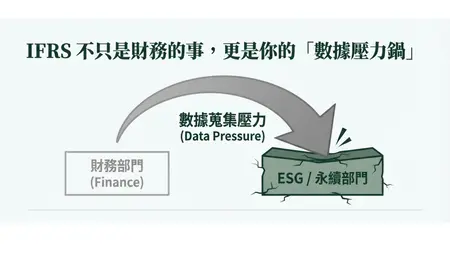
An 81-page official Q&A lies on your desk, alongside a 58-page summary of the practical guide—a familiar scene for many ESG leaders in 2026. While answering the board's questions, “Does this apply to us? When do we start?”, you also need to work out what terms such as Scope 3, internal carbon pricing and remuneration links actually mean. IFRS Sustainability Disclosure Standards are rapidly moving from international standards on paper to real pressure on Taiwan's TWSE/TPEx-listed companies.
Issued by the International Sustainability Standards Board (ISSB) in June 2023, these standards incorporate and replace TCFD, aiming to align global sustainability reporting around information that is “useful for investor decisions”. Taiwan's Financial Supervisory Commission (FSC) has amended the annual report disclosure and internal control regulations and announced Taiwan's Roadmap for Adopting IFRS Sustainability Disclosure Standards. TWSE/TPEx-listed companies adopt the standards in three phases based on capital, while financial holding companies, banks, securities firms and futures firms follow sector-specific rules—Phase 1 companies must begin applying the standards this year (2026).
This article organises common questions by adoption timeline, disclosure content, transition provisions and internal control preparation, with official sources to check against your company's circumstances.
- Phased timeline: Companies with capital of NT$10 billion or more apply from FY2026; NT$5 billion to less than NT$10 billion from FY2027; NT$2 billion to less than NT$5 billion, or companies outside the first two phases regulated by the Ministry of Environment, from FY2028. Companies below NT$2 billion and outside that regulatory scope are exempt from mandatory adoption but must still disclose basic climate information (adjusted 2026-09-23). All 14 financial holding companies start in 2026.
- Transition relief and Scope 3: In the first year, companies may disclose climate information only and omit comparative information; Phase 3 companies may disclose climate information only for their first two reporting years. Phases 1 and 2 may defer Scope 3 disclosure until the 4th financial year of application (Phase 1 must disclose FY2029 data by 2030 at the latest). Under the 23 September 2026 policy proposal, Phase 3 disclosure becomes voluntary.
- Four core areas: Governance, strategy, risk management, and metrics and targets—the structure directly follows TCFD, so companies without TCFD experience will face a steeper challenge.
- The 5% materiality threshold is now history: Professional judgement under IFRS S1 paragraphs 17–19 replaces it, combining quantitative and qualitative factors.
- Sustainability information internal controls are already in force: Effective 2025/1/1, regardless of capital size; in 2026, your internal audit work should already be underway.
1. What Are IFRS Sustainability Disclosure Standards? Understanding S1 and S2
1. ISSB and Taiwan's adoption pathway
The board (International Sustainability Standards Board, ISSB) was established by the IFRS Foundation at COP26 in 2021 to create a globally consistent, “investor-focused” baseline for sustainability disclosures. In June 2023, the ISSB issued its first two standards:
- IFRS S1: General Requirements for Disclosure of Sustainability-related Financial Information — Sets out the overarching requirements governing disclosures on all sustainability topics.
- IFRS S2: Climate-related Disclosures — Incorporates and replaces the TCFD recommendations, requiring companies to disclose climate risks and opportunities.
The FSC's Securities and Futures Bureau formally endorsed IFRS S1 and S2 on 12 November 2025 under Order No. 11403851755. Companies can obtain the official versions from the “IFRS Foundation IFRS Standards download portal” and access Traditional Chinese translations and practical guidance through the “IFRS Sustainability Disclosure Standards Adoption Portal” (https://isds.tpex.org.tw).
2. IFRS S1 vs IFRS S2: Key Differences
| Comparison | IFRS S1 | IFRS S2 |
|---|---|---|
| Purpose | General sustainability disclosure requirements (covering all sustainability topics) | Climate-specific standard (replacing TCFD) |
| Four core areas | Governance, strategy, risk management, and metrics and targets | |
| Disclosure scope | All sustainability-related risks and opportunities | Climate transition risks, physical risks and climate opportunities |
| Metrics | Reference SASB industry-based metrics | Cross-industry metrics (GHG emissions, vulnerable assets, internal carbon prices, remuneration links, etc.) + SASB climate metrics |
| Transition provisions | First-year relief from comparative information; climate-only disclosures permitted | Taiwan's Scope 3 transition timeline for TWSE/TPEx-listed companies follows FSC orders; international standards have separate provisions |
| Scenario analysis | Depends on the nature of the risk | Climate scenario analysis is mandatory to assess climate resilience |
3. Relationship with TCFD, GRI and SASB
Many ESG practitioners ask: “We already produce TCFD and GRI reports. Why do we also need IFRS S1 / S2?” Their purposes differ:
- GRI: Stakeholder-focused, reporting an organisation's impacts on the economy, environment and people, including human rights; GRI remains the main framework for Taiwan's sustainability reports.
- SASB: Investor-focused, industry-based metrics; IFRS S1 paragraph 55 requires companies to refer to SASB disclosure topics and consider their applicability.
- TCFD: Climate disclosure recommendations; IFRS S2 incorporates and replaces TCFD, whose work transferred to the ISSB from 2023.
- IFRS S1 / S2: Investor-focused sustainability disclosures that require connections with financial statements. Taiwan's future annual report chapter on sustainability-related financial information will follow these standards, while sustainability reports will continue to focus on GRI.
The FSC makes clear that the annual report's “sustainability-related financial information chapter” and the “sustainability report” serve different purposes, although some information may overlap: The annual report chapter discloses sustainability information with material financial effects for investor decisions; the sustainability report covers material topics relating to external impacts for stakeholders. Overlapping information can be handled through cross-references.
2. Who Must Apply? The Three-Phase Timeline and Entities in Scope
1. Three-phase timeline for TWSE/TPEx-listed companies
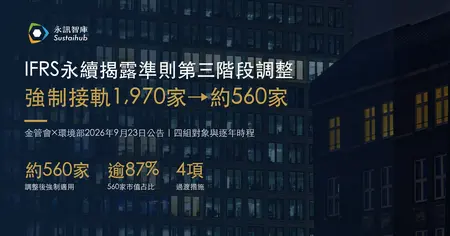
Latest adjustment (23 September 2026): The FSC and Ministry of Environment announced a policy proposal adjusting the sustainability disclosure adoption pathway, reducing mandatory IFRS Sustainability Disclosure Standards adoption from approximately 1,970 TWSE/TPEx-listed companies to approximately 560. The threshold becomes paid-in capital of NT$2 billion or more, or emission sources regulated by the Ministry of Environment and subject to inventory and verification requirements. Companies below NT$2 billion and outside that scope (approximately 1,410) are exempt from mandatory adoption but must still disclose basic climate information. Phase 3 companies need disclose only climate-related information for their first two financial years, and Scope 3 disclosure becomes voluntary; Phases 1 and 2 retain their timelines. This adjustment does not apply to the financial, insurance, securities or futures sectors. The competent authorities' formally issued regulations govern the actual requirements. For a full overview, see IFRS Phase 3 Adjustment: Mandatory Adoption Falls from 1,970 Companies to Around 560.
The FSC roadmap uses paid-in capital to determine the phase: larger companies start earlier. Although the timetable may appear generous, separating the filing year from the reporting year reveals that Phase 1 companies actually needed to start in the first quarter of 2025 by submitting an implementation plan to their boards—explained in more detail below.
(including all 14 financial holding companies)
(mid-sized TWSE/TPEx-listed companies)
(or outside the first two phases and regulated by the Ministry of Environment)
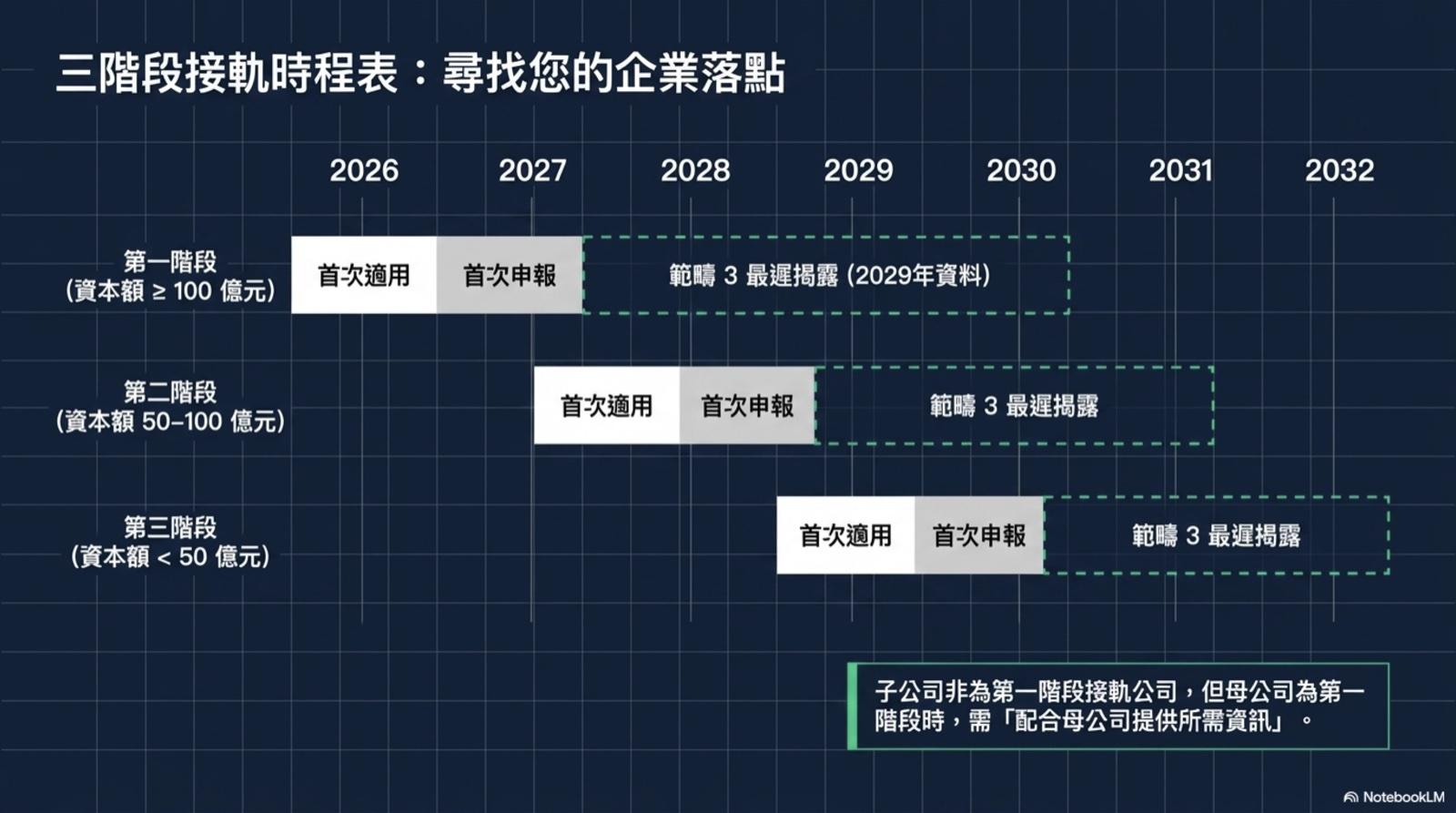
Based on the FSC's 7 November 2025 amendments to the Regulations Governing Information to be Published in Annual Reports of Public Companies and its 12 November Order No. 11403851756, incorporating the 23 September 2026 policy proposal, the entities and timelines are listed below. The competent authorities' formally issued regulations govern the actual requirements:
| Phase | Entities in scope | First financial year of application | First filing year | Latest year for Scope 3 disclosure |
|---|---|---|---|---|
| Phase 1 | TWSE/TPEx-listed companies with paid-in capital ≥ NT$10 billion (net worth ≥ NT$20 billion for no-par-value shares) | 2026 | 2027 | 2030 (disclosing FY2029 data) |
| Phase 2 | Paid-in capital ≥ NT$5 billion and < NT$10 billion (net worth ≥ NT$10 billion and < NT$20 billion) | 2027 | 2028 | 2031 |
| Phase 3 | Companies outside the first two phases with paid-in capital of NT$2 billion to less than NT$5 billion, or emission sources regulated by the Ministry of Environment and subject to inventory and verification | 2028 | 2029 | Voluntary disclosure |
| No mandatory adoption | Paid-in capital below NT$2 billion and outside Ministry of Environment regulatory scope | No mandatory adoption; basic climate information must still be disclosed | No mandatory adoption of IFRS Scope 3 requirements | |
Paid-in capital is assessed at the “end of the reporting period”. Companies should anticipate their adoption timeline based on paid-in capital at each year-end from 2026 to 2028.
2. Special Rules for Financial Holding Companies, Banks, Securities Firms and Futures Firms
The financial sector has been placed in the fast lane for adoption for a simple reason: as providers of capital, financial institutions must establish their own disclosures before asking investees to do the same.
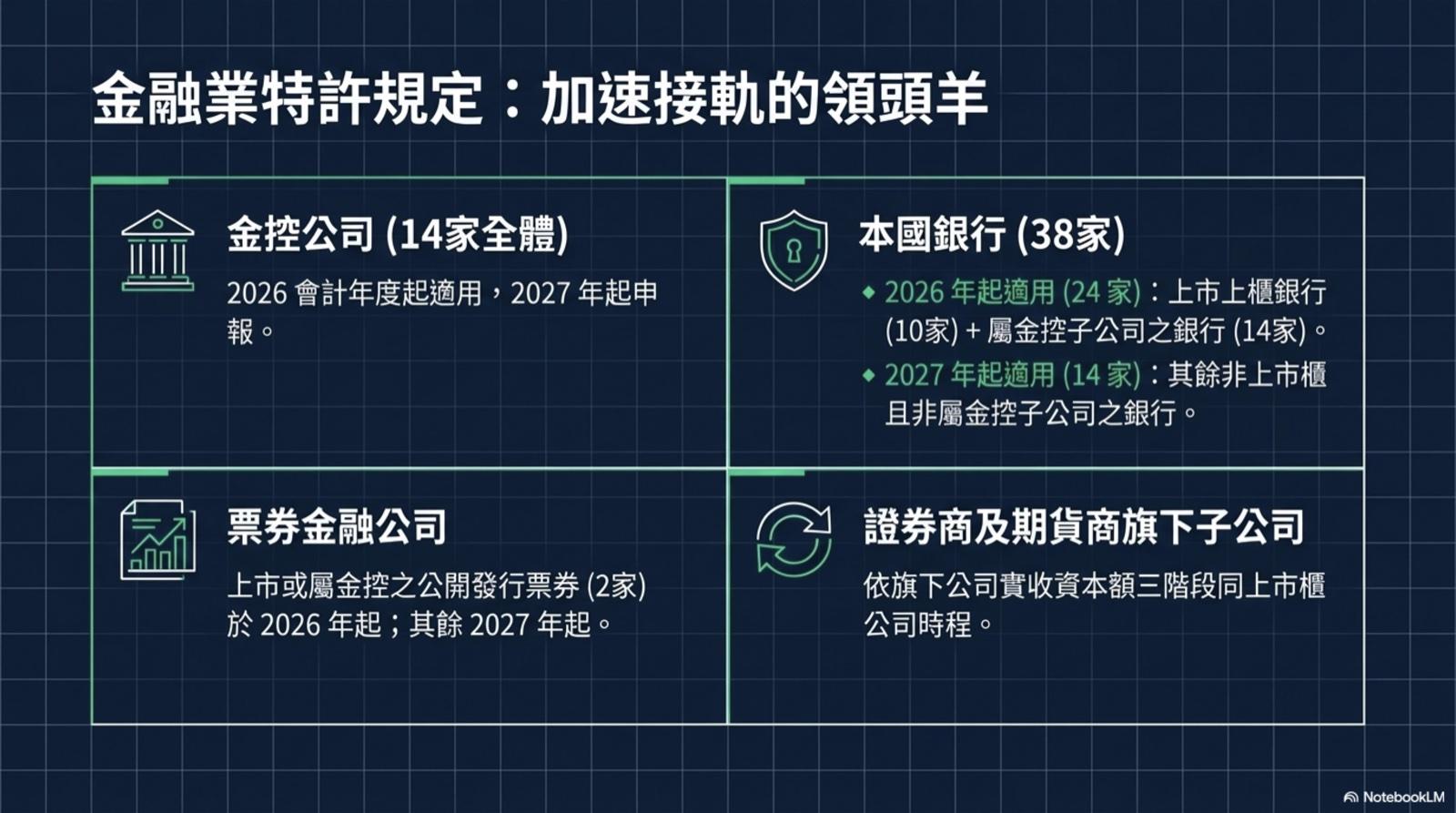
The FSC's 16 December 2025 Banking Order No. 11402739247 governs financial holding companies and banks; its 24 December 2025 Securities Order No. 1140385609 governs securities firms and futures firms:
- Financial holding companies (all 14): Apply from FY2026 and file from 2027.
- Domestic banks (all 38, with phased application):
- Apply from 2026 (24 banks): TWSE/TPEx-listed banks (10) + domestic bank subsidiaries of financial holding companies (14).
- Apply from 2027 (14 banks): Other domestic banks that are neither TWSE/TPEx-listed nor subsidiaries of financial holding companies.
- Bills finance companies: TWSE-listed bills finance companies, or public bills finance companies that are subsidiaries of financial holding companies, apply from FY2026; other cases should check the competent authority's sector-specific rules.
- Securities firms and futures firms: TWSE/TPEx-listed securities firms, integrated securities subsidiaries of TWSE/TPEx-listed companies, TWSE/TPEx-listed futures firms and dedicated futures subsidiaries of TWSE/TPEx-listed companies adopt in three phases based on paid-in capital; see official Q&A 1-1-12 for the detailed scope.
3. How Do Parent Companies, Subsidiaries, Emerging Stock Companies and Newly Listed Companies Determine Applicability?
- Reporting scope for subsidiaries: IFRS S1 paragraph 20 requires the reporting entity for sustainability-related financial disclosures to be the same as that for the related financial statements (i.e. entities included in consolidated financial statements). Subsidiaries of Phase 1 companies must therefore provide the information their parents need.
- Subsidiaries outside Phase 1: If the parent is a Phase 1 company with capital of NT$10 billion or more, subsidiaries follow their own applicable phases and disclose information under IFRS Sustainability Disclosure Standards in their annual report sustainability chapters.
- Companies newly listed on TWSE/TPEx during the year: They need not file the previous year's annual report sustainability-related financial information. For example, a company with paid-in capital of NT$12 billion listed in January 2027 need not file FY2026 sustainability information.
- Emerging Stock companies: The current roadmap excludes Emerging Stock companies, but the FSC's “IFRS Sustainability Disclosure Standards Adoption Portal” offers a simulated roadmap. Companies planning an IPO can enter their name, expected listing year and paid-in capital to generate a simulated disclosure timeline.
3. The Four Core Areas of IFRS S1 / S2: Governance, Strategy, Risk Management, and Metrics and Targets
If you are still wondering what IFRS S1 / S2 disclosures should cover, the answer is straightforward—the same four familiar areas as TCFD. The TWSE's May 2026 practical guide summary divides the standards into four pillars: governance, strategy, risk management, and metrics and targets. The standards do not prescribe how to manage your company; they require you to transparently explain what you currently do. For Taiwanese companies, this is good news: you do not need to rebuild your sustainability governance system, but must express existing arrangements in a way that meets IFRS disclosure requirements.
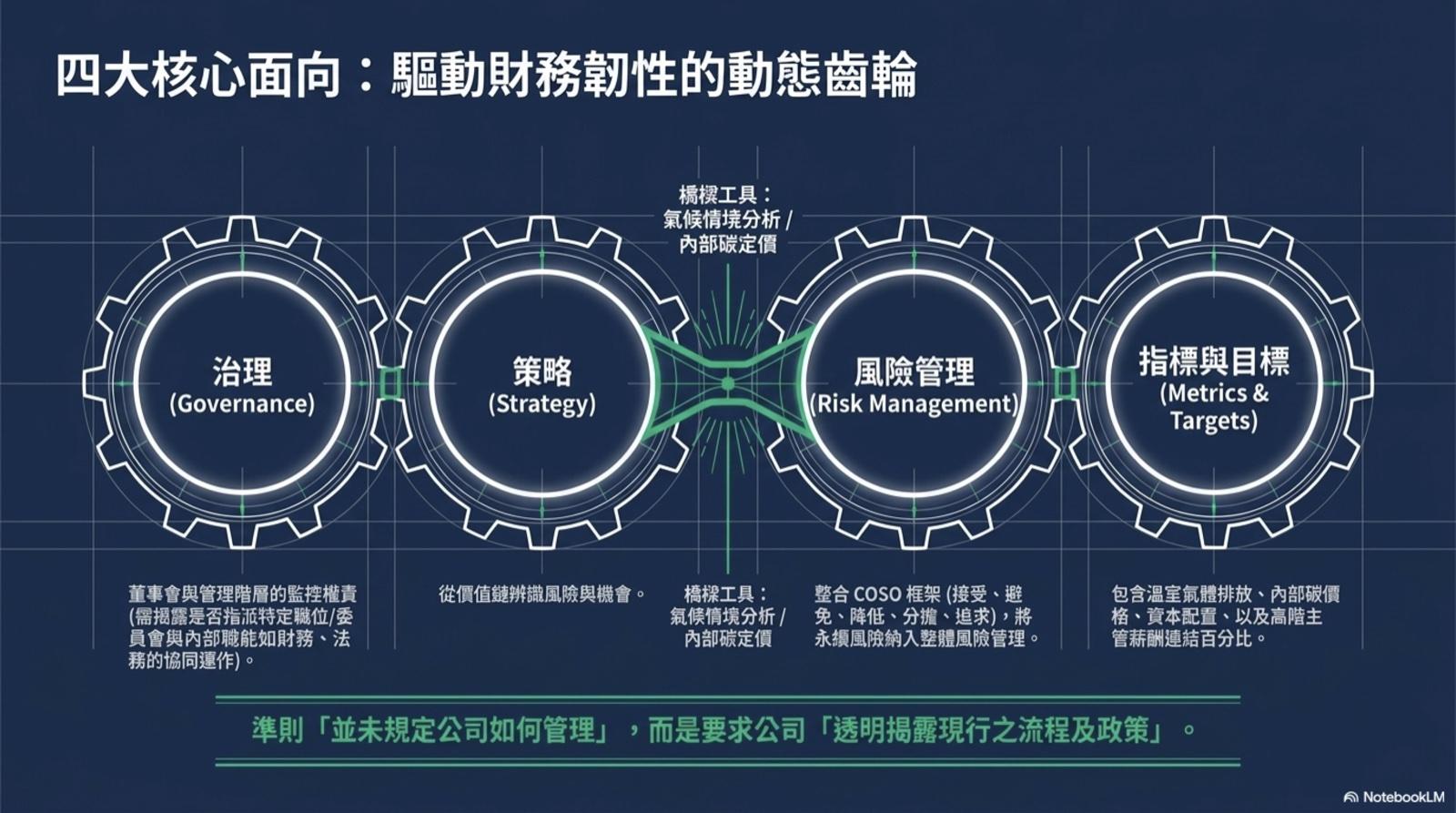
These four gears are not independent; they are interconnected: Governance determines oversight, strategy identifies risks and opportunities, risk management establishes assessment processes, and metrics and targets quantify performance. If any gear stalls, the entire disclosure loses credibility.
1. Governance: 6 Required Disclosure Points
Under IFRS S1.27(a) and S2.6(a), companies must identify and disclose:
- The governance body or individual responsible for overseeing sustainability-related risks and opportunities (the board, a sustainability committee or a designated director).
- The governance body's responsibilities and terms of reference.
- The governance body's development of sustainability skills and competencies (including training, external speakers and seminars).
- The frequency and methods of communication through which the governance body receives sustainability information (quarterly reporting, immediate notifications, annual reviews, etc.).
- How sustainability risks and opportunities are weighed in strategy decisions, major transactions and risk management.
- Sustainability target-setting and the links between performance metrics and remuneration policies.
For management (S1.27(b) / S2.6(b)), explain its key responsibilities in monitoring, managing and overseeing sustainability-related risks and opportunities; whether responsibility is delegated to a specific management role or committee (such as a chief sustainability officer or ESG committee); whether controls and procedures are used; and how these coordinate with internal functions such as finance, legal and operations.
2. Strategy: Identifying Sustainability Risks and Opportunities Across the Value Chain
IFRS S1 defines the value chain as “the full range of interactions, resources and relationships related to a reporting entity's business model and the external environment in which it operates” (S1.32, B2, B4, B5). Although abstract, this can be broken down into five familiar business activities:
Every link may contain sustainability risks—from upstream suppliers' labour practices, water resources at your own factories and transport emissions to responsibilities for recycling and disposal. All require assessment.
First identify sustainability risks and opportunities across the value chain that may affect the company's prospects, then determine disclosures based on materiality and applicable standards. Data collection can be prioritised by gaps, but this does not mean that first-year assessments can be limited to your own operations or tier-one suppliers.
Four dimensions of risk assessment
Traditional corporate risk assessments often rely on a two-dimensional matrix of “likelihood × impact”. The practical guide cautions that sustainability risks—chronic, spanning multiple years and difficult to predict—often undermine this approach. It recommends four dimensions:
Why is “vulnerability” a key dimension? It directly determines whether a company needs to establish adaptation measures immediately. A low-likelihood risk with extreme vulnerability, such as extreme weather at a single overseas facility, may affect the company's prospects much more than a high-likelihood risk with comprehensive responses already in place.
When identifying sustainability-related risks, companies must also consider both the user perspective and the management perspective to determine relevant risks and opportunities. If either management or primary users expect a risk or opportunity to affect the company's prospects, it is a relevant risk or opportunity.
3. Risk Management: 5 COSO Risk Responses
Drawing on the COSO risk management framework, the practical guide presents 5 risk responses:
| Response | Definition | Example |
|---|---|---|
| Accept | Take no action to change risk severity, but monitor it closely | Monitor supply chain sustainability risks with manageable short-term effects to maintain stable operations |
| Avoid | Eliminate the risk. Apply zero tolerance to a specific risk to avoid it entirely or minimise it | Relocate a key facility from an earthquake-prone area to a lower-risk location |
| Reduce | Take mitigation measures to bring residual risk within an acceptable risk appetite | Assess the risk of community protests against a solar installation and adjust investment decisions accordingly |
| Share | Transfer some risk through external collaboration (insurance, joint ventures, suppliers, etc.) | Purchase employee insurance to reduce the financial effects of occupational accidents on the company |
| Pursue | Respond to a risk while turning it into an opportunity to create value | Improve processes to cut waste disposal costs and refine waste for sale as a by-product |
Four steps to integrate sustainability into overall risk management: (1) Understand sustainability concepts → (2) Identify processes and functions → (3) Update risk classifications → (4) Adjust risk management components.
4. Metrics and Targets: 7 Cross-Industry Climate Metrics
IFRS S2 paragraph 29 requires companies to disclose 7 categories of cross-industry climate-related metrics:
- Greenhouse gas emissions: Scope 1, 2 and 3 emissions (generally measured under the GHG Protocol).
- Climate-related transition risks: The amount and percentage of assets or business activities vulnerable to transition risks.
- Climate-related physical risks: The amount and percentage of assets or business activities vulnerable to physical risks.
- Climate-related opportunities: The amount and percentage of assets or business activities aligned with climate opportunities.
- Capital deployment: Capital expenditure, financing or investment deployed towards climate-related risks and opportunities.
- Internal carbon prices: Whether and how carbon prices inform decisions, and the price per metric tonne of greenhouse gas emissions.
- Remuneration: Whether and how climate considerations are incorporated into executive remuneration, and the percentage linked to climate considerations.
In addition to cross-industry metrics, companies should disclose SASB industry-based metrics, as well as the following established to address sustainability risks or seize opportunities: company-specific metrics and targets.
4. The Q&A's 12 Revisions: Tracking the Latest FSC Guidance
Since first publishing the IFRS Sustainability Disclosure Standards Q&A on 18 September 2023, the FSC has made 12 revisions. Tracking these revisions helps companies keep pace with policy changes:
| Revision date | Highlights |
|---|---|
| 2023.09.18 | Initial publication of Questions 1–9 |
| 2024.02.29 | Restructured into two main topics: Policy and Regulations, and IFRS Sustainability Disclosure Standards |
| 2024.11.08 | Incorporated company questions from July–August briefing sessions; reorganised into three topics with 60 questions in total |
| 2025.06.10 | Added questions on IFRS S1 transition provisions, acquisitions and disposals of subsidiaries, and value chain estimates |
| 2025.07.22 | Added 4 questions on identifying and disclosing risk mitigation activities (2-1-12 to 2-1-15) |
| 2025.11.26 | Adjusted adoption timelines and added requirements for securities and futures firms following FSC amendments to the Regulations Governing Information to be Published in Annual Reports of Public Companies |
| 2026.04.09 | Added a Q&A index aligned with the standards' structure and further questions on climate scenario analysis, cross-industry metrics and remuneration links |
| 2026.04.14 | Revised Question 1-1-5 following FSC endorsement and announcement of the IFRS S2 Amendments to Greenhouse Gas Emissions Disclosures |
Corporate ESG or finance leaders should review the Q&A revision history quarterly and incorporate relevant updates into internal training and internal control review checklists.
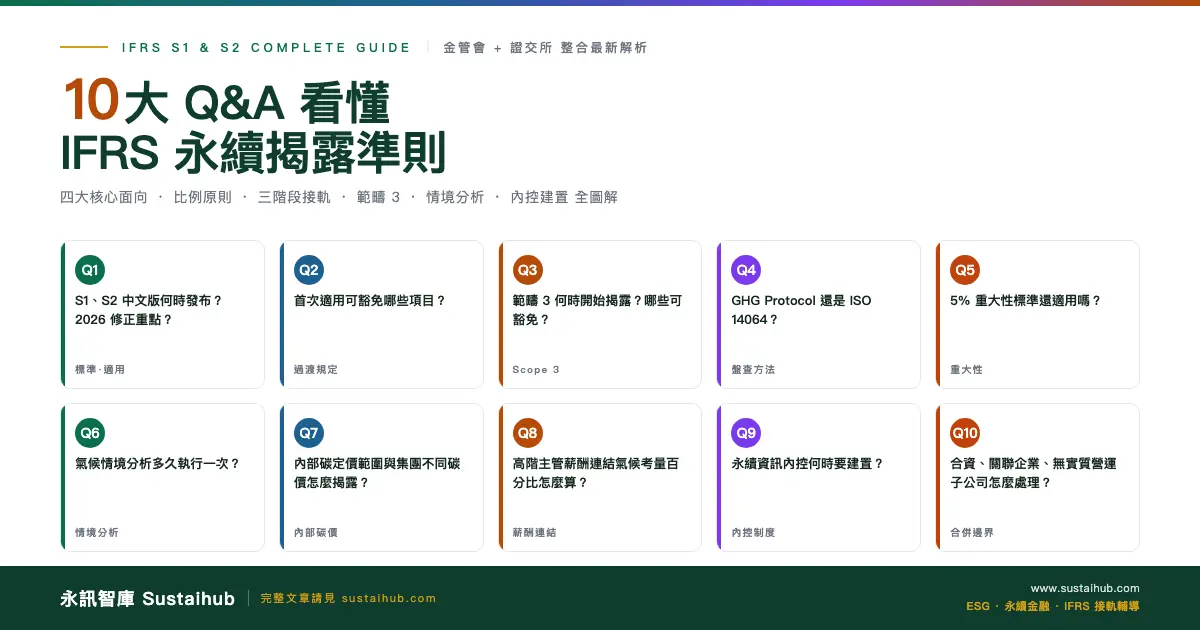
5. Full Answers to the 10 Questions ESG Practitioners Need to Know
Sustaihub selected these 10 questions from the 81-page Q&A to address the issues ESG practitioners search for most often and the most common practical pitfalls. Each includes the original question number for quick reference.
Q1: When Were the Traditional Chinese Versions of IFRS S1 and S2 Published? What Are the Latest 2026 Amendments?
Corresponding Q&A: 1-1-5
The FSC endorsed IFRS S1 and S2 on 12 November 2025 under Order No. 11403851755. The Traditional Chinese versions are available from the IFRSs download portal. The Accounting Research and Development Foundation (ARDF) is responsible for translating IFRS Sustainability Disclosure Standards into Chinese.
The latest 2026 changes, issued by the ISSB on 11 December 2025 and endorsed by the FSC on 13 April 2026, are the IFRS S2 Amendments to Greenhouse Gas Emissions Disclosures. Companies may elect early application from 1 January 2026. The four main changes are:
- Scope 3 Category 15 financed emissions: Measurement and disclosure may be limited to financed emissions (excluding other non-financing activities in Category 15).
- Flexible industry classification for financial institutions: Companies engaged in commercial banking or insurance may use industry classification systems other than the Global Industry Classification Standard (GICS) when disclosing financed emissions.
- Flexibility in GHG measurement methods: If a jurisdictional authority requires all or part of an entity to use a method other than the GHG Protocol (2004 edition), that part may use the alternative method required by the authority.
- Flexibility in GWP values: When converting GHG emissions, if a jurisdictional authority requires global warming potential (GWP) values from a different IPCC assessment report, the affected part may use the mandated values.
Q2: What Relief Is Available on First Applying IFRS Sustainability Disclosure Standards?
Corresponding Q&A: 2-1-9, 2-1-15
Under the transition provisions in IFRS S1 Appendix E, the FSC allows TWSE/TPEx-listed companies to use transition relief, recognising differences in domestic companies' sustainability maturity:
- Climate-only disclosures in the first year: Phases 1 and 2 may disclose only climate-related risks and opportunities under IFRS S2 in their first year. Under the 23 September 2026 proposal, Phase 3 companies may disclose climate information only for their first two years, applying only IFRS S1 requirements relevant to climate risks and opportunities, such as fair presentation, materiality, the reporting entity and connected information.
- No comparative information required in the first year: Comparative-period information may be omitted in the first year of application.
- Deferred Scope 3 disclosure: Phases 1 and 2 may defer Scope 3 until their 4th financial year of application (Phase 1 must disclose FY2029 data by 2030 at the latest). Under the 23 September 2026 policy proposal, Phase 3 disclosure becomes voluntary. Phases 1 and 2 follow FSC Order No. 11403851756; financial institutions remain subject to the original rules.
Note: IFRS S1 paragraph 72 states that an entity may not claim compliance unless its sustainability-related financial disclosures comply with all IFRS Sustainability Disclosure Standards requirements. Accordingly, a company's first year of application is the first year in which it fully complies with the standards; applying only some provisions early in 2025 does not count as the first year.
Q3: When Must Scope 3 GHG Emissions Be Disclosed? What Exemptions Apply?
Corresponding Q&A: 1-2-5, 1-2-6, 2-2-11
Disclosure timing: Phases 1 and 2 may defer Scope 3 until their 4th financial year of application (Phase 1 must disclose FY2029 data by 2030 at the latest). Under the 23 September 2026 policy proposal, Phase 3 disclosure becomes voluntary. Comparative information is not required when Scope 3 is first disclosed; financial institutions follow their sector-specific rules.
Disclosure scope: All 15 Scope 3 categories should be considered in the inventory. Companies may refer to Question (4) in Appendix 2 of the “Scope 3 GHG Inventory Reference Guide and Frequently Asked Questions” and the Scope 3 GHG Inventory Reference Guide: At a Glance on the adoption portal, determining disclosure categories based on their position in the industry value chain and identification of material emission source categories.
The IFRS S2 amendments endorsed by the FSC on 13 April 2026 further permit Scope 3 Category 15 measurement and disclosure to be limited to financed emissions, easing pressure on the financial sector.
Addressing data collection difficulties:
- Estimate in accordance with the IFRS S2 measurement framework (paragraphs B38–B57), prioritising primary data (data from specific activities within the entity's value chain, meter readings, utility bills and supplier-provided activity-specific data).
- Where primary data are unavailable, estimates of value chain information may also incorporate secondary data (industry-average data from third-party databases).
- The Taiwan Stock Exchange (TWSE), Taipei Exchange (TPEx), Taiwan Futures Exchange and Taiwan Depository & Clearing Corporation held Scope 3 inventory workshops in 2024 and 2025 and published the Scope 3 GHG Inventory Reference Guide and Frequently Asked Questions and its At a Glance summary.
Q4: Should GHG Inventories Use the GHG Protocol or ISO 14064?
Corresponding Q&A: 1-2-1, 1-2-2
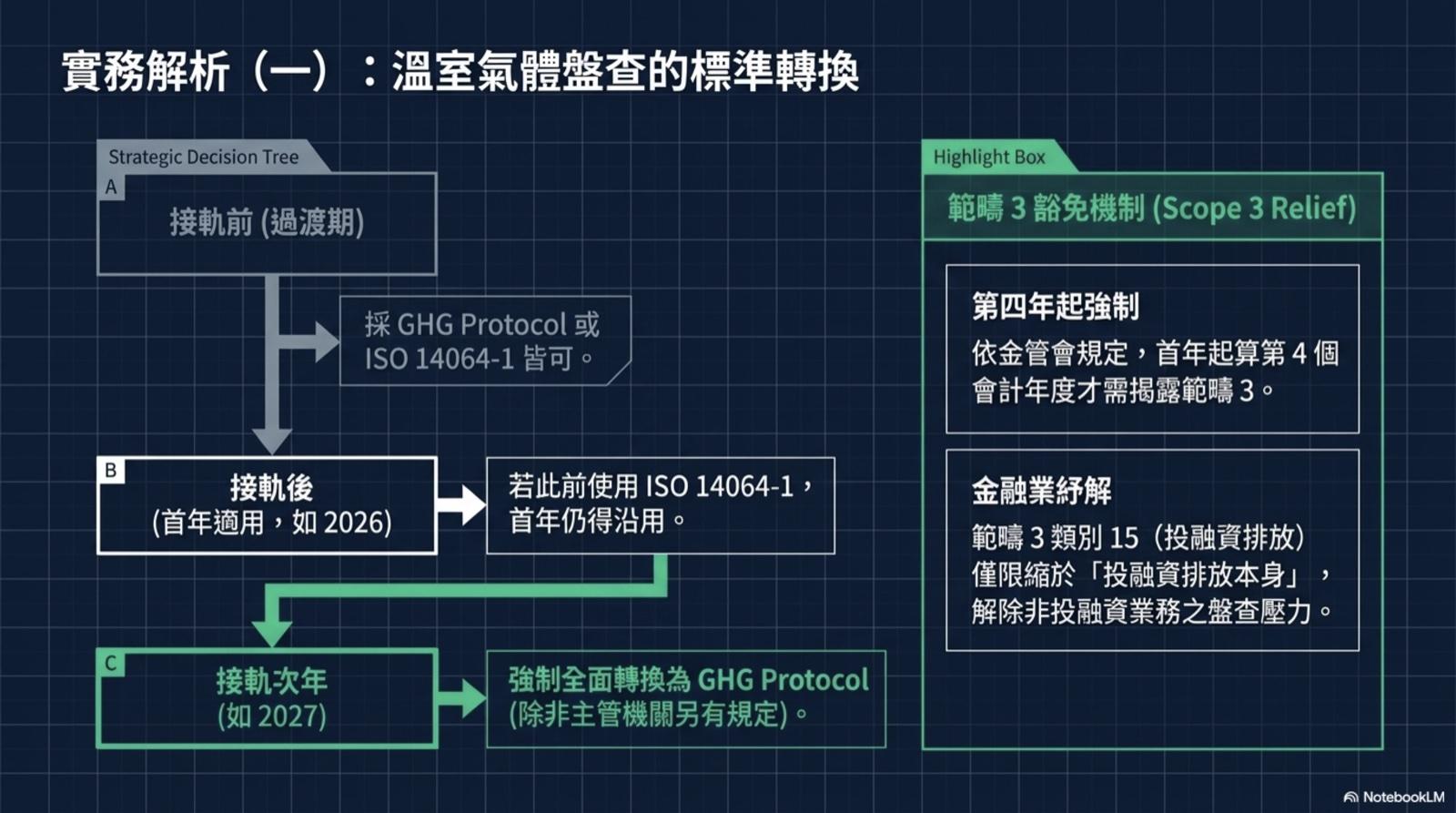
Before adoption: Use the GHG Protocol (2004 edition) or ISO 14064-1. If the company's roadmap inventory boundary includes emission sources regulated by the Ministry of Environment, those sources may directly follow the ministry's inventory and assurance requirements.
After adoption: The relevant IFRS S2 requirements are as follows:
- Measurement method: For GHG emissions in climate-related information, except emission sources subject to inventory requirements under the Climate Change Response Act that follow Ministry of Environment methods, measurement must follow the Greenhouse Gas Protocol: A Corporate Accounting and Reporting Standard or an FSC-endorsed method. Disclose the applicable method, measurement approach, inputs and assumptions under IFRS S2 Climate-related Disclosures.
- Transition provisions: If a company used another method, such as ISO 14064-1, in the annual reporting period immediately before first application, it may continue using that method in its first year. For example, a Phase 1 TWSE/TPEx-listed company adopting in 2026 that used ISO 14064-1 in 2025 may retain it for FY2026 under IFRS S2 paragraph C4(a). From FY2027, it follows the GHG Protocol or an FSC-endorsed method, subject to applicable exceptions.
- New 2026 amendments: If a jurisdictional authority requires all or part of an entity to use a GHG measurement method other than the GHG Protocol (2004 edition), that part may follow the mandated alternative method.
Assurance requirements: Scope 1 and Scope 2 require independent third-party assurance. If the assurance opinion is unavailable when the annual report is filed, the report must state this, and assured GHG information and the assurance report must be disclosed and uploaded to the Market Observation Post System by the end of October of the same year. Scope 3 assurance is not currently mandatory.
Q5: How Is Materiality Assessed? Does the Sustainability Roadmap's 5% Disclosure Threshold Still Apply?
Corresponding Q&A: 1-2-10, 2-1-4
The 5% disclosure materiality threshold no longer applies. Q&A 1-2-10 explicitly removed in April 2025 the former Sustainability Roadmap Q5 requirement that omitted GHG emissions must not exceed 5% of total emissions.
After adopting IFRS Sustainability Disclosure Standards, companies must apply IFRS S1 paragraphs 17–19 and exercise professional judgement based on their circumstances. Materiality depends on whether omitting, misstating or obscuring information could reasonably be expected to influence decisions by primary users of general purpose financial reports (investors). IFRS S1 paragraph B21 requires both quantitative and qualitative factors to be considered.
Practical example: An amount immaterial to consolidated financial statements does not necessarily make the related sustainability risk or opportunity's financial effects or metrics immaterial. A company may identify Labour Practices as an applicable SASB disclosure topic and find that a subsidiary's total wages fall below financial statement materiality. However, it also considers qualitative factors, such as whether average wages by region or subsidiary are significantly below or above peers and could affect its reputation. It may therefore judge that subsidiary's average wage information material and retain it.
Exception to note: Material discrepancies in GHG assurance still use 5% as a reference threshold. If assured GHG information differs from the original annual report figures by 5%, or by less than 5% but is judged material by nature, the company should submit a corrected filing to the board for approval.
Q6: How Often Must Climate Scenario Analysis Be Performed?
Corresponding Q&A: 2-2-8, 2-2-9
Under IFRS S2 Appendix B paragraph B18, companies need not repeat climate scenario analysis annually, but must update it at least in line with their strategic planning cycle to ensure assumptions and results remain appropriate.
However, disclosures under IFRS S2 paragraph 22(a)—the results of the entity's climate resilience assessment—must be updated each reporting period. Scenario analysis itself may follow the strategic planning cycle, but resilience must be assessed annually to reflect updated insights into how climate uncertainty affects the business model and strategy.
Practical example: A company conducts climate scenario analysis every 2 years in line with its strategic planning cycle (most recently in 2026, with an update planned for 2028), while continuously assessing resilience to climate risks in each reporting period:
- 2026 reporting period: The company uses the IEA Net Zero Emissions (NZE) Scenario for climate scenario analysis, such as evaluating carbon fee risk, and discloses climate resilience, including the feasibility of strategies and adaptive capacity to address cost pressure.
- 2027 reporting period: It determines that existing assumptions and analysis remain appropriate, so no new scenario analysis is needed. It nevertheless assesses and discloses climate resilience based on operational results, strategy adjustments and adaptive capacity during the reporting period.
IFRS S2 paragraphs 25(a)(ii) and 25(b) also require disclosure of processes for identifying, assessing, prioritising and monitoring climate-related risks and opportunities, including whether and how scenario analysis informs their identification. Its forward-looking nature helps identify structural shifts such as transition policies, technology substitution, demand changes and extreme weather, while improving consistency in subsequent resilience assessments and disclosures.
The practical guide frames climate resilience assessment as an annually repeatable judgement process: Assess resilience every year, repeat scenario analysis in line with the strategic planning cycle, and initiate it whenever material operational or external changes occur.
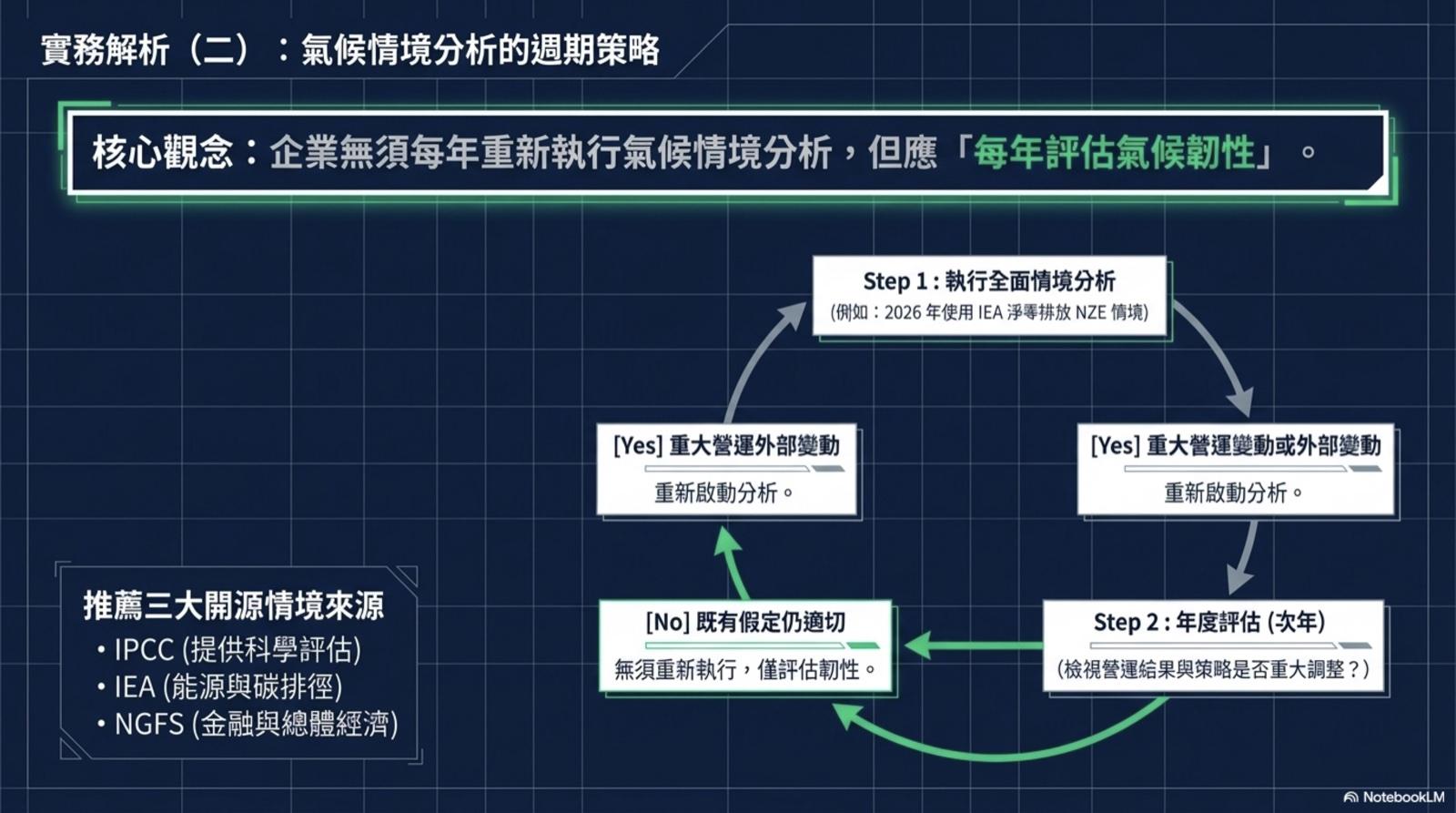
Three main sources of climate analysis data (usable directly in corporate scenario analysis):
- Intergovernmental Panel on Climate Change (IPCC): Provides scientific assessments of global climate change to help governments and businesses identify climate risks and impacts and plan policy.
- International Energy Agency (IEA): Analyses how energy systems affect climate change and assesses future energy use and carbon emissions, including the NZE scenario.
- Network for Greening the Financial System (NGFS): Comprises central banks and supervisors, focuses on financial climate risks and opportunities, and provides scenario analysis suitable for financial holding companies and banks.
Q7: What Is the Disclosure Scope for Internal Carbon Pricing? How Should Groups Disclose Different Carbon Prices?
Corresponding Q&A: 2-2-3, 2-2-13
Under IFRS S2 paragraph 29(f), an entity must disclose:
- Specifically, whether and how internal carbon prices inform decisions, such as investment decisions, transfer pricing and scenario analysis;
- The price per metric tonne of greenhouse gas emissions used to assess its emissions costs.
Internal carbon pricing disclosures are not limited to management of Scope 1, Scope 2 or Scope 3 emissions; they reflect how the company actually uses internal carbon pricing to manage emissions and make decisions.
Disclosing different carbon prices within a group: If consolidated entities use different internal carbon prices, apply the materiality principles in IFRS S1 paragraphs 17–19 and aggregation and disaggregation requirements in paragraphs B29–B30. Consider all facts and circumstances to avoid obscuring material information. Suggested considerations include:
- Materiality principle: If carbon price information for certain entities, such as the parent or major operating sites, is material and adequately represents the group's material information about carbon-pricing decisions, disclose that information.
- Aggregation by shared characteristics: For example, group by the pricing scheme's scope—activities, geographic areas or entities—and disclose corresponding prices. Where internal pricing mechanisms differ, assess whether aggregation, such as averaging prices, faithfully represents management mechanisms and decision uses. Disaggregate appropriately if aggregation would obscure material information.
- Presenting ranges: A range may be used, such as “internal carbon prices across the group range from NT$300 to NT$500 per metric tonne”, but a wider range may provide less useful information.
The practical guide divides internal carbon pricing implementation into 4 stages: build internal consensus → select a method → pilot → monitor and evaluate. In Sustaihub's advisory experience, Taiwanese companies most often struggle with Step 2 (method selection) and Step 4 (getting business units to use it):
Secure board and cross-departmental support and establish an internal carbon pricing working group.
Choose from 4 types: shadow prices, carbon fees, implicit prices and internal trading.
Trial the approach in selected departments or decision contexts, then adjust based on results.
Expand implementation, link to KPIs, provide training and review regularly.
Q8: How Is the Percentage of Executive Remuneration Linked to Climate Considerations Calculated?
Corresponding Q&A: 2-2-14
Under IFRS S2 paragraph 29(g), an entity must disclose:
- Whether and how climate-related considerations are incorporated into executive remuneration, described in narrative form;
- For executive remuneration recognised in the current period, the percentage linked to climate-related considerations.
When disclosing this percentage, an entity must use executive management remuneration recognised in the current-period financial statements as the calculation basis to calculate the portion linked to climate-related considerations.
Disclosing different management mechanisms within a group: Where consolidated entities use different mechanisms to incorporate climate considerations into executive remuneration, apply IFRS S1 paragraphs 17–19 on materiality and B29–B30 on aggregation and disaggregation. In practice, companies may use more feasible approaches that reflect group management arrangements:
- Describe the share of executive remuneration linked to climate considerations using ranges, such as “up to 5% of total remuneration”, “ESG metrics account for approximately 10%–15%” or “10% weighting in variable remuneration”.
- Explicitly list material entities and their remuneration links to climate metrics.
- For information omitted from disclosure, companies must still carefully assess and document their judgement under IFRS S1's materiality principles, confirming that omission could not reasonably be expected to influence primary users' decisions.
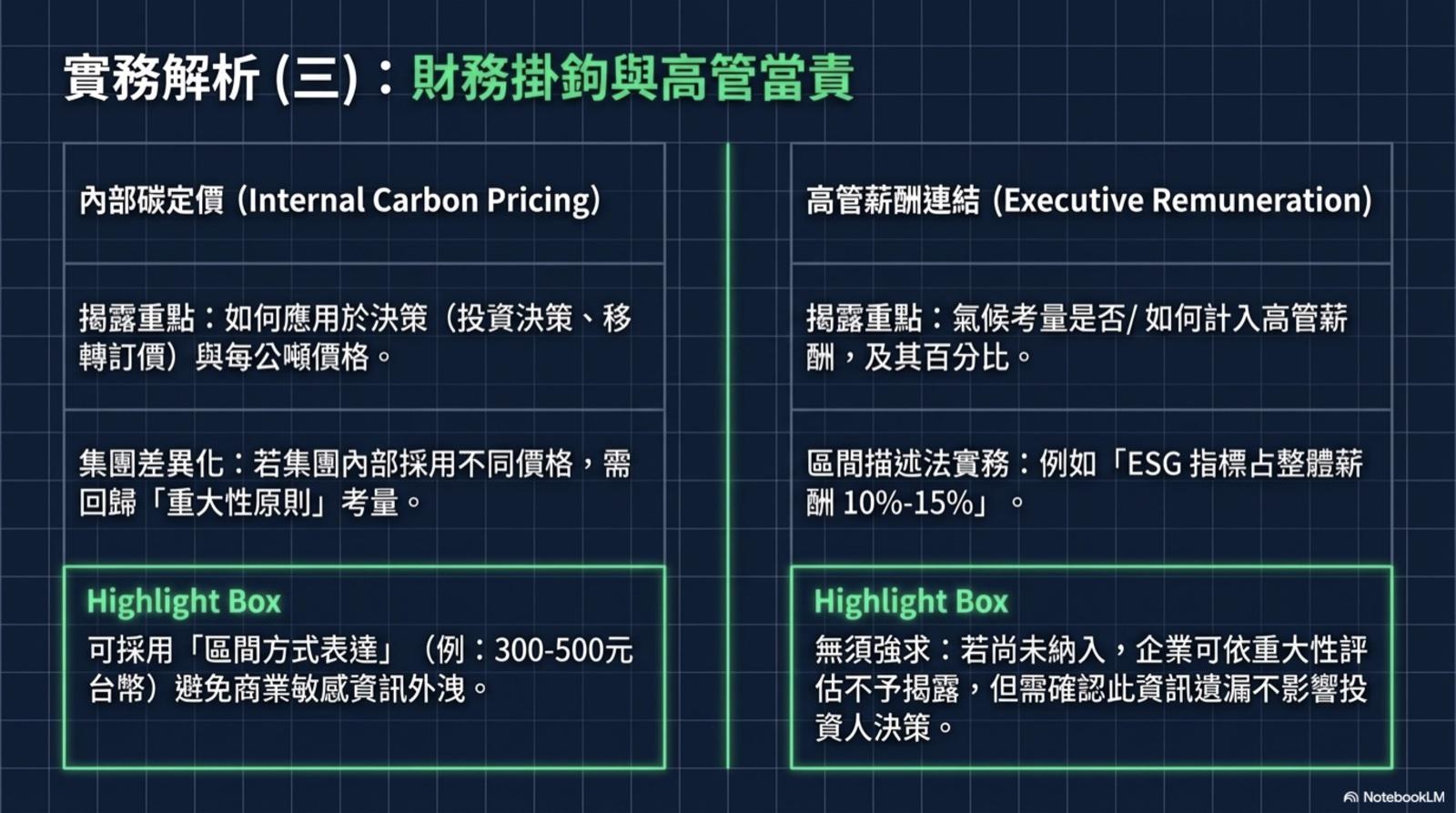
8 Steps to Incorporate Climate Considerations into Executive Remuneration (TWSE practical guide summary, section 5.1.4):
- Connect climate and strategy: Integrate climate targets into operating strategy and risk management.
- Connect targets with strategy and plans: Incorporate climate targets, such as net zero, into transition plans, set short- and medium-term milestones, and clarify responsibilities.
- Engage appropriate stakeholders: Involve remuneration, sustainability, finance, risk management and other departments in metric design and decisions.
- Select appropriate metrics: Consider global decarbonisation trends and current incentive structures when choosing climate metrics, such as Scope 1+2 emissions, renewable energy share and net-zero milestones.
- Design the mechanism: Use market practices and company targets to design remuneration incentives and formulas.
- Involve the remuneration committee: Seek remuneration committee and board participation and approval to address climate challenges.
- Disclose clearly: Clearly disclose mechanisms and metrics, ensuring consistency with business strategy and climate disclosures.
- Review and adjust: Regularly review effectiveness and adjust the design, metrics and targets over time.
Q9: When Must Internal Controls for Sustainability Information Management Be Established?
Corresponding Q&A: 3-1-1

The FSC amended the Regulations Governing Establishment of Internal Control Systems by Public Companies on 22 April 2024. Article 8, paragraph 4 requires companies with shares listed on TWSE or traded on TPEx to include sustainability information management in their internal control systems, effective 1 January 2025. The requirements apply to TWSE/TPEx-listed companies regardless of capital size.
Implementation priorities:
- Effectiveness of control design: Under Articles 8 and 13 of the internal control regulations and Article 5, paragraph 3 of the TWSE/TPEx rules for preparing and filing sustainability reports, identify necessary changes to existing sustainability information and preparation processes and design the required controls.
- Operating effectiveness of controls: Include whether the key controls identified during design are actually implemented in self-assessment items.
- Audit plan: Under TWSE/TPEx procedures for reviewing listed companies' internal control systems, a company found non-compliant will be asked to develop concrete corrective measures, with follow-up until deficiencies are resolved. Material deficiencies may incur contractual penalties under the rules.
Emerging Stock companies applying for TWSE/TPEx listing: A company planning to apply in 2024 and list in 2025 must incorporate sustainability information management into internal controls before listing at the latest and include it in the annual audit plan. A company applying in 2025 must have established and implemented those controls when submitting its application and include them in its 2025 annual audit plan.
Financial sector: In its 28 August 2024 letter No. 11302725761, the FSC instructed financial holding companies and banks to complete planning for incorporating sustainability information management into internal controls by the end of 2024. Insurance-sector requirements were amended on 7 May 2024 and apply from 1 January 2025.
Q10: How Are Scope 1 and 2 Emissions of Joint Ventures, Associates and Non-Operating Subsidiaries Handled?
Corresponding Q&A: 1-2-4, 2-2-10
Under the current Q&A, emissions from associates and joint ventures may be calculated using the control approach (financial or operational control) or the equity share approach, applied consistently:
- If a company uses the financial control approach and determines that it lacks financial control over an associate, it need not separately obtain that associate's inventory information and discloses zero under IFRS S2 paragraph 29(a)(iv)(2). For joint ventures with shared financial control, emissions are recognised in proportion to equity ownership.
- If a company uses the operational control approach and has operational control over an associate or joint venture, it recognises 100% of emissions; otherwise, 0%.
- If a company uses the equity share approach, it recognises emissions in proportion to its ownership of associates and joint ventures.
- Regardless of whether the GHG Protocol method is used, the measurement approach and reasons must be disclosed under IFRS S2 paragraphs B26–B28.
Risk assessment for subsidiaries without substantive operations: Under IFRS S1, sustainability-related financial disclosures use the same reporting entity as the related financial statements—the consolidated reporting entity. Even a subsidiary without substantive operations remains within group risk management. Assess whether climate risks or opportunities could reasonably affect group prospects, including assets held, contractual or guarantee obligations, or location in a high physical-risk area. If assessment shows extremely low physical risks, such as factory flooding, or transition risks, such as carbon taxes, with immaterial group financial effects, a simplified assessment may be used based on materiality (IFRS S1 paragraph 18) and proportionality (IFRS S1 Appendix B paragraph B6; IFRS S2 paragraph 11).
6. A Recommended 6-Step Approach to Adopting IFRS Sustainability Standards
Combining Q&A topics 3-1 (sustainability information internal controls) and 3-2 (implementation plans), Sustaihub recommends these 6 steps for systematic adoption. From establishing a cross-departmental team to obtaining third-party assurance, each step brings the company closer to compliance in 2026:

Step 1: Establish a Cross-Departmental Project Team
Under Q&A 3-2-1, the adoption project team should be led by a senior executive overseeing sustainability-related work, such as policy implementation and resource allocation. We recommend the chief sustainability officer or chief financial officer, with representation from sustainability, accounting and finance, risk management, compliance and internal audit. The project team should include accounting and finance personnel because the standards emphasise connections and consistency with financial statements.
Step 2: Assess the Current Position and Perform a Gap Analysis
Use the ARDF's “Paragraph-by-Paragraph Gap Analysis of IFRS S1 and S2 Against Annual Reports and Sustainability Reports” (published under Practical Guidance and Q&A / Gap Analysis on the adoption portal) to compare current disclosures with each requirement and identify areas needing improvement.
Step 3: Establish Internal Controls for Sustainability Information Management
Under Q&A 3-1-1, TWSE/TPEx-listed companies must establish sustainability information management controls from 1 January 2025. Refer to the “Reference Items for Assessing Internal Control System Effectiveness” examples amended by TWSE and TPEx on 24 May 2024, particularly RA1.7.7 on preparing sustainability information, and use a Risk Control Matrix (RCM) to integrate risk assessment and control activities.
Step 4: Report the Implementation Progress Schedule to the Board Quarterly
Under Q&A 3-2-2, Phase 1 companies must report the previous quarter's implementation work to the board from Q1 2025 and upload it to the ESG digital platform within 15 days after the end of the quarter in which it was presented, continuing through Q2 2027, when Q1 2027 work is reported. If no work is scheduled for a quarter, no board report or filing is required for that quarter.
Step 5: Prepare a Trial Annual Report Chapter on Sustainability-Related Financial Information
Under Q&A 3-2-2, the key deliverable for implementation item “4-1. Complete the annual report sustainability information chapter and obtain board approval” is the board meeting minutes approving that chapter. When the board approves the FY2026 sustainability chapter in Q1 2027, Phase 1 companies may also report completion in the implementation progress schedule, then file their implementation progress by 15 April 2027.
Step 6: Obtain Third-Party Assurance and Continue Improving
Under Q&A 1-2-7 and 1-2-9, assurance is currently not mandatory for annual report sustainability topics other than GHG information. Companies may nevertheless select recognised assurance providers under the “Guidelines for the Management of Assurance Institutions for Sustainability Reports of TWSE/TPEx-Listed Companies” (issued 2022.12.21), such as the Big Four accounting firms or specialist third parties, to improve information quality and accuracy. Scope 1 and 2 assurance opinions should be obtained by annual report filing; if unavailable, they must be disclosed on the Market Observation Post System by the end of October of the same year.
7. Proportionality and Quantitative Relief: How Can Companies Reasonably Reduce the Disclosure Burden?
Recognising practical challenges involving resources, data availability and access to experts, IFRS Sustainability Disclosure Standards introduce the “proportionality principle” to ease the disclosure burden. It is an often-overlooked mechanism that can legitimately reduce preparation work.
1. Two Main Proportionality Mechanisms
| Area | “Reasonable and supportable information…without undue cost or effort” | Consideration of skills, capabilities and resources |
|---|---|---|
| Identifying risks and opportunities | ✅[S1.B6(a) / S2.11] | — |
| Determining the value chain's scope | ✅[S1.B6(b) / S2.B36] | — |
| Current financial effects | — | — |
| Anticipated financial effects | ✅[S1.37 / S2.18] | ✅[S1.39 / S2.20] |
| Climate-related scenario analysis | ✅[S2.B1] | ✅[S2.B8] |
| Calculations in specified cross-industry metric categories | ✅[S2.30] | — |
| Measuring Scope 1 and Scope 2 GHG emissions | — | — |
| Measuring Scope 3 GHG emissions | ✅[S2.B39] | — |
“Reasonable and supportable information available without undue cost or effort” (S1.B9–B10, BC12): Companies may use various internal and external sources, including internal risk management processes, industry and peer experience, and external ratings, reports and statistics.
“Consideration of skills, capabilities and resources” (S1.37, 39 / S2.18, B6): Use an approach commensurate with the skills, capabilities and resources available to prepare the disclosures. If a company lacks the skills, capabilities or resources to provide quantitative information on the anticipated financial effects of a sustainability risk or opportunity, it need not provide that quantitative information and may provide qualitative information instead.
2. Quantitative Disclosure Relief: A 3-Step Decision Process
Not every sustainability risk requires a forced estimate of financial effects. The standards provide relief, but its proper use requires passing through 3 filters. The practical guide organises this logic into a “Burden-Relief Funnel”:

Under IFRS S1.38–40 and S2.19–21, companies can assess whether quantitative disclosure is required as follows:
- Can the effects be separately identified? If not → Provide alternative disclosures (qualitative information + quantified combined financial effects).
- Is measurement uncertainty so high that quantification would not be useful? If yes → Provide alternative disclosures.
- Does the company have the skills, capabilities or resources? If not → Provide alternative disclosures.
- If all three filters are passed → Disclose fully quantified financial effects.
3. Exemption for Commercially Sensitive Information (S1.73, B34–B37)
If a company determines that information about a sustainability-related opportunity is commercially sensitive and meets all of the following conditions, it may omit that information:
- The information is not already publicly available;
- Disclosure would seriously prejudice the company's economic benefits;
- It cannot disclose the information in a way that meets the disclosure objective, such as at an aggregated level, without seriously prejudicing its economic benefits.
A company using this exemption must disclose that it has done so for the omitted information and reassess eligibility at each reporting date. Note: this exemption applies only to sustainability-related opportunities; sustainability-related risks are not eligible for the commercially sensitive information exemption.
8. Common IFRS Sustainability Disclosure Pitfalls and Solutions
The following six checks draw on the standards and Q&A to help review reporting boundaries, data discrepancies and judgement records.

| Common pitfall | Relevant standard / Q&A | Solution |
|---|---|---|
| A material error is discovered after disclosure in the annual report sustainability chapter | IFRS S1 paragraphs 83 and B58–59 (Q&A 2-1-7) | Restate prior-period comparative amounts and disclose the nature of the error unless impracticable; if impracticable, disclose the circumstances causing this. |
| The annual report and sustainability report use different reporting entities | IFRS S1 paragraph 20 (Q&A 2-1-1) | Sustainability reports primarily follow GRI and have broader coverage; the annual report chapter must match consolidated financial statement boundaries. A sustainability report may cross-reference the annual report for identical information. |
| Assured GHG figures differ materially from the original annual report filing | IFRS S1 paragraphs 83 and B55–59 (Q&A 1-2-2) | Correct the filing and explain the discrepancy. If it reaches 5% of the original figure or is otherwise judged material, obtain renewed board approval and complete correction by the end of October of the same year. |
| No specific foreign currency translation rate is prescribed | IFRS S1 paragraphs 77–82 (Q&A 2-1-19) | In practice, use rates applied to corresponding items, such as profit or loss and assets, in current-period financial statements. If this creates material measurement uncertainty, disclose its sources, assumptions and estimation judgements as required. |
| Long-term climate risk assessments involve high measurement uncertainty | IFRS S1 paragraph 79 (Q&A 2-1-6, 2-1-18) | The standards permit disclosure of information with high measurement uncertainty. Disclose uncertainty sources, assumptions, approximations and other judgements; uncertainty alone does not justify non-disclosure. |
| Updates to GRI Topic Standards are not adopted on time | Q&A 1-1-6 | GRI 101: Biodiversity 2024 took effect on 1 January 2026, replacing GRI 304, and should apply to FY2025 sustainability reports. GRI 102: Climate Change 2025 and GRI 103: Energy 2025 take effect on 1 January 2027 and should apply to FY2026 sustainability reports. |
9. How Sustaihub Helps Companies Adopt IFRS Sustainability Disclosure Standards
With years of experience in Taiwan's ESG and sustainable finance sectors, Sustaihub helps TWSE/TPEx-listed companies, financial holding companies, banks and manufacturers establish carbon inventories, ESG reports, TCFD climate risk disclosures and sustainability information internal controls. For IFRS Sustainability Disclosure Standards adoption, we provide:
- IFRS S1 / S2 gap assessment and implementation planning: Assess the current position and develop a 6-step implementation pathway.
- GHG inventories and Scope 3 estimation: Complete Scope 1, 2 and 3 inventories under both the GHG Protocol and ISO 14064-1, and establish financed-emissions measurement mechanisms.
- Syber digital ESG reporting platform: Systematise sustainability information management with version control, automated citations and audit trails to reduce preparation costs and meet internal control requirements.
- Climate scenario analysis and financial effect quantification: Use scenarios such as IEA NZE and IPCC SSP to assess short-, medium- and long-term climate resilience.
📩 Book an IFRS Sustainability Standards Implementation Consultation
10. Further Resources and Official Links
- FSC IFRS Sustainability Disclosure Standards Adoption Portal (https://isds.tpex.org.tw) — Includes company-specific and simulated roadmaps, practical guidance, Q&A and examples for 10 industries, including steel manufacturing, hardware, semiconductors and commercial banking.
- Financial Supervisory Commission — Adoption roadmap, annual report disclosure regulations and sustainability reporting rules.
- Accounting Research and Development Foundation — Traditional Chinese IFRS S1 / S2 translations, paragraph-by-paragraph gap analyses and TCFD comparison documents.
- ISSB / IFRS Foundation Sustainability Standards — Original English IFRS S1 and S2 standards and educational materials, including the ISSB's August 2025 publication “Disclosing information about anticipated financial effects applying ISSB Standards”.
- Original PDF downloads: FSC IFRS Sustainability Disclosure Standards Q&A, revised 2026.4.14 (81 pages), and TWSE Practical Guide to IFRS Sustainability Disclosure Standards (Including IFRS S1 and S2): At a Glance, 2026.5.22 (58 pages). Both are available from the adoption portal.
- Scope 3 GHG Inventory Reference Guide and Frequently Asked Questions, Scope 3 GHG Inventory Reference Guide: At a Glance — Jointly published by TWSE, TPEx, the Taiwan Futures Exchange and Taiwan Depository & Clearing Corporation to support Scope 3 disclosure preparation.
Conclusion: Turn Uncertainty into Actionable Next Steps
Start by organising existing annual reports, sustainability reports and climate risk data, then allocate work according to your adoption phase and gap assessment. Record each disclosure's source, period, owner and review history so the team can find and update it easily.
Whether you are a Phase 1 company with capital of NT$10 billion or more, a financial holding company or bank, or an Emerging Stock company planning an IPO, Sustaihub can tailor an IFRS S1 / S2 implementation approach to your phase, industry and data readiness. Our strength is translating complex official provisions into worklists your accounting, sustainability and internal audit teams can understand.
Further reading:
- The Complete GHG Inventory Guide: GHG Protocol vs ISO 14064-1
- Scope 3 Inventories in Practice: Identifying and Estimating the 15 Categories
- 5 Practical Challenges in TCFD Climate Scenario Analysis
- GRI 101: Biodiversity 2024 Disclosure Guide for Sustainability Reports
Updated 6 October 2026. Main updates: Adoption scope, timelines and Scope 3 explanations adjusted to the 23 September policy proposal. IFRS Sustainability Disclosure Standards continue to evolve, and the FSC, ISSB and ARDF regularly issue new guidance. Visit the official portal quarterly for updates. If this article differs from current regulations, official announcements take precedence.
Check Taiwan's Applicable Timeline and Data Preparation
The deferred Scope 3 timelines stated here for Phase 1 and 2 TWSE/TPEx-listed companies follow FSC Order No. 11403851756; they are not a globally applicable four-year IFRS S2 exemption. Under the 23 September 2026 policy proposal, Phase 3 Scope 3 disclosure becomes voluntary; the competent authorities' formally issued regulations govern the actual requirements. Phase 1 companies file FY2026 information in 2027. For annual report chapter deadlines, see the FSC's February 2026 reminder. Financial institutions and other entity types should check their own applicable rules.
Disclosure Preparation Example: Turn Water Shortage Risk into a Reviewable Worksheet
This example supports data collection and allocation of team responsibilities. Materiality and final disclosures must still be judged against the company's actual circumstances.
- Risk and boundary: Which facilities and processes might shut down because of water shortages? Identify the legal entities and reporting period.
- Data and owners: Facilities teams compile water use, backup water sources and shutdown records; finance confirms relevant costs, assets and estimation assumptions.
- Assessment and evidence: Distinguish realised from anticipated effects, recording periods, methods, sources and data gaps. Do not enter zero for figures that cannot be estimated.
- Review and follow-up: Assign reviewers, target completion dates and versions, retain the basis for judgements, and recheck when data change.
Next, refer to the IFRS implementation planning steps and learn about using Syber to organise disclosure data and reviews. Applicable timeline checked: 6 October 2026.
Download the official IFRS Sustainability Disclosure Standards Q&A (14 April 2026 edition, PDF) and use this article's question numbers to check the original. Updated editions can be checked on the adoption portal's Q&A page.