
2025 Corporate Governance Evaluation Indicators Released: Sustainability Weighting Rises to 49%
The 12th Corporate Governance Evaluation significantly increased the weighting of "Promoting Sustainable Development" to nearly half. These historical indicators precede the transition to the ESG Evaluation in 2026 (ROC year 115), highlighting Taiwan's capital market efforts to encourage stronger corporate governance mechanisms and sustainability. This article explains the key indicator revisions to help companies prepare early and improve their evaluation performance.
What to decide after reading If you are still researching, first confirm whether your task is the report, the carbon inventory, peer disclosure references, or software selection.
Table of Contents

Updated on October 6, 2026. This update identifies the historical evaluation year and links to the current ESG Evaluation system and the 12th evaluation results.
This article preserves the 2025 (ROC year 114) Corporate Governance Evaluation indicators. The key points have been consolidated in The ESG Evaluation System: Current Indicators and the Transition from Earlier Evaluations. From 2026 (ROC year 115), prepare according to the new ESG Evaluation system. For the 2025 results, see Understanding the 12th Corporate Governance Evaluation Results. Official reference: TWSE annual results and explanation of the new system.
Turn this article into your next step
If this article touches disclosure, carbon inventory, or report preparation, use the system or database to check how peers handle it.
The Taiwan Stock Exchange (TWSE) released the 2025 (ROC year 114, 12th) Corporate Governance Evaluation Indicators, comprising 70 indicators across four dimensions. The changes include 9 new indicators, 11 revisions, 14 deletions and adjustments to 4 indicator question types. The evaluation covers January 1 to December 31, 2025 (ROC year 114), and the results were announced on April 30, 2026 (ROC year 115).
Key Changes to the Indicators
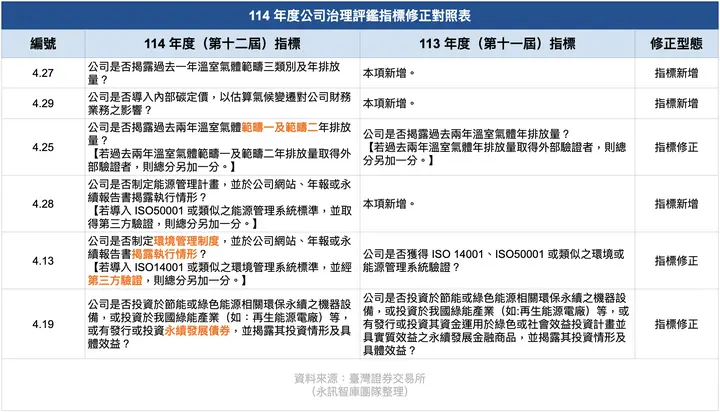
[Environmental]
To encourage stronger greenhouse gas disclosures, a transition to lower emissions, and the achievement of net-zero sustainability goals:
- New indicator 4.27: "Disclose Scope 3 greenhouse gas categories and annual emissions for the preceding year"
- New indicator 4.29: "Introduce internal carbon pricing"
- New advanced bonus criterion: "Disclose 2030 emissions reduction targets, strategies and action plans" (indicator 4.26)
- Indicator 4.25 revised to: "Disclose annual Scope 1 and Scope 2 greenhouse gas emissions for the preceding two years"; its advanced bonus criterion is also revised to: "Obtain external verification of annual Scope 1 and Scope 2 greenhouse gas emissions"
To encourage companies to address climate change, improve energy efficiency and reduce environmental impacts:
- New indicator 4.28: "Establish an energy management plan", with certification to an energy management system standard added as an advanced bonus criterion
- Indicator 4.13 revised to: "Establish an environmental management system", with certification to an environmental management system standard reclassified as an advanced bonus criterion
- Indicator 4.19 revised to: "Invest in environmentally sustainable machinery and equipment relating to energy efficiency or green energy, invest in Taiwan's green energy industry (such as renewable energy power plants), or issue or invest in sustainable development bonds, and disclose the investments and their specific benefits"
[Social]
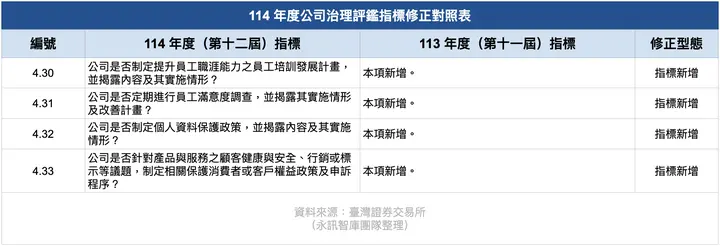
To encourage companies to support employees' career development and communicate and engage with them:
- New indicator 4.30: "Establish employee training and development plans to enhance career capabilities, and disclose their content and implementation"
- New indicator 4.31: "Conduct regular employee satisfaction surveys, and disclose their implementation and improvement plans"
To encourage companies to protect consumer rights:
- New indicator 4.32: "Establish a personal data protection policy, and disclose its content and implementation"
- New indicator 4.33: "Establish policies and complaint procedures protecting consumer or customer rights in relation to product and service issues such as customer health and safety, marketing or labelling"
[Governance]
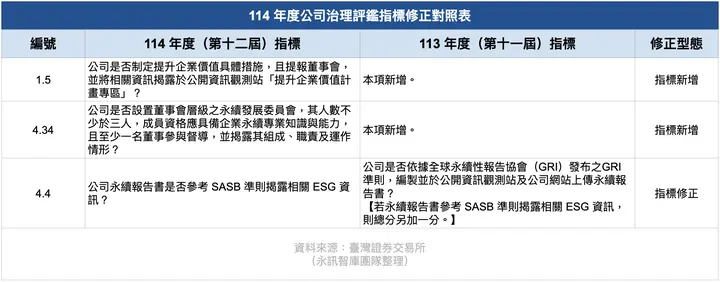
To encourage companies to prioritise shareholder value and actively communicate with shareholders:
- New indicator 1.5: "Establish specific measures to enhance corporate value, report them to the board, and disclose the relevant information in the Corporate Value Enhancement Plan section of the Market Observation Post System"
To encourage TWSE/TPEx-listed companies to establish sustainability and nomination committees:
- New indicator 4.34: "Establish a board-level sustainability committee with at least three members who possess professional sustainability knowledge and capabilities, with at least one director participating in oversight, and disclose its composition, responsibilities and operations"
To improve differentiation and reflect changes in domestic regulations and practice:
- The original advanced bonus criterion under indicator 4.4, "Disclose relevant ESG information in the sustainability report with reference to the SASB Standards", is reclassified as a basic scoring criterion
Changes to Scoring Weights
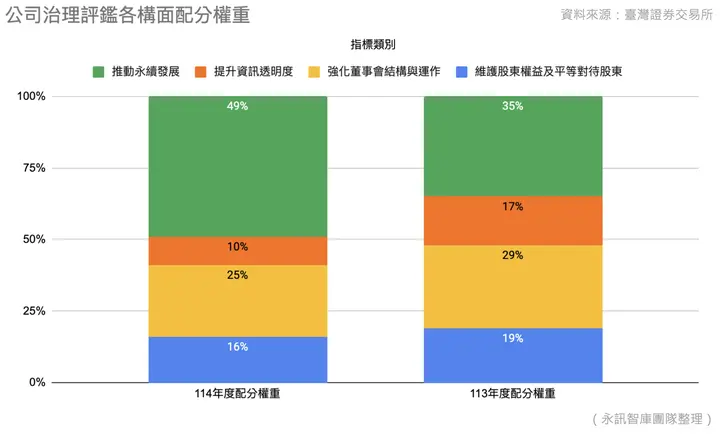
To encourage companies to prioritise sustainability and reflect changes in the number of indicators, the weighting for "Promoting Sustainable Development" increases from 35% to 49%. "Protecting Shareholder Rights and Equitable Treatment of Shareholders" decreases from 19% to 16%, "Enhancing Board Composition and Operation" from 29% to 25%, and "Increasing Information Transparency" from 17% to 10%.
From 2026 (ROC Year 115): Corporate Governance Evaluation Becomes ESG Evaluation
To assess TWSE/TPEx-listed companies more comprehensively across ESG dimensions and support investors' ESG investment decisions, the TWSE has transformed the Corporate Governance Evaluation into the ESG Evaluation from 2026 (ROC year 115). To support a smooth transition, this evaluation added 7 environmental and social indicators and increased the weighting of "Promoting Sustainable Development" to nearly half, demonstrating Taiwan's capital market commitment to sustainable transformation. Companies should respond early, using the changes not only to improve evaluation results but also to review and strengthen their sustainability governance capabilities comprehensively.
Explore Digital Management to Strengthen Sustainability Competitiveness!
Sustaihub's digital sustainability consulting team is committed to exploring effective ways to achieve corporate sustainability management goals!
The Syber Sustainability Management Platform is an ideal collaboration platform for ensuring the accuracy of sustainability information. It stores and classifies all corporate sustainability data in a structured way, removing the need to spend extensive staff time repeatedly reviewing and collecting information and helping reduce overall processing time.
Source: Corporate Governance Center / Corporate Governance Evaluation section
TWSE Listed Company Sustainability Corporate Governance Evaluation
FAQ
View AllWhat were the key changes to the 2025 (ROC year 114) Corporate Governance Evaluation indicators?
The 2025 (ROC year 114, 12th) Corporate Governance Evaluation added 9 indicators, revised 11, deleted 14 and adjusted 4 indicator question types. New environmental indicators include disclosure of Scope 3 greenhouse gas categories and annual emissions, and the introduction of internal carbon pricing. The sustainability dimension's weighting increased to 49%.
What period does the 2025 (ROC year 114) Corporate Governance Evaluation cover?
The 2025 (ROC year 114) Corporate Governance Evaluation covers January 1 to December 31, 2025. Results were announced on April 30, 2026.
How did the sustainability dimension's weighting change in 2025 (ROC year 114)?
In the 2025 (ROC year 114) Corporate Governance Evaluation, the sustainability dimension's weighting rose to 49%, the highest to date. This encourages TWSE/TPEx-listed companies to give greater attention to sustainability, including environmental, social and governance disclosures and practices.
Choose the ESG task you want to complete first
Still researching? See how peers write in the report database, or compare Syber and DCarbon.
How to decide the next stepStart by deciding what you need: an answer, regulations, peer examples, or a tool?