1. What is CCUS Carbon Capture Technology?
1.1 Basic Technical Concept
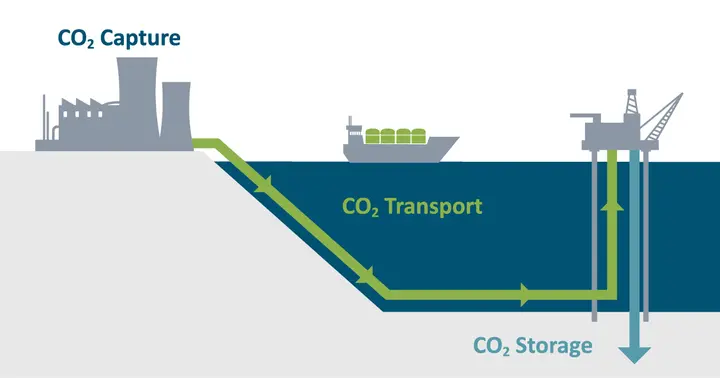
CCUS (Carbon Capture, Utilization and Storage) refers to directly capturing carbon dioxide from emission sources (such as power plants or industrial smokestacks), compressing it, and then utilizing it (for example, as chemical feedstock) or storing it in geological formations to prevent its release into the atmosphere.
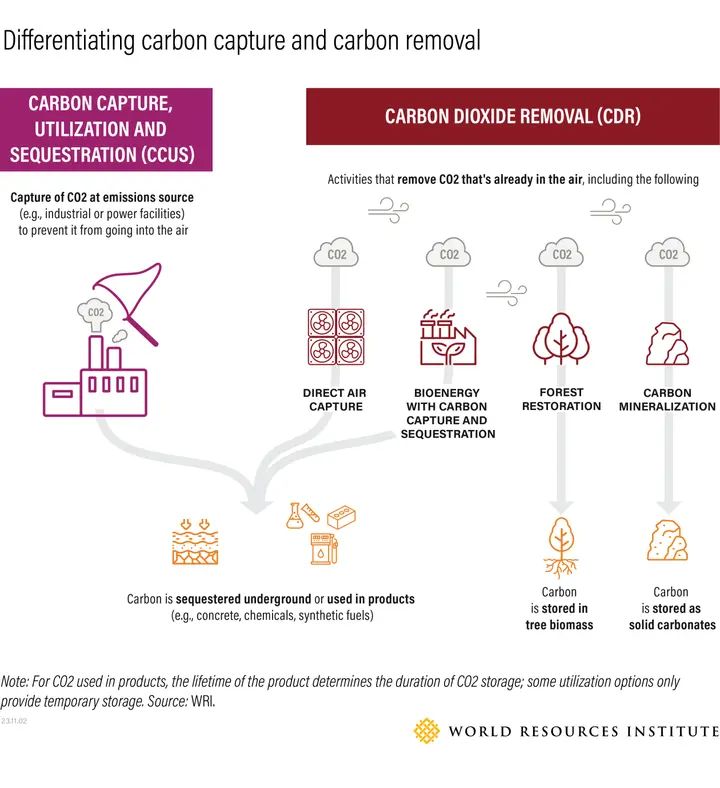
Differences between CCUS and various CDR technologies, World Resources Institute
1.2 Main Application Areas
CCUS primarily serves hard-to-abate industries, such as steel, cement, and petrochemicals.
These industries have concentrated emissions during production that are difficult to completely decarbonize through energy efficiency improvements alone, making CCUS a viable supplementary solution.
2. Policy Promotion and Controversy Around CCUS Technology
In recent years, governments worldwide have actively incorporated this technology into national carbon reduction strategies.
The Japanese government is fully developing CCUS technology as a carbon reduction strategy, viewing it as an important tool for achieving net-zero emissions. Meanwhile, Taiwan's Ministry of Environment Climate Change Administration has also proposed a "Carbon Reduction Flagship Action Plan," listing CCUS technology as a key development project, hoping to help domestic hard-to-abate industries achieve carbon reduction goals.
However, while policies are being promoted, international skepticism toward CCUS continues to grow.
- At the COP28 climate summit, although a historic consensus was reached on "transitioning away from fossil fuels," experts warned that over-reliance on carbon capture technology may delay the truly necessary energy transition.
- Maurice Burns, Chairman of BCG's Center for Energy Impact, echoed this concern, pointing out that solar, wind, and battery technologies are already economically viable and can be rapidly scaled. What's truly needed is accelerating the deployment of renewable energy and storage; while hydrogen and carbon capture remain supplementary tools for energy transition, overemphasis on them could cause global carbon reduction efforts to lose focus.
3. Why is CCUS Technology So Controversial?
3.1 "False Solution" Criticism
The international organization Oil Change International (OCI) directly states that CCUS technology is a "false solution" because it is easily misapplied.
- Much of the captured carbon dioxide is "reused" by being injected into oil wells to extract more oil, known as Enhanced Oil Recovery (EOR).
- The U.S. Petra Nova project is one example: although claiming a 90% capture rate, it lacked complete data verification and was revealed to use captured CO₂ for enhanced oil recovery, essentially extending fossil fuel extraction under the guise of storage.
- ExxonMobil's Shute Creek project was also named: over 90% of CO₂ ultimately went to enhanced oil recovery, criticized for extending fossil fuel lifespans through "sell or emit."
- The Science and Environmental Health Network's "Carbon Capture Facts" website also points out that every 1 ton of carbon dioxide injected into oil wells produces 2-5 tons of carbon dioxide, which actually worsens the climate crisis.
Many international scholars also believe this technology is over-packaged and cannot actually provide effective climate solutions. These criticisms mainly focus on the technology's inherent limitations and its potential to become an excuse for fossil fuel industries to continue operating.
Additionally, there are social backlash and safety concerns. Residents in Iowa, USA, worry that underground pipelines transporting carbon dioxide might trigger earthquakes, pollution, and health and safety issues.
3.2 Technical Benefits Below Expectations
Using ExxonMobil's Shute Creek project as an example again, although the project has operated continuously for 35 years, actual capture volume was one-third less than the design target.
Furthermore, while the IPCC recognizes CCUS as one carbon reduction action, it does not endorse it as a core carbon reduction method. More critically, the technology's actual emission reduction results are minimal—currently, global CCUS technology captures only 0.1% of emissions.
4. What Should Businesses Watch Out for When Adopting CCUS Technology?
4.1 Risk Assessment
When considering procuring this technology, businesses must conduct comprehensive risk assessments. Cost-effectiveness and actual emission reduction effect risks are key areas businesses must carefully examine. Most importantly is greenwashing risk. Businesses must avoid procuring technology solutions that appear environmentally friendly but actually have no substantive emission reduction effects. This not only wastes corporate resources but may also damage the company's ESG reputation.
4.2 Alternatives and Future Trends
Compared to the problematic CCUS technology, businesses have more mature and effective carbon reduction choices. A renewable energy-first strategy is the current international consensus. COP28 set a clear goal of tripling renewable energy by 2030, indicating that renewable energy is the mainstream direction for carbon reduction.
From Taiwan's policy direction, the 2050 power mix plan projects renewable energy to account for 60-70%, far exceeding the proportion of thermal power including carbon capture technology. This clearly shows the main direction of future energy development.
5. Conclusion: Rationally Viewing CCUS's Role in Carbon Reduction Strategies
Although CCUS technology theoretically has carbon reduction potential, based on current development status, it is not a panacea for corporate carbon reduction. Building a diversified carbon reduction strategy is key. Businesses should not pin all hopes on a single technology but should adopt multiple technology combinations to reduce risks and improve carbon reduction effectiveness. This way, businesses can truly avoid falling into the "greenwashing" trap and achieve substantial environmental benefits and sustainable development goals.
The path to corporate carbon reduction doesn't need flashy new technology packaging, but rather steady, effective, and verifiable practical actions. In this process, rationally evaluating the true value of each technology will be key for businesses to move toward genuine sustainable development.
References
- "Japan's Wrong Net-Zero Solution: Carbon Capture and Storage" — Environmental Information Center, June 6, 2025
- "Carbon Capture Is Not a Panacea: Why CCS Is a False Solution for the Oil and Gas Industry" — Environmental Information Center, March 12, 2024
- Taiwan 2050 Net-Zero Pathway — National Development Council
- Strategic Plan (p.26) — Japan Ministry of Economy, Trade and Industry | Agency for Natural Resources and Energy, February 2025
- The ill-fated Petra Nova CCS project: NRG Energy throws in the towel, Institute for Energy Economics & Financial Analysis, October 5, 2022
- Carbon Capture to Serve Enhanced Oil Recovery: Overpromise and Underperformance, Institute for Energy Economics & Financial Analysis, March 2022