
How to Deliver a Twin Transition: Five Actions and Corporate Examples Linking Digitalisation and Sustainability
To succeed in the future, companies need to deliver sustainability solutions through digital technology. Research shows that businesses pursuing a twin transition are 2.5 times more likely than others to perform strongly. This article explores how digital transformation and sustainability can strengthen competitiveness, with practical examples and implementation strategies to help companies stand out in a rapidly changing business environment.
What to decide after reading If you are still researching, first confirm whether your task is the report, the carbon inventory, peer disclosure references, or software selection.
Table of Contents
- Introduction: Why a Twin Transition Matters for the Future
- The Drivers of Digital Transformation
- Corporate Sustainability's Role in the Twin Transition and the Drivers of Digital Transformation
- Corporate Examples
- Challenges and Opportunities in the Twin Transition
- How Can Companies Plan and Implement a Twin Transition?
- Conclusion: Advance Both Transitions for a Sustainable Future
- About Sustaihub

Introduction: Why a Twin Transition Matters for the Future

(Advancing digital transformation and sustainability together helps companies find new sources of value and strengthen competitiveness and sustainability capabilities. Image: Royal Schiphol Group and PA Consulting)
The twin transition, also called twin transformation, was first introduced in the EU's 2020 industrial strategy. It aims to advance digital transformation and sustainability together so they are closely integrated and mutually reinforcing.
In this decisive decade for climate action, digitalisation plays a key role in sustainable growth. The World Economic Forum estimates that digital solutions could reduce global emissions by 20%. They are also essential to achieving the United Nations Sustainable Development Goals (SDGs), with digital technologies able to positively affect around 70% of the targets. Integrating digitalisation and sustainability can unlock major efficiency and productivity gains. Research by international management consultancy Accenture found that companies pursuing a twin transition are 2.5 times more likely than others to perform strongly in the future. In today's rapidly changing business environment, combining digital transformation with ESG sustainability offers a new strategic approach to finding value, strengthening competitiveness and building sustainability capabilities.

(Accenture research found that companies pursuing a twin transition are 2.5 times more likely than others to perform strongly in the future. Image: Accenture Research)
The Drivers of Digital Transformation
Digital transformation is an essential corporate strategy. Rapid advances in cloud computing, big data, artificial intelligence and the Internet of Things help companies improve operating efficiency, innovate products and services, and remain competitive. These technologies enable continuous data collection and analysis, revealing market trends and customer needs to support more precise business strategies.
Corporate Sustainability's Role in the Twin Transition and the Drivers of Digital Transformation
Corporate sustainability is an essential part of the twin transition. Amid global environmental problems and social challenges, investors, consumers and regulators increasingly scrutinise companies' sustainability capabilities. Through a twin transition, companies can use digital technology to improve environmental management, reduce resource consumption and emissions, and advance supply chain management, employee well-being and social responsibility, supporting sustained long-term growth.
Corporate Examples
Examples from Far EasTone, ASUS and SYSTEX illustrate the practical benefits of a twin transition.
1. Far EasTone and Sustaihub Connect Energy Management and Carbon Inventory Systems:

(Image: Far EasTone Startup Accelerator)
Far EasTone and Sustaihub launched an SME Sustainability Transformation Toolkit to help smaller businesses adopt environmental solutions quickly. It combines Far EasTone's energy management system with Sustaihub's DCarbon greenhouse gas inventory SaaS platform, allowing companies to understand energy use and emissions and generate report drafts with AI, making the first step in sustainability management easier.
>> Article link: Far EasTone and Sustaihub Launch an SME Sustainability Transformation Toolkit Connecting Energy Management and Carbon Inventories
2. ASUS Uses Data-Driven Decisions and a Supply Chain Platform to Improve Value Chain Management:

(Image: ASUS Sustainability Report 2022)
Since 2021, ASUS has developed a sustainable supply chain platform to analyse suppliers' ESG performance, identify potential risks and focus audits and improvements on high-risk suppliers. It also plans a greenhouse gas management platform consolidating emissions across the value chain to support reduction target management and its 2050 net-zero vision. These digital measures strengthen risk management and emissions tracking, creating an environmentally responsible supply chain with controlled risks while improving value chain efficiency and competitiveness.
>> ESG case study: ASUS Sustainability Report 2022
3. SYSTEX Uses Digital Tools to Improve Sustainability Reporting Efficiency:
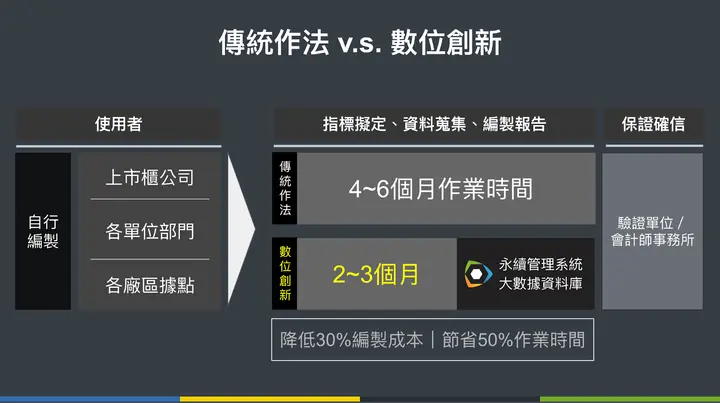
(Image: Compiled and provided by Sustaihub)
Using Sustaihub's SMS sustainability management system, SYSTEX archives routinely repeated disclosures, reducing time spent on email confirmations, proofreading and searching. Keyword searches in the ESG database quickly locate peer-industry and historical CSR/ESG reports for reference, substantially reducing processing costs and improving reporting efficiency. Consolidating data across years also supports more effective sustainability target setting.
>> Press release: Saving Companies 50% in Time and 30% in Costs: Wistron and SYSTEX Use Its AI to Produce ESG Reports
Challenges and Opportunities in the Twin Transition
A twin transition offers opportunities but also presents challenges. Companies must carefully consider how to balance digital investment and sustainability costs, drive cultural and structural change internally, and manage stakeholder relationships throughout the transition.
How Can Companies Plan and Implement a Twin Transition?
In its research report, Accenture identifies five concrete, targeted actions companies can take:
- Set the Direction: Promote business models driven by sustainability and enabled by technology. Focus on ecosystem business models that use technology to scale faster and more sustainably. Most twin-transition companies already generate more than 10% of revenue from these models and expect them to account for nearly 80% within the next three years.
- Begin the Journey: Combine resources to scale technology-enabled sustainability practices. Twin-transition companies allocate a larger share of investment to innovation: before the pandemic, 45% invested more than 10% of annual revenue, with that proportion expected to reach 57% during recovery. They treat sustainability and technology as inseparable priorities.
- Deepen the Impact: Establish relevant authority and responsibilities across the organisation. Business transformation requires cultural change and organisation-wide understanding of sustainability programmes. Non-financial key performance indicators—such as emissions reduction progress, the share of green products and sustainable procurement—can strengthen employee support.
- Achieve Scale: Scalability is essential to combining digitalisation and sustainability successfully. Focus on the entire product lifecycle, involve all value chain partners, incorporate relevant standards into selection processes, and provide training to improve supply chain sustainability and traceability. Work with stakeholders to achieve sustainable development goals.
- Sustain the Transformation: Lead, empower and develop talent. Sustaining environmental, social and digital transformation requires employees with the right knowledge and motivation. This includes ongoing education in the latest technologies and building personal commitment throughout the organisation.
Conclusion: Advance Both Transitions for a Sustainable Future
The key to corporate success is the ability to turn sustainability and technology efforts into business value. By accelerating digitalisation and intelligent operations and pursuing sustainability solutions through technological innovation, companies can capture the substantial value of the interaction between digital technology and sustainability, preparing for future growth.
About Sustaihub
In 2019, Sustaihub created Taiwan's first AI sustainability reporting system, followed in 2022 by a carbon inventory system for the carbon market, helping companies implement sustainability more efficiently. Its products have been adopted by more than 30 TWSE/TPEx-listed companies. Sustaihub has also been selected for Silicon Valley accelerator 500 Global, SparkLabs and the Far EasTone Startup Accelerator, and has received resources through government programmes and numerous awards. Core services include CSR/ESG/USR sustainability report management systems, DCarbon carbon inventories, a CSR/ESG sustainability information search engine, sustainability data analysis and strategic planning, and corporate CSR/ESG consulting and advisory services.
To learn more about our products and services, please contact us.
Email: service@sustaihub.com
Phone: (02)7753-8680
LINE@: 567hggve
Carbon Emission Management Corporate Sustainability Sustainable Supply Chain Digital Transformation Twin Transformation
FAQ
View AllWhat is a twin transition, and why is it important in the EU's industrial strategy?
A twin transition advances digital transformation and sustainability together, a concept first introduced in the EU's 2020 industrial strategy. It matters because digitalisation supports sustainable growth. The World Economic Forum estimates that digital solutions could reduce global emissions by 20%, and they are also essential to achieving the United Nations Sustainable Development Goals (SDGs).
What future performance advantages do twin-transition companies have?
Accenture research found that companies pursuing a twin transition are 2.5 times more likely than others to perform strongly in the future. They can adapt more effectively to rapidly changing business conditions, stand out from competitors and build momentum for long-term growth.
How does Far EasTone use the twin transition to strengthen SME sustainability management?
Far EasTone and Sustaihub launched an SME Sustainability Transformation Toolkit combining Far EasTone's energy management system with Sustaihub's DCarbon greenhouse gas inventory system. It helps SMEs understand energy use and emissions and generate report drafts with AI, making it easier to begin sustainability management.
Choose the ESG task you want to complete first
Still researching? See how peers write in the report database, or compare Syber and DCarbon.
How to decide the next stepStart by deciding what you need: an answer, regulations, peer examples, or a tool?