Last updated: 6 October 2026
Sustainability regulations for Taiwan businesses fall into two areas. The first is information disclosure overseen by the Financial Supervisory Commission (FSC), Taiwan Stock Exchange (TWSE) and Taipei Exchange (TPEx), including sustainability reports, IFRS Sustainability Disclosure Standards and ESG Evaluation. The second is carbon management overseen by the Ministry of Environment, including greenhouse gas inventory registration, carbon fees and reduction credits. The most frequently used deadlines are: TWSE/TPEx-listed companies file ESG information by the end of June and sustainability reports by 31 August each year; regulated emission sources register the previous year's emissions by 30 April; and carbon fee payers file and pay the previous year's fees by the end of May.
The table below lists the authorities, coverage and nearest key date for eight systems. Each section then explains the main points and links to our detailed articles. For terminology used here, see the sustainability glossary.
Taiwan Sustainability Regulations at a Glance
| Regulation / system | Authority | Coverage | Nearest key date | Further reading |
|---|---|---|---|---|
| Sustainability reports for TWSE/TPEx-listed companies | TWSE and TPEx, supervised by the FSC | All TWSE/TPEx-listed companies | File the 2026 report by 31 August 2027 | Key amendments to the procedures |
| IFRS Sustainability Disclosure Standards | FSC | Mandatory for approximately 560 TWSE/TPEx-listed companies after the adjustment | First-phase companies file their 2026 sustainability chapter in 2027 | Third-phase adjustment |
| Corporate Governance Evaluation / ESG Evaluation | TWSE Corporate Governance Center | TWSE/TPEx-listed companies | First ESG Evaluation results to be announced by the end of April 2027 | 75 ESG Evaluation indicators |
| Greenhouse gas inventory registration and verification | Ministry of Environment | Businesses with emission sources designated by the Ministry of Environment | Upload verification results by 31 October 2026; register 2026 emissions by 30 April 2027 | Greenhouse gas inventory registration |
| Carbon fee | Ministry of Environment | Electricity and gas suppliers and manufacturers with annual emissions of at least 25,000 metric tonnes CO₂e | File and pay 2026 carbon fees by the end of May 2027 | Carbon fee |
| Emission factors and electricity emission factors | Ministry of Environment; Energy Administration, Ministry of Economic Affairs | All businesses using the emission factor method for inventories | The 2025 (ROC year 114) electricity emission factors were announced on 2 June 2026 | 2025 (ROC year 114) electricity emission factors |
| Market Observation Post System / ESG Digital Platform | TWSE and TPEx | TWSE/TPEx-listed companies | File ESG information by the end of June 2027 | Complete guide to ESG filing |
| Carbon credits and domestic reduction credits | Ministry of Environment; Taiwan Carbon Solution Exchange (TCX) | Businesses obtaining or needing reduction credits | Apply with the carbon fee filing by the end of May 2027 if credits are used for deductions | Taiwan carbon credits |
1. Sustainability Reports for TWSE/TPEx-Listed Companies
Under the TWSE Rules Governing the Preparation and Filing of Sustainability Reports by TWSE Listed Companies and the corresponding TPEx rules, companies with paid-in capital below NT$2 billion have also been required to prepare reports since 2025, filing their 2024 reports in 2025. All TWSE/TPEx-listed companies must prepare Chinese-language sustainability reports under the GRI Standards, file them by 31 August each year, and incorporate report preparation and assurance procedures into internal controls. Industries such as food, chemicals and finance must also disclose industry-specific sustainability indicators and obtain assurance from certified public accountants. The TWSE rules were most recently amended on 18 May 2026. Companies already applying IFRS Sustainability Disclosure Standards and disclosing the relevant information in annual reports may be exempt from some duplicate disclosure requirements, but must still prepare and file sustainability reports.
- Coverage: All TWSE/TPEx-listed companies.
- Key dates: File the previous year's report by 31 August each year; the next deadline is 31 August 2027 for the 2026 report.
- Authority: TWSE for TWSE-listed companies and TPEx for TPEx-listed companies, supervised by the FSC.
- Official sources: Rules Governing the Preparation and Filing of Sustainability Reports by TWSE Listed Companies, TWSE press release on amendments to sustainability reporting requirements, TPEx handbook on preparing and compiling sustainability reports.
- Further reading on our website: Key amendments to sustainability reporting procedures, What is a sustainability report?, Review results for 2024 sustainability reports.
2. Taiwan's Adoption Timeline for IFRS Sustainability Disclosure Standards
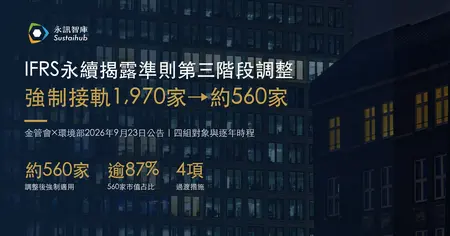
The FSC released its adoption roadmap on 17 August 2023. TWSE/TPEx-listed companies are to disclose sustainability-related financial information in a dedicated annual-report chapter in phases based on paid-in capital: NT$10 billion or more from the 2026 financial year; NT$5 billion or more but below NT$10 billion from the 2027 financial year; and the remainder originally from the 2028 financial year. On 23 September 2026, the FSC and Ministry of Environment announced a reduction in mandatory coverage from 1,970 to approximately 560 companies: around 535 with paid-in capital of at least NT$2 billion, plus around 25 subject to the Ministry of Environment's inventory registration and verification requirements. Other companies must still disclose basic information on climate governance, risk management and Scope 1 and 2 emissions. Under the FSC's plan, third-phase companies need only disclose climate information during their first two years of adoption, with a temporary Scope 3 exemption, although voluntary disclosure remains possible. During the first two years of the transition, if the sustainability chapter cannot be filed with financial reports by the end of March, the proposed relaxation would allow filing with the annual report by its deadline, 14 days before the shareholders' meeting. The FSC expects to amend annual-report rules and related directives by the end of 2026; actual requirements remain subject to formal publication.
- Coverage: Mandatory for approximately 560 TWSE/TPEx-listed companies after the adjustment; other listed companies disclose basic climate information. The adjustment does not apply to the financial, insurance, or securities and futures industries.
- Key dates: The first phase applies initially to the 2026 financial year, with filing in 2027. Coverage and exemptions are expected to be reviewed again in 2030. Regulatory amendments remain subject to formal publication.
- Authority: Financial Supervisory Commission, which announced this adjustment jointly with the Ministry of Environment.
- Official sources: FSC press release of 23 September 2026, TPEx IFRS Sustainability Disclosure Standards adoption portal: Taiwan's adoption roadmap.
- Further reading on our website: IFRS third-phase adjustment and 4 transitional measures, Taiwan's IFRS S1/S2 adoption timeline, Sustainability chapters and annual-report filing.
3. Corporate Governance Evaluation and ESG Evaluation
The Corporate Governance Evaluation administered by the TWSE Corporate Governance Center expanded its environmental and social coverage under the FSC's Sustainable Development Action Plans for TWSE- and TPEx-Listed Companies (2023), and was renamed ESG Evaluation from 2026 (ROC year 115). Results of the 12th Corporate Governance Evaluation, covering 2025 (ROC year 114) before the transition, were announced on 30 April 2026. The first ESG Evaluation covers the full 2026 calendar year and includes 75 indicators: 16 environmental indicators weighted at 21%, 23 social indicators at 31%, and 36 governance indicators at 48%. New indicators cover the circular economy, energy use, biodiversity, natural carbon sinks, human rights due diligence and investor engagement. Results are expected by the end of April 2027; no first-cycle ESG Evaluation rankings exist before then.
- Coverage: TWSE/TPEx-listed companies.
- Key dates: The evaluation covers the full 2026 calendar year; first-cycle results are expected by the end of April 2027.
- Authority: TWSE Corporate Governance Center, implementing the FSC's sustainable development action plan.
- Official sources: TWSE ESG Evaluation portal, Overview of amendments to the 2026 (ROC year 115) ESG Evaluation system, Press release on first-cycle ESG Evaluation indicators, 12th evaluation awards and introduction to the new system.
- Further reading on our website: TWSE's 75 ESG Evaluation indicators, Guide to top performance in the 2026 (ROC year 115) ESG Evaluation, Interpreting the 12th Corporate Governance Evaluation results.
4. The Climate Change Response Act and Greenhouse Gas Inventory Registration
The Climate Change Response Act was amended and promulgated on 15 February 2023. Article 21 requires emission sources designated by the Ministry of Environment to conduct inventories and register emissions; specified entities must also undergo verification. Two coverage announcements currently apply. The announcement on emission sources subject to greenhouse gas inventory registration and verification, amended on 22 February 2024, covers designated industry processes and sources with fossil fuel combustion emissions, or manufacturers' facility-wide combined direct and electricity-related indirect emissions, of at least 25,000 metric tonnes CO₂e. The announcement on emission sources subject to greenhouse gas inventory registration, issued on 4 March 2025, adds certain service businesses, higher education institutions, medical centres, transport businesses and other manufacturers from 2026, based on criteria such as electricity use, retail outlet counts or vehicle numbers. Register the previous year's emissions by 30 April each year; entities requiring verification must upload results by 31 October.
- Coverage: Businesses with emission sources listed in the Ministry of Environment's two announcements. Entities newly added by the 2025 announcement need only conduct inventories and registration.
- Key dates: Upload verification results by 31 October 2026; register 2026 emissions by 30 April 2027.
- Authority: Ministry of Environment, with administration handled by the Climate Change Administration.
- Official sources: Climate Change Response Act, Regulations Governing Greenhouse Gas Emission Inventory, Registration and Verification, Emission sources subject to greenhouse gas inventory registration and verification, Expanded inventory announcement and operating guidance.
- Further reading on our website: Greenhouse gas inventory registration schedules and categories, What is a carbon inventory?, Ministry of Environment expansion of mandatory carbon inventories.
5. Carbon Fee
Under the Regulations Governing the Collection of Carbon Fees, coverage includes electricity and gas suppliers and manufacturers with emission sources subject to inventory registration and verification, whose facility-wide combined annual direct and electricity-related indirect emissions reach 25,000 metric tonnes CO₂e. The Ministry of Environment issued the collection regulations and supporting rules on 29 August 2024, announced rates on 21 October 2024, and made them effective from 1 January 2025. The general rate is NT$300 per metric tonne CO₂e. Businesses with approved voluntary reduction plans meeting industry-specific designated reduction rates qualify for preferential rate A of NT$50; those meeting technology benchmarks qualify for preferential rate B of NT$100. Fees for 2025 emissions were first paid in 2026. Thereafter, the previous year's fees must be filed and paid by the end of May each year. In calculating chargeable emissions, first deduct K: 25,000 metric tonnes for general businesses and zero for high carbon leakage risk businesses.
- Coverage: Electricity and gas suppliers and manufacturers with total annual emissions of at least 25,000 metric tonnes CO₂e.
- Key dates: File and pay the previous year's carbon fee by the end of May each year; the next deadline is the end of May 2027 for 2026 fees.
- Authority: Ministry of Environment, Climate Change Administration.
- Official sources: Regulations Governing the Collection of Carbon Fees, Climate Change Administration carbon fee portal.
- Further reading on our website: Carbon fee rates, coverage and calculations, Guide to voluntary reduction plan applications.
6. Emission Factors and Electricity Emission Factors
The Ministry of Environment announced Greenhouse Gas Emission Factors on 5 February 2024, separately listing factors for combustion, process and fugitive emission sources and global warming potentials for use in inventories calculated by the emission factor method. For electricity purchased from public electricity retailers, use the latest electricity emission factor announced by the Ministry of Economic Affairs at the time of inventory and verification. On 2 June 2026, the Energy Administration, Ministry of Economic Affairs, announced the 2025 (ROC year 114) public electricity retailer factor of 0.467 kg CO₂e per kWh, with separate factors of 0.466 for industrial electricity and 0.471 for residential electricity. Historical years have separate requirements; for example, the relevant factors for 2023 emissions use version 6.0.4 of the Greenhouse Gas Emission Factor Management Table, under the Ministry of Environment's interpretive letter of 6 June 2024. The 2026 (ROC year 115) electricity emission factors have not yet been announced.
- Coverage: Businesses calculating emissions using the emission factor method. The industrial factor applies to commercial metered lighting, low-voltage, high-voltage and extra-high-voltage electricity customers; the residential factor applies to non-commercial metered lighting and flat-rate lighting customers.
- Key dates: The 2025 (ROC year 114) electricity emission factors were announced on 2 June 2026. The 2026 (ROC year 115) factors remain subject to the Energy Administration's announcement.
- Authority: Ministry of Environment for greenhouse gas emission factors; Energy Administration, Ministry of Economic Affairs, for electricity emission factors.
- Official sources: Ministry of Environment greenhouse gas emission factor announcement of 5 February 2024, Interpretive letter on the applicable year for version 6.0.4, Business Greenhouse Gas Emissions Information Platform, Ministry of Economic Affairs press release of 2 June 2026, Energy Administration electricity emission factors for 2025 (ROC year 114).
- Further reading on our website: Applicable years for announced emission factors, Understanding the 2025 (ROC year 114) electricity emission factors, Historical-year use of version 6.0.4.
7. Filing through the Market Observation Post System (MOPS) and ESG Digital Platform
TWSE/TPEx-listed companies log into the MOPS filing system (SII) to submit sustainability information. Since 6 May 2024, SII has linked to the TWSE's new ESG Digital Platform for Corporate ESG Information Disclosure filings and sustainability reports. Under the information filing procedures for TWSE/TPEx-listed companies, ESG information has been due by the end of June each year since 2022. Sustainability reports are due by 31 August under the reporting procedures described above. The 2026 filing process adds indicators such as the Scope 2 greenhouse gas calculation method, market-based or location-based, and a corporate governance information section. Mandatory and encouraged disclosures vary by industry and capital size. If a correction is needed after confirming submission, apply through the platform; editing is enabled after confirmation by TWSE or TPEx.
- Coverage: TWSE/TPEx-listed companies.
- Key dates: File ESG information by the end of June and sustainability reports by 31 August each year. The next deadlines are 30 June 2027 and 31 August 2027 respectively.
- Authority: TWSE and TPEx.
- Official sources: 2026 Corporate ESG Information Disclosure filing manual, Rules Governing the Preparation and Filing of Sustainability Reports by TWSE Listed Companies.
- Further reading on our website: Complete guide to ESG filing, TWSE ESG Digital Platform, Four steps to correcting data on the ESG Digital Platform.
8. Carbon Credits and Domestic Reduction Credits
The Taiwan Carbon Solution Exchange was jointly established by the TWSE and National Development Fund under Article 36 of the Climate Change Response Act. It opened on 7 August 2023 and is commissioned by the Ministry of Environment to handle domestic reduction-credit trading and auctions. Domestic reduction credits are issued by the Ministry of Environment in three categories: voluntary reduction, offset and early-action projects. Accounts and transfers are managed through the Ministry's Greenhouse Gas Reduction Credit Management System. Domestic trading began in October 2024 through fixed-price trading, negotiated trading and auctions. It is available to businesses needing incremental-emission offsets or carbon fee deductions, and is not open to individuals. Domestic credits can deduct up to 10% of chargeable emissions. Recognised foreign credits are available only to businesses without high carbon leakage risk, capped at 5%. Both require an application with proof of cancellation by the end of May each year.
- Coverage: Project implementers obtaining reduction credits, and businesses needing incremental-emission offsets or carbon fee deductions.
- Key dates: For carbon fee deductions, apply with the filing by the end of May each year; the next deadline is the end of May 2027.
- Authority: Ministry of Environment for credit issuance and management; Taiwan Carbon Solution Exchange for operation of the commissioned trading platform.
- Official sources: Taiwan Carbon Solution Exchange, TCX introduction to carbon credit trading, October–November 2025, Greenhouse Gas Reduction Credit Management System, Articles 9–11 of the Regulations Governing the Collection of Carbon Fees.
- Further reading on our website: How to buy and use carbon credits in Taiwan, Global carbon markets and Taiwan's ETS pilot programme.
Next Step: Prepare Data According to the Schedule
- To prepare the sustainability report due on 31 August 2027, explore how the Syber sustainability management system centralises reporting data and maps it against GRI and IFRS disclosure items.
- To complete inventory registration by 30 April each year, use the DCarbon carbon inventory system to organise activity data and supporting documents and generate inventory reports. Formal verification remains the responsibility of verification bodies.
All schedules are subject to the latest announcements from the competent authorities.