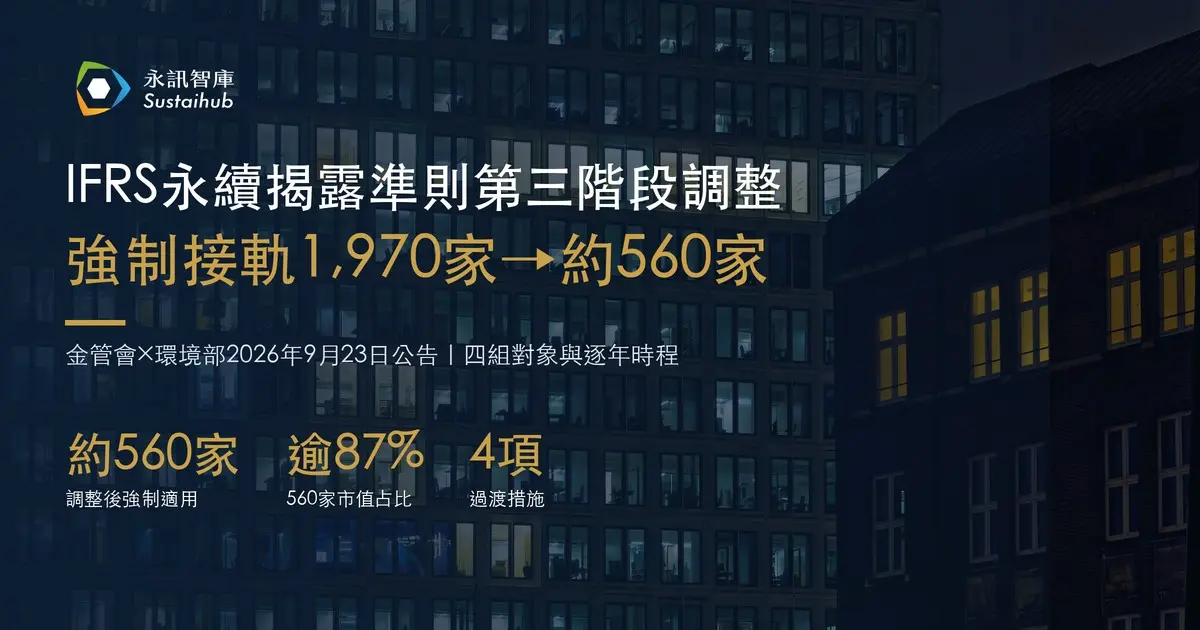
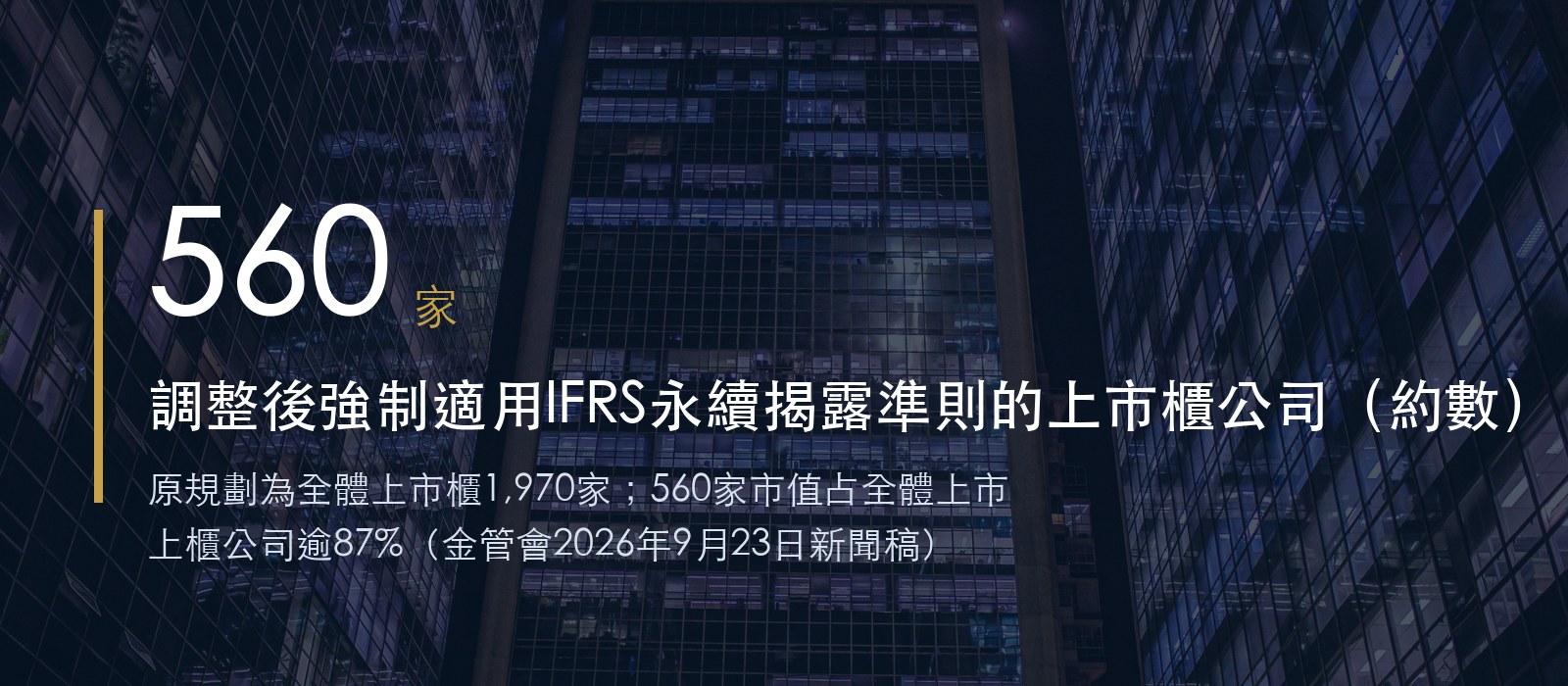
On 23 September 2026, the Financial Supervisory Commission (FSC) and Ministry of Environment jointly announced changes to Taiwan Stock Exchange (TWSE) and Taipei Exchange (TPEx)-listed companies' application of the IFRS Sustainability Disclosure Standards. Mandatory coverage will fall from all 1,970 listed companies to around 560. Listed companies with capital below NT$2 billion and outside the Ministry of Environment's inventory list will instead disclose basic climate information.
The changes focus on IFRS Phase 3, but extended filing deadlines also cover Phases 1 and 2, and the parent-only assurance exemption also covers Phase 2. Drawing on the FSC release and three attachments, this article explains four transition measures, differences among four groups and their timelines through 2031. It describes the announced policy and revised roadmap; application of regulations and orders remains subject to the formal texts subsequently issued.
(ROC years in this article are accompanied by Gregorian equivalents: 115=2026, 116=2027, 117=2028, 118=2029, 119=2030, 120=2031, 121=2032, 112=2023, 114=2025.)
I. Announcement Highlights: What Changed on 23 September?
The FSC release, titled “Aligning Internationally for Steady Progress—Ministry of Environment × FSC Jointly Optimise the Sustainability Disclosure Adoption Path, Balancing Information Quality and Industry Competitiveness”, includes three attachments: a comparison of adjustments (Attachment 1), the revised adoption and sustainable development roadmaps (Attachment 2), and an explanatory presentation (Attachment 3).
Start with the numbers. These four figures come from the release and Attachment 3; company counts and market capitalisation are as of 30 June 2026.
The release clearly states that all listed companies' adoption timelines remain unchanged. What changes is who must adopt, what must be disclosed initially, the assurance level and when the chapter is filed. There are four dimensions:
- Coverage: Mandatory adoption applies to paid-in capital of NT$2 billion or more, plus listed companies whose emission sources are subject to Ministry of Environment inventory and verification requirements.
- Disclosure content: Phase 3 companies disclose climate information only for the first two years; Scope 3 GHG disclosure becomes voluntary.
- Assurance requirements: Phases 2 and 3 no longer need parent-only Scope 1 and 2 assurance. Companies below NT$2 billion and outside Ministry of Environment mandatory inventory registration and verification may obtain assurance voluntarily. Finance, steel, cement and other specified sectors follow separate rules.
- Filing deadline: During the first two financial years starting from initial application, the sustainability chapter may be deferred to the annual report deadline, 14 days before the shareholders' meeting.
| Item | Current requirement | Simplified approach | Main changes and benefits |
|---|---|---|---|
| Entities covered | Mandatory for all listed companies (1,970) | ① Paid-in capital ≥ NT$2 billion (around 535) ② Below NT$2 billion but subject to Ministry of Environment inventory registration and verification (around 25) | Focus on companies with greater resources and impact |
| Non-climate information (IFRS S1) | Exempt in the first application year; non-climate sustainability information required from year 2 | For Phase 3 companies: ① Non-climate sustainability information exempt in the first 2 financial years of application ② Non-climate sustainability information required from year 3 (2030) | Focus initially on climate information, reducing the combined burden of climate and other sustainability topics |
| Scope 3 GHG emissions | Exempt in the first 3 financial years; mandatory from year 4 | Voluntary for Phase 3 companies | Focus first on Scope 1 and 2, reducing the cost and staffing burden of obtaining assured supply chain information |
| Scope 1 & 2 GHG assurance | Independent third-party limited assurance at both parent-only and consolidated levels | Parent-only assurance exempt | Reduce assurance costs while maintaining information quality |
| Filing schedule | Sustainability chapter filed with financial statements (by the end of March) | For the first 2 application years, the chapter may follow the annual report deadline (14 days before the shareholders' meeting); from year 3, filing with financial statements resumes | Allow a transition-period deadline extension so companies can adjust workflows |
II. Why the Changes: International Practice, Surveys and Consultation
International Practice Cited by the FSC
The release cites the EU's narrowing of the Corporate Sustainability Reporting Directive (CSRD) as policy background. The EU formally implemented the Omnibus I Directive in March 2026; according to the FSC, mandatory coverage fell from around 50,000 to around 5,000 companies, a reduction of about 90%. The release also mentions a reduction of over 60% in mandatory data points. According to the European Commission announcement, this concerns revised European Sustainability Reporting Standards (ESRS) adopted on 3 July 2026, which require European Parliament and Council scrutiny before application. This is separate from the Omnibus I Directive, with a different effective date. Japan, South Korea and Australia use phased, size-based adoption.
Attachment 3, page 6 also lists Japanese and Korean thresholds. Japan plans phased SSBJ adoption by market capitalisation for Tokyo Stock Exchange Prime Market companies valued at ¥500 billion or more (Japan Financial Services Agency roadmap); South Korea's threshold is consolidated assets exceeding KRW5 trillion, as cited in the FSC presentation.
Taiwan's Original Plan
The FSC published Taiwan's IFRS Sustainability Disclosure Standards Adoption Roadmap on 17 August 2023 (ROC year 112), then amended annual report disclosure regulations (the Annual Report Regulations) and related orders in 2025 (ROC year 114). Listed companies were required to adopt in three phases by paid-in capital from financial year 2026 (ROC year 115), disclosing sustainability-related financial information in a dedicated annual report chapter:
| Original phase | Paid-in capital | First financial year of application |
|---|---|---|
| Phase 1 | NT$10 billion or more | FY2026 (ROC year 115) |
| Phase 2 | NT$5 billion to below NT$10 billion | FY2027 (ROC year 116) |
| Phase 3 | Below NT$5 billion (all remaining listed companies) | FY2028 (ROC year 117) |
The release states that large Phase 1 and 2 companies are progressing on schedule. Phase 3 has many more companies with fewer resources, making it the focus of these changes.
Survey and Consultation Process
Attachment 3, page 7 outlines the process. According to the release, most survey respondents found non-climate sustainability judgements difficult and faced challenges obtaining supply chain data.
-
May–JuneSurvey
Through the IFRS Sustainability Disclosure Standards Endorsement Advisory Group, more than 1,700 Phase 3 companies were surveyed, with 1,643 responses. Views were also collected from investment and lending institutions and accounting firms. -
7/1Project team meeting
The FSC project team's third subgroup (referred to as “the Bureau” in the presentation) invited representatives from the environment, economic affairs and transport ministries for preliminary discussions on the advisory group's proposals. -
7/20First advisory group meeting
Participants included academics, experts, 20 industry representatives, relevant associations, verification bodies and environment and economic affairs ministry representatives. The recorded consensus was to draw on EU and other rules and adjust methods while retaining objectives. -
AugustDiscussions with the Ministry of Environment
The Ministry met on 5 August to discuss Scope 3 factors and inventory rule harmonisation. Further discussions on 19 and 25 August addressed simplification, with the Ministry recommending EU-style thresholds and narrower coverage. -
8/28Second advisory group meeting
Consensus was reached on the proposed measures: sustainability objectives unchanged, implementation steps adjusted. The FSC and Ministry of Environment jointly announced them on 23 September.

III. Which Group Does Your Company Belong To?
These adjustments do not yet apply to financial institutions, insurers, or securities and futures businesses, which follow the FSC's Green and Transition Finance Action Plan and their supervisory bureaus' arrangements. Steel and cement GHG inventories and assurance remain under the original roadmap, so capital size alone is insufficient to determine requirements.
After adjustment, all listed companies fall into four groups. The first three remain subject to mandatory adoption with different start years. Group 4 no longer has mandatory IFRS adoption, but must still disclose climate information.
| Group | Criteria | Company count (Attachment 2) | Adjusted obligations |
|---|---|---|---|
| Phase 1 | Paid-in capital ≥ NT$10 billion | 126 companies | Mandatory from FY2026 (ROC year 115) |
| Phase 2 | Paid-in capital ≥ NT$5 billion and below NT$10 billion | 118 companies | Mandatory from FY2027 (ROC year 116) |
| Phase 3 | Paid-in capital ≥ NT$2 billion and below NT$5 billion; or below NT$2 billion but subject to Ministry of Environment inventory registration and verification | 316 companies | Mandatory from FY2028 (ROC year 117), with the new transition measures |
| Group 4 | Paid-in capital below NT$2 billion and outside Ministry of Environment inventory registration and verification requirements | 1,410 companies | No mandatory IFRS adoption; basic climate information required, such as governance, risk management, and Scope 1 and 2 emissions |
Phase 3's 316 companies comprise two groups. Attachment 3, page 9 lists 291 companies with capital of NT$2–5 billion, plus around 25 below NT$2 billion subject to Ministry of Environment inventory registration and verification. The release includes the latter because they may face higher climate transition risks and the information supports investment and lending decisions.
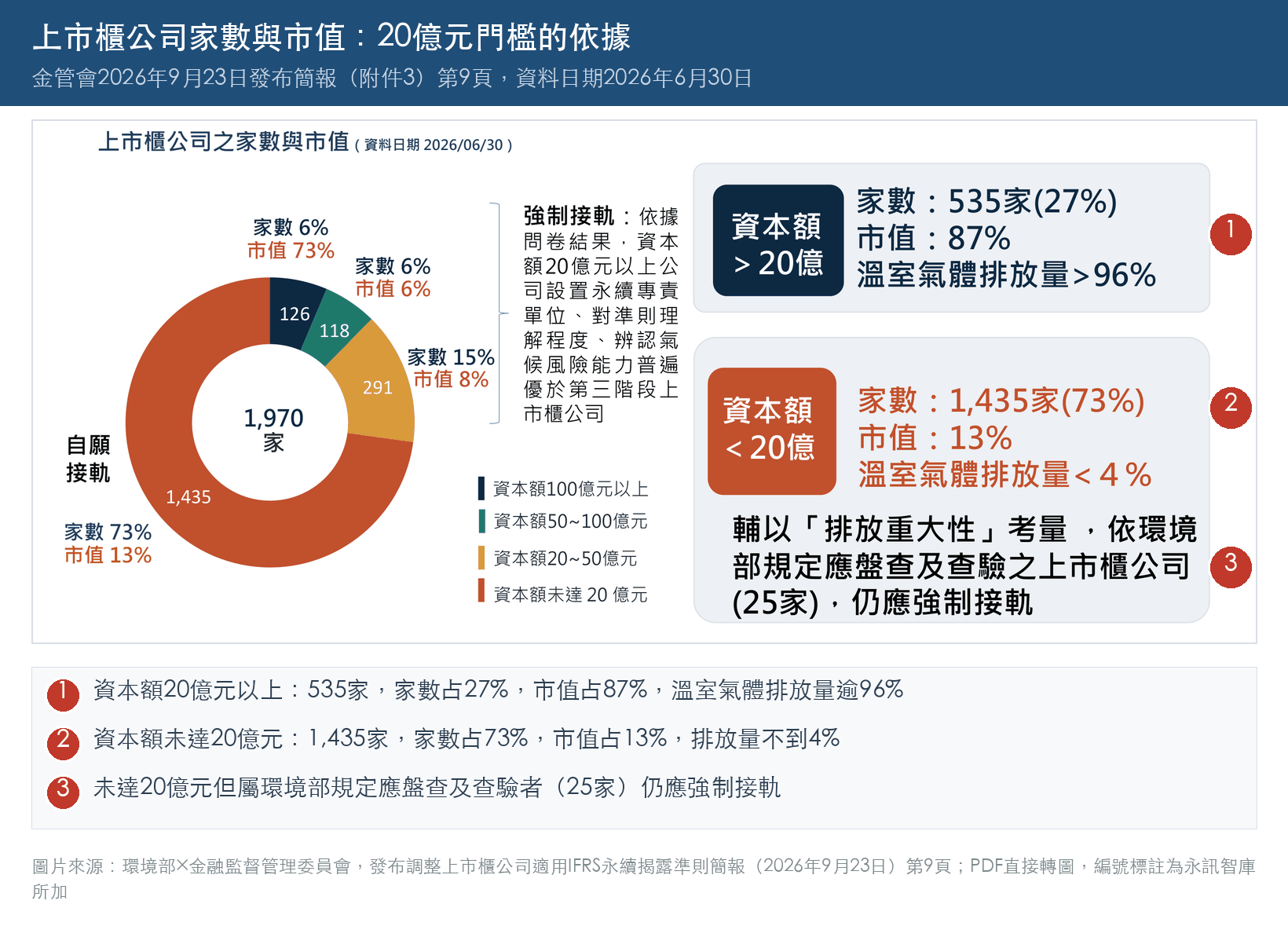
Attachment 3, page 9 lists 1,435 companies below NT$2 billion, while Group 4 in Attachment 2 contains 1,410. The difference is the 25 companies below NT$2 billion subject to Ministry of Environment inventory registration and verification, which are included in Phase 3.
Two Points to Check
First, the capital measurement date. The release and attachments do not specify the date for assessing paid-in capital against the NT$2 billion threshold. Current phases are defined by orders prescribing conditions under the Annual Report Regulations. Attachment 3, page 19 states that the FSC will amend the Article 7 conditions order dated 114.11.12 (12 November 2025). Companies near the threshold should use the amended order expected by year-end rather than classify themselves using today's capital.
Second, the Ministry of Environment inventory list. The release refers to listed companies whose emission sources are subject to Ministry of Environment inventory and verification. Our interpretation is that companies whose sources have mandatory inventory registration and verification obligations under Ministry announcements fall within this category. If uncertain, consult the announcements and your company's GHG inventory team.
IV. The Four Transition Measures Explained
1. Coverage: From 1,970 Companies to Around 560
The release gives two reasons: companies with paid-in capital of at least NT$2 billion have more mature sustainability governance and risk management; those below NT$2 billion account for around 4% of listed-company GHG emissions.
Although mandatory coverage falls from 1,970 to around 560 companies, those 560 represent over 87% of total listed market value, and all companies' adoption timelines remain unchanged.
Group 4 still has obligations. The release says these companies must disclose basic climate governance, risk management, and Scope 1 and 2 information. The FSC will provide simplified examples and use ESG Evaluation bonus points to encourage voluntary adoption by smaller listed companies. For evaluation scoring, see our 2026 (ROC year 115) ESG Evaluation Guide to Top Scores; specific bonus conditions await regulatory announcement.
2. Disclosure Content: Non-Climate Information Deferred, Scope 3 Voluntary
This measure applies only to Phase 3 companies and has two parts.
Non-climate sustainability information (IFRS S1). Originally, only the first year was exempt, with non-climate IFRS S1 information required from year 2. Phase 3 begins in FY2028 (ROC year 117), so this originally meant 2029 (ROC year 118). The adjustment exempts both first financial years; material non-climate sustainability-related financial information begins with year 3, FY2030 (ROC year 119), normally filed in 2031 (ROC year 120). Climate-only reporting still applies IFRS S1's general requirements relevant to climate risks and opportunities; the entire S1 standard is not deferred (the TPEx IFRS S2 example cites S1 E5). The release references Japan's and Malaysia's climate-first strategies. Companies may still voluntarily disclose material non-climate topics based on their industry.
Scope 3 GHG emissions. Phase 3 originally required Scope 3 inventories from FY2031 (ROC year 120), disclosed in 2032 (ROC year 121). Disclosure now becomes voluntary. The release cites limited staff and resources, difficult value chain data access, and the absence of mandatory Scope 3 disclosure for smaller listed companies in nearby markets such as Singapore, Hong Kong and South Korea.
This is practical advice, not a regulatory statement. Voluntary Scope 3 disclosure refers to statutory obligations in the sustainability chapter. Customer requests for emissions data and product carbon footprints are commercial requirements unaffected by this change. Companies already asked for Scope 3 or product carbon data should continue preparing it. For supply chain preparation, see How SMEs Can Meet Customer Carbon Inventory Requirements.
3. Assurance: Parent-Only Assurance Exempted
Under the current Sustainable Development Roadmap for TWSE/TPEx-Listed Companies, Phase 2 and 3 companies were to obtain independent third-party assurance of parent-only GHG information in 2027 (ROC year 116) and 2028 (ROC year 117), respectively. The release explains that after IFRS adoption, disclosures use consolidated group emissions, so parent-only assurance is exempted for both phases.
Companies below NT$2 billion may obtain third-party GHG inventory assurance voluntarily, except those subject to Ministry of Environment inventory registration and verification, which must continue following its rules. Section V explains the annual roadmap.
4. Filing Deadline: Up to 14 Days Before the Shareholders' Meeting During Transition
Currently, the sustainability chapter must be filed with financial statements by the end of March. The proposed relaxation covers the first two financial years from initial application: if the chapter cannot be filed with the financial statements by March-end, it may be filed with the annual report no later than 14 days before the shareholders' meeting. From year 3, simultaneous filing with the financial statements is still required.
Attachment 3, page 14 says the extension covers all adopters, including Phases 1 and 2, but excludes finance, insurance, securities and futures businesses. For practical coordination among the chapter, annual report and financial statements, see When the Sustainability Chapter and Annual Report Are Published Together: A Faster Route for Listed Companies.
| After financial year-end | By the end of March | 14 days before the shareholders' meeting |
|---|---|---|
| Current requirement | Financial statements + sustainability chapter | Other annual report information |
| Transition (first two financial years from initial application) | Financial statements | Sustainability chapter may be deferred to this date and filed with the annual report |
| From year 3 | Financial statements + sustainability chapter | Other annual report information |
V. GHG Inventories and Assurance: How the Roadmap Changes
Attachment 2, page 2 contains the revised Sustainable Development Roadmap for TWSE/TPEx-Listed Companies. Two year rows appear above the table: the upper row is the required disclosure year and the lower row is the financial year covered. For example, Phase 3's parent-only assurance exemption in the “2027” column (FY2027 information) corresponds to the assurance originally due in 2028 (ROC year 117), as stated in the release.
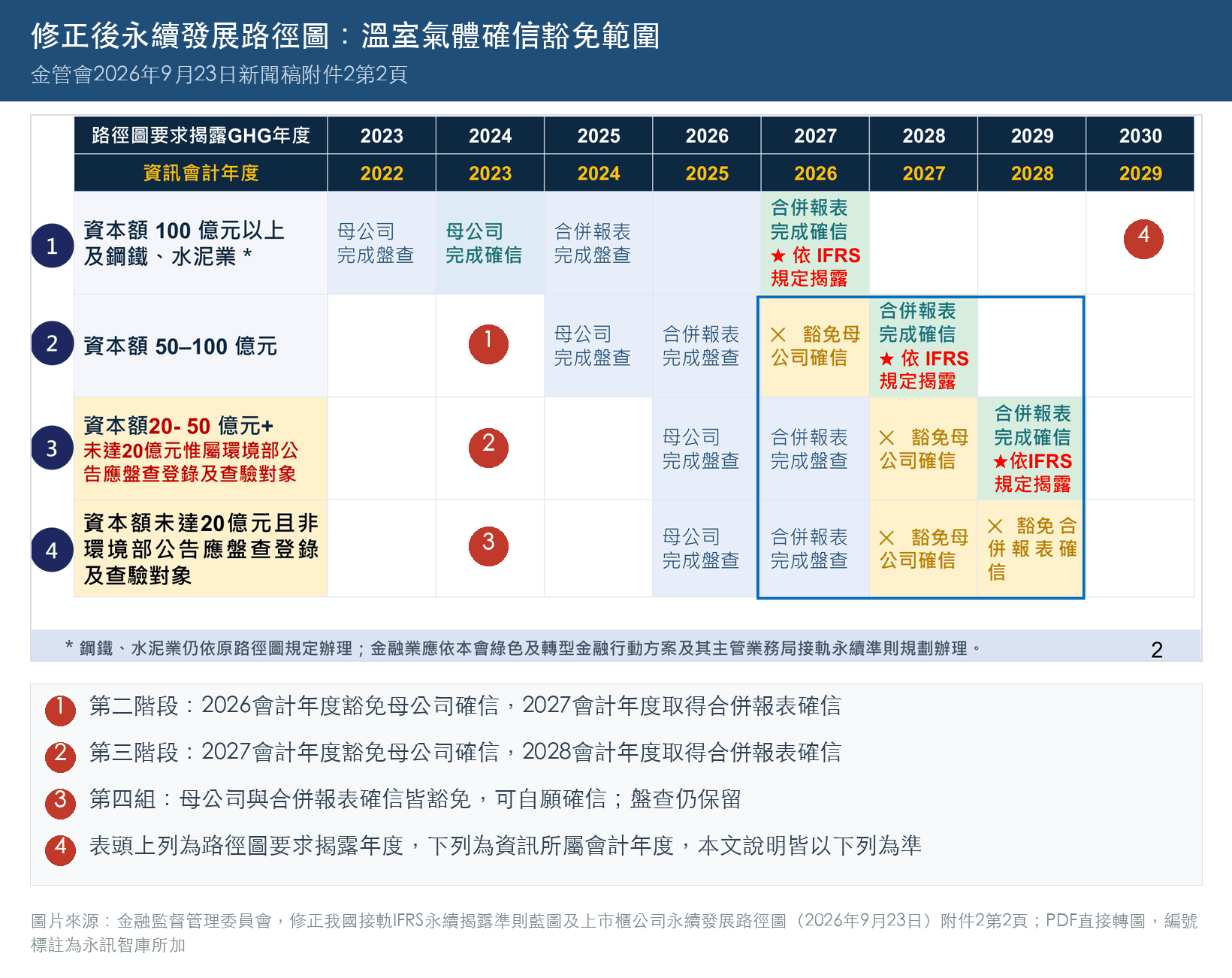
Figure 2 yields the following requirements. All years in the table are the financial years covered; steel and cement retain the original roadmap, while finance follows the Green and Transition Finance Action Plan:
| Group | Inventories completed or underway | New exemption | Assurance still required |
|---|---|---|---|
| Phase 1 (roadmap row 1: capital ≥ NT$10 billion, plus steel and cement) | Parent-only and consolidated inventories | None | Consolidated assurance for FY2026 (Attachment 2: disclosure under IFRS) |
| Phase 2 | Parent-only inventory for FY2024; consolidated inventory for FY2025 | Parent-only assurance for FY2026 | Consolidated assurance for FY2027 (Attachment 2: disclosure under IFRS) |
| Phase 3 | Parent-only inventory for FY2025; consolidated inventory for FY2026 | Parent-only assurance for FY2027 | Consolidated assurance for FY2028 (Attachment 2: disclosure under IFRS) |
| Group 4 | Parent-only inventory for FY2025; consolidated inventory for FY2026 | Parent-only assurance for FY2027 and consolidated assurance for FY2028 | Not mandatory; voluntary assurance permitted |
Attachment 2 notes that steel and cement follow the original roadmap, while their IFRS adoption phase remains determined by paid-in capital. The release also says the approximately 25 Phase 3 companies subject to Ministry of Environment inventory registration and verification must continue following its rules.
For Phase 3 and Group 4, Figure 2 does not exempt the FY2025 parent inventory or FY2026 consolidated inventory. Group 4's exemptions cover parent-only and consolidated assurance; inventories and Scope 1 and 2 disclosure remain. Consolidated inventory boundaries must match consolidated financial statements. For boundary methods, see How to Choose Carbon Inventory Boundaries; for differences between standards, see ISO 14064 and GHG Protocol Compared.
The release also says the FSC and Ministry of Environment will harmonise GHG verification bodies' and accountants' assurance mechanisms to avoid duplication. Specific arrangements have not yet been announced.
VI. Annual Timelines and Preparation Priorities by Group
Attachment 2, page 1 shows the revised adoption roadmap for all four groups from 2026 (ROC year 115) to 2031 (ROC year 120).
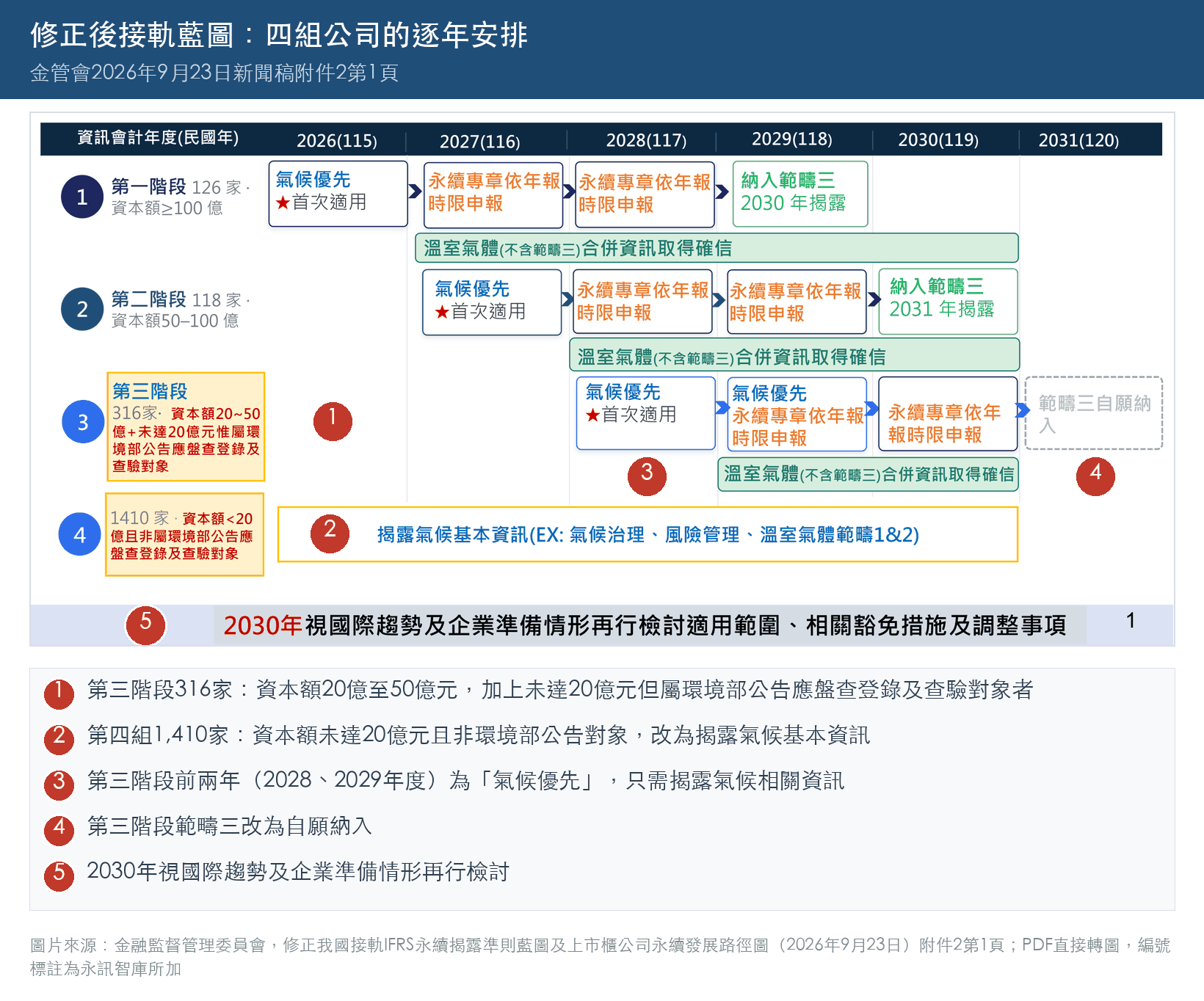
The following key years are compiled from the release and Attachments 1 and 2. The rows for initial non-climate information and annual-report filing deadlines are our calculations based on initial application and the first two financial years counted from it. Attachment 2 places the filing-deadline boxes in the filing year (for example, 2027 and 2028 for Phase 1). We interpret Attachment 1's first-two-years wording as FY2026 and FY2027 (ROC years 115 and 116) information, filed in 2027 and 2028 (ROC years 116 and 117). The formal amended Article 23 of the Annual Report Regulations will prevail.
| Item | Phase 1 | Phase 2 | Phase 3 |
|---|---|---|---|
| First financial year of application | FY2026 (ROC year 115) | FY2027 (ROC year 116) | FY2028 (ROC year 117) |
| First year of non-climate information | FY2027 (ROC year 116), unchanged | FY2028 (ROC year 117), unchanged | FY2030 (ROC year 119), deferred 1 year |
| Chapter may follow annual report filing deadline | FY2026 and FY2027 information (ROC years 115, 116) | FY2027 and FY2028 information (ROC years 116, 117) | FY2028 and FY2029 information (ROC years 117, 118) |
| Scope 3 | Attachment 2 states disclosure in 2030 | Attachment 2 states disclosure in 2031 | Voluntary disclosure |
| GHG assurance | Consolidated information, excluding Scope 3 | Consolidated information, excluding Scope 3; parent-only assurance exempt | Consolidated information, excluding Scope 3; parent-only assurance exempt |
Attachment 2 states that coverage, exemptions and adjustments will be reviewed in 2030 based on international trends and company readiness. Phase 3's voluntary Scope 3 status and Group 4's coverage may therefore change at the 2030 (ROC year 119) review.
What Each Group Can Do Now
The following are practical recommendations, not regulatory requirements:
- Phase 1: FY2026 (ROC year 115) is the first application year. With the extension, the chapter may be filed with the annual report no later than 14 days before the shareholders' meeting. However, its reporting entity and period must match the related financial statements, and material differences in data, assumptions or measurement units must be disclosed (Annual Report Regulations Article 10-1, subparagraphs 2 and 4). Allow time for accountants and assurance providers; the extension is not a reason to delay preparation.
- Phase 2: First application is FY2027 (ROC year 116). The announced proposal exempts parent-only assurance, subject to formally amended orders. Assurance resources can focus on consolidated FY2027 information, disclosed in 2028 under the roadmap. First confirm that consolidated inventory boundaries match the entities in the consolidated financial statements.
- Phase 3: First application is FY2028 (ROC year 117), with climate-only disclosures for the first two years. Adoption plans can prioritise IFRS S2 governance, strategy, risk management, and metrics and targets. Although Scope 3 becomes voluntary, continue collecting data where customers require it. For planning steps, see IFRS Sustainability Disclosure Standards Adoption Plans: Steps and Recommendations.
- Group 4: IFRS adoption is no longer mandatory, but basic climate governance, risk management, and Scope 1 and 2 disclosures remain, as do GHG inventories. Watch for the FSC's simplified disclosure examples and specific ESG Evaluation bonus conditions before deciding on voluntary adoption.
For IFRS S1 and S2 basics and a full Q&A guide, see 2026 IFRS Sustainability Disclosure Standards Q&A Explained.
VII. Excluded Industries and Supporting Measures
Finance, Insurance, Securities and Futures
The release explicitly states that these adjustments do not yet apply to financial institutions, insurers, or securities and futures businesses. Regardless of size, these sectors follow the FSC's Green and Transition Finance Action Plan. Attachment 2 also directs financial institutions to that plan and their supervisory bureaus' adoption arrangements.
Steel and Cement
Attachment 2, page 2 notes that steel and cement continue to follow the original roadmap.
FSC Supporting Measures
-
1Amend the Roadmaps and Annual Report Regulations
The roadmaps were revised concurrently in Attachment 2. The FSC expects to review and amend the Annual Report Regulations and related orders by year-end. Attachment 3, page 19 lists the Article 7 conditions order, Articles 10-1 and 23, the 13 November 2023 (ROC year 112) order and related Q&A. -
2Practical Guidance and Disclosure Examples
Attachment 3, page 20 plans Phase 3 adoption plan examples, simplified examples for small and medium non-manufacturing companies, and guidance on using SASB to identify relevant industry topics. Basic climate disclosure examples are planned for companies below NT$2 billion outside Ministry of Environment inventory registration and verification requirements. Materials and Q&A are available at the IFRS Sustainability Disclosure Standards Portal. -
3Interministerial Cooperation with the Ministry of Environment
Improve the product carbon footprint factor database to lower Scope 3 data costs, and harmonise verification-body and accountant assurance mechanisms to prevent duplicate work.
The 23 September announcement sets policy direction and revises the roadmaps. Regulations and related orders are expected to be amended by year-end. Details such as capital measurement dates and transition-period counting should follow the formal text. As of publication, the Laws & Regulations Database of the Republic of China lists 19 December 2025 (ROC year 114) as the latest amendment to the Annual Report Regulations, which do not yet reflect these changes.
VIII. Will Your Data Pass Assurance After the Scope Changes?
For Phases 2 and 3, only parent-only assurance is exempted. Consolidated Scope 1 and 2 information still requires assurance under the Annual Report Regulations and related orders, with disclosure under FSC-endorsed IFRS Sustainability Disclosure Standards (Article 10-1, subparagraph 8). Previously both levels required assurance; only the parent level is removed. Consolidated assurance still asks whether inventory subsidiaries match consolidated financial statements, each activity figure can be traced to bills or system records, and changes and approvals can be tracked.
None of these three tasks is reduced by the exemption. More subsidiaries across more locations increase the likelihood of scattered evidence. Common review problems include matching totals without original documents, or consolidated totals that do not reconcile to individual sites.
These three areas are preparation priorities, not sufficient conditions for passing assurance. Measurement methods, calculations, completeness and other procedures must still satisfy the provider. DCarbon links activity data and evidence to the relevant emission sources and retains review histories, allowing consolidated totals to be traced to sites and original documents. Other chapter sections need traceability to standard paragraphs and data sources, which Syber's standards mapping checklist can support.
The Assurance Scope Has Changed. Will Your GHG Data Pass Review?
Under the proposal, Phases 2 and 3 will be exempt from parent-only assurance, while consolidated assurance remains. Check these three areas beforehand and complete all other procedures required by the assurance provider.
DCarbon links activity data and evidence to emission sources and retains review history; Syber can tag chapter sections with applicable disclosure standards and data sources.
Frequently Asked Questions
Q1. Must Listed Companies Below NT$2 Billion Still Prepare an IFRS Sustainability Chapter?
If outside Ministry of Environment inventory registration and verification requirements, they no longer face mandatory IFRS adoption under the FSC's 23 September 2026 release. Finance, insurance, securities and futures follow separate supervisory arrangements. Basic climate governance, risk management, and Scope 1 and 2 information remain required. The FSC will provide simplified examples and encourage voluntary adoption through ESG Evaluation bonus points. Formal requirements depend on the regulations and orders amended by year-end.
Q2. How Can We Tell Whether We Are Subject to Ministry of Environment Inventory Registration and Verification?
The release refers to listed companies whose emission sources are subject to Ministry of Environment inventory and verification. Attachment 1 identifies around 25 such companies below NT$2 billion, which remain mandatory IFRS adopters. If uncertain, consult Ministry announcements and confirm with your GHG inventory team.
Q3. When Must Phase 3 Companies Disclose Non-Climate Sustainability Information?
Attachment 1 exempts the first two financial years from initial application, with non-climate information required from year 3 (2030). Phase 3 starts in FY2028 (ROC year 117), so FY2028 and FY2029 (ROC years 117 and 118) require climate information only, while still applying IFRS S1's climate-related general requirements. From FY2030 (ROC year 119), include material non-climate sustainability-related financial information. Companies may voluntarily disclose earlier based on their industry.
Q4. If Scope 3 Is Voluntary, Can We Stop Conducting Inventories?
The change concerns Phase 3 statutory disclosure in the sustainability chapter: inventories originally due from FY2031 (ROC year 120) and disclosure in 2032 (ROC year 121) become voluntary. Customer or brand requirements for Scope 3 or product carbon footprint data are commercial supply chain requirements outside this adjustment. Companies already asked to provide carbon data should continue preparing it.
Q5. Are Phase 1 and Phase 2 Companies Affected?
In two ways. First, extended filing deadlines cover all adopters except finance, insurance, securities and futures. The proposal allows chapters for the first two financial years to follow the annual report deadline, 14 days before the shareholders' meeting. Second, Phase 2 will no longer need parent-only Scope 1 and 2 assurance, subject to amended orders. Deferred non-climate disclosure and voluntary Scope 3 apply only to Phase 3.
Q6. After Parent-Only Assurance Is Exempted, Will GHG Results Still Pass Assurance?
The issue is whether consolidated Scope 1 and 2 data can pass assurance. Attachment 2 still requires Phase 2 and 3 consolidated information, excluding Scope 3, to obtain assurance under annual report rules and orders and be disclosed under FSC-endorsed IFRS standards. Check inventory boundaries against consolidated financial statements, trace activity data to original documents and retain change records. These are preparation priorities, not complete assurance criteria. Without them, consolidated totals may fail to reconcile by site, compressing correction work into the filing deadline.
Q7. Do Finance and Insurance Also Qualify for These Changes?
No. The release excludes finance, insurance, securities and futures, which follow the FSC's Green and Transition Finance Action Plan regardless of size. Attachment 2 also retains the original sustainable development roadmap for steel and cement GHG inventories and assurance.
Further Reading
- 2026 IFRS Sustainability Disclosure Standards Q&A Explained: S1, S2, Adoption Timelines, Scope 3 and Internal Controls
- IFRS S1/S2 Is Here: A Faster Route When the Sustainability Chapter and Annual Report Are Published Together
- How Companies Can Plan IFRS Sustainability Disclosure Standards Adoption: Steps and Recommendations
- Choosing a Carbon Inventory Standard: ISO 14064 vs GHG Protocol
- 2026 (ROC Year 115) ESG Evaluation Guide to Top Scores: 3 AA and 17 A+ Indicators Explained
Official Sources
- FSC release: Ministry of Environment × FSC Optimise the Sustainability Disclosure Adoption Path (23 September 2026): Main source, including Attachments 1–3
- Attachment 1: Adjustments to IFRS Sustainability Disclosure Standards for Listed Companies: Comparison of current rules and simplified measures
- Attachment 2: Revised IFRS Adoption Roadmap and Sustainable Development Roadmap for Listed Companies: Annual timelines for four groups and GHG assurance requirements
- Attachment 3: Presentation on Adjusted IFRS Sustainability Disclosure Standards Application for Listed Companies: Company counts and market value as of 30 June 2026, consultation process and supporting measures
- FSC: Taiwan's IFRS Sustainability Disclosure Standards Adoption Roadmap (17 August 2023, ROC year 112): Original three-phase adoption plan
- Regulations Governing Information to Be Published in Annual Reports of Public Companies (Laws & Regulations Database): Current provisions; FSC amendments expected by year-end
- European Commission: Adoption of Revised European Sustainability Reporting Standards (3 July 2026): Source and effective-date process for the reduction of over 60% in mandatory data points
- Japan Financial Services Agency: Sustainability Disclosure and Assurance Roadmap: Phased SSBJ application for Prime Market companies valued at ¥500 billion or more
- IFRS Sustainability Disclosure Standards Portal (TWSE, TPEx): Educational materials, Q&A and disclosure examples
Compiled from the FSC's 23 September 2026 release and Attachments 1–3. Company counts and market values are as of 30 June 2026 and will change with listings and paid-in capital. EU and Japanese information was cross-checked against European Commission and Japan FSA announcements; the Korean threshold is quoted from the FSC presentation. Formal adjustments depend on annual report regulations and related orders expected by year-end. This article is for reference; actual filings should follow the latest regulatory announcements and the advice of signing accountants and assurance providers.