
IFRS S1/S2 Is Here: How Can Listed Companies Streamline Sustainability Chapters in Annual Reports?
IFRS S1/S2 highlights the urgency of data governance. Move beyond file chaos and give sustainability professionals a truly sustainable way of working.
What to decide after reading If you came for IFRS, SASB, TCFD, GRI, or ESG reporting requirements, the next step is to turn disclosure items into data collection, section assignments, and review workflows.
Table of Contents
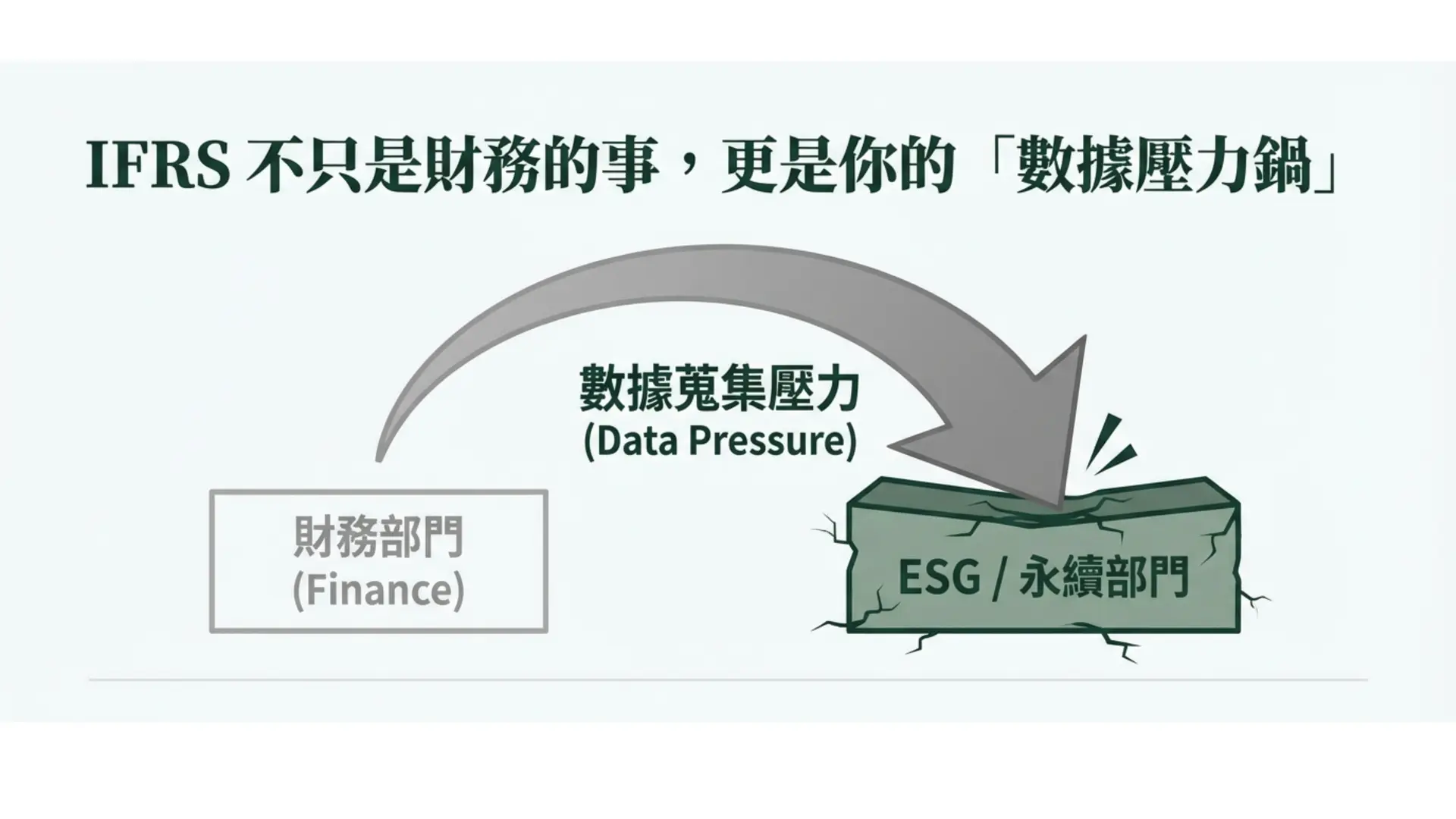
Preparing the sustainability chapter of an annual report often requires sustainability, finance, facilities and HR teams to confirm data together. When information is scattered across emails and spreadsheets, checking units, versions and supporting evidence directly affects preparation progress.
Phase 1 companies listed on the Taiwan Stock Exchange (TWSE) or Taipei Exchange (TPEx) apply IFRS Sustainability Disclosure Standards from financial year 2026 and file in 2027. The Financial Supervisory Commission (FSC) has reminded them to complete the relevant chapter by March 16, 2027. Under the policy package announced on September 23, 2026, sustainability chapters for the first two financial years of initial application may be filed no later than the annual report deadline—14 days before the shareholders' meeting. From the third year, they must be filed together with financial reports. Actual requirements remain subject to regulations formally issued by the authorities. These adjustments do not apply to financial, insurance, or securities and futures businesses. Companies in other phases and industries must check their own schedules. See the FSC reminder for Phase 1 companies and Taiwan's IFRS S1/S2 adoption timeline.
The entities covered in other phases were adjusted on September 23, 2026. See IFRS Phase 3 Adjustments.
Work Back from the Filing Deadline to Plan Cross-Department Tasks
First confirm the company's applicable year and filing deadline, then schedule data collection, financial reconciliation, review and board submission. Departmental reporting deadlines should allow time to address missing data, unit conversions and version corrections.
Turn this article into your next step
If this article touches disclosure, carbon inventory, or report preparation, use the system or database to check how peers handle it.
The Limits of File-Based Work Become the Limits of Your Overtime
We understand the challenges faced by frontline sustainability professionals. During peak inventory season, your time often goes not into sustainability strategy but into cumbersome document handling:
The version control "black hole": You send files to 10 departments and receive 10 files with different names. You then manually copy and paste them into a master spreadsheet. What if you paste into the wrong column, or miss an updated file sent by a department? This is how data errors arise. Including the wrong version and failing to update to the latest figures can be disastrous.
The data consolidation "gap": HR counts people, facilities counts kilowatt-hours, and general affairs measures waste. Everyone uses different units, mixing kilograms, metric tonnes and cubic metres. You build countless Excel formulas to convert them, but one incorrect input unit can invalidate all subsequent emissions calculations. Even collecting employee benefits data across plants in mainland China and Vietnam, a North American site and a Taiwan office can take substantial time to organise.
"Disappearing" supporting evidence: The figures are entered, but where are the photos of water and electricity bills? They may be scattered across LINE groups, email attachments or a deeply nested shared folder, making them impossible to find when assurance begins. When closing out the year's employee welfare activities, which photos belong to which event? How should you manage risk assessments and analyses, flowcharts, policy documents, implementation updates and related records?
In 2026, using manual work and Office documents to process vast quantities of data that require assurance is like running AI calculations on an abacus. It is not impossible, but the risk is too high and efficiency extremely low.
Centralise Data Submission and Review with Collaboration Tools
Data Collection
Assign forms and responsible staff based on disclosure needs and track submission status so the team knows which data is still missing.
Fields and Supporting Evidence
Confirm periods, units, required fields and attachment requirements in advance. After submission, the responsible person should check the data; entering a number does not mean the review is complete.
Versions and Review
Retain data sources, editing histories and review records for traceability. Tools can support management, but the company and relevant professionals must still confirm whether disclosures are complete and comply with applicable requirements.
Explore Syber's data collection, collaboration and review features, starting with your existing disclosure framework and one set of cross-department data to confirm workflows and plan terms.
Updated on October 6, 2026. Key update: transitional measures allowing sustainability chapters to follow annual report filing deadlines during the first two years of adoption.
IFRS Syber Digital Transformation Sustainability Report ESG Professionals
FAQ
View AllWhat reporting timelines apply under IFRS S1/S2?
Phase 1 TWSE/TPEx-listed companies report 2026 information in 2027, and the FSC has reminded them to complete their annual report sustainability chapters by March 16, 2027. Under the policy package announced on September 23, 2026, sustainability chapters for the first two financial years of initial application may be filed no later than the annual report deadline—14 days before the shareholders' meeting. From the third year, they must be filed together with financial reports. Actual requirements remain subject to regulations formally issued by the authorities. These adjustments do not apply to financial, insurance, or securities and futures businesses. Departments should schedule collection and review around the company's deadlines.
How can digital systems improve data collection efficiency?
Collaboration tools can centralise responses, attachments, versions and review records. The time required depends on data readiness, disclosure scope and the allocation of team responsibilities.
What problems commonly arise during data collection?
Common problems include version control errors, unit conversion errors and missing supporting evidence—for example, inconsistent units across departments or missing photos of water and electricity bills.
Turn Sustainability Disclosure into a Collaborative Workflow
Use Syber to manage section ownership, metric data, review records, and disclosure progress, turning IFRS, SASB, and GRI requirements into a team workflow.
How to decide the next stepTurn the disclosure requirements in the article into sections, data sources, and owners first. If collaboration, version control, or verification is involved, then evaluate whether a reporting workflow is needed.