
What Is Net Zero? Taiwan's 2050 Pathway, the Law and Corporate Targets
Net zero is a balance between emissions and carbon sinks, not zero emissions. From the pathway announced in 2022 and its enactment into law in 2023 to the SBTi version timeline, see where national targets end and corporate obligations begin, and how to prepare starting with an inventory.
What to decide after reading If you came for emission factors, ISO 14064, CBAM, or carbon data, the next step is to check whether activity data, emission factor versions, and supporting evidence can be traced.
Table of Contents
- How the Law Defines Net Zero: A Balance of Emissions and Sinks
- The National Pathway: Four Transitions, Two Governance Foundations and 12 Key Strategies
- 2050 Net Zero in Law: Where National Targets End and Corporate Obligations Begin
- Corporate Targets: The SBTi's Role and Version Timeline
- Net Zero and Carbon Neutrality: Two Commitments, Two Kinds of Evidence
- Start with an Inventory: Turning Net-Zero Direction into Trackable Work
Net-zero emissions means bringing greenhouse gas emissions into balance with carbon sinks. It does not mean emitting nothing at all, nor is it a status you can claim by continuing to emit and buying credits at will. Following a timeline from Taiwan's net-zero pathway announced in 2022 and its enactment into law in 2023 to the version timeline for companies setting targets with the SBTi, the sections below explain where national targets end and corporate obligations begin, and where companies can start.
Turn this article into your next step
If this article touches disclosure, carbon inventory, or report preparation, use the system or database to check how peers handle it.
How the Law Defines Net Zero: A Balance of Emissions and Sinks
Article 3 of the Climate Change Response Act (氣候變遷因應法) defines net zero as a balance between greenhouse gas emissions and carbon sinks. Under the same Act, carbon sinks include natural or man-made facilities and sites that can continuously remove and absorb or store greenhouse gases. Net zero is about balance; it does not require every activity to have no emissions at all.
Precisely because it is a balance, a net-zero statement has to explain more than the final number: whose emissions are covered, which period is quantified, what measures have been taken and how residual emissions are handled. Completing an inventory this year means you have emissions data; starting to replace equipment is a reduction action. Both are real progress, but leaving out the results achieved and the conditions for balance means it cannot be called net zero achieved. Describing progress by concrete stage is easier for customers to understand than simply applying a "net-zero company" label.
The National Pathway: Four Transitions, Two Governance Foundations and 12 Key Strategies
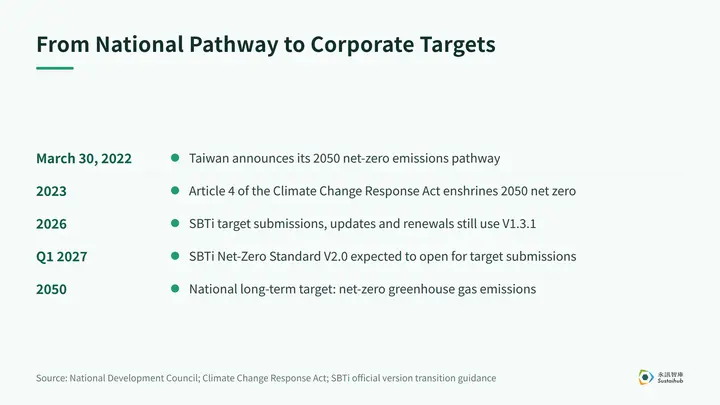
On March 30, 2022, Taiwan announced its net-zero pathway, built on four transitions (energy, industry, lifestyle and society), supported by two governance foundations (technology R&D and climate legislation) and implemented through 12 key strategies. For the framework and announcement date, see the National Development Council (國家發展委員會) page on the 12 key strategies; for the overall pathway, see Taiwan's Pathway to Net-Zero Emissions in 2050.
The framework has since been given more specific timelines. On January 23, 2025, the government introduced Taiwan's Overall Carbon Reduction Action Plan (臺灣總體減碳行動計畫), driven by 20 flagship actions across six sectors and 6 major institutional innovations. The Nationally Determined Contribution (NDC 3.0) uses 2005 as its base year and sets reduction targets of 26%–30% by 2030 and 36%–40% by 2035 (approved NDC 3.0). These are national-level targets; companies still need to set their own targets based on the regulations that apply to them and their customers' requirements.
This is a national transition framework, not an emissions quota allocated to each company, and it does not mean every industry must adopt the same technology. A more practical way for companies to read it is to identify the strategies directly related to their operations, assign a responsible department and gather data for assessment. The table below lists all 12 strategies, with questions companies can discuss internally in the right-hand column.
| Key strategy | Questions for internal discussion |
|---|---|
| Wind and solar power | When buying energy, how do we confirm its source and supply terms? |
| Hydrogen | Do our processes need an assessment of alternative fuels? |
| Innovative energy | Which R&D directions could affect our long-term energy choices? |
| Power systems and energy storage | How do we integrate electricity demand, supply resilience and load management? |
| Energy saving | Which equipment and operating practices can be improved first? |
| Carbon capture, utilization and storage | Do hard-to-abate processes need to track the conditions for these technologies? |
| Electrification and decarbonization of vehicles | How do we assess vehicles and infrastructure when renewing the fleet? |
| Resource circularity and zero waste | How can we reduce material losses and improve reuse processes? |
| Natural carbon sinks | If we plan carbon sinks, how do we prove removal effects and permanence? |
| Net-zero green lifestyle | What can change in office operations, purchasing and services? |
| Green finance | What emissions and transition data do investment decisions need? |
| Just transition | How will the transition affect employees, suppliers and local communities? |
These strategies are often interconnected within a company. For a company that needs to renew its fleet, discussions on "electrification and decarbonization of vehicles" should also cover electricity demand and staff operating training, rather than splitting each strategy into unrelated projects.
Energy is the most direct starting point for most companies, and renewable energy use among listed companies is still at an early stage. Sustaihub's analysis of the 2025 ESG disclosure open data from the Taiwan Stock Exchange (證交所) and the Taipei Exchange (櫃買中心) shows a median renewable energy share of 1.6% among the 702 listed companies that reported it, with computers and peripheral equipment (14.0%) and financial and insurance (15.5%) notably higher. For most companies, "wind and solar power" is not a distant topic: how to confirm the source and supply terms when buying energy is something they can start on right away.
2050 Net Zero in Law: Where National Targets End and Corporate Obligations Begin
The Climate Change Response Act, amended and promulgated in 2023, sets net-zero greenhouse gas emissions by 2050 as the national long-term reduction target in Article 4. This is a national goal; it does not mean every company must immediately obtain the same kind of net-zero certification. Individual companies' obligations must be determined separately under the applicable provisions and announcements: whether they are subject to inventory registration, verification or the carbon fee, and what disclosure rules and customer requirements apply. Managing statutory filing obligations separately from voluntary corporate targets makes things much clearer.
Likewise, the technology scenarios in successive pathways are not fixed emissions quotas for each company; for investment decisions, check the current policies for the relevant industry and technology. For which companies must conduct statutory inventories and register, see "GHG Inventory Registration: Which Companies Must Register".
Corporate Targets: The SBTi's Role and Version Timeline
The SBTi (Science Based Targets initiative) provides standards and methods for companies to set science-based reduction targets; target validation is handled by SBTi Services. Setting a target or passing validation is one stage of target management and is different from actually achieving net zero; companies still need to implement their plans and track progress. The SBTi Corporate Net-Zero Standard overview also distinguishes a company's own reductions from additional climate contributions, and the latter cannot replace the former.
The version is what needs the most attention right now. As of October 6, 2026, the SBTi has published the Corporate Net-Zero Standard V2.0, but its official version transition guidance still recommends that companies submitting, updating or renewing targets in 2026 use V1.3.1, with target submissions under V2.0 expected to open from Q1 2027. "A new standard has been published" does not mean "all applications switch to the new version immediately," and the specific conditions of different versions should not be mixed. The pathway, target boundary and submission timing that apply to a company and its sector determine how data should be prepared; a generic set of reduction percentages cannot replace these judgments.
Net Zero and Carbon Neutrality: Two Commitments, Two Kinds of Evidence
At the company and product level, net zero and carbon neutrality differ in purpose and in the conditions for achieving them, and they cannot be treated as interchangeable certificates. Net zero is a matter of transition and target management; a carbon neutrality claim must specify the subject, boundary and period, and how the residual carbon footprint is balanced.
| Aspect | Corporate net-zero target | Carbon neutrality claim |
|---|---|---|
| Core question | How does the company drive reductions and transition along a science-based pathway? | Which organization, product or service, and which period, does the claim cover? |
| Foundation needed | Inventory data, reduction targets, transition actions and progress | Carbon footprint quantification, reduction results, residual emissions and offset evidence |
| Role of external credits | Must follow the target standard and cannot replace the company's own reductions | Offset the residual footprint after reductions under the applicable standard |
| What cannot be inferred | An approved target does not mean the target has been met | Carbon neutrality for one subject does not mean the whole company is net zero |
ISO 14068:2026 applies to carbon neutrality for organizations and products; it is not a standard for setting net-zero targets. Carbon neutrality for a single product or a single year therefore does not mean the whole company has reached net zero.
Start with an Inventory: Turning Net-Zero Direction into Trackable Work
A net-zero target needs a comparable emissions baseline. The GHG Protocol Corporate Standard provides the basis for organizational inventories, and the Scope 3 Standard helps companies identify value chain emissions and improvement opportunities. On that basis, corporate preparation is broadly a cycle: confirm the purpose and boundary, including applicable rules, sites, period and value chain activities; build inventory data with sources, factors and assumptions documented; compare reduction options across equipment, energy and the supply chain; set the base year and target period, and define quantifiable, trackable targets; and finally compare actual results, explain variances and adjust measures.
The items to address usually come from four directions. Regulatory: whether the company is subject to inventory registration, verification or the carbon fee. Customers: whether they want organizational emissions, a product carbon footprint or reduction targets. Operations: which improvements in equipment upgrades, fuel use and purchasing decisions can fit into the annual budget. External communication: completed data, measures under way and future commitments should be presented separately. This is a way to take stock of company needs, not a new list of regulatory requirements.
When starting out, data can be sorted into three columns, "confirmed", "to be estimated" and "missing", with no need to omit limitations to make the report look complete. Even without complete Scope 3 data, small and medium-sized enterprises can start from value chain activities, data sources and gaps to build preliminary estimates with stated assumptions; missing data does not mean no emissions. For measures still under evaluation, record expected and achieved reductions separately. In annual reviews, explain any changes in output, boundary or method, and do not directly subtract figures that are not comparable.
Sustaihub's DCarbon supports organizational carbon inventories under ISO 14064-1 and product carbon footprint calculation under ISO 14067; the system handles data organization and calculation, while formal verification is carried out by third-party bodies. Further reading: for the full inventory steps, see "Taiwan Carbon Inventory: Who Must Report, 5 Stages and Verification"; if you are considering credits for residual emissions, "Taiwan Carbon Credits: Trading, Prices and Carbon Fee Deduction Rules" covers Taiwan's trading and deduction conditions.
FAQ
View AllDoes net-zero emissions mean emitting nothing at all?
No. The Climate Change Response Act defines net zero as a balance between greenhouse gas emissions and carbon sinks. In practice, companies still need to actively reduce emissions and then address residual emissions that are hard to eliminate; continuing to emit while buying credits at will cannot be called net zero.
How do net zero and carbon neutrality differ?
In a corporate context, net zero focuses on driving transition along a science-based pathway; carbon neutrality targets a defined subject, boundary and period, quantifying and reducing the carbon footprint and balancing the residual through offsets under applicable conditions. Carbon neutrality for a single product or a single year does not mean the whole company is net zero.
What are the key points of Taiwan's 2050 net-zero pathway?
Announced on March 30, 2022, the pathway combines four transitions (energy, industry, lifestyle and society) with two governance foundations (technology R&D and climate legislation) and 12 key strategies. It is an overall transition framework, not an identical emissions quota for every company. In 2025 the government also introduced Taiwan's Overall Carbon Reduction Action Plan, and NDC 3.0 sets interim reduction targets for 2030 and 2035.
Turn Carbon Data into an Auditable Workflow
Use DCarbon to calculate emissions with the emission factors you configure and organize activity data and supporting evidence, so inventory data stays traceable, reviewable, and ready for customer requests.
How to decide the next stepTurn the regulation or factor requirements in the article into a data checklist first. If data crosses sites or departments, or needs verification, then evaluate whether system-based management is needed.