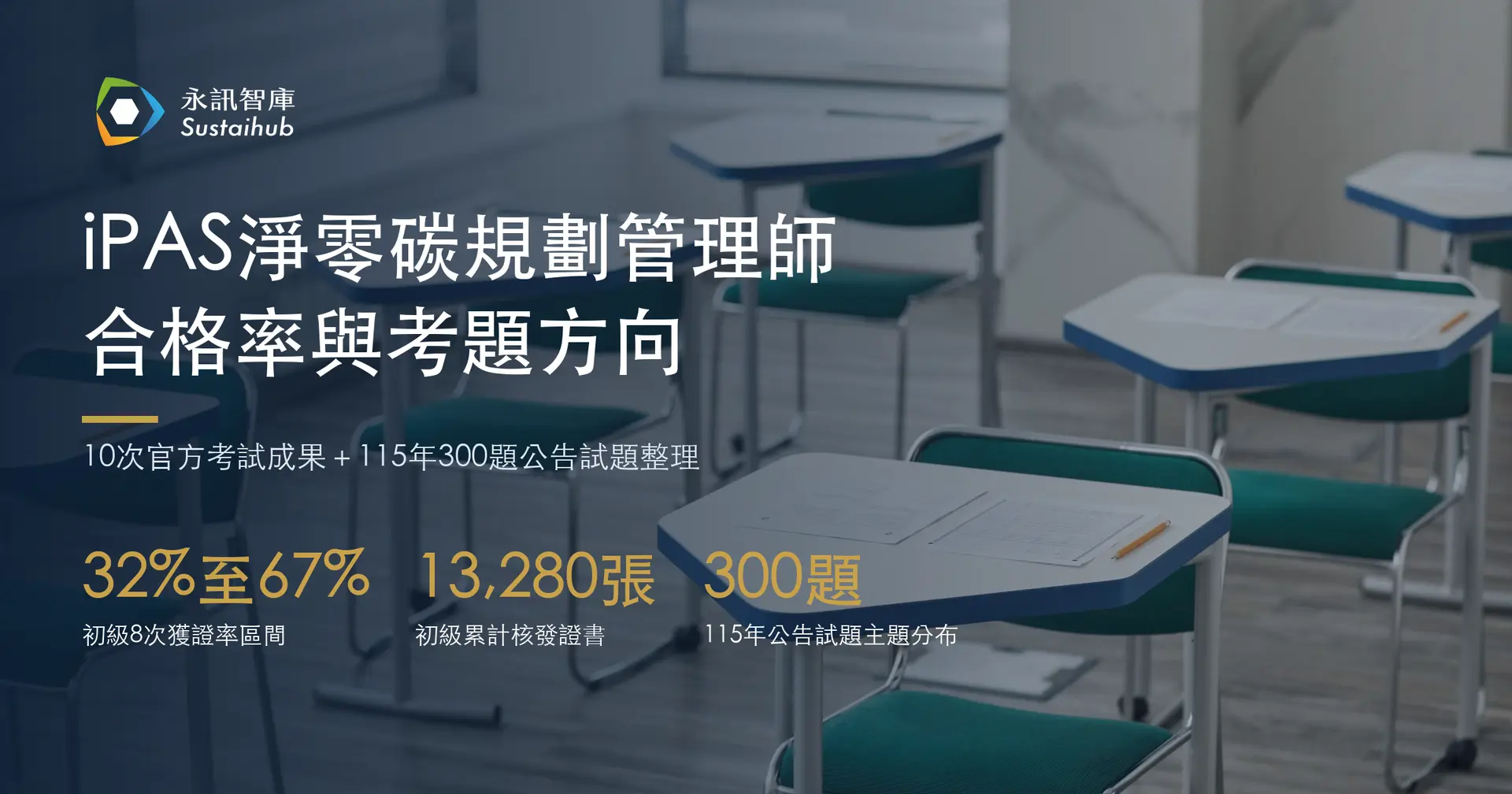
iPAS Net-Zero Carbon Planning Manager is one of the Ministry of Economic Affairs' iPAS industry professional assessment programmes, organised by the Industrial Development Administration and administered by the Industrial Technology Research Institute. From the first elementary exam in 2024 (ROC year 113) to the second intermediate exam in August 2026 (ROC year 115), the official “Past Exam Results” page has published 10 sets of results: 8 elementary and 2 intermediate.
This article does two things. First, it transcribes all 10 official results graphics into tables, presenting pass rates (officially termed “certification rates”), registrations, subject-level pass rates and the calculation definitions needed to interpret them. Second, it classifies the 300 questions in the 6 published 2026 (ROC year 115) papers against the assessment content codes in the exam brochure, identifies the topics actually tested and proposes a study sequence based on official learning resources.
The third elementary exam of 2026 (ROC year 115) is scheduled for November 7. Individual registration closes at 12 noon on September 22.
(All ROC calendar years in this article are accompanied by Gregorian years: 113 = 2024, 114 = 2025, 115 = 2026, 116 = 2027.)
1. Four Key Figures from 10 Exams
All four figures come from results graphics published on the iPAS website. “Certification rate” is the official term, though searches often use “pass rate”. In this article, these terms refer to the same measure: certificates issued for that sitting divided by total attendees for that sitting.
For candidates, the third figure has the most direct implications for preparation. The two elementary subjects are “Introduction to Net-Zero Carbon Planning and Management” and “Overview of Net-Zero Carbon Inventory Standards and Procedures”. In 7 of 8 exams, Subject One had a lower pass rate than Subject Two. Subject Two involves emissions calculations and boundary decisions, while Subject One focuses on international initiatives, policies and standards. Historical pass rates show that Subject One has not been easier to pass.

2. What Is the Net-Zero Carbon Planning Manager Certification? Elementary vs Intermediate
According to the 2026 (ROC year 115) brochure, the Net-Zero Carbon Planning Manager assessment currently has two levels: Elementary and Intermediate, with certificates issued by the Ministry of Economic Affairs. The brochure explains that iPAS was launched in 2016 (ROC year 105) to provide an objective reference for corporate interviews and hiring, and to guide schools and training organisations in designing courses around industry needs.
Subjects, Question Types and Duration
| Item | Elementary | Intermediate |
|---|---|---|
| Subject One | Introduction to Net-Zero Carbon Planning and Management | Energy-Saving and Carbon-Reduction Technology Practice |
| Subject Two | Overview of Net-Zero Carbon Inventory Standards and Procedures | Carbon Management Systems Practice |
| Question Types | 50 single-answer multiple-choice questions per subject | 50 questions per subject, comprising single-answer, multiple-answer and scenario questions |
| Time per Subject | 75 minutes | 90 minutes |
| Test Format | Computer-based test; electronic calculators approved by Taiwan's Ministry of Examination for national examinations are permitted | |
| Recommended Candidates | University junior or above; junior college graduate with 1 year of relevant work experience | Elementary certificate holder; university graduate with 2 years of relevant work experience; graduate degree holder with 1 year of relevant work experience; or 3 or more years of relevant experience |
| Registration Fee (Standard) | NT$1,200 per subject | NT$1,500 per subject |
| Certificate Validity | Permanent | 5 years; renewal requires at least 48 hours of relevant training (each year of net-zero-related work experience may offset 8 hours) |
Source: 2026 (ROC year 115) Net-Zero Carbon Planning Manager Assessment Brochure (Elementary and Intermediate), version 115.04 | Compiled by Sustaihub
“Recommended candidates” does not mean eligibility requirements. The official FAQ states that iPAS has no age or prior training threshold, and no required sequence between elementary and intermediate exams. Candidates may register directly for the intermediate level without an elementary certificate.
Several fee discounts are available: new candidates who have never registered for iPAS pay NT$800 per elementary subject or NT$1,000 per intermediate subject. Returning candidates who have completed any iPAS exam, and those eligible for the iPAS recognition scheme, group registration scheme or Ministry of Economic Affairs talent training scheme, pay NT$600 per elementary subject or NT$700 per intermediate subject.
Certification Routes and Score Retention
One detail matters in the elementary certification rules: Taking Both Subjects Together and Taking Subjects in Separate Sittings have different thresholds. Including the intermediate level, there are three routes.

- Both elementary subjects in the same sitting: an average of 70 with neither subject below 60 qualifies. For example, 65 in Subject One and 75 in Subject Two gives an average of 70 and qualifies.
- Separate sittings: each subject must score at least 70.
- Intermediate level: both Subject One and Subject Two must score at least 70; averaging does not apply.
- Score retention: a subject score of 70 or above is retained for three years from the exam date. The brochure's example is an exam on March 21, 2026 (ROC year 115), with a passed subject retained until December 31, 2029 (ROC year 118).
The effect of score retention is visible in the official results graphics, as discussed in Section Four.
3. Historical Certification Rates and Registrations
The following table presents complete results for all 10 exams, transcribed cell by cell from official graphics. Headcounts were recalculated using the published percentages to confirm consistency.
| Sitting | Registered Candidates | Total Attendees | Certificates Issued | Certification Rate | Subject One Pass Rate | Subject Two Pass Rate |
|---|---|---|---|---|---|---|
| 2024 (ROC 113), First Elementary | 2,614 | 2,361 | 1,592 | 67.43% | 64.28% | 72.82% |
| 2024 (ROC 113), Second Elementary | 6,159 | 5,556 | 2,961 | 53.29% | 46.43% | 55.70% |
| 2024 (ROC 113), Third Elementary | 8,704 | 7,627 | 2,731 | 35.81% | 27.76% | 29.29% |
| 2025 (ROC 114), First Elementary | 5,078 | 4,364 | 1,470 | 33.68% | 19.63% | 42.45% |
| 2025 (ROC 114), Second Elementary | 3,842 | 3,092 | 1,055 | 34.12% | 25.65% | 41.68% |
| 2025 (ROC 114), Third Elementary | 4,886 | 3,884 | 1,245 | 32.05% | 22.46% | 36.39% |
| 2026 (ROC 115), First Elementary | 3,605 | 3,049 | 1,012 | 33.19% | 28.77% | 39.19% |
| 2026 (ROC 115), Second Elementary | 2,579 | 2,157 | 1,214 | 56.28% | 71.00% | 41.59% |
| 2026 (ROC 115), First Intermediate | 1,606 | 1,437 | 627 | 43.63% | 73.25% | 46.46% |
| 2026 (ROC 115), Second Intermediate | 1,373 | 1,158 | 607 | 52.42% | 48.38% | 69.87% |
Source: official iPAS Net-Zero Carbon Planning Manager “Past Exam Results” graphics (retrieved September 14, 2026; second intermediate exam of ROC year 115 additionally retrieved September 17) | Compiled by Sustaihub. Certificates include qualifications completed within one sitting and across sittings. Intermediate Subject One is Energy-Saving and Carbon-Reduction Technology Practice; Subject Two is Carbon Management Systems Practice.
Registrations Declined After Peaking at 8,704 in the Third Exam of 2024 (ROC 113)
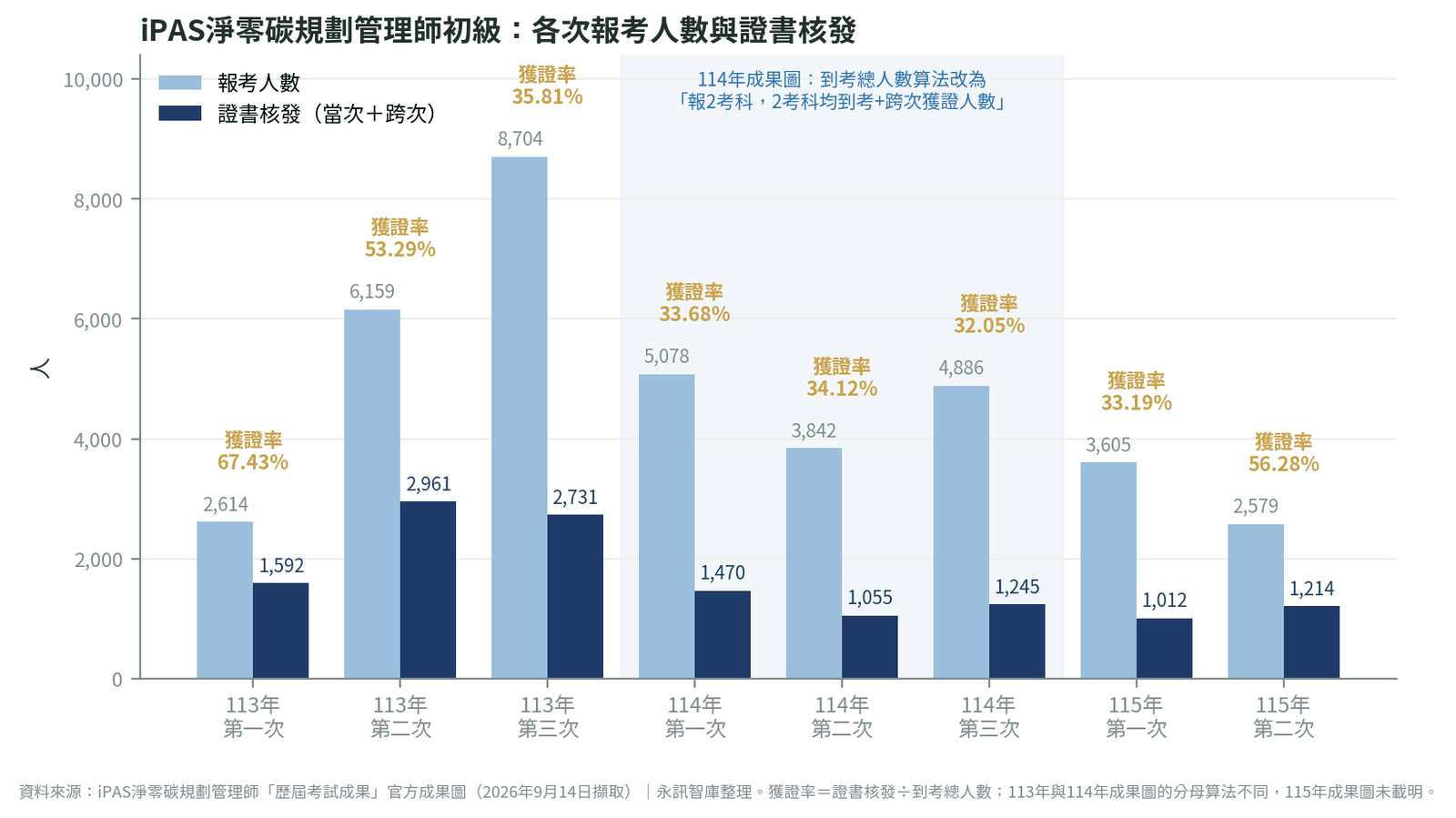
Elementary registrations increased in each of the three 2024 (ROC year 113) sittings, reaching 8,704 in the third, before declining to 2,579 in the second sitting of 2026 (ROC year 115). Annual totals were: 17,477 registrations and 7,284 certificates across 3 sittings in 2024 (ROC 113); 13,806 registrations and 3,770 certificates across 3 sittings in 2025 (ROC 114); and 6,184 registrations and 2,226 certificates across the 2 sittings held so far in 2026 (ROC 115).
Registrations are counted separately for each sitting. A person who takes two exams is counted once in each. The total of 37,467 across 8 sittings therefore does not represent 37,467 unique people. Certificates differ: the 2026 brochure prohibits holders from obtaining the same level's certificate again. On that basis, 13,280 certificates roughly correspond to 13,280 elementary certificate holders. This wording was not found in the certification section of the 2024 brochure, so official materials cannot confirm whether the same rule applied to the earliest sittings.
The intermediate exam began in 2026 (ROC year 115), with 1,606 registrations for the first sitting. Official data do not provide a basis for determining whether its launch is related to declining elementary registrations, so this article makes no such inference.
Before Comparing Certification Rates: The Denominator Changed in 2025 (ROC 114)
The highest and lowest elementary certification rates differ by 35.38 percentage points. Before comparing years, however, examine the small print in the results graphics explaining how “total attendees for this sitting” is calculated.
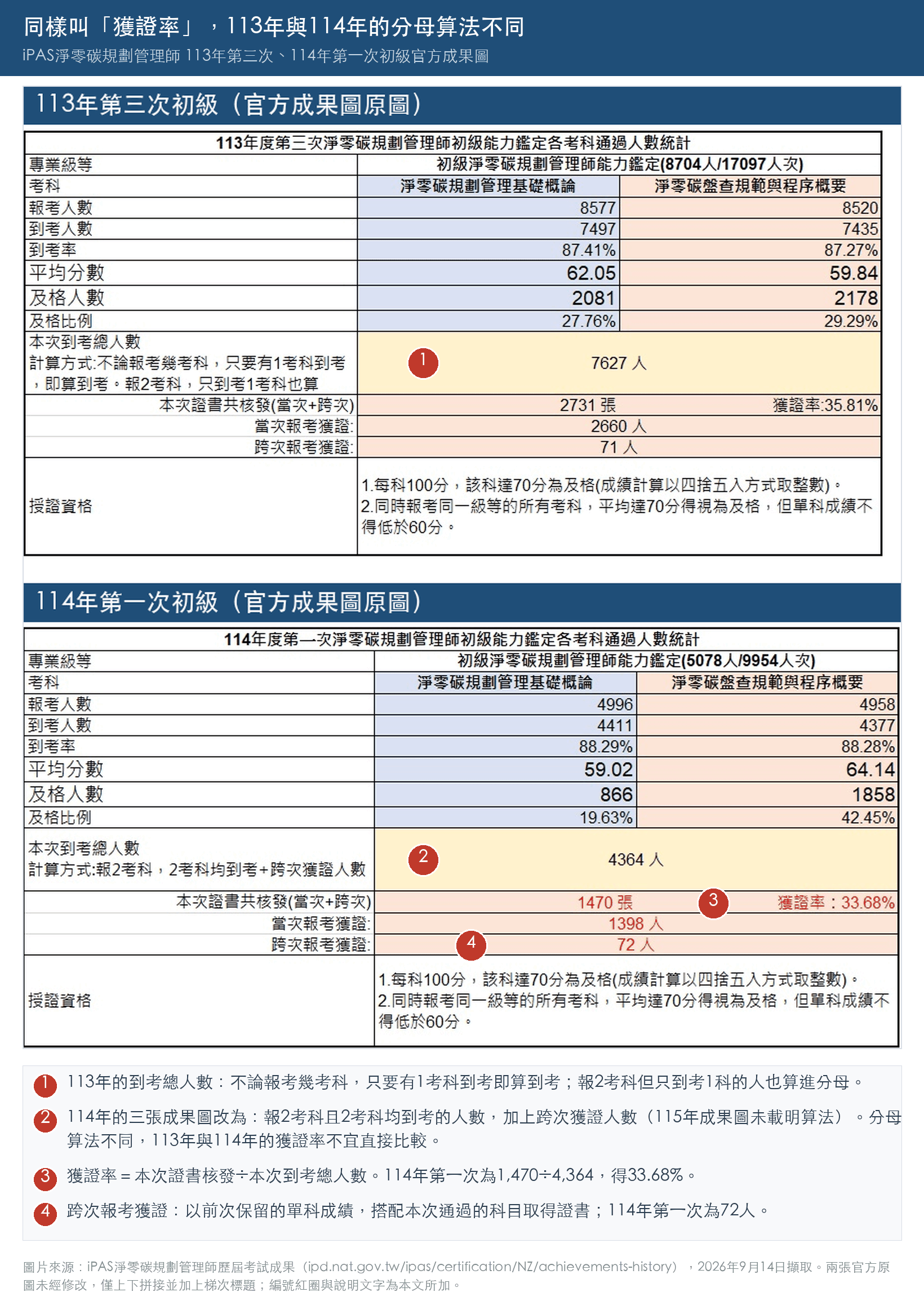
- The three 2024 (ROC 113) graphics state: “Regardless of the number of subjects registered, attending at least 1 subject counts as attendance. Registering for 2 subjects but attending only 1 also counts.”
- The three 2025 (ROC 114) graphics state: “Registered for 2 subjects and attended both + cross-sitting certificate recipients.”
- The four 2026 (ROC 115) graphics use a new layout and do not specify the calculation method.
Certification rate = certificates issued ÷ total attendees. Because the denominator changed, rates for 2024 (ROC 113) and 2025 (ROC 114) are not calculated on the same basis. By contrast, the subject-level Pass Rate is “candidates passing that subject ÷ candidates attending that subject”. Recalculation confirms that all 10 graphics follow this formula, so this article uses it to compare exam difficulty.
When citing the “Net-Zero Carbon Planning Manager pass rate”, specify both the sitting and definition—for example, “56.28% certification rate for the second elementary exam of 2026 (ROC year 115), according to the official results graphic”. A percentage without the sitting leaves readers unable to identify the exam or how its denominator was calculated.
4. The Two Subjects Differ in Difficulty
Subject One Had a Lower Pass Rate in 7 of 8 Exams

Comparing subject pass rates across the 8 elementary exams:
- Subject One, “Introduction to Net-Zero Carbon Planning and Management”, had a lower pass rate in 7 exams. The largest gap among those 7 was in the first exam of 2025 (ROC 114): 19.63% versus 42.45%, a difference of 22.82 percentage points. Subject One's average score that time was 59.02.
- For five consecutive exams, from the third of 2024 (ROC 113) to the first of 2026 (ROC 115), Subject One's pass rate stayed below 30%: 27.76%, 19.63%, 25.65%, 22.46% and 28.77%.
- Across all 8 exams, 34.53% of Subject One attendees passed, compared with 42.75% for Subject Two. Individuals may have attended more than once, so these figures are an overall reference only.
Subject One covers COP developments, international initiatives, CBAM, Taiwan's 2050 net-zero pathway and the ISO 14068-1 carbon neutrality standard. Section Six provides examples, including questions on policy targets, thresholds and statistical figures.
Second Exam of 2026 (ROC 115): A 71.00% Subject One Pass Rate
The second elementary exam on August 15, 2026 (ROC year 115) was an exception. Subject One's average score was 73.54 and its pass rate was 71.00%, the highest across all 8 exams. Subject Two's pass rate was 41.59%, similar to preceding sittings. The certification rate was 56.28%, second only to the first 2024 (ROC 113) exam's 67.43% among the 8 elementary exams.
A change in one sitting may reflect question difficulty, candidate composition or other factors; the organiser did not explain the cause. Candidates should not treat an easier Subject One in the second 2026 exam as a trend. It still deserves adequate study time.
Cross-Sitting Certificate Recipients Rose from 0 to 216
The results graphics divide certificates into “qualified within this sitting” and “qualified across sittings”. The latter combines a retained score with a subject passed in the current sitting.
Cross-sitting recipients increased from 0 in the first 2024 (ROC 113) exam to 216 in the second 2026 (ROC 115) exam, accounting for 17.79% of the 1,214 certificates issued in that sitting. The first exam had no prior scores to retain, hence zero. Every subsequent exam has included candidates qualifying with a retained subject score.
For candidates, passing only one subject still leaves a route forward: retain that score for three years, take only the other subject next time and score 70 to qualify. Remember that separate sittings do not allow averaging; the remaining subject must independently reach 70.
5. Two Intermediate Exams: Certification Rates of 43.63% and 52.42%
The intermediate exam launched in 2026 (ROC year 115) and has held two sittings so far: April 11 and August 22. Both results are published, with 627 + 607 = 1,234 people receiving intermediate certificates.
| Item | 2026 (ROC 115), First Intermediate | 2026 (ROC 115), Second Intermediate |
|---|---|---|
| Candidates / Subject Registrations | 1,606 candidates / 3,209 subject registrations | 1,373 candidates / 2,421 subject registrations |
| Total Attendees | 1,437 | 1,158 |
| Certificates Issued (Same Sitting + Cross-Sitting) | 627(627+0) | 607(367+240) |
| Certification Rate | 43.63% | 52.42% |
| Subject One: Energy-Saving and Carbon-Reduction Technology Practice | 1,439 attendees; 1,054 passes 73.25% pass rate; average score 74.68 | 897 attendees; 434 passes 48.38% pass rate; average score 68.08 |
| Subject Two: Carbon Management Systems Practice | 1,440 attendees; 669 passes 46.46% pass rate; average score 66.94 | 1,135 attendees; 793 passes 69.87% pass rate; average score 73.19 |
Source: iPAS “Past Exam Results” graphics for the first and second intermediate exams of 2026 (ROC 115). Second results published September 15, 2026 and retrieved September 17, 2026 | Compiled by Sustaihub
Candidates should note three points about the two intermediate exams:
- The harder subject reversed between sittings. In the first, Subject One's pass rate was 73.25% and Subject Two's was 46.46%. In the second, Subject One fell to 48.38% while Subject Two reached 69.87%, a 21.49-percentage-point gap. Two results are insufficient to establish which subject is consistently harder. Prepare to score 70 in both.
- 240 recipients qualified across sittings. Of the 607 certificates in the second intermediate exam, 240 combined a retained subject score with a newly passed subject, accounting for 39.54%. Subject registrations also differed: 1,081 for Subject One and 1,340 for Subject Two. The 2,421 subject registrations were fewer than twice the 1,373 candidates, indicating some registered for only one subject.
- The certification rate rose from 43.63% to 52.42%. The second sitting included 240 cross-sitting recipients, so candidate composition differed from the first. The organiser did not explain the change, which should not be read directly as an easier exam.
Intermediate certification requires 70 in each subject; averaging does not apply. Subject One covers reduction targets and pathways, energy-saving technologies and investment benefits, renewables and green power procurement. Subject Two covers domestic climate regulations, disclosure systems such as IFRS and GRI, voluntary reductions and offsets, Scope 3 inventories and supply chain management. Section Six presents the first intermediate exam's topic distribution. As of September 17, 2026, the official learning resources page had not published the second intermediate papers.
6. Question Topics: Distribution of 300 Published Questions from 2026 (ROC Year 115)
The official source for past papers is “Past Exam Questions” on the iPAS website's “Learning Resources” page. Six papers from 2026 (ROC year 115) are currently published: both subjects from the first and second elementary exams and both subjects from the first intermediate exam. Each contains 50 questions with reference answers. Below is our classification of all 300 questions against the brochure's assessment content codes.
Sustaihub classified each question using the brochure's assessment content codes. This is our analysis, not an official classification; the organiser has not published topic weightings. A question may involve two topics, but we assign it only to the main one. The sample covers just 6 papers from 2026 (ROC year 115), and the next exam's distribution may differ.

Elementary Subject One: International Initiatives, Taiwan's Net-Zero Pathway and CBAM Dominate
Assessment topic L112, “Introduction to Net-Zero Carbon Management”, accounts for 70 questions; L111, “International Responses and Trends Under Extreme Climate Conditions”, accounts for 30. All are single-answer multiple-choice questions. Our review identified none requiring calculation.
Specific observations:
- International Initiatives (L11201) Lead with 22 Questions, covering SBTi, RE100, TCFD, CDP, GRI, SASB and IFRS S1 and S2. Questions often test differences between initiatives and specific thresholds, such as SBTi's SME definition and RE100 membership criteria.
- CBAMEach exam contains 6 questions on reporting schedules, exemption thresholds, certificates and emissions calculation principles. The papers state that reference answers follow regulations in force when the exam was announced. Check the EU's latest announcements when studying CBAM thresholds and timelines. For background, see “2026 Update: EU CBAM Enters Its Definitive Phase—How Can Taiwanese Exporters Stay Globally Competitive?”.
- COPBoth exams include COP28 questions. The first 2026 (ROC 115) exam tests the global stocktake's quantitative target for global renewable capacity by 2030 (reference answer: triple existing capacity). The second tests concrete actions to accelerate the energy transition. COP29, COP30 and Article 6 of the Paris Agreement also appear. For background, see “From COP30 and NDC 3.0 to CBAM: How Can Companies Manage the Carbon Transition and Plan a Practical Net-Zero Pathway?”.
- ISO 14068-1Each exam has 5–6 questions. Questions 46–50 in the first 2026 (ROC 115) exam are five consecutive ISO 14068-1 questions covering carbon neutrality claims, the priority of reductions over offsets and scope definition.
- Carbon Asset Trading (L11204) has 10 questions, covering carbon credit additionality, internal carbon pricing and the Taiwan Carbon Solution Exchange's functions. For international carbon market developments, see “Carbon Trading and Credits: Five Global Market Trends | 2025 ICAP ETS Report”.
- Taiwan's Energy Data: the first 2026 (ROC 115) exam cites the Ministry of Economic Affairs' Energy Statistics Handbook, asking about the largest source in Taiwan's 2024 electricity generation mix and the range of its energy self-sufficiency rate. These questions require remembering specific official statistics.
Elementary Subject Two: Quantification and Boundary Setting
Organisational greenhouse gas inventories (L121) account for 60 questions and product carbon footprints (L122) for 40. Approximately one-third of the 100 questions start with a business scenario. Our review identified 6 requiring actual calculation.
- Quantification (L12103) Leads with 21 Questions. Calculation questions mostly use the basic formula “activity data × emission factor”. For example, the first 2026 (ROC 115) exam gives factors for 10,000 kWh of electricity and 1,000 litres of diesel and asks candidates to distinguish Category 1 and Category 2 emissions. Other questions cover refrigerant leakage and converting septic-tank methane using GWP. The topic also tests calorific values (conversion between lower and higher heating values) and data required for the emission factor method. For factor years and use, see “2025 (ROC Year 114) Electricity Emission Factor Announced at 0.467: Falling Carbon Emissions and Taiwan's Energy Transition”.
- Boundary Setting (L12102): 13 Questions. Operational control, financial control and equity share approaches all appear. One question in the second 2026 (ROC 115) exam lists four emissions sources, including electricity at a warehouse leased to an independently operating third party. Candidates must identify the excluded source under operational control and sum Category 1 and 2 emissions. We classify it under quantification, though it also tests boundaries. For the differences, see “How to Choose Carbon Inventory Boundaries: Control and Equity Share Approaches Explained”.
- Inventories and Reports (L12104): 14 Questions, covering disclosure of exclusions, circumstances requiring base-year recalculation and required report sections. For significant emissions assessment, see “How to Conduct a Carbon Inventory Significance Assessment: A Practical Guide to Corporate Sustainability”.
- Specific Domestic Regulatory Requirements are also tested. Both exams ask about decimal places for emissions. Article 4 of the Regulations Governing Greenhouse Gas Emissions Inventory, Registration and Verification (Laws & Regulations Database of the Republic of China) requires emissions in metric tonnes of CO2 equivalent, rounded to three decimal places. Article 14 requires inventory, registration and verification records to be retained for six years; the second 2026 (ROC 115) exam also tests this.
Intermediate Level: 12 Calculation Questions and Scenario Sets
Both intermediate subjects have the same format: 28 single-answer questions, 10 multiple-answer questions and 12 questions in scenario sets. The brochure calls them “scenario questions”; the published papers call them “question sets”. A business scenario is followed by 2–4 questions, with 4 sets in each subject.
| Subject | Assessment Topics (Question Counts) | Most Frequently Tested Content | Calculation Questions |
|---|---|---|---|
| Energy-Saving and Carbon-Reduction Technology Practice | L211 Organisational Energy-Saving and Carbon-Reduction Strategies (15) L212 Energy-Saving Technologies and Energy Management (18) L213 Renewables and Green Power Adoption (17) | L21303 Green Power Procurement Models and Systems (9 questions) | 12 questions |
| Carbon Management Systems Practice | L221 Carbon Regulations and Disclosure Standards (23) L222 Organisational Voluntary Reductions (12) L223 Sustainable Supply Chain Management (15) | L22101 Domestic Climate Policies and Carbon-Reduction Regulations (9 questions) | 12 questions |
Source: published papers for both subjects in the first intermediate exam of 2026 (ROC 115) | Sustaihub classification using the brochure, not an official classification; calculation counts reflect our assessment of questions requiring actual arithmetic
Each intermediate subject has 12 calculation questions out of 50, a higher proportion than the elementary level. Examples include:
- Energy-Saving and Carbon-Reduction Technology Practice: simple payback periods, annual electricity cost savings from lighting replacement, target electricity consumption for ISO 50001 energy performance indicators (EnPIs), and annual emissions ceilings along a reduction pathway. One scenario describes a company using 20 million kWh annually with 2.3% electricity demand growth, followed by questions on monthly green power purchases for RE20, cost comparisons between power purchase agreements and efficiency projects, and payback for self-generated solar power.
- Carbon Management Systems Practice: reduction rates in voluntary reduction plans, SBTi annualised reduction rates, allocation of supplier targets, carbon fee calculations and deduction of reduction credits. One scenario describes a manufacturer emitting 175,000 metric tonnes annually at a preferential fee of NT$100 per tonne. Candidates calculate fees with no credits, with domestic voluntary reduction credits and with foreign credits. This requires knowing several provisions of the Regulations Governing the Collection of Carbon Fees (Laws & Regulations Database of the Republic of China): Article 5 calculates chargeable emissions by subtracting K, 25,000 metric tonnes, from annual emissions (K is zero for businesses at high risk of carbon leakage), then multiplying by the emissions adjustment factor. Article 6 sets this factor at one for businesses not at high leakage risk. Article 9 sets the deduction ratio for domestic voluntary project credits at 1.2 and caps deductions at 10% of chargeable emissions. For voluntary plans and preferential rates, see “How to Prepare a Voluntary Reduction Plan: A 2026 Application Guide to Cutting Carbon Fees from NT$300 to NT$50”.
- Disclosure Systems: IFRS Sustainability Disclosure Standards implementation timelines, GRI 3 Material Topics, SASB financial materiality and TNFD nature-related dependencies, physical risks and opportunities (three consecutive questions, 45–47). For IFRS adoption, see “2026 IFRS Sustainability Disclosure Standards FAQ: S1, S2, Adoption Timelines, Scope 3 and Internal Controls”.
What Changed Between the 2024 (ROC 113) and 2026 (ROC 115) Brochures?
The assessment scope is not fixed. Comparing elementary assessment content in the 2024 brochure (version 113.01) and 2026 brochure (version 115.04) reveals the main differences below. Minor wording changes to some topic names are not listed individually.
| Code | 2024 Version (113.01) | 2026 Version (115.04) |
|---|---|---|
| L11104 | Not included | Major Global Decarbonisation Trends and Policy Instruments |
| L11201 | Major International Initiatives (CDP, SBTi, RE100, GRI Universal Standards, etc.) | Overview and Key Points of Major International Initiatives (CDP, SBTi, RE100, GRI, SASB, TCFD, IFRS, etc.) |
| L11205 | PAS 2060 Carbon Neutrality Implementation Standard | ISO 14068-1 Carbon Neutrality Standard |
| L11202 | International Carbon Tax and Trade Policies (e.g. EU CBAM, US CCA) | International Carbon Tax and Trade Policies (e.g. CBAM) |
| L12104 | Not included | Preparation of Greenhouse Gas Inventories and Reports |
| L12205 | Not included | Activity Data Collection, Emission Factor Acquisition, Product Emissions Calculation and Interpretation |
| L12202/L12204 | L12202 Product Process Mapping and System Boundaries; L12204 Introduction to Life Cycle Assessment | L12202 Life Cycle Assessment (LCA) Concepts; L12204 Product Process Mapping and System Boundaries (codes switched) |
Sources: 2024 (ROC 113) Net-Zero Carbon Planning Manager Assessment Brochure (Elementary, version 113.01) (reposted on the National Kaohsiung University of Science and Technology website, not the current iPAS website file), and 2026 brochure (Elementary and Intermediate, version 115.04) | Compiled by Sustaihub. The official site does not provide the 2025 brochure, so the year of the changes cannot be determined.
Across the two elementary exams in 2026 (ROC 115), the three new items total 28 questions: 3 for L11104, 14 for L12104 and 11 for L12205. The replacement of the carbon neutrality standard with ISO 14068-1 also yielded 11 questions. Note the code switch: life cycle assessment was L12204 in 2024 and became L12202 in 2026, while process mapping moved the other way. If using notes or course materials from 2024 or earlier, cross-check the latest brochure's assessment content and codes.
7. Preparation Priorities: A Study Sequence Based on Official Resources
The official FAQ recommends first reviewing the brochure's assessment topics and content, then using study guides and sample questions in the website's Learning Resources section. The sequence below is our proposed approach based on those official resources.
-
1Use the Brochure's Assessment Content Table as Your Contents Page
Check whether you can explain the key points of each of the 18 elementary or 20 intermediate content items. Section Six's question distribution can help prioritise, but it comes only from 6 papers in 2026 (ROC 115). -
2Read the Official Study Guides
Both elementary subject guides are version 114.04; both intermediate guides are version 115.02. Read the intermediate guide errata published on the website alongside those guides. -
3Complete Published Papers Under Timed Conditions
Elementary: 50 questions in 75 minutes, averaging 1.5 minutes each. Intermediate: 50 questions in 90 minutes, averaging 1.8 minutes each. Map incorrect answers back to assessment content codes to identify weaknesses. -
4Check Regulations and Numbers Against Official Originals
The website lists 32 references, including ISO 14064-1, ISO 14067, ISO 14068-1, the Ministry of Environment's greenhouse gas inventory guidelines, the Climate Change Response Act, carbon fee collection regulations and corporate carbon neutrality declaration guidelines. Reference answers follow regulations at the time of the exam; check for amendments when reviewing older questions. -
5Practise Calculations with a Calculator
Electronic calculators approved by the Ministry of Examination for national exams are permitted. Check your model on its website beforehand. Elementary candidates should practise emissions conversion and GWP; intermediate candidates should practise payback, green power procurement volumes, carbon fees and reduction credit deductions.
Historically, Subject One's pass rate has been lower in most sittings. Candidates taking both subjects together can account for this when allocating study time. The same-sitting rule—average 70, neither score below 60—also leaves a route to certification when one subject is slightly weaker.
Another official clarification is worth knowing: iPAS separates examinations from training. The FAQ states that the examination body does not offer training courses or partner with private organisations to deliver them. Candidates must assess commercial courses independently.

8. Schedule for the Third Elementary Exam of 2026 (ROC Year 115)
| Item | Third Elementary Exam, 2026 (ROC Year 115) |
|---|---|
| Group Registration | July 9 to September 21 at 12 noon |
| Individual Registration | July 9 to September 22 at 12 noon (online) |
| Exam Notification | Available in the candidate service portal from 10 days before the exam; iPAS does not issue admission tickets |
| Exam Date | Saturday, November 7: Subject One 09:00–10:15; Subject Two 10:45–12:00 |
| Exam Locations | Taipei, New Taipei 1, New Taipei 2, Taipei/New Taipei combined allocation, Taoyuan, Hsinchu, Taichung, Yunlin, Tainan, Kaohsiung, Kinmen and Penghu |
| Results Announcement | November 25 (subject to the latest official website notice) |
| Score Review | Apply online within 2 days of results publication |
| Certificate Mailing | Mailed progressively from January 15, 2027 (ROC year 116) |
Sources: important dates in the 2026 assessment brochure (Elementary and Intermediate), version 115.04; official exam information and FAQ pages | The administrator reserves the right to adjust the schedule; official announcements prevail
Elementary registrations are capped at 5,000 per sitting, closing when full. After the deadline, late registration, rescheduling and changes to exam location or subjects are not accepted. The official FAQ also states there is no postponement mechanism. As of September 17, 2026, the exam information page listed only 2026 (ROC 115) sittings; dates for 2027 (ROC 116) had not been announced.
9. After the Exam: From Certification Knowledge to Inventory Work
One elementary competency in the brochure is “understanding greenhouse gas types and collecting emissions-source activity data, assessing activity data quality and internal greenhouse gas verification practices, and gaining a preliminary understanding of corporate greenhouse gas emissions”.
Single-answer questions test whether you know the rules: emissions rounded to three decimal places, records retained for six years, and warehouses leased to independently operating third parties excluded under operational control. In corporate inventory work, these become concrete recordkeeping requirements: every activity datum must link to an original record; each emission factor needs its issuing authority, year and document title; excluded sources need reasons; and calculations must be reproducible for verification sampling. For inventory standards and methods, see “Which Corporate Carbon Inventory Framework Should You Choose? ISO 14064 vs GHG Protocol”.
Obtaining the Net-Zero Carbon Planning Manager certificate means passing the Ministry of Economic Affairs' competency assessment. When responsible for actual inventory or carbon management work, start assessing whether data is usable with four questions: Does it align with standards? Can the source be found? Is responsibility clear? Can the result pass review? Practical versions follow below.
- Does it align with standards? Does this inventory follow ISO 14064-1:2018, the Ministry of Environment's guidelines or a customer-specified method? Is the boundary-setting approach documented?
- Can the source be found? Can each activity datum be traced to its original record? Are the emission factor's issuing authority, year and document title recorded?
- Is responsibility clear? Which department supplies the data, who reviews it and how often is it updated?
- Can the result pass review? When verifiers sample records, can calculations and supporting evidence be reproduced in one place?
Only when all four can be answered will the inventory withstand verification. Any unanswered question identifies the next gap to close.
Sustaihub's DCarbon brings activity data, emission factors, supporting attachments and inventory reports into one workflow, turning data scattered across sites into traceable, verifiable inventory information.
See How DCarbon Organises Activity Data and Evidence →Frequently Asked Questions
Q1. What Is the iPAS Net-Zero Carbon Planning Manager Pass Rate?
The official term is “certification rate”: certificates issued divided by total attendees. Across 8 elementary exams it ranged from 32.05% in the third 2025 (ROC 114) sitting to 67.43% in the first 2024 (ROC 113) sitting. The latest, the second 2026 (ROC 115) sitting, reached 56.28%. Intermediate rates were 43.63% and 52.42% in the first and second 2026 sittings. The total-attendee calculation changed in 2025 (ROC 114), so subject pass rates are preferable for cross-year comparisons.
Q2. Can I Take the Intermediate Exam Without Passing Elementary?
Yes. The official FAQ states that elementary and intermediate iPAS exams are administered independently, with no required registration or passing sequence. The brochure's “recommended candidates” describes suggested learning backgrounds, not eligibility requirements.
Q3. How Long Can I Retain a Score If I Pass Only One Subject?
A subject score of 70 or above is retained for three years from the exam date. For example, a passing score from 2026 (ROC 115) can be retained until December 31, 2029 (ROC 118). Pass the other subject with 70 during that period to qualify. Separate sittings do not allow averaging; the remaining subject must independently reach 70.
Q4. Where Can I Download Past Papers?
The Net-Zero Carbon Planning Manager Learning Resources page on the iPAS website includes Past Exam Questions. As of September 17, 2026, it published 6 papers from 2026 (ROC 115): both subjects from the first and second elementary exams and both from the first intermediate exam, with reference answers. The papers specify that answers follow regulations when that exam was announced; check for amendments when revising.
Q5. Can I Bring a Calculator?
Yes. The brochure permits electronic calculators approved by the Ministry of Examination for national examinations. Check your model on its National Examination Electronic Calculator Measures page. Phones, wearable electronics, books, paper, drinks and food are prohibited in the examination room.
Q6. How Long Is the Certificate Valid?
Elementary certificates are permanently valid and need no renewal. Intermediate certificates are valid for 5 years. Renewal must be requested within the three months before expiry and requires at least 48 hours of assessment-related training in each 5-year period after certification. Each year of net-zero-related work experience can offset 8 training hours.
Q7. How Much Does Registration Cost?
Under the 2026 (ROC 115) brochure, standard fees are NT$1,200 per elementary subject and NT$1,500 per intermediate subject. First-time iPAS registrants pay NT$800 and NT$1,000 respectively. Returning candidates who have completed any iPAS exam, and those eligible for iPAS recognition, group registration or Ministry of Economic Affairs talent training schemes, pay NT$600 and NT$700 respectively.
Q8. Are There Officially Designated Training Courses?
No. The official FAQ states that iPAS separates examinations from training. The examination body neither offers courses nor partners with private organisations to provide them. It recommends reviewing the brochure's assessment topics and content and using official study guides, sample questions and other website learning resources.
Q9. If AI Helps Organise Exam Study Notes, Can the Answers Be Traced to Their Sources?
Check whether each answer maps back to an official original, such as brochure assessment content, a study guide page or a regulatory article. Sample questions involving figures and thresholds—for example, emissions decimal places, record retention periods or the deduction used to calculate chargeable emissions—and compare them directly with official documents or the Laws & Regulations Database. Untraceable answers may derive from outdated regulations or incorrect summaries. Official papers follow regulations at the time of the exam, so memorising an unverified answer may lead to an incorrect choice.
Related Reading
- Green Jobs Reach a 10-Year High: Senior AI + Sustainability Roles Pay Over NT$100,000 Monthly—How Can the 230,000-Person Gap Be Filled?
- Which Corporate Carbon Inventory Framework Should You Choose? ISO 14064 vs GHG Protocol
- Want to Enter Sustainability as a New Graduate? The Corporate Sustainability MA Programme Partners with Businesses to Train Talent
Official Sources
- iPAS, Ministry of Economic Affairs Industry Professional Assessment: Net-Zero Carbon Planning Manager Past Exam Results: 10 results graphics, from the first elementary exam of 2024 (ROC 113) to the second of 2026 (ROC 115), plus the first and second intermediate exams of 2026. All table and chart figures in this article were transcribed cell by cell from these graphics.
- iPAS, Ministry of Economic Affairs Industry Professional Assessment: Net-Zero Carbon Planning Manager Exam Information: dates, subjects, locations and certification conditions for elementary and intermediate exams in 2026 (ROC 115)
- 2026 (ROC 115) Net-Zero Carbon Planning Manager Assessment Brochure (Elementary and Intermediate), Version 115.04: organised by the Industrial Development Administration, Ministry of Economic Affairs, and administered by the Industrial Technology Research Institute; key dates, assessment topics and content, fees, certification and score retention rules
- iPAS, Ministry of Economic Affairs Industry Professional Assessment: Net-Zero Carbon Planning Manager Learning Resources: elementary and intermediate study guides, intermediate guide errata, 6 published 2026 (ROC 115) papers and 32 references
- Laws & Regulations Database: Regulations Governing Greenhouse Gas Emissions Inventory, Registration and Verification: Article 4, emissions rounded to three decimal places; Article 14, six-year record retention (amended December 19, 2025, ROC year 114)
- Laws & Regulations Database: Regulations Governing the Collection of Carbon Fees: Article 5, chargeable emissions and K value; Article 6, emissions adjustment factor; Article 9, domestic credit deduction ratio and cap (amended September 1, 2026, ROC year 115)
- iPAS, Ministry of Economic Affairs Industry Professional Assessment: Net-Zero Carbon Planning Manager FAQ: official explanations of exam–training separation, direct intermediate entry, score retention and certificate mailing
Exam results were transcribed cell by cell from official iPAS Net-Zero Carbon Planning Manager graphics, retrieved September 14, 2026, with the second intermediate results additionally retrieved September 17. Headcounts were reconciled using published percentages. Exam rules come from the 2026 brochure (version 115.04) and official exam information and FAQ pages. Assessment topics for 2024 come from the elementary brochure (version 113.01), reposted by the National Kaohsiung University of Science and Technology because the redesigned official site no longer provides older brochures. Sustaihub classified the 300 published 2026 questions individually against brochure content codes; this is our analysis, not an official classification, and no official topic weightings are published. Registration totals sum sittings and may count individuals more than once. Dates, deadlines and fees are subject to the latest iPAS announcements. ROC years are accompanied by Gregorian years: 113 = 2024, 114 = 2025, 115 = 2026, 116 = 2027, 118 = 2029.