
What Is a Carbon Footprint? Calculation, Factors and Carbon Labels
A product carbon footprint answers how much one product emits, and the figure only makes sense alongside the product, unit, boundary and data period. Compare ISO 14067 with an organizational inventory, see how allocation and factor choices are made, find the official lookup sources, and understand the data window and 2-year validity that apply to Taiwan carbon label applications.
What to decide after reading If you came for emission factors, ISO 14064, CBAM, or carbon data, the next step is to check whether activity data, emission factor versions, and supporting evidence can be traced.
Table of Contents
- Product Carbon Footprints and Organizational Inventories Answer Different Questions
- Four Pieces of Context Behind Every Carbon Footprint Figure
- The Core of the Calculation: Activity Data, Factors and Allocation
- Where to Find Emission Factors and Product Category Rules
- Applying for Taiwan's Carbon Label: Verification, Approval and the Two 2-Year Rules
- Before Delivery: Make Sure the Recipient Can Read the Figure
A product carbon footprint is the greenhouse gas emissions a good or service generates across the stages of its life cycle, converted into carbon dioxide equivalent (CO₂e). It answers the question for one product, so every figure needs four pieces of context: which product, what unit it is calculated per, which life-cycle stages it covers, and which period the data comes from. A factory's annual emissions total, on its own, cannot answer a customer's question about a product's carbon footprint. The sections below explain where a product footprint ends and an organizational inventory begins, the judgments that shape the result, the official sources for emission factors and product category rules, and the two "2-year" rules that are easily confused when applying for Taiwan's carbon label, so you can gauge how far your current data is from a deliverable result.
Product Carbon Footprints and Organizational Inventories Answer Different Questions
Under Article 2 of the Regulations Governing the Approval, Labeling and Management of Voluntary Product Carbon Footprints (自願性產品碳足跡核定標示及管理辦法), the life cycle of a good can cover raw materials, manufacturing, distribution and retail, use, and disposal, while a service has corresponding raw material, service and disposal stages. Results are expressed in CO₂e, meaning different greenhouse gases have been converted into a common carbon dioxide equivalent rather than counting carbon dioxide alone. ISO 14067 focuses on a product's climate change impact; it does not amount to an assessment of environmental, social or economic aspects as a whole.
| Item | ISO 14064-1 organizational inventory | ISO 14067 product carbon footprint |
|---|---|---|
| Question answered | How much the organization emits within its scope | How much a specific product system emits |
| Boundary | Organizational boundary and reporting scope | Product life cycle and system boundary |
| Data focus | Each emission source and applicable indirect emissions | Product materials, energy, transport and other life-cycle data |
| How to read the result | The organization's emissions for the reporting period | Emissions tied to the product's functional or declared unit |
Some organizational inventory data can support a product calculation, but the product boundary and allocation method must be reconfirmed: dividing total company emissions by the number of products does not give a product carbon footprint. The scope of each standard is set out in the official descriptions of ISO 14064-1 and ISO 14067. Companies that have not yet organized their energy and emissions data can start with "What Is a Carbon Inventory?" to build a data foundation that traces back to source documents.
Four Pieces of Context Behind Every Carbon Footprint Figure
- Product: which model, made at which production site, or which service.
- Unit: per kilogram or per item; the result must correspond to the product's functional or declared unit.
- Boundary: ISO 14067 also covers partial product carbon footprints, and ISO's official introduction to product carbon footprints explains how full and partial life cycles differ. A result that stops at the factory gate should state its boundary clearly and cannot be presented as a full life-cycle result that includes the use and disposal stages.
- Period: which period the activity data belongs to; Taiwan carbon label applications carry a separate regulatory limit on this.
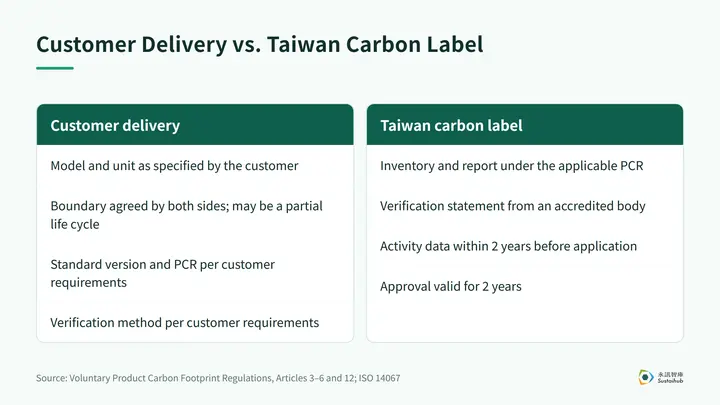
When a customer asks for data, write down these four points together with the version of the standard to be used, whether specific product category rules apply and whether third-party verification is required, and the direction of data collection becomes clear. If the customer only needs data from raw materials to the factory gate, confirm the delivery boundary with them; if you also want to apply for Taiwan's carbon label, you must separately meet the current approval and labeling regulations. The Taiwan carbon label is a voluntary scheme, and an individual customer's request does not mean every product must carry a label. Treating "customer delivery" and "label application" as two separate outputs, each checked on its own, avoids discovering after the calculation that application documents are missing.
Demand for product data can also be understood through how customers disclose. Sustaihub's analysis of the 2025 ESG disclosure open data from the Taiwan Stock Exchange (證交所) and the Taipei Exchange (櫃買中心) shows that 65.6% (1,288) of 1,962 listed companies have disclosed Scope 3 emissions. When customers ask suppliers for data to support their Scope 3 disclosure, they may want a product carbon footprint or an organization-level figure, and the two are calculated differently. For how the scopes are classified, see What Are Scope 1, 2 and 3 Emissions?
Turn this article into your next step
If this article touches disclosure, carbon inventory, or report preparation, use the system or database to check how peers handle it.
The Core of the Calculation: Activity Data, Factors and Allocation
A common starting formula multiplies each activity quantity by a compatible factor and sums the results, but the final figure must still comply with the applicable standard and product category rules. Based on ISO 14067's product quantification principles and Articles 3, 4 and 5 of Taiwan's regulations, the work generally runs in this order:
- Confirm the product and purpose: list the good or service, model, site and purpose of delivery.
- Select rules and boundary: check the product category rules, unit and life-cycle processes, and look for stages that are missing or double-counted.
- Collect activity data: compile materials, energy, transport and applicable scenario data, and confirm that source records refer to the same period and product.
- Choose factors and allocate: check data sources, units, geography, technology and the basis for allocation, and explain how shared energy is divided among products.
- Calculate and review: aggregate and confirm the results, assumptions and data quality, so every figure can be traced back from the result.
- Report and verify: prepare the inventory, report and any required verification for the delivery purpose, and state the boundary the result covers.
Three judgments most often swing the result. The first is allocation: when applying for approval in Taiwan, you must disclose the output of products at the same site and how shared energy and resources are allocated, and differences between products and processes cannot be ignored for convenience. The second is double counting: if product data from a supplier already includes some life-cycle emissions, confirm which stages it covers before using it, or it may overlap with your own raw material or transport items. The third is data gaps: missing data does not mean zero emissions, and how any shortfall was handled should be recorded together with its rationale. Recording the quantity, unit, period, source and allocation method for every input leaves a trail that reviewers can follow.
Where to Find Emission Factors and Product Category Rules
Taiwan's official source is the Ministry of Environment (環境部) Product Carbon Footprint Information Network (產品碳足跡資訊網), where you can look up product carbon footprint factors, product category rules and label information; the Ministry's overview of its thematic websites also lists this current portal. Product category rules, usually abbreviated as PCR, define the life cycle and calculation requirements for a given product category, and applicable documents can be found through the PCR search page.
Under Article 4 of the regulations, factors used in an approval application may come from carbon footprint factors published by the competent authority, international literature or domestic and international life-cycle databases, and qualifying site-specific factors. Keep the version, data source and unit of every factor, and explain the reason for each choice case by case. When choosing a factor, what matters is which material, energy or activity it describes and which stages it covers; a similar name does not mean it can be applied. If a factor already includes upstream stages, your own calculation should not add the same emissions again.
Factors used in organizational inventories may have different boundaries from product carbon footprint data. For checking the year and units of general emission factors, see the guide to selecting emission factors and checking the year and emission sources of announced factors, but these principles cannot replace product-specific PCRs.
Applying for Taiwan's Carbon Label: Verification, Approval and the Two 2-Year Rules
Moving from calculation to using the official label involves three stages: complete the product carbon footprint inventory and report under the applicable PCR, obtain a verification statement from an accredited verification body, and apply to the competent authority for approval. A preliminary calculation alone does not allow use of the official label. Under Articles 3 to 6 of the regulations issued on March 19, 2025, application materials include basic information on the applicant, product and site, registration certificates, the labeling method, a life-cycle flow chart, the inventory, the report and the verification statement. A PCR not published by the competent authority must be reviewed and approved before it can be used. See the official application process for the procedure.
The two 2-year rules are the easiest to mix up. Article 4 requires the activity data in an application to fall within the 2 years before the application date and to follow the latest version of ISO 14067 and the PCRs published by the competent authority, so check whether the data period fits the planned application date while compiling the data. Article 12 sets the validity of a product carbon footprint approval at 2 years. The first governs data; the second governs approval. Manage the data period, approval validity and renewal separately, and keep external statements consistent with what was approved rather than stretching them to suggest the product has no environmental impact.
Before Delivery: Make Sure the Recipient Can Read the Figure
When delivering, provide the value together with its calculation unit, product identification, boundary and data period, so the recipient knows which product and which part of the life cycle it represents. A final check can go item by item: whether product models are consistent, whether per-item and per-kilogram figures are mixed, whether raw material and energy quantities reconcile, whether shared items have an allocation rationale, whether factor sources are complete, which stages are excluded, and whether the verification method matches the customer's requirements. The actual method still follows the standard and the applicable PCR.
When two products differ in unit, function or system boundary, comparing which is higher is meaningless; compare only once the conditions are aligned. A product carbon footprint is also not a carbon neutrality claim: the official scope of ISO 14067 explicitly excludes carbon offsetting from quantification, and buying credits cannot change the product's own inventory result.
Sustaihub's DCarbon supports product carbon footprint calculation under ISO 14067 as well as organizational carbon inventories under ISO 14064-1. The company still confirms boundaries and data, formal verification is carried out by third-party bodies, and carbon labels are applied for through the competent authority's procedures. Further reading: statutory registration requirements at the organizational level are covered in the GHG inventory registration guide; if your emissions are subject to the carbon fee, see What Is Taiwan's Carbon Fee?
FAQ
View AllWhat is a carbon footprint?
A product carbon footprint is the greenhouse gas emissions of a good or service across its life-cycle stages, converted into carbon dioxide equivalent (CO₂e). It should always be stated together with the product, unit, boundary and data period.
How do ISO 14067 and ISO 14064-1 differ?
ISO 14067 covers products and calculates emissions within a product's life cycle and system boundary; ISO 14064-1 covers organizations and quantifies emissions within the organizational boundary. Dividing total company emissions by the number of products does not give a product carbon footprint.
How is a product carbon footprint calculated?
Confirm the product and purpose, select the PCR and boundary, collect activity data, choose factors and allocate, calculate and review, and finally prepare the report and any required verification for the delivery purpose. The common formula multiplies activity quantities by compatible factors and sums the results.
Turn Carbon Data into an Auditable Workflow
Use DCarbon to calculate emissions with the emission factors you configure and organize activity data and supporting evidence, so inventory data stays traceable, reviewable, and ready for customer requests.
How to decide the next stepTurn the regulation or factor requirements in the article into a data checklist first. If data crosses sites or departments, or needs verification, then evaluate whether system-based management is needed.