
What Are Scope 1, 2 and 3? 15 Scope 3 Categories and ISO Mapping
Scopes 1, 2 and 3 classify emission sources by their relationship to the company. Learn how to assign each scope, how the 15 Scope 3 categories map to ISO 14064-1 categories, and what 2025 open data shows about gaps in Scope 3 disclosure among listed companies.
What to decide after reading If you came for emission factors, ISO 14064, CBAM, or carbon data, the next step is to check whether activity data, emission factor versions, and supporting evidence can be traced.
Table of Contents
Scope 1, Scope 2 and Scope 3 are the GHG Protocol's classification of emissions by the relationship between the emission source and the company: Scope 1 covers direct emissions from sources the company owns or controls, Scope 2 covers indirect emissions associated with purchased electricity, steam, heat or cooling, and Scope 3 covers all other indirect emissions in the value chain. With this framework you can tell which scope each data point belongs to and whether to get it from facilities, procurement or suppliers, and see why Scope 3 is not the same as "Category 3" in ISO 14064-1.
Classification depends on the relationship, not on where emissions physically occur or which account the expense is booked to. The same activity can fall into different scopes for different companies: a power company burning fuel and a company buying electricity look at it from different positions. The inventory boundary therefore has to be settled before classification, including which companies, sites and assets are included, and whether each piece of equipment is owned, leased or controlled by the company. Leased equipment does not automatically go into Scope 3 just because the company does not own it. The definitions follow the GHG Protocol Corporate Standard.
Turn this article into your next step
If this article touches disclosure, carbon inventory, or report preparation, use the system or database to check how peers handle it.
Scope 1: Sources the Company Owns or Controls
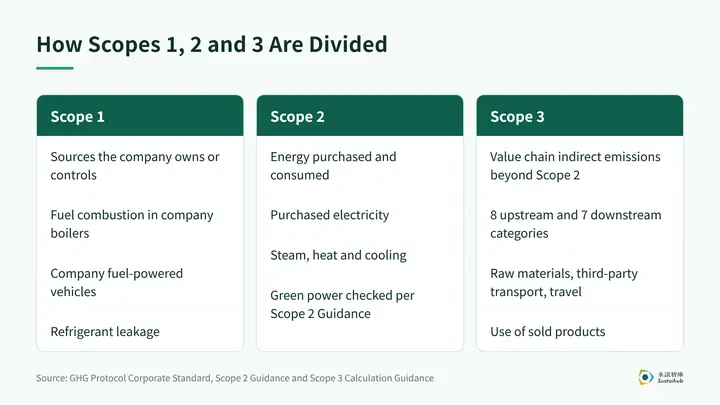
Scope 1 is the direct emissions from sources within the inventory boundary that the company owns or controls. Common examples are fuel combustion in company boilers, company fuel-powered vehicles and refrigerant leakage. This data mostly comes from facility fuel use and equipment records.
In practice, the most common mistakes are not in the calculation but in the boundary. Within the same plant, which equipment the company controls and which is leased or operated by others directly determines whether a given fuel emission belongs in Scope 1 or Scope 3. That is why a boundary statement should explain the reasons for inclusion and exclusion, not just list sites.
Scope 2: Purchased Electricity, Steam, Heat and Cooling
Scope 2 covers the emissions at the point of generation that correspond to energy the company purchases and consumes. The most common source is purchased electricity, but steam, heat and cooling are included too. Calculation follows the GHG Protocol Scope 2 Guidance.
Buying green electricity or carbon credits does not, by the act of purchase alone, bring Scope 2 to zero. Green power contracts and energy attribute certificates must be checked for quality and the applicable method under the Scope 2 Guidance, and carbon credit offsetting is a separate matter from calculating emissions from purchased energy. Keep electricity records, contracts and the basis for factors in full.
The Scope 2 rules are also under revision. The GHG Protocol's July 2026 update set out development plans for the integrated corporate standard, and feedback from the Scope 2 public consultation remains part of the revision work. Until the revision is finalized, treat published guidance and proposals still under discussion separately; more granular time matching, for example, is not yet an effective requirement. The more useful preparation for now is to fully document electricity consumption, consumption locations, contracts and energy attribute documents, and the factors and methods used, rather than changing historical emissions figures. According to the standard development plan the GHG Protocol published on July 29, 2026, the integrated draft is expected to go to public consultation in Q2 2027, with the final version expected in Q4 2028. For background on the revision, see "GHG Protocol September 2025 Update: Three Implications of Scope 2 Revisions for Corporate Electricity Inventories"; any future arrangements described there remain subject to later official updates.
Scope 3: 15 Categories of Indirect Value Chain Emissions
Scope 3 covers indirect value chain emissions beyond Scope 2, split into 8 upstream and 7 downstream categories, from purchased raw materials through to the use and disposal of products after sale. The table below lists the activity in each category and the data usually needed first; the minimum boundary and calculation method for each category follow the GHG Protocol Scope 3 Calculation Guidance.
| Category | Activity | Data usually needed first |
|---|---|---|
| 1 | Upstream: purchased goods and services | Acquisition data for raw materials, components and outsourced services |
| 2 | Upstream: capital goods | Capital purchases such as equipment, machinery and buildings |
| 3 | Upstream: fuel- and energy-related activities | Upstream emissions of fuel and energy not included in Scope 1 or 2 |
| 4 | Upstream: transportation and distribution | Weight and distance for purchased transport services and upstream logistics |
| 5 | Upstream: waste generated in operations | Type, weight and treatment method of waste sent for outside treatment |
| 6 | Upstream: business travel | Travel mode and distance for business trips |
| 7 | Upstream: employee commuting | Commuting mode, distance and attendance |
| 8 | Upstream: leased assets | Operation of leased-in assets not included in Scope 1 or 2 |
| 9 | Downstream: transportation and distribution | Transport and distribution after sale that the company does not purchase |
| 10 | Downstream: processing of sold products | Processing of intermediate products at the customer's end |
| 11 | Downstream: use of sold products | Energy demand and use scenarios during the product's use phase |
| 12 | Downstream: end-of-life treatment of sold products | Materials, quantities and disposal scenarios of sold products |
| 13 | Downstream: leased assets | Operation of leased-out assets not included in Scope 1 or 2 |
| 14 | Downstream: franchises | Franchise activities not included in Scope 1 or 2 |
| 15 | Downstream: investments | Investment-related emissions not included in Scope 1 or 2 |
Having 15 categories does not mean every category has emissions. A company with no franchise activities will not generate Category 14 emissions out of nowhere. But "no such activity" and "activity without data" are two different states, and the latter cannot be entered as zero. Recording each category as one of three states, "no such activity", "activity quantified" or "activity with insufficient data", shows in the next inventory cycle where the gaps are and whom to ask for the missing information.
Two areas cause the most confusion. The first is transport: third-party transport services purchased by the company, including some outbound shipping, may belong in Category 4; only downstream transport after sale that the company does not purchase goes into Category 9, subject to conditions. The deciding questions are who buys the service and where the goods are going. The second is energy: Category 3 covers upstream emissions of fuel and energy not included in Scope 1 or 2, and must not be added on top of the Scope 2 figure that matches the electricity bills.
You can start on Scope 3 even before suppliers have carbon data. The procurement department's annual purchasing summary is a good entry point: identify raw materials and capital equipment in it and plan data collection for each separately, rather than relying on one questionnaire sent to every supplier as the only method. For categories with insufficient data, estimate from available activity quantities and secondary data while recording sources, assumptions and limitations. If you only have spend data, for example, state the basis of the estimate clearly; when you later obtain weights or supplier data, record the method change instead of overwriting the original records. Improving data quality for significant emission items deserves priority.
In ISO 14064-1 Terms: Scope 3 Is Not "Category 3"
Statutory inventories in Taiwan often use Categories 1 to 6 of ISO 14064-1:2018. Scopes 1 and 2 broadly correspond to Categories 1 and 2, while Scope 3 is spread across Categories 3 to 6, and Category 3 refers only to indirect emissions from transportation. Moving between the two frameworks takes item-by-item checking, not just renaming report columns.
| ISO 14064-1:2018 category | Content | GHG Protocol mapping notes |
|---|---|---|
| 1 | Direct emissions and removals | Scope 1 direct emissions; handle removals separately under the applicable standard |
| 2 | Indirect emissions from imported energy | Scope 2 |
| 3 | Indirect emissions from transportation | Scope 3 Categories 4, 6, 7 and 9 |
| 4 | Indirect emissions from products used by the organization | Scope 3 Categories 1, 2, 3, 5 and 8 |
| 5 | Indirect emissions associated with the use of products from the organization | Scope 3 Categories 10 to 15 |
| 6 | Indirect emissions from other sources | Determined by activity; no single fixed Scope 3 category |
Source: Ministry of Environment (環境部) inventory guidance, Introduction, Table 1 (page 11 of the PDF). Only the general classification from this guidance is cited here; the statutory registration conditions for hospitals it contains do not apply to other industries. The table helps explain how the two frameworks relate; for a formal conversion, confirm that boundaries, periods and emission sources match, and note that the two totals will not necessarily be equal. For how to use the two standards together, read "Which Standard for a Corporate Carbon Inventory? ISO 14064 vs. GHG Protocol"; for which companies must conduct statutory inventories and register, see "GHG Inventory Registration: Which Companies Must Register".
Scope 3 Disclosure Today: Where Do Listed Companies Stand?
Sustaihub reviewed the 2025 ESG disclosure open data from the Taiwan Stock Exchange (證交所) and the Taipei Exchange (櫃買中心) for 1,962 companies, and 65.6% (1,288 companies) had disclosed Scope 3 emissions. The gaps between industries are clear: financial and insurance (100%), shipping (84.8%), iron and steel (79.6%) and communications and internet (77.2%) have the highest rates, while tourism and hospitality (39.2%), textiles (46.2%) and home and living (46.9%) are below half. Electronic components and semiconductors, the industries with the most reports, stand at 72.4% and 74.8% respectively.
Two points are worth noting when reading these figures. First, "disclosed" here means the Scope 3 emissions value in the open data is greater than 0: it shows the company reported a figure, not that all 15 categories are covered, and it reveals nothing about estimation methods or data quality. Second, these are 2025 filings; the proposal to make Scope 3 disclosure voluntary for the third phase was only announced in September 2026.
According to the Financial Supervisory Commission (金管會) announcement of September 23, 2026, Scope 3 disclosure for third-phase listed companies becomes voluntary, with amendments to the annual report regulations and related rulings expected before the end of the year; the financial, insurance, and securities and futures industries are not covered by this adjustment. This is an announced policy direction, and formal filing still follows the rules once amended. For timeline details, read "IFRS Phase 3 Adjustment" together with "2026 IFRS Sustainability Disclosure Standards FAQ"; if articles from different dates give different timelines, the latest official announcement prevails.
This adjustment concerns statutory disclosure by listed companies, which is a separate matter from the Scope 3 data customers request through supply chain questionnaires. When a customer questionnaire arrives, it is worth clarifying whether they want company-level emissions, the carbon footprint of a specific product, or data on particular materials and transport, so that what you deliver answers the question.
To organize inventory data and calculations in a system, Sustaihub's DCarbon supports organizational carbon inventories under ISO 14064-1; the system handles data organization and calculation, while formal verification is carried out by third-party bodies. Further reading: to turn the classification into an inventory, start with "Taiwan Carbon Inventory: Who Must Report, 5 Stages and Verification"; if a customer wants emissions for a single product, continue with "What Is a Carbon Footprint? Product Calculation and ISO 14067".
FAQ
View AllWhat is the simplest way to tell Scope 1, 2 and 3 apart?
Once the organizational boundary is set, look at the emission source: direct emissions from equipment the company owns or controls are Scope 1, emissions from producing purchased energy are Scope 2, and other indirect value chain emissions are Scope 3. Classification is based on the activity and the control relationship, not on which department pays.
Does every one of the 15 Scope 3 categories have emissions?
Not necessarily. Review each category for whether the activity exists and falls within the inventory boundary, and record the reasons for inclusion or exclusion. A company with no franchise activities will not generate emissions in that category out of nowhere. But missing data does not mean no emissions and cannot be entered as zero.
Is Scope 3 the same as Category 3 in ISO 14064-1?
No. Scope 3 covers other indirect value chain emissions, while ISO Category 3 refers only to indirect emissions from transportation. Scope 3 content is mainly spread across ISO Categories 3 to 6 and needs item-by-item checking; renaming report columns is not enough.
Turn Carbon Data into an Auditable Workflow
Use DCarbon to calculate emissions with the emission factors you configure and organize activity data and supporting evidence, so inventory data stays traceable, reviewable, and ready for customer requests.
How to decide the next stepTurn the regulation or factor requirements in the article into a data checklist first. If data crosses sites or departments, or needs verification, then evaluate whether system-based management is needed.