Insights
Regulatory updates, carbon inventory and AI applications, IFRS adoption experience, corporate case studies, and system updates, written by our consultants and engineers.
-
Updated Sustainability Reporting Rules: Filing Priorities and Timelines for Taiwan's Listed Companies (May 2026 Amendments)
The Taiwan Stock Exchange announced the latest amendments to its Rules Governing the Preparation and Filing of Sustainability Reports by TWSE Listed Companies on May 18, 2026, following approval for recordation by the Financial Supervisory Commission on May 14, 2026. This article summarises the amendments and current filing requirements to help companies understand industry indicators, climate information, assurance and internal controls.
-
From Trump's Paris Agreement Exit to Taiwan's 2050 Net-Zero Commitment: New Priorities for Supply Chain Decarbonisation
The US withdrawal from the Paris Agreement took effect on January 27, 2026. Although this appears to weaken the global consensus on climate governance, ESG has already become embedded in the operating culture of leading international companies. Taiwan has also reaffirmed its direction: at a National Climate Change Committee meeting, President Lai Ching-te made clear that Taiwan's 2050 net-zero goal would not waver with international political changes. More significantly, on August 25, 2026, the Ministry of Environment announced the Regulations Governing the Storage of Captured Carbon Dioxide, marking a turning point for supply chain decarbonisation and Scope 3 management. This article explains how companies can seize this transition opportunity.
-
Before You File: Common ESG Report Deficiencies, FY2024 Review Results and Corporate Examples
The Taiwan Stock Exchange (TWSE) and Taipei Exchange (TPEx) regularly sample corporate sustainability reports. All TWSE/TPEx-listed companies are reviewed at least once every five years. Non-compliant disclosures may require corrections and improvements and may affect the ESG Evaluation, which replaces the Corporate Governance Evaluation from 2026.
-
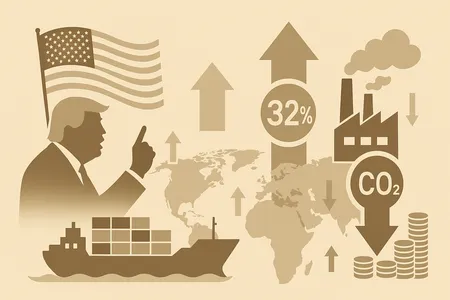
Tariff Policies Change Overnight! Learning Corporate Decarbonization Survival Rules from Trump Tariffs
Trump's tariff policy U-turn reveals the nature of policy risk. Facing the upcoming implementation of carbon tariffs led by CBAM, only enterprises that are well-prepared can maintain competitiveness amid change.
-
Relaxing Sustainability Reporting Requirements? Changes EU Omnibus Package Will Bring to CSRD and CBAM
The newly proposed EU Sustainability Simplification Omnibus Package aims to simplify corporate sustainability reporting. Regulations proposed for relaxation include the Corporate Sustainability Reporting Directive (CSRD), Carbon Border Adjustment Mechanism (CBAM), and more. Here's a comprehensive overview of the key changes:
-
Q1 2025 ESG Trends: International Standards, Taiwan Regulations and Carbon Markets (3 February–30 March)
In Q1 2025, the EU proposed Omnibus simplification, US climate disclosure policy and ESG commitments shifted, and Taiwan launched carbon fees. Japan and SBTi also updated reduction targets and standards. This page organises key developments from 3 February to 30 March by week and topic.
-
AI Digital Era: Are You Ready for ESG Digitalization?
Facing challenges such as increasingly stringent ESG regulatory requirements, rising difficulty in cross-departmental data integration, and complex and redundant report writing processes, if you are also wondering 'Can digital tools reduce the burden and improve efficiency?' This article provides a sustainability digital maturity self-assessment for your reference in evaluating whether your enterprise is ready to embark on ESG digitalization.
-
[2025 Carbon Fee Guide] How Enterprises Can Reduce Carbon Fees from NT$300 to NT$50 Through Voluntary Reduction Plans
With the Climate Change Response Act officially in effect, the carbon fee system has become one of the operational costs that Taiwanese enterprises must take seriously. Companies subject to government-regulated carbon fee collection, including power, gas supply, and manufacturing industries with annual direct or indirect greenhouse gas emissions reaching 25,000 metric tons of CO₂e, will need to pay carbon fees of up to NT$300 per ton of CO₂e. Facing carbon fee pressure, the key for enterprises to reduce payment amounts lies in proposing and passing a 'Voluntary Reduction Plan,' which qualifies them for preferential rates of NT$50 or NT$100 per ton. This article explains how systematic planning and reporting for voluntary reduction plans can not only legally save expenses but also help enterprises with long-term net-zero planning.
-
What Is CBAM? Its 2026 Launch, 2027 Certificate Sales and Impacts on Taiwanese Businesses
EU CBAM entered its definitive phase on 1 January 2026. Certificates go on sale on 1 February 2027, with the first declaration and surrender due by 30 September 2027. A guide to covered products, the 50-tonne threshold, certificate prices and preparation for Taiwanese exporters.