No single carbon inventory tool suits every company. Work through it in this order: why you are doing the inventory, how many sites and people hold the data, and whether the results will go to customers or a verification body. The 8 questions below follow that order. Information on regulations and government tools is linked to official sources, checked on October 7, 2026.
The big picture: what tools are available
What carbon inventory systems are available in Taiwan?
Carbon inventory tools available to companies in Taiwan fall into five broad types: the Ministry of Environment's registration platform and estimation tool, in-house Excel, general ESG platforms, dedicated carbon inventory systems, and consultant-led services. Each type does a different job: one is the channel for mandatory registration, one is a calculation tool, one manages data, and one is a full service. They can be combined, so you do not have to choose only one.
- The Ministry of Environment (MOENV, 環境部) Business GHG Emissions Information Platform (事業溫室氣體排放量資訊平台): Under Article 6 of the Regulations Governing the Inventory, Registration and Verification of Greenhouse Gas Emissions (溫室氣體排放量盤查登錄及查驗管理辦法), regulated businesses must register their previous year's greenhouse gas emissions inventory and inventory report on this platform by April 30 each year; under Article 9, those subject to verification must upload their verification results by October 31 each year (Laws and Regulations Database of the Republic of China (全國法規資料庫)). The platform is where the inventory and inventory report are registered. Before registration, MOENV also provides industry-specific inventory forms that help companies organize emission sources, activity data and emission factors and complete the inventory (Business GHG Emissions Information Platform: Getting Started (事業溫室氣體排放量資訊平台:新手上路)); bills and other supporting evidence are kept and managed by the company itself. For details on coverage and deadlines, see GHG Inventory Registration: Coverage, Annual Deadlines and Guidelines.
- MOENV estimation tool and inventory guidelines: The platform's "estimation tool" (試算工具) covers six categories of emission sources: fuel oil, gas, coal, electricity, processes, and fugitive/fluorinated gases. The platform describes it as a simple self-estimate that "captures roughly 80% of greenhouse gas emissions"; to meet the inventory requirements of the Climate Change Response Act (氣候變遷因應法), a full inventory following the regulations and guidelines is still required (MOENV estimation tool page (環境部試算工具頁面)). MOENV also provides inventory guidelines for the service sector, transportation, hospitals, universities and colleges, and manufacturing (Inventory Guidelines for Entities Required to Register (Expanded Inventory) (應盤查登錄對象之盤查作業指引(擴大盤查))). For a summary of the guidelines and estimation tools for four industries, see MOENV's Estimation Tools and Carbon Inventory Guidelines for Four Industries.
- In-house Excel: There is no implementation cost, and formulas and fields can be arranged exactly as you need; versions, permissions, evidence and handovers all depend on internal rules.
- General ESG platforms: These cover multiple environmental, social and governance topics and report preparation, with greenhouse gases usually one module among several; the depth of the inventory functions needs to be checked item by item.
- Dedicated carbon inventory systems: These are built around inventory boundaries, emission sources, activity data, emission factors, evidence and the inventory report, with the focus on making calculations traceable and reusable the following year.
- Consultant-led services: An external team helps with boundary setting, emission source identification and report writing, which suits companies without in-house inventory experience; confirm which files will be delivered and who takes over the following year.
| Tool type | Best suited when | What to confirm when choosing |
|---|---|---|
| MOENV estimation tool | You want a rough estimate of emissions or a preliminary check of whether you are a regulated entity | Results are a simple estimate and cannot replace a full inventory |
| Excel | Single site, few emission sources, one or two people responsible, no verification requirement for now | How versions, permissions, evidence storage and handovers are managed |
| General ESG platform | The same team handles the inventory and the sustainability report | Whether the inventory module can handle boundaries, emission factor versions and evidence |
| Dedicated carbon inventory system | Multiple sites, several people sharing the work, responding to customers or preparing for verification | Test calculations, evidence and report output with a sample of your own data |
| Consultant-led service | First inventory, limited in-house staff, need for methodological judgment | Deliverable files, scope of service and how the work continues the following year |
Which tool suits a small or medium-sized enterprise doing a GHG inventory?
For SMEs, it depends on what the inventory is for. If you only want a rough estimate of emissions, the MOENV estimation tool is enough, and you can compare its results with the coverage criteria announced by MOENV to make a preliminary judgment on whether you are regulated. If you need to hand the data to customers or may face verification later, you need a tool that keeps evidence and the calculation basis. Both Excel and dedicated systems can do this; the difference lies in the number of sites and people involved.
For a single plant whose only emission sources are electricity, company vehicles and a small amount of fuel, an Excel file with fixed fields can usually handle the first year. Once data comes from two or more sites, different departments need to enter data separately, or customers ask for updated figures every year, Excel versions and evidence tend to scatter across files, and that is when the work allocation and traceability functions of a dedicated system make a difference. If no one in-house has assessed inventory boundaries and emission sources before, you can work with a consultant for the first year and then take the work over internally.
What to compare when choosing
What software can support an ISO 14064-1 inventory?
ISO 14064-1 sets out principles and requirements for quantifying and reporting greenhouse gases at the organization level and does not specify any particular software. Excel, a general ESG platform or a dedicated carbon inventory system can all help, as long as the tool fully handles boundary setting, emission source identification, activity data, emission factors, evidence and the inventory report.
To judge whether software fits ISO 14064-1, check whether it can organize emission sources by the ISO 14064-1 "Categories 1–6", whether it records the source and version of every emission factor, and whether it can produce the content required for the inventory report. For the differences between ISO 14064-1 and the GHG Protocol, see ISO 14064 vs GHG Protocol Explained; for boundary-setting methods, see Control Approach vs Equity Share Approach: How to Choose.
DCarbon supports organizational greenhouse gas inventories under ISO 14064-1; the actual scope of application is confirmed according to your plan.
How should you choose a carbon inventory system, and which functions should you compare?
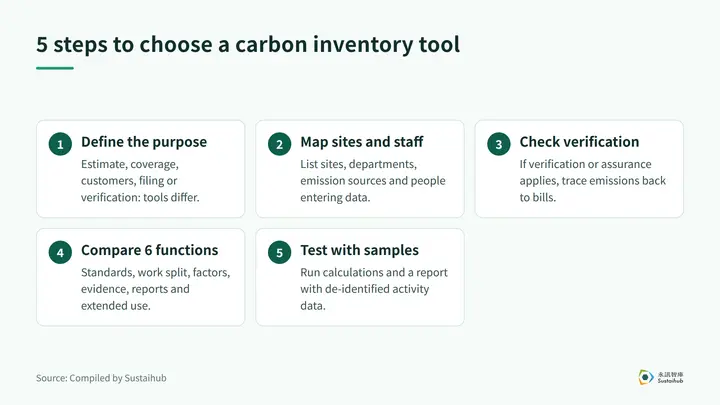
Compare carbon inventory systems on six things: inventory standards and boundaries, activity data collection and work allocation, the source and version of emission factors, evidence and calculation traceability, inventory report output, and whether results can be extended to customer questionnaires and sustainability reports. You can take the table below straight to vendors and confirm each item.
| Item | Questions to ask | How to verify |
|---|---|---|
| Inventory standards and boundaries | Which inventory standards are supported? Can you set the organizational boundary and sites? | Set it up once using your own legal-entity and site structure |
| Data collection and work allocation | Can data entry and review be assigned by site, department and person in charge? | Have two colleagues each enter one record and observe the review flow |
| Emission factors | Can you check each factor's source, year of announcement and version? Can you define your own? | Check one calculation against the 2026 announced GHG emission factors |
| Evidence and traceability | Can bills be attached to each activity data entry and traced to the calculation basis? | Trace one emissions figure back to the original bill |
| Report output | Can it produce inventory report content? Who reviews and finalizes it? | Review a draft report produced from sample data |
| Extended use | Can results be used for customer questionnaires, sustainability reports or reduction planning? | Confirm that the output content and fields meet downstream needs |
Bringing a de-identified sample of activity data to a trial reveals more than reading a feature list. Features with the same name can differ greatly in the data formats and review methods they actually handle. For a comparison of the public features of two carbon inventory products, and how to combine them with Excel or consultants, see Comparing Carbon Inventory Systems in Taiwan.
How does a carbon inventory system differ from doing it yourself in Excel?
Both a system and Excel can calculate emissions. The difference lies in multi-user collaboration, version control, evidence traceability and reuse the following year: Excel relies on people to maintain the rules, while a system builds those rules into the workflow.
- Collaboration: When several people edit an Excel file, multiple versions easily appear; when choosing a system, confirm whether work can be assigned by site or department and whether an edit history is kept.
- Factors and calculations: If factors are typed directly into cells, each one has to be checked when the year changes; when choosing a system, confirm whether factor versions are tied to the calculations, so you can see which version was used when tracing back.
- Evidence: Excel evidence usually sits in a separate folder and has to be matched manually when verifiers sample; when choosing a system, confirm whether bills can be attached to the corresponding activity data.
- Reuse and handover: When the person in charge changes, Excel needs handover notes; when choosing a system, confirm whether emission sources and settings are retained so the next year can be updated on the same structure.
If you have one site, one person in charge and no verification or customer requirements, Excel is a reasonable starting point; add any one of these conditions, and a system is worth evaluating.
Decide based on your situation
What should manufacturers look for when choosing a carbon inventory system?
Manufacturers should check whether a system can handle process and fugitive emission sources, work allocation across multiple plants, and the product carbon footprints customers request. They should also confirm whether they are subject to MOENV inventory registration or verification, since that determines the deadlines and verification requirements.
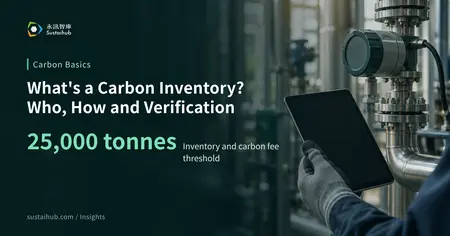
According to the Business GHG Emissions Information Platform, "six industries with designated processes, such as power generation and steel, whole-plant direct emissions from fossil fuel combustion, or manufacturers' whole-plant direct emissions from fossil fuel combustion plus indirect emissions from electricity reaching 25,000 tonnes CO2e" are subject to mandatory inventory and verification (Inventory Guidelines for Entities Required to Register and Be Verified (應盤查登錄及查驗對象之盤查作業指引)). Article 3 of the Regulations Governing the Inventory, Registration and Verification of Greenhouse Gas Emissions requires the inventory to cover direct emissions from stationary and mobile combustion, process and fugitive emission sources, as well as indirect energy emissions from purchased electricity or steam (Laws and Regulations Database).
So when trialing a system, manufacturers should test it with their own process and fugitive emissions data: where the factors come from, whether formulas can be traced, and whether multiple plants can enter data separately and then be consolidated. If customers also ask for product-level data, confirm whether the system supports product carbon footprints; for the concept, see What Is a Carbon Footprint?. DCarbon provides product carbon footprint (ISO 14067) calculation, from life-cycle setup all the way to the results.
How can a system help prepare inventory data for third-party verification?
A system can bring together the bills, factor basis, calculation steps and edit history for every activity data entry, so verifiers can find the source when sampling. However, verification results are determined by the verification body, and no system can guarantee that you pass verification.
MOENV's official guidelines recommend ISO 14064-3 for verification (ISO 14064 vs GHG Protocol Explained). During verification sampling, you often need to trace an emissions figure back to the original bill and explain why factors were chosen and why figures differ between years. When choosing a system, run through "tracing from the total back to the bill" once and see how many steps it takes.
DCarbon can organize supporting evidence and collaboration records to help you prepare for verification; AI can also help draft the inventory report, which your company reviews and finalizes itself.
What do listed companies need from inventory tools under the Sustainable Development Roadmap?
Inventory tools for listed companies must at least be able to expand from the parent company alone to the scope of the consolidated financial statements, collect Scope 1 and Scope 2 data by subsidiary and site, and carry the results into sustainability report and annual report disclosures. For companies that need assurance, the tool must also retain evidence that can be used for assurance.
The Sustainable Development Roadmap for TWSE- and TPEx-Listed Companies (上市櫃公司永續發展路徑圖), launched by the Financial Supervisory Commission (FSC, 金管會) in March 2022, originally required all listed companies to complete greenhouse gas inventories by 2027 and verification of those inventories by 2029 (FSC press release, March 3, 2022 (金管會 2022 年 3 月 3 日新聞稿)). On September 23, 2026, the FSC and MOENV adjusted the alignment pathway: phase 2 and phase 3 companies no longer need to obtain assurance on the parent company's standalone Scope 1 and 2 emissions information; listed companies with capital below NT$2 billion may voluntarily obtain third-party assurance on greenhouse gas inventory information, except that those designated by MOENV as subject to mandatory inventory registration and verification must still follow MOENV rules; and phase 3 companies are temporarily exempted from Scope 3 disclosure, which they may make voluntarily (FSC press release, September 23, 2026 (金管會 2026 年 9 月 23 日新聞稿)). For a phase-by-phase summary, see IFRS Phase 3 Adjustments.
On inventory standards, the FSC allows greenhouse gas inventory disclosure under the GHG Protocol or ISO 14064-1, with assurance under ISAE 3410 or ISO 14064-3 (ISO 14064 vs GHG Protocol Explained). When choosing a tool, confirm that it supports the standard you use, and that data for each legal entity within the consolidation scope can be kept separately and then aggregated.
If you plan to disclose Scope 3 voluntarily, you will usually need some data from suppliers. DCarbon can collect Scope 1, 2 and 3 activity data by site, department and person in charge, but it does not provide a supplier data-entry function; supplier data must be obtained separately through questionnaires or business documents and then incorporated into the inventory. For Scope 3 categories, see What Are Scope 1, 2 and 3 Emissions?.
Which companies DCarbon suits
DCarbon is a carbon inventory system developed by a Taiwan-based team. It suits companies that need an ISO 14064-1 organizational inventory (actual scope of application confirmed according to plan) and whose data is spread across multiple sites or departments. If you only need a rough estimate, or need carbon fee estimation or supplier data entry, you will need to switch to, or add, other tools.
Good fit
- You need an ISO 14064-1 organizational greenhouse gas inventory; the actual scope of application is confirmed according to your plan.
- Scope 1, 2 and 3 activity data comes from different sites and departments and needs to be collected by site, department and person in charge.
- You handle a large volume of electricity, fuel and other bills and want AI to help organize the bills and map them to emission sources, then calculate organizational emissions.
- You are preparing for third-party verification and need to organize supporting evidence and collaboration records; AI can help draft the inventory report, which your company reviews and finalizes itself.
- You want to use inventory results to answer customers' supply chain questionnaires, or extend them to ESG report disclosures.
- You want to take your base-year inventory results and estimate a reduction pathway to a target year based on Taiwan's NDC or MOENV's sectoral targets.
- Customers also require product carbon footprints calculated under ISO 14067.
Not a fit, or needs to be combined with other tools
- You only want a rough estimate of emissions, or a preliminary check of whether you are regulated: The MOENV estimation tool together with the announced coverage criteria can do this, without implementing a system.
- You need carbon fee estimation: DCarbon does not include carbon fee estimation; for carbon fee calculation, see Taiwan's Carbon Fee: Rates and Deduction Estimates.
- You want to invite suppliers to enter Scope 3 data in the system: DCarbon does not provide a supplier data-entry function; supplier data must be collected separately.
- Single site, few emission sources, no verification or customer requirements: Excel may already be enough.
- You need external experts to judge boundaries and methods: A system cannot replace methodological judgment; you can work with a consultant alongside it.
- You want a tool that guarantees passing verification: Verification results are determined by the verification body based on the actual scope and evidence, and no system can guarantee them.
To check whether DCarbon fits your inventory process, start with the DCarbon product overview; when you want hands-on use, leave your contact details and the team will provide a way to try it. For the basics of carbon inventories, see What Is a Carbon Inventory?.
Official sources and date checked
- Regulations Governing the Inventory, Registration and Verification of Greenhouse Gas Emissions (溫室氣體排放量盤查登錄及查驗管理辦法) (amended December 19, 2025), Articles 3, 6 and 9
- MOENV Business GHG Emissions Information Platform: Estimation Tool (環境部事業溫室氣體排放量資訊平台:試算工具)
- MOENV Business GHG Emissions Information Platform: Inventory Guidelines for Entities Required to Register and Be Verified (環境部事業溫室氣體排放量資訊平台:應盤查登錄及查驗對象之盤查作業指引); Inventory Guidelines for Entities Required to Register (Expanded Inventory) (應盤查登錄對象之盤查作業指引(擴大盤查))
- MOENV Business GHG Emissions Information Platform: Getting Started, industry-specific inventory forms (環境部事業溫室氣體排放量資訊平台:新手上路(行業別清冊表單))
- FSC: Official Launch of the Sustainable Development Roadmap for TWSE- and TPEx-Listed Companies (金管會:正式啟動「上市櫃公司永續發展路徑圖」), March 3, 2022
- FSC and MOENV: Jointly Optimizing the Sustainability Disclosure Alignment Pathway (金管會、環境部:共同優化永續揭露接軌路徑), September 23, 2026
Date checked: October 7, 2026. For regulations and government tools, the latest announcements by the competent authorities prevail.