
What Is Carbon Neutrality? ISO 14068 Update and Taiwan's Guidelines
A carbon neutrality claim needs an inventory, reductions, offsets and public evidence. From what a claim must contain and how ISO 14068 has changed to the credit conditions and legal status of the Ministry of Environment's guidelines, judge whether your data is ready for a public claim.
What to decide after reading If you came for emission factors, ISO 14064, CBAM, or carbon data, the next step is to check whether activity data, emission factor versions, and supporting evidence can be traced.
Table of Contents
- What a Carbon Neutrality Claim Must Make Clear
- From PAS 2060 to ISO 14068:2026: Reading the Standard Versions
- From Inventory to Disclosure: Five Stages in the Ministry of Environment Guidelines
- Offsetting: Credit Vintage and Retirement Deadlines
- Are the Ministry of Environment Guidelines Law? Must Plans Be Submitted for Review?
- The Final Check Before Going Public: Make the Claim Stand Up to Scrutiny
Carbon neutrality means quantifying the carbon footprint of a clearly defined organization, product or service for a specific period, prioritizing emission reductions and increased removals, and only then using qualifying offsets to address what remains. A credible claim lets readers see the scope, reduction results and retirement evidence; how many carbon credits were bought cannot support such a claim on its own. The sections below cover what a claim should contain, how the standard versions have changed, the time conditions for offsets and the legal status of the Ministry of Environment (環境部) guidelines, to help you judge whether your data is ready for a public claim.
What a Carbon Neutrality Claim Must Make Clear
A carbon neutrality claim has a specific subject and boundary, and readers should be able to tell whether you mean the whole organization, a particular product or a service. The Ministry of Environment's Guidelines for Corporate Carbon Neutrality Claims (企業宣告碳中和指引) also distinguish between organizational claims and product or service claims. "Carbon" here covers greenhouse gases in general, not just carbon dioxide, so other greenhouse gases that should be included cannot be left out because of the name.
The simplest test of readiness is to try writing one complete sentence: which subject, which activities are covered, which period, and which quantification method. If you cannot write that sentence clearly, your data and boundary are not yet ready for a claim. For example, if the work has been completed only for one product line, the claim should clearly identify that line and the period covered; whether the company's other products and sites are included also needs an explanation people can look up. Internal documents should not be clear while the public headline gives the impression that all operations are done.
The Ministry of Environment's statement on issuing the guidelines focuses on misleading claims and insufficient disclosure, so that the public can examine what companies have actually done. If all you have now are future targets or reduction plans in progress, simply describe your progress accurately; commitments and completed results each have their own clear place.
It is also important to separate carbon neutrality from quantification work. ISO 14064-1 focuses on quantifying and reporting organizational emissions and removals, and ISO 14067 on quantifying product carbon footprints, with offsetting outside its scope. Completing either kind of quantification does not equal completing reductions, handling residual emissions and making a claim, and an inventory report cannot serve as proof of carbon neutrality.
From PAS 2060 to ISO 14068:2026: Reading the Standard Versions
You may still see the name ISO 14068-1:2023, but the current version is ISO 14068:2026. Its core principle puts emission reductions and removal enhancements within the value chain ahead of offsetting, and requires substantiated carbon neutrality commitments, claims and continual improvement. The Ministry of Environment's Guidelines for Corporate Carbon Neutrality Claims (September 2024 edition) still use ISO 14068-1 as their example and have not been revised for the new international standard, so note each version separately when citing them.
| Document | Confirmed status | What to watch when reading |
|---|---|---|
| PAS 2060:2014 | Listed by BSI as withdrawn on December 1, 2025 | Part of the history of carbon neutrality standards; not presented as the current latest version |
| ISO 14068-1:2023 | Listed by ISO as withdrawn; a later version has been published | Existing documents may still cite it; identify when it was adopted and which version applies |
| ISO 14068:2026 | Published September 11, 2026 | Check current principles and conditions, and confirm transition arrangements case by case |
Version sources: BSI PAS 2060 status, ISO 14068-1:2023 status and the ISO 14068:2026 life cycle record. The progression from PAS 2060 to ISO 14068 does not mean all historical claims lapse automatically on the same day; the validity of individual cases and the transition deadlines in contracts and verification programs must be confirmed with the relevant bodies one by one.
"Reduce first, increase removals, address the residual last" translates directly into a checking order: list the equipment or process improvements already carried out, with their quantification basis, and only then discuss the emissions that still need to be addressed. Estimating a quantity and buying credits while skipping improvement plans reverses that order.
From Inventory to Disclosure: Five Stages in the Ministry of Environment Guidelines
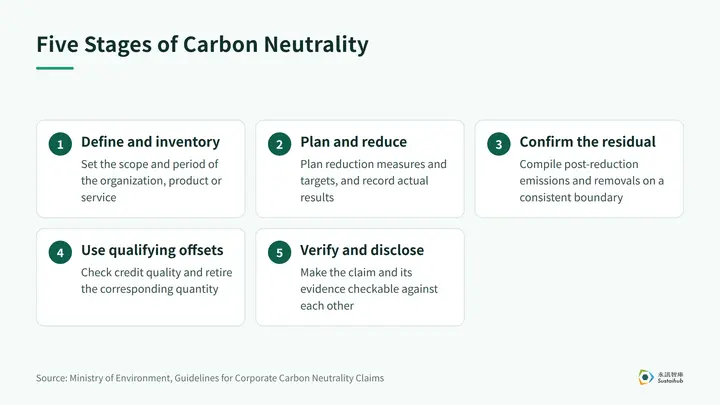
Under the Ministry of Environment guidelines, carbon neutrality proceeds through conducting an inventory and defining the subject, implementing reductions or increasing removals, offsetting the residual where necessary, and finally full disclosure. The diagram below organizes these principles into five stages to make it easier to assign responsibilities and check results.
Turn this article into your next step
If this article touches disclosure, carbon inventory, or report preparation, use the system or database to check how peers handle it.
Each stage has corresponding evidence: when defining the subject, the boundary statement, emission sources, activity data and calculation basis; for reductions, before-and-after data, methods and explanations of variances; for confirming the residual, emission and removal records, calculations and review records; for offsets, the credit source, serial numbers, vintage and retirement certificates; and for disclosure, the management plan, verification documents and website explanation. This is a way of organizing evidence; the actual scope and verification content must still be checked against the applicable standard and program.
If your organizational inventory or product quantification is not yet complete, start with "What Is a Carbon Inventory?" and "What Is a Carbon Footprint?". On the division of work, having a single point of contact check the claim period keeps credit purchases, emissions data and website copy from each using a different year.
Offsetting: Credit Vintage and Retirement Deadlines
Buying credits only acquires a tool; credits must also meet offsetting conditions and be retired before they can support the corresponding carbon neutrality result. The Ministry of Environment guidelines require the relevant credits to be retired before the claim, prohibit their reuse, and require checks on source and quality.
The credit conditions in the guidelines add two time limits: the year in which the reduction or removal occurred should not be more than 5 years before the carbon neutrality period, and retirement should be completed within 12 months after the end of the subject's reporting period. These are checks on whether credits are eligible for a claim; buying the same number of tonnes does not mean all of them qualify.
The residual amount to be addressed comes from the inventory and reduction results, not from the purchasing budget, and providers should list the available credits and supporting evidence. After a purchase, also check whether the credits have actually been transferred, retired or merely paid for, and make sure external materials reflect the real status. For Taiwan's credit market and how credits relate to the carbon fee, see "Taiwan Carbon Credits: Trading, Prices and Carbon Fee Deduction Rules".
Are the Ministry of Environment Guidelines Law? Must Plans Be Submitted for Review?
The Ministry of Environment has stated that the guidelines are for voluntary adoption by companies and contain no mandatory requirements or penalties in themselves, and that there is no Ministry review mechanism for carbon neutrality management plans (FAQ on the legal nature of the guidelines, FAQ on whether management plans must be submitted for review). However, matters involving false advertising, statutory inventories, or the transfer or retirement of credits are still governed by their respective laws; voluntary adoption does not mean anything can be claimed.
Completing a plan therefore should not be labeled as "carbon neutrality approved by the Ministry of Environment." The Ministry of Environment FAQ on verification stresses that claims should be supported by reasonable calculation and external third-party verification. Third-party verification and government approval are different things; when you obtain a verification result, state the verification body, standard, period and scope accurately.
International standards and Taiwan's guidelines should also be read together. The Ministry of Environment FAQ on applicable standards explains that claims made under ISO must still follow the operational and disclosure content of the guidelines. With the new version of the standard published, the version adopted by verification programs and the details of how Taiwan's guidelines apply also need to be confirmed one by one.
The Final Check Before Going Public: Make the Claim Stand Up to Scrutiny
A claim should present the result together with the data that supports it, so readers can check the scope, method, reductions and offsets. The Ministry of Environment FAQ on the carbon neutrality guidelines specifically highlights product representativeness, the company's own reductions, the future pathway and public information; do not pick one easy-to-complete showcase and let people mistake it for the overall result.
An external page can summarize the result in short paragraphs and link to the full data. One practical check is to ask someone who was not involved in the project to read it and see whether they can find the following answers in the public content:
- What is the subject of the claim, and which sites, products or services are in scope?
- Which period and which version of the standard are used, and how were the inventory and calculations carried out?
- Which reduction measures have been implemented, and which are still only future plans?
- If offsets are used, how do the credits correspond to the residual, and where can their source and retirement be checked?
- What were the subject and scope of verification, and can the full explanation be opened directly?
These are questions for checking the copy, not a template that guarantees passing any review. If only one product is complete, limit the headline to that product; if you have only committed to a target, write about the target and planned actions. Keeping the wording and the evidence to the same scope is more persuasive than adding more emphatic adjectives.
The inventory and carbon footprint data needed for a claim can be organized with Sustaihub's DCarbon, which supports organizational carbon inventories under ISO 14064-1 and product carbon footprint calculation under ISO 14067, with formal verification carried out by third-party bodies. Further reading: for how carbon neutrality and long-term net-zero targets divide the work, "What Is Net Zero? Taiwan's 2050 Net-Zero Pathway" offers a full comparison; related terms can be looked up in the ESG glossary.
FAQ
View AllWhat is carbon neutrality? Does it only count carbon dioxide?
Carbon neutrality requires quantifying the greenhouse gas carbon footprint of a clearly defined subject, boundary and period, prioritizing reductions and increased removals, and finally offsetting the residual under applicable conditions. "Carbon" here is shorthand for greenhouse gases, and other greenhouse gases that should be included cannot be left out because of the name.
Can a company claim carbon neutrality just by buying carbon credits?
Purchase records alone cannot support a claim. A company must also provide evidence of its inventory, reductions and residual emissions; when offsetting with credits, confirm their quality, quantity, applicable period and retirement status, and publicly disclose the results.
Is ISO 14068-1:2023 still the latest version?
No. ISO's website shows that ISO 14068:2026 was published in September 2026 and lists ISO 14068-1:2023 as withdrawn. Transition arrangements for existing claims or contracts should be confirmed with your chosen verification body and the relevant program; do not assume all older claims become invalid immediately.
Turn Carbon Data into an Auditable Workflow
Use DCarbon to calculate emissions with the emission factors you configure and organize activity data and supporting evidence, so inventory data stays traceable, reviewable, and ready for customer requests.
How to decide the next stepTurn the regulation or factor requirements in the article into a data checklist first. If data crosses sites or departments, or needs verification, then evaluate whether system-based management is needed.