Of the sustainability reports filed by 2,023 listed companies for reporting year 2025, 45.4% (918 companies) list third-party verification or assurance and 25.5% (515 companies) were assured by CPA firms, while only 2 companies obtained reasonable assurance. In the 2025 ESG open data published by the Taiwan Stock Exchange (TWSE, 證交所) and the Taipei Exchange (TPEx, 櫃買中心), 65.6% (1,288 of 1,962 companies) disclose Scope 3 emissions.
The lower share of third-party verification or assurance since 2024 mainly reflects the extension of the reporting mandate to all listed companies, which raised the number of reporting companies from 1,120 to 1,940. It does not mean that existing reporters dropped assurance. This study was compiled by Sustaihub from public filings, with data retrieved on October 6, 2026. The raw data and calculation script are available for download below, so every figure on this page can be recomputed.
Key findings
- New reporters diluted the assurance rate. In 2023, 59.9% of 1,120 reporting companies listed third-party verification or assurance. In 2024, the number of reporters rose to 1,940 and the share fell to 43.5%; in 2025 it recovered to 45.4%.
- Industries required by regulation to obtain CPA assurance show markedly higher rates. Among industries with at least 30 reports, the CPA assurance rates for Chemicals (100%), Food (97.1%), Financial and Insurance (95.9%) and Tourism and Hospitality (59.6%, where the requirement applies to companies with a high share of food and beverage revenue) are markedly higher than elsewhere. This matches the Rules Governing the Preparation and Filing of Sustainability Reports by TWSE Listed Companies (上市公司編製與申報永續報告書作業辦法), which require companies in the food, chemical, and financial and insurance industries, as well as companies deriving 50% or more of operating revenue from food and beverage sales, to obtain CPA assurance on industry-specific indicators (TWSE Q&A on the Rules, May 18, 2026 edition). The match also serves as indirect evidence of the reliability of this dataset.
- Reasonable assurance is rare. From 2023 to 2025, only 2 to 3 companies a year obtained reasonable assurance; the rest obtained limited assurance or did not state an assurance level (filings for 2022 and earlier have no assurance-level field).
- Scope 3 disclosure has passed the halfway mark, but varies widely by industry. Among industries with at least 30 reports, Financial and Insurance (100%, covering 31 companies in the open data), Shipping and Transportation (84.8%), Iron and Steel (79.6%) and Communications and Internet (77.2%) rank highest, while Tourism and Hospitality (39.2%), Textiles (46.2%) and Home and Living (46.9%) rank lowest.
- Renewable energy use remains low. Among the 702 companies in the open data that reported a renewable energy ratio, the median is 1.6%. Among industries with at least 30 reports, Computer and Peripheral Equipment (14.0%) and Financial and Insurance (15.5%) are markedly higher.
For the filing requirements and timeline under the Rules, see Latest amendments to the sustainability report rules: key filing points and timeline for listed companies. For how Scope 3 is handled as Taiwan aligns with the IFRS Sustainability Disclosure Standards (IFRS 永續揭露準則), see IFRS Phase 3 adjustments and transitional measures by the Financial Supervisory Commission (金管會).
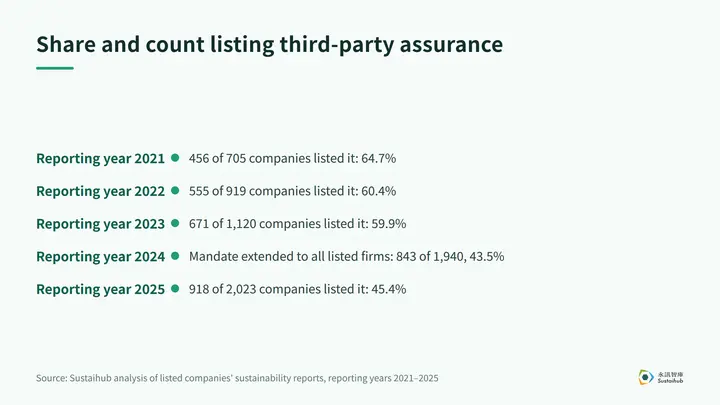
Table 1: Third-party verification and assurance by year (reporting years 2021–2025)
| Reporting year | Companies | Third-party verification or assurance | Share | Assured by CPA firms | Share | Reasonable assurance |
|---|---|---|---|---|---|---|
| 2021 | 705 | 456 | 64.7% | 209 | 29.6% | — |
| 2022 | 919 | 555 | 60.4% | 244 | 26.6% | — |
| 2023 | 1,120 | 671 | 59.9% | 326 | 29.1% | 3 |
| 2024 | 1,940 | 843 | 43.5% | 447 | 23.0% | 2 |
| 2025 | 2,023 | 918 | 45.4% | 515 | 25.5% | 2 |
"—": filings for 2022 and earlier have no assurance-level field. The rise in companies from 1,120 to 1,940 in reporting year 2024 is the main reason the share declined; over the same period, the number of companies assured by CPA firms rose from 326 to 447, and further to 515 in 2025.
Table 2: By industry, reporting year 2025 (industries with at least 30 reports)
"Third-party verification or assurance" and "Assured by CPA firms" use the number of 2025 reports as the denominator. "Scope 3 disclosed" and "Median renewable energy ratio" come from the ESG open data and cover the "Companies matched in open data".
| Industry | 2025 reports | Third-party verification or assurance | Assured by CPA firms | Companies matched in open data | Scope 3 disclosed | Median renewable energy ratio |
|---|---|---|---|---|---|---|
| Electronic Components | 212 | 40.1% | 17.0% | 210 | 72.4% | 4.4% |
| Semiconductors | 205 | 42.4% | 13.2% | 202 | 74.8% | 1.3% |
| Biotechnology and Medical Care | 155 | 32.3% | 16.8% | 150 | 51.3% | 0.0% |
| Optoelectronics | 119 | 33.6% | 10.1% | 115 | 65.2% | 2.4% |
| Computer and Peripheral Equipment | 112 | 48.2% | 8.9% | 110 | 70.9% | 14.0% |
| Others | 102 | 41.2% | 27.5% | 96 | 54.2% | 1.3% |
| Electric Machinery | 98 | 36.7% | 14.3% | 98 | 65.3% | 1.0% |
| Other Electronics | 97 | 39.2% | 12.4% | 94 | 68.1% | 4.7% |
| Communications and Internet | 92 | 40.2% | 13.0% | 92 | 77.2% | 6.0% |
| Building Materials and Construction | 87 | 37.9% | 23.0% | 87 | 58.6% | 0.0% |
| Textiles | 52 | 25.0% | 13.5% | 52 | 46.2% | 1.5% |
| Tourism and Hospitality | 52 | 61.5% | 59.6% | 51 | 39.2% | 0.0% |
| Financial and Insurance | 49 | 98.0% | 95.9% | 31 | 100.0% | 15.5% |
| Iron and Steel | 49 | 63.3% | 36.7% | 49 | 79.6% | 1.3% |
| Information Services | 45 | 35.6% | 15.6% | 44 | 59.1% | 1.2% |
| Green Energy and Environmental Services | 43 | 41.9% | 25.6% | 41 | 65.9% | 8.3% |
| Chemicals | 42 | 100.0% | 100.0% | 42 | 71.4% | 0.4% |
| Automobiles | 42 | 42.9% | 28.6% | 42 | 76.2% | 0.6% |
| Electronic Products Distribution | 36 | 38.9% | 25.0% | 36 | 58.3% | 0.1% |
| Digital and Cloud Services | 35 | 31.4% | 25.7% | 35 | 54.3% | 1.8% |
| Food | 34 | 97.1% | 97.1% | 33 | 66.7% | 0.1% |
| Shipping and Transportation | 33 | 51.5% | 18.2% | 33 | 84.8% | 0.3% |
| Home and Living | 33 | 27.3% | 24.2% | 32 | 46.9% | 3.0% |
Industries with fewer than 30 reports (such as Securities, Cement, and Paper and Pulp) are covered in by_industry_2025.csv in the data pack; indicators based on fewer than 5 companies are not calculated.
Data and methodology
- Report data: Sustaihub's SustainAI sustainability report database, covering 10,161 sustainability reports from Taiwan listed companies (reporting years 2009–2025), with fields taken from filings on the Market Observation Post System (MOPS, 公開資訊觀測站) and ESG Digital Platform (ESG 數位平台). Where a company had more than one record for the same year, only one was kept (the amended version, if any), yielding 10,154 company-years. Individual companies' original reports can be searched by company, industry and year in the sustainability report database.
- Third-party verification or assurance: From 2023, filings have separate "verification provider" and "assurance provider" fields, and a company is counted if either has a value. For 2022 and earlier, a single field is used (e.g., "None", "CPA firm: XX", "Other verification body: XX"); "None" or blank is not counted.
- Assured by CPA firms: From 2023, counted when the "assurance provider" field has a value; for 2022 and earlier, counted when the field contains "CPA firm".
- Scope 3 disclosure and renewable energy ratio: ESG disclosure open data from TWSE and TPEx (2025 data, 1,962 companies, retrieved 2026-10-06), matched by stock code to industry classifications in the report database. Scope 3 emissions greater than 0 are treated as disclosed; the renewable energy ratio is the median among companies that reported it; groups with fewer than 5 companies are not calculated.
- No industry-average carbon intensity: In the open data, each company sets its own denominator for emission intensity (e.g., per million NT dollars of revenue or per unit of product), so the figures cannot be averaged directly across companies. This study therefore does not calculate industry-average carbon intensity.
Limitations
- A report "listing" verification or assurance means the filing field has a value; it does not mean the assurance covers the entire report. The scope of assurance must be checked in each report's assurance statement.
- Field formats differ for 2022 and earlier, so cross-year comparisons follow the definitions used in this study.
- The filing fields record verification or assurance of the sustainability report itself. We spot-checked the original reports of 10 companies: all 5 companies whose fields listed verification or assurance included a corresponding verification or assurance statement in the report. Of the 5 whose fields did not, 1 had obtained CPA assurance only on its greenhouse gas inventory, while the sustainability report itself was not assured; such cases are not counted as "listing third-party verification or assurance".
- Some companies have yet to file or amend their reports for reporting year 2025, so the figures may change slightly.
For common shortcomings in report quality, see also TWSE's review of 2024 sustainability reports: a full breakdown.
Data download and recalculation
The data pack contains g01_reports.csv (report data), g01_twse.csv (ESG open data), analyze.py (calculation script), by_year.csv, by_industry_2025.csv and summary.json. Running analyze.py reads g01_reports.csv and g01_twse.csv and regenerates by_year.csv, by_industry_2025.csv and summary.json, which together contain every figure on this page. by_year.csv also includes data for reporting years 2013–2020.
Download the data pack (ZIP, raw data and analyze.py)
How to cite
Suggested citation:
Source: Sustaihub (永訊智庫) 2026, "Third-Party Assurance and Scope 3 Disclosure in Taiwan Listed Companies' Sustainability Reports", data retrieved 2026-10-06. https://www.sustaihub.com/blog/sustainability-report-assurance-study-2026/
When citing a single figure, please also state the data scope, e.g., "reporting year 2025, 2,023 listed companies" or "2025 ESG open data, 1,962 companies".