
ESG Glossary: 27 Sustainability and Carbon Terms with Official Sources
27 common ESG and carbon management terms, organized into six groups: reporting, standards, inventory, assurance, carbon pricing and ratings. Each comes with a concise definition and its official source, and the glossary flags concepts that are often confused, such as carbon inventory and carbon footprint, net-zero emissions and carbon neutrality, and assurance and verification.
What to decide after reading If you came for emission factors, ISO 14064, CBAM, or carbon data, the next step is to check whether activity data, emission factor versions, and supporting evidence can be traced.
Table of Contents
- Sustainability reporting and materiality
- ESG (Environmental, Social and Governance)
- CSR (Corporate Social Responsibility)
- Sustainability report
- Material topics
- Double materiality
- Disclosure standards and frameworks
- GRI Standards
- SASB Standards
- ISSB and IFRS S1/S2
- TCFD (Task Force on Climate-related Financial Disclosures)
- TNFD (Taskforce on Nature-related Financial Disclosures)
- GHG inventory and quantification
- Carbon inventory (GHG inventory)
- Scope 1/2/3
- GHG Protocol (Greenhouse Gas Protocol)
- Emission factor
- Carbon footprint
- Assurance and verification
- Assurance
- Verification
- Carbon fees, carbon credits and reduction targets
- Carbon fee
- Carbon credits (reduction credits)
- CBAM (Carbon Border Adjustment Mechanism)
- Net-zero emissions
- Carbon neutrality
- SBTi (Science Based Targets initiative)
- SDA (Sectoral Decarbonization Approach)
- Ratings and questionnaires
- CDP
- DJSI (Dow Jones Sustainability Indices) and S&P Global CSA
- ESG Evaluation (Taiwan)
- Mapping the terms to your own data

This ESG glossary covers 27 terms that come up most often in sustainability reports, carbon inventories and investor questionnaires. Each definition is drawn from the original text of the issuing body or Taiwanese regulation and comes with a link to the source. The terms are grouped into six categories by use. Pay particular attention to a few pairs that are easily confused: carbon inventory and carbon footprint, net-zero emissions and carbon neutrality, assurance and verification, and financial materiality and double materiality. Telling them apart is how you work out which data a customer questionnaire, regulator or rating agency is actually asking for.
Sustainability reporting and materiality
These terms are the common vocabulary for discussing corporate sustainability performance, and they also guide what goes into a sustainability report.
ESG (Environmental, Social and Governance)
ESG stands for Environmental, Social and Governance. It describes how a company manages non-financial issues such as climate, human rights, employees and ethical conduct, along with the risks and opportunities these issues create, and is widely used in disclosure, ratings and investment decisions. The term is commonly traced to the "Who Cares Wins" report published during the 2004 UN Global Compact Leaders Summit. Source: UNEP FI: 2004 Global Compact Leaders Summit. For the disclosure process in practice, see How to approach ESG disclosure.
CSR (Corporate Social Responsibility)
CSR stands for Corporate Social Responsibility. In 2011 the European Commission defined it as "the responsibility of enterprises for their impacts on society" and expected companies to work with their stakeholders to integrate social, environmental, ethical, human rights and consumer concerns into their business operations and core strategy. Compared with ESG, CSR focuses on the responsibilities a company should take on and the actions it takes. In Taiwan, the "corporate social responsibility reports" of listed companies were renamed "sustainability reports" in December 2021. Sources: European Commission 2011 CSR strategy, Taiwan Stock Exchange (TWSE, 臺灣證券交易所) Q&A on the Sustainability Report Rules; for a full comparison of the two, see ESG vs. CSR: what is the difference.
Sustainability report
An annual report in which a company explains its material topics relating to the economy, environment and people, its impacts and how it manages them. Under the TWSE Rules Governing the Preparation and Filing of Sustainability Reports by TWSE Listed Companies (上市公司編製與申報永續報告書作業辦法), listed companies must prepare a report on the previous year in accordance with the GRI Standards, post it on their website and file it on the Market Observation Post System (MOPS, 公開資訊觀測站) by August 31 each year. Companies listed on the Taipei Exchange (TPEx, 證券櫃檯買賣中心) follow the TPEx rules of the same name. Source: TWSE Q&A on the Sustainability Report Rules; for the structure of a report, see What is a sustainability report, and for filing deadlines, see Taiwan sustainability regulations at a glance.
Material topics
Under GRI 3, material topics are the topics that represent an organization's most significant impacts on the economy, environment and people, including impacts on their human rights. When preparing a sustainability report, Taiwanese listed companies must follow GRI 3 to disclose their process for determining material topics, the list of material topics and how each topic is managed, and explain changes to the list compared with the previous reporting period. Sources: GRI Universal Standards 2021, TWSE Q&A on the Sustainability Report Rules; further reading: The GRI 2021 revision and materiality analysis.
Double materiality
The materiality principle of the European Sustainability Reporting Standards (ESRS), which has two dimensions. Impact materiality looks at a company's actual or potential, positive or negative impacts on people and the environment. Financial materiality looks at whether the risks and opportunities arising from sustainability matters have a material effect on the company's financial position, performance, cash flows, access to finance or cost of capital. A matter is material if it meets either criterion. The first dimension is close to GRI's focus on outward impacts; the second reflects the financial effects that SASB and IFRS S1 and S2 are concerned with. Source: EFRAG: ESRS 1.
Disclosure standards and frameworks
These are the standards and disclosure frameworks companies use to prepare sustainability information. GRI focuses on a company's impacts on the outside world, while SASB, IFRS S1/S2 and TCFD start from the financial effects that matter to investors; a single report often maps to several of them at once.
GRI Standards
Sustainability reporting standards issued by GRI, an independent international not-for-profit organization headquartered in the Netherlands. They help organizations report their impacts on the economy, environment and people in a comparable and credible way, and are organized into three series: the Universal, Sector and Topic Standards. Under the TWSE rules, Taiwanese listed companies must use the GRI Standards to prepare their sustainability reports, with the 2021 version applying from 2023. Sources: GRI: About GRI, GRI Standards, TWSE Q&A on the Sustainability Report Rules.
SASB Standards
Industry-based sustainability disclosure standards covering 77 industries. They help companies identify the sustainability issues that are most likely to affect cash flows, access to finance or cost of capital and most relevant to investor decisions. Since the IFRS Foundation completed its consolidation with the Value Reporting Foundation in August 2022, the ISSB has been responsible for maintaining the SASB Standards, and the industry-based requirements of IFRS S2 also draw on them. Sources: SASB Standards, IFRS Foundation completes consolidation with the VRF, IFRS S2; further reading: SASB Standards and reporting requirements.
ISSB and IFRS S1/S2
The IFRS Foundation announced the formation of the ISSB (International Sustainability Standards Board) at COP26 on November 3, 2021, with the goal of setting a global baseline of sustainability disclosures for investors and financial markets. In June 2023 the ISSB issued IFRS S1 (General Requirements) and IFRS S2 (Climate-related Disclosures), which require companies to disclose sustainability- and climate-related risks and opportunities that could affect their cash flows, access to finance or cost of capital. They are effective for annual reporting periods beginning on or after January 1, 2024. Taiwan's TWSE- and TPEx-listed companies are adopting the standards in phases under the roadmap of the Financial Supervisory Commission (FSC, 金融監督管理委員會). Sources: IFRS Foundation: ISSB, IFRS S1, IFRS S2, FSC press release of September 23, 2026; for Taiwan's timeline, see IFRS S1/S2 adoption timeline in Taiwan.
TCFD (Task Force on Climate-related Financial Disclosures)
A task force set up by the Financial Stability Board (FSB). In 2017 it published its recommendations on climate-related financial disclosures, built on four core elements (governance, strategy, risk management, and metrics and targets) and 11 recommended disclosures, to help investors assess climate-related risks and opportunities. The TCFD fulfilled its remit and disbanded in October 2023. Its recommendations are fully incorporated into IFRS S1 and S2, and the IFRS Foundation has taken over monitoring of climate-related disclosures. The IFRS Foundation also notes that companies may still use the TCFD recommendations as a starting point for applying the ISSB Standards. Sources: TCFD: About, IFRS Foundation: ISSB and TCFD; further reading: From TCFD to IFRS S2: how the climate disclosure framework evolved.
TNFD (Taskforce on Nature-related Financial Disclosures)
A market-led, science-based and government-supported initiative that published its final recommendations in September 2023 to help companies and financial institutions identify and disclose their nature-related dependencies, impacts, risks and opportunities. Its disclosure framework rests on four pillars (governance; strategy; risk and impact management; and metrics and targets), consistent with the TCFD and the ISSB Standards, and it offers the LEAP approach as implementation guidance. Since November 2025, the ISSB has been developing nature-related disclosure requirements that build on the TNFD's work, and the TNFD will issue no new guidance once its work in progress is complete (IFRS Foundation announcement). Sources: TNFD: About, TNFD recommendations.
GHG inventory and quantification
These terms determine how emissions figures are calculated. Where a term already has its own page on this site, this glossary keeps only a concise definition; follow the links in each entry for calculation methods and timelines.
Carbon inventory (GHG inventory)
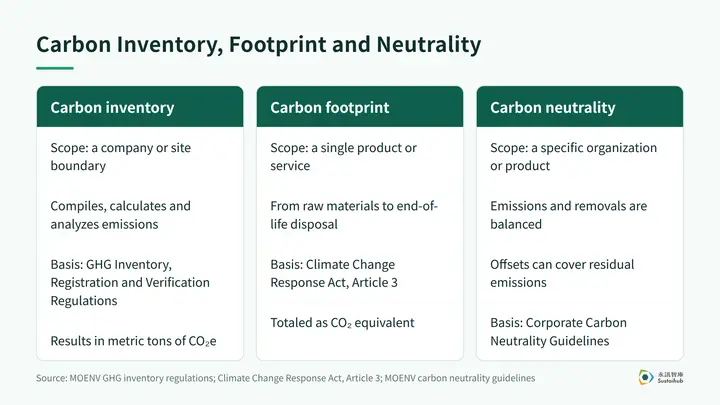
Under the Regulations Governing Greenhouse Gas Emissions Inventory, Registration and Verification (溫室氣體排放量盤查登錄及查驗管理辦法) issued by Taiwan's Ministry of Environment (環境部), a greenhouse gas inventory is the process of compiling, calculating and analyzing greenhouse gas emissions. In practice, this means defining the organizational boundary and reporting period, gathering activity data such as fuel and electricity use, and calculating emissions with the emission factor method, the mass balance method or direct monitoring, with results expressed in metric tons of CO₂ equivalent. Source: Regulations Governing Greenhouse Gas Emissions Inventory, Registration and Verification; further reading: What is a carbon inventory, GHG inventory registration.
Scope 1/2/3
The emissions categories defined by the GHG Protocol. Scope 1 covers direct emissions from sources a company owns or controls. Scope 2 covers indirect emissions from the generation of energy the company purchases. Scope 3 covers all other indirect emissions beyond Scope 2 that occur upstream and downstream in the value chain, such as purchased goods, outsourced transportation, business travel and the use of sold products. Sources: GHG Protocol FAQ, GHG Protocol Corporate Standard; further reading: What are Scope 1, 2 and 3 emissions.
GHG Protocol (Greenhouse Gas Protocol)
A family of greenhouse gas accounting standards developed through a partnership between the World Resources Institute (WRI) and the World Business Council for Sustainable Development (WBCSD). It provides businesses and governments with standards, guidance, tools and training for measuring and managing emissions. Its Corporate Standard is used to prepare an organization's emissions inventory, together with the Scope 2 Guidance and the Scope 3 Standard. Sources: GHG Protocol: About, GHG Protocol Corporate Standard; further reading: ISO 14064 vs. GHG Protocol.
Emission factor
Under the Regulations Governing Greenhouse Gas Emissions Inventory, Registration and Verification, an emission factor is the quantity of emissions per unit of raw material, fuel used, product output or other recognized operating quantity. With the emission factor method, emissions are calculated by multiplying activity data by the factor. Companies should use the greenhouse gas emission factors published by the Ministry of Environment, or site-specific factors obtained from international literature or test reports. Source: Regulations Governing Greenhouse Gas Emissions Inventory, Registration and Verification; further reading: The emission factors published in 2026.
Carbon footprint
Under Article 3 of the Climate Change Response Act (氣候變遷因應法), a carbon footprint is the total carbon emissions generated across every stage of a product's life cycle, including raw material acquisition, manufacturing, distribution and sale, use, and disposal, converted to CO₂ equivalent. A carbon footprint covers a single product or service, unlike a carbon inventory, whose boundary is a company or site; data from one cannot substitute for the other. Source: Climate Change Response Act; further reading: What is a carbon footprint.
Assurance and verification
Both involve an independent third party reviewing information; they differ in their basis and subject matter. According to the TWSE Q&A on the sustainability report rules, assurance of Scope 1 and Scope 2 greenhouse gas emissions may be performed under Taiwan Standard on Assurance Engagements (確信準則) No. 3410 or ISO 14064-3, which is why the two terms are often used side by side for greenhouse gases. For a sense of how widespread this is: Sustaihub reviewed the 2025 sustainability reports of 2,023 TWSE- and TPEx-listed companies and found that 45.4% (918 companies) reported third-party verification or assurance in their filings, while 25.5% (515 companies) were assured by accounting firms.
Assurance
An independent assurance practitioner issues an assurance report, under assurance standards, on non-financial information such as sustainability report indicators. Under the TWSE rules, listed companies in the food, chemical, and finance and insurance industries, as well as those earning 50% or more of their revenue from food and beverage services, must obtain an assurance report on designated indicators issued by a CPA under Standard on Assurance Engagements No. 3000. Scope 1 and Scope 2 greenhouse gas emissions are subject to assurance on a phased schedule. Source: TWSE Q&A on the Sustainability Report Rules.
Verification
Under the Ministry of Environment's Regulations Governing the Management of Greenhouse Gas Accreditation Bodies and Verification Bodies (溫室氣體認證機構及查驗機構管理辦法), verification is the process in which a verification body assesses whether a statement of historical data and information, covering an inventory, a voluntary reduction project or a product carbon footprint carried out by a business or government agency, is materially correct. Verification bodies must hold a permit. The same regulations also define validation, which assesses the assumptions and methods a reduction project uses for its future outcomes. Source: Regulations Governing the Management of Greenhouse Gas Accreditation Bodies and Verification Bodies; further reading: GHG inventory registration and verification.
| Item | Assurance | Verification |
|---|---|---|
| Typical provider | CPAs and other assurance practitioners meeting the TWSE and TPEx rules for assurance providers | Verification bodies permitted by the Ministry of Environment |
| Main basis | Standards on Assurance Engagements No. 3000, No. 3410 and others | Ministry of Environment regulations on verification bodies, ISO 14064-3 and others |
| Typical subject | Sustainability report indicators; Scope 1 and Scope 2 greenhouse gas emissions | Data statements for inventories, voluntary reduction projects and product carbon footprints |
Carbon fees, carbon credits and reduction targets
These terms concern the cost of emissions and the commitments made to reduce them. The first three relate to fees, trading and exports; the last four are the concepts and methods companies cite most often when setting decarbonization targets.
Carbon fee
Under the Regulations Governing the Collection of Carbon Fees (碳費收費辦法), the carbon fee is levied on a business's direct emissions and indirect emissions from electricity use, as inventoried, registered and verified, converted to CO₂ equivalent. It currently applies to power and gas suppliers and manufacturers that operate designated emission sources and whose total annual emissions across the whole facility reach 25,000 metric tons of CO₂e or more. The general rate is NT$300 per metric ton, with two preferential rates of NT$50 and NT$100. Sources: Regulations Governing the Collection of Carbon Fees, Ministry of Environment announcement on carbon fee rates; further reading: What is Taiwan's carbon fee.
Carbon credits (reduction credits)
What is commonly called a carbon credit in Taiwan usually refers, in legal terms, to a reduction credit. Under the Climate Change Response Act, reduction credits are credits that businesses and government agencies obtain by carrying out voluntary greenhouse gas reduction projects, offset projects or early action projects. They differ from emission allowances, which permit emissions under an emissions cap. Reduction credits must meet the requirements of the Regulations Governing the Collection of Carbon Fees before they can be used to deduct from emissions subject to the carbon fee; deductions using domestic reduction credits are capped at 10% of chargeable emissions. Sources: Climate Change Response Act, Regulations Governing the Collection of Carbon Fees; further reading: What are carbon credits in Taiwan.
CBAM (Carbon Border Adjustment Mechanism)
The EU mechanism for addressing carbon leakage, which makes the price of imported goods reflect their embedded emissions. It covers six product categories: cement, iron and steel, aluminium, fertilizers, electricity and hydrogen. The transitional period ran from 2023 to 2025, and the definitive period began on January 1, 2026. Importers bringing in more than 50 metric tons a year must obtain authorized CBAM declarant status. CBAM certificates go on sale from February 2027, and the first annual declaration and certificate surrender for goods imported in 2026 are due by September 30, 2027. An amendment extending the scope to downstream products is still under negotiation in the EU. Source: European Commission: CBAM; further reading: The EU CBAM definitive period.
Net-zero emissions
Under Article 3 of the Climate Change Response Act, net-zero emissions means that greenhouse gas emissions are balanced by carbon sinks. Carbon sinks are trees, forests, soils, oceans, geological formations, facilities or sites that can continuously remove and absorb or store greenhouse gases. Article 4 of the Act sets the national long-term reduction target of net-zero greenhouse gas emissions by 2050 (ROC year 139). Source: Climate Change Response Act; further reading: What is net-zero emissions.
Carbon neutrality
A state in which a given entity's anthropogenic greenhouse gas emissions and removals are balanced, with offsets allowed to compensate for residual emissions. Under the Ministry of Environment's Guidelines for Corporate Carbon Neutrality Claims (企業宣告碳中和指引), organizational carbon neutrality covers a specific period, while carbon neutrality for a product or service covers all or part of its life cycle. The guidelines require a three-stage process of inventory, reduction and offsetting, with full disclosure, and ISO 14068 can serve as a reference for international practice. Compared with net-zero emissions under the Climate Change Response Act, carbon neutrality is limited to a specific organization, period or product. Sources: Ministry of Environment: Guidelines for Corporate Carbon Neutrality Claims, ISO 14068; further reading: What is carbon neutrality.
Turn this article into your next step
If this article touches disclosure, carbon inventory, or report preparation, use the system or database to check how peers handle it.
SBTi (Science Based Targets initiative)
A corporate climate action organization that helps companies and financial institutions set science-based emission reduction targets. It was originally founded as a partnership between CDP, the UN Global Compact, the We Mean Business Coalition, the World Resources Institute (WRI) and the World Wide Fund for Nature (WWF). The SBTi develops standards, tools and guidance for target setting, and provides target validation services through its subsidiary, SBTi Services. Source: SBTi: About us; further reading: What is net-zero emissions.
SDA (Sectoral Decarbonization Approach)
The SDA (Sectoral Decarbonization Approach) is an SBTi target-setting method that derives reduction targets from sector-specific decarbonization pathways and carbon budgets, based on a company's activity levels, projected growth and emissions intensity. The version published in 2015 is based on the International Energy Agency's 2°C scenario and suits sectors with well-defined intensity data, such as power generation, iron and steel, cement, aluminium, transport and commercial buildings. Source: SBTi: A Quick Guide to the Sectoral Decarbonization Approach.
Ratings and questionnaires
These are the questionnaires and assessments that customers, investors and regulators most often ask companies about.
CDP
A global non-profit founded in 2000, formerly known as the Carbon Disclosure Project. It runs the system through which companies, cities, states and regions disclose environmental information, covering climate change, forests and water security. Companies are scored after responding to its questionnaires, and financial institutions and supply chain buyers also use CDP to request environmental data from companies. Sources: CDP: About, CDP media factsheet.
DJSI (Dow Jones Sustainability Indices) and S&P Global CSA
Launched in 1999, the DJSI was the first global sustainability best-in-class index family on the market, with constituents selected on the basis of the S&P Global Corporate Sustainability Assessment (CSA). In 2025, S&P Dow Jones Indices renamed the DJSI family the Dow Jones Best-in-Class Indices (DJ BIC) and moved the annual constituent review to the end of April each year. The CSA is conducted annually, using a questionnaire to collect public and company-provided information and assess company performance on financially material ESG issues. Sources: S&P Global: 20 years of the DJSI, S&P Global: CSA, S&P Dow Jones Indices: Dow Jones Best-in-Class Indices 2026 review results.
ESG Evaluation (Taiwan)
An evaluation of TWSE- and TPEx-listed companies conducted by the TWSE and TPEx. It succeeds the former Corporate Governance Evaluation (公司治理評鑑), and its first edition covers ROC year 115 (2026). The indicators and scoring guidance are published by the TWSE Corporate Governance Center (公司治理中心). According to the TWSE Q&A, steps such as having the sustainability report approved by a board resolution and preparing an English version of the report can earn points in the evaluation. Sources: TWSE Corporate Governance Center: ESG Evaluation, TWSE Q&A on the Sustainability Report Rules; further reading: The TWSE ESG Evaluation.
Mapping the terms to your own data
Once the terms are clear, the real work is checking them against the data you have. When responding to a customer's emissions questionnaire, the key is to work out whether they want your organization's Scope 1, 2 and 3 emissions or the carbon footprint of a single product. When preparing a sustainability report, you need to confirm the applicable standards, your material topics and the indicators that require assurance.
Organizational carbon inventory and product carbon footprint data can be organized in Sustaihub's DCarbon carbon inventory system, which supports ISO 14064-1 organizational inventories and ISO 14067 product carbon footprint calculations; formal verification is still carried out by a third-party body. To collect ESG data across departments and prepare your report, take a look at the Syber sustainability reporting system: choose your standards and disclosure scope, assign questions to each department and track review progress, then edit and export the report in a single document.
To place these terms on a timeline, continue with Taiwan sustainability regulations at a glance. If you are preparing for the iPAS Net-Zero Carbon Planning Manager exam (淨零碳規劃管理師), practice with 20 iPAS practice questions.
FAQ
View AllWhat is the difference between ESG and CSR?
CSR refers to a company's responsibility for its impacts on society, with the focus on the responsibilities a company should take on and the actions it takes. ESG looks at a company's non-financial performance and risks across environmental, social and governance dimensions, and is widely used in disclosure, ratings and investment decisions. In Taiwan, the corporate social responsibility reports of listed companies were renamed sustainability reports in December 2021.
What is the difference between assurance and verification?
In assurance, an assurance practitioner issues an assurance report under assurance standards on information such as sustainability report indicators, for example a CPA engagement under Standard on Assurance Engagements No. 3000. In verification, a verification body permitted by the Ministry of Environment assesses whether statements of historical data on inventories, reduction projects or product carbon footprints are materially correct. Assurance of Scope 1 and Scope 2 greenhouse gas emissions can be performed under Standard on Assurance Engagements No. 3410 or ISO 14064-3.
Are net-zero emissions and carbon neutrality the same?
Not exactly. Taiwan's Climate Change Response Act defines net-zero emissions as a balance between greenhouse gas emissions and carbon sinks, with a national target of reaching it by 2050. Carbon neutrality, under the Ministry of Environment's guidelines, balances emissions and removals for a specific organization over a specific period, or over the life cycle of a specific product or service, and offsets may be used to compensate for residual emissions.
Turn Carbon Data into an Auditable Workflow
Use DCarbon to calculate emissions with the emission factors you configure and organize activity data and supporting evidence, so inventory data stays traceable, reviewable, and ready for customer requests.
How to decide the next stepTurn the regulation or factor requirements in the article into a data checklist first. If data crosses sites or departments, or needs verification, then evaluate whether system-based management is needed.