Insights
Regulatory updates, carbon inventory and AI applications, IFRS adoption experience, corporate case studies, and system updates, written by our consultants and engineers.
-
Taiwan's New Human Rights Due Diligence System Is About to Launch — Why Should Enterprises Act Now?
The Ministry of Economic Affairs is promoting the draft "Taiwan Enterprise Supply Chain Respect for Human Rights Program," planning to require listed manufacturing companies with annual revenue exceeding NT$50 billion to establish and implement human rights due diligence mechanisms. This system is expected to be implemented from 2026 and included in sustainability reports from 2027.
-
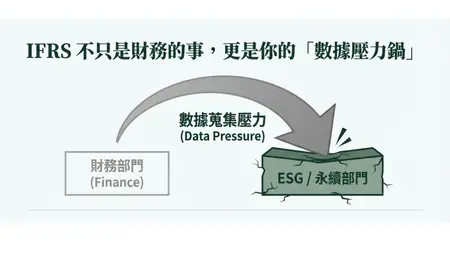
IFRS S1/S2 Is Here: How Can Listed Companies Streamline Sustainability Chapters in Annual Reports?
IFRS S1/S2 highlights the urgency of data governance. Move beyond file chaos and give sustainability professionals a truly sustainable way of working.
-
What Happens If SMEs Don't Do ESG? Watch Out for Being Kicked Out of the Supply Chain!
ESG transformation for SMEs is urgent! Facing carbon inventory pressure from major supply chain clients, failing to adopt sustainability management risks losing orders. This article analyzes the crises facing OEMs and traditional manufacturers, and provides digital solutions for efficient sustainability supply chain management.
-
The Third Wave of Mandatory Carbon Inventory Is Coming! Is Your Healthcare Facility Ready for Net-Zero Transformation?
The Ministry of Environment has officially mandated carbon inventory declaration requirements for healthcare facilities and universities. In this wave of global net-zero transformation, the healthcare industry is shifting from 'passive compliance' to 'proactive positioning.' Although hospitals vary in operational scale, management's accurate anticipation of industry transformation opportunities will be key to building brand competitiveness. Beyond completing organizational carbon inventories independently, arranging third-party verification further establishes green transformation benchmarks in the healthcare industry beyond compliance standards. This article analyzes complex data including Sevoflurane anesthetic gases, medical cylinders, and septic tanks, providing healthcare facilities with a 'one-stop' carbon emission calculation and declaration strategy.
-
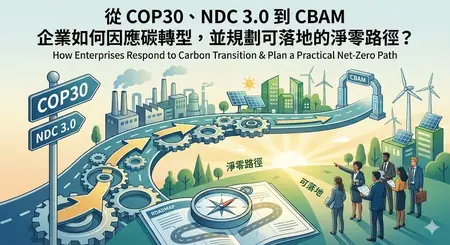
From COP30 and NDC 3.0 to CBAM: How Can Enterprises Navigate Carbon Transition and Plan Actionable Net-Zero Pathways?
As global climate governance accelerates and carbon costs become increasingly internalized, enterprises no longer face just the question of 'whether to reduce emissions' but rather 'how to complete transformation ahead of time amid uncertain international consensus and increasingly clear regulatory frameworks.' This article explores international trends from COP30, NDC 3.0 emission reduction targets across countries, and the practical impacts of EU CBAM and Taiwan's carbon fee system, helping you understand the key aspects and strategic directions enterprises should focus on during carbon transition.
-
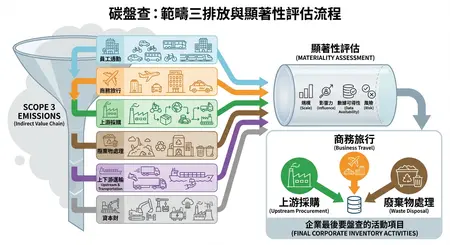
How to Conduct a Carbon Inventory 'Significance Assessment'? A Key Guide for Corporate Sustainability
When enterprises start a carbon inventory, most teams reach for data collection, tables and calculations first. But what really decides quality and efficiency is not "how much data" but "which emission sources are worth collecting." This step is called the carbon inventory Significance Assessment. A significance assessment acts as the steering wheel for the whole inventory: it helps you identify high-emission, high-risk, high-attention activities, focusing subsequent data collection and avoiding wasted time and effort. This article walks you through the purpose, indicators and procedure of significance assessment, and how to run it quickly through a system that connects directly to the rest of the inventory workflow.
-
Responding to FET Green Supply Chain Initiative: Taiwan Sunlink Partners with Sustaihub to Produce ESG Report in 30 Days
As global green transformation accelerates, implementing ESG has shifted from passive regulatory compliance to proactive supply chain alignment. Far EasTone Telecommunications held a supplier conference on November 18, 2025, explicitly encouraging partners to prepare sustainability reports. Key FET supplier 'Taiwan Sunlink' actively responded, completing their first report in just one month through Sustaihub's system assistance, setting a practical example for SMEs efficiently meeting ESG requirements.
-
[December Syber Feature Update] Advanced Sustainability Governance: Enhancing Materiality, Verification & Internal Control Processes
For enterprises with established sustainability teams, ESG reporting is already familiar territory. With disclosure standards, ESG ratings and internal control requirements rising every year, how can your sustainability team use a sustainability performance management platform and AI tools to systematize materiality, assurance and audit processes? Catch all the December feature updates here.
-
SMEs Can Complete Sustainability Reports Too! 12-Hour Course + Digital System for Your First Draft
Writing sustainability reports is no longer out of reach for SMEs. Sustaihub partnered with the Food & Beverage ESG Promotion Association to offer a 12-hour hands-on course, combined with the Syber Sustainability Management System, helping food and beverage SMEs complete their first sustainability report from scratch.