Insights
Regulatory updates, carbon inventory and AI applications, IFRS adoption experience, corporate case studies, and system updates, written by our consultants and engineers.
-
Taiwan’s 2025 (ROC Year 114) Electricity Emission Factor Falls to 0.467: Carbon Trends and the Energy Transition
On 2 June 2026, the Ministry of Economic Affairs’ Energy Administration announced the FY2025 (ROC year 114) public electricity retailer emission factor of 0.467 kg CO₂e/kWh, approximately 1.5% below FY2024 (ROC year 113) and 12% below FY2016 (ROC year 105). For the first time, separate industrial (0.466) and residential (0.471) factors were introduced, alongside a preliminary national electricity emission factor of 0.456 that includes private green electricity trading. For companies preparing GHG inventories, reporting Scope 2 emissions or responding to international supply chain decarbonisation requirements, these annually updated figures underpin electricity emissions calculations. This article explains the four factors, five-year trends and how companies should correctly apply officially announced factors.
-
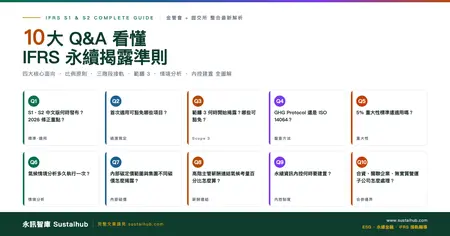
2026 IFRS Sustainability Disclosure Standards Q&A: S1, S2, Adoption Timelines, Scope 3 and Internal Controls
A guide to IFRS S1, S2 and Taiwan adoption questions, covering the three-phase timeline, Scope 3 transition provisions, materiality and internal controls, with official legal sources and a disclosure data inventory example.
-
12th Corporate Governance Evaluation Results: Consistent Leaders, Reform Successes and Industry Trends Across the 10th–12th Rounds
The Corporate Governance Evaluation is the most important official measure of governance quality among Taiwan's TWSE/TPEx-listed companies. Each year, the Taiwan Stock Exchange (TWSE) and Taipei Exchange (TPEx) assess companies against four dimensions and multiple indicators, publishing results by ranking band. The 12th Corporate Governance Evaluation results were officially announced on 30 April 2026, with a record 1,009 TWSE-listed and 801 TPEx-listed companies evaluated. The Sustaihub research team consolidated more than 10,000 ranking-band records across the 10th, 11th and 12th Corporate Governance Evaluations and cross-referenced industry and market classifications from the Market Observation Post System (MOPS). Covering 6 perspectives—consistent leaders, governance reform models, overall mobility, industry rankings, finance and insurance, and electronics vs non-electronics—this article helps investors, board members, chief sustainability officers and governance professionals understand evaluation trends and changes across Taiwan's listed companies.
-
2026 (ROC Year 115) ESG Evaluation Guide to Top Scores: 3 AA Indicators (G-18 / G-19 / G-26) and 17 A+ Indicators Explained—From 100 to 120 Points
The key takeaway: the 2026 (ROC year 115) ESG Evaluation maximum is 120, not 100. The extra 20 points are in a checklist of 3 weighted AA indicators—G-18 Risk Management Committee, G-19 External Board Performance Evaluation and G-26 Voluntary Individual Director Remuneration Disclosure—plus 17 A+ bonus indicators. Based on TWSE's official indicator framework, this article explains each requirement, industry practice and value-for-money priorities, and value-for-money priorities.
-
2026 ESG Evaluation Final Check Window: 6 Key Review Points After Your Sustainability Report Draft
Once the sustainability report draft is complete, teams should immediately benchmark content against the 75 indicators of the first Taiwan ESG Evaluation (FY2026) and mark each as fully compliant, partially compliant, or non-compliant — then close the gaps before the report goes to print. April through June is the golden window when most companies revise the draft, and the last real chance to change substantive content. The first evaluation cycle adds 12 new indicators, revises 17, removes 7 and restructures 5, aligning more closely with SASB, TCFD and ISSB. If the draft is not reviewed against the new indicators, issues like E-14 Biodiversity or G-30 Chief Sustainability Officer can no longer be fixed once you submit the 2025 report on 31 August and enter the September review period. This article breaks the post-draft check into six key points — from indicator mapping and new-item inventory through E/S/G gap closure to pre-submission scheduling — and shows how Syber AI compresses the 7–10 working-day manual review into a single day with an auto-generated gap list.
-
How SMEs Can Meet Customer Carbon Inventory Requirements: From 'Form-Filling' to 'Precise Data' — Delivering High-Quality Carbon Data
When small and medium enterprises face carbon inventory requests from their customers, the key is delivering high-quality, credible data. Strengthening data accuracy and completeness through on-site investigation lets SMEs effectively respond to customer expectations, stabilize order sources, and gradually build the trust foundation for long-term partnership. This article walks through supply chain carbon inventory practice, explains how on-site material surveys improve supplier data quality, and draws on real project results to show how SMEs can reinforce customer collaboration resilience and move toward more stable sustainable development.
-
Event Recap: SMEs Write Their First Sustainability Report — Supply Chain Workshop Uses AI to Complete Draft On-Site
SMEs facing net-zero demands from major clients like Far EasTone Telecommunications and increasingly strict global supply chain ESG audits often feel lost. What's even more frustrating is the near-complete absence of solutions tailored for SMEs. They're trapped in the 'no staff, no budget, no time' dilemma while orders keep piling up. However, at the recently concluded 'Far EasTone Supply Chain Sustainability Workshop — Taipei Edition,' we witnessed a historic moment. Through the innovative 'AI Sustainability Report System,' over 30 SME suppliers produced ESG sustainability report chapter drafts on-site in just one day, improving efficiency by over 90%!
-
[2026 Update] EU CBAM Enters Its Definitive Phase: How Can Taiwanese Exporters Stay Globally Competitive?
With the EU Carbon Border Adjustment Mechanism (CBAM) entering its definitive phase on January 1, 2026, Taiwanese exporters face new challenges affecting export costs and market competitiveness. This article explains the latest CBAM changes, focusing on actual emissions data, carbon fee deductions and the reporting process to help companies turn carbon risk into a competitive advantage.
-
Taiwan's 2026 Greenhouse Gas Emission Factor Announcements: Checking Years, Sources and Units
Distinguish the 2026 announcement year from the 2025 (ROC year 114) activity year. Check factors by stationary or mobile combustion, fuel, gas and unit, and use diesel examples to organise calculation references and supporting evidence.
-
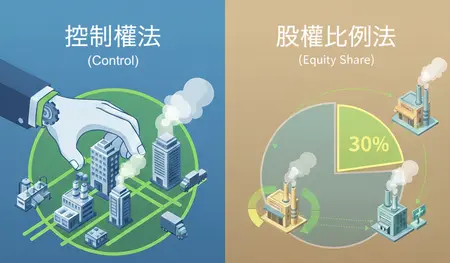
How to Choose the "Boundary Setting Method" for Carbon Inventory? Understanding Control Approach vs. Equity Share Approach
When executing a carbon inventory project, the first task is to define the "organizational boundary." If the boundary is unclear, which emission sources and activity data should be included often lacks consistent standards. This article explains operational control, financial control, and equity share approaches in plain language to help readers choose the appropriate method.