-
How to Choose Carbon Inventory Software: 8 Questions Before You Buy
Before choosing a carbon inventory tool, be clear about what it is for: a rough estimate, answering customers, mandatory registration or preparing for verification. The 8 common questions below compare when Taiwan's Ministry of Environment (環境部) estimation tool, Excel, ESG platforms, dedicated systems and consultants fit, and include a comparison checklist you can use right away.
-
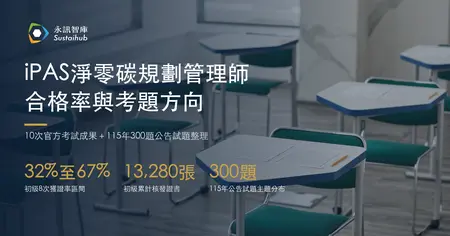
iPAS Net-Zero Carbon Planning Manager Pass Rates of 32%–67%: Results from 10 Exams and Question Topics
Official results from 8 elementary and 2 intermediate iPAS Net-Zero Carbon Planning Manager exams: elementary certification rates ranged from 32.05% to 67.43%, with 13,280 certificates issued. Subject One had a lower pass rate than Subject Two in 7 of 8 exams. Includes topic distributions for 300 questions in 6 published 2026 (ROC year 115) papers and a recommended study sequence. Individual registration for the third elementary exam closes at noon on September 22.
-
What Is Carbon Neutrality? ISO 14068 Update and Taiwan's Guidelines
A carbon neutrality claim needs an inventory, reductions, offsets and public evidence. From what a claim must contain and how ISO 14068 has changed to the credit conditions and legal status of the Ministry of Environment's guidelines, judge whether your data is ready for a public claim.
-
Choose a starting point for the task you are working on
Find peer reportsSustainability Report DatabaseBrowse Taiwanese corporate ESG reports for free (10,000+ reports).Find peer reports → Selection guideTaiwan ESG Reporting Software Selection GuideCompare the features and costs of ESG reporting systems before deciding which tool to use.Read the selection guide → SyberCoordinate disclosure with SyberChapter ownership, data collection, AI drafts, and review records.See the Syber reporting workflow → -
What Is Net Zero? Taiwan's 2050 Pathway, the Law and Corporate Targets
Net zero is a balance between emissions and carbon sinks, not zero emissions. From the pathway announced in 2022 and its enactment into law in 2023 to the SBTi version timeline, see where national targets end and corporate obligations begin, and how to prepare starting with an inventory.
-
Taiwan Carbon Fee: Rates and Deductions for a 100,000-Tonne Plant
The carbon fee is not simply total emissions multiplied by a rate. A hypothetical plant emitting 100,000 tonnes CO₂e a year shows how the K value, adjustment coefficient, the NT$300 and preferential rates, and the 10% cap on reduction credits affect the amount due, along with the end-of-May payment schedule.
-
What Is a Carbon Footprint? Calculation, Factors and Carbon Labels
A product carbon footprint answers how much one product emits, and the figure only makes sense alongside the product, unit, boundary and data period. Compare ISO 14067 with an organizational inventory, see how allocation and factor choices are made, find the official lookup sources, and understand the data window and 2-year validity that apply to Taiwan carbon label applications.
-
GHG Inventory Registration in Taiwan: Who, Deadlines and Guidelines
Covered businesses must in principle register the previous year's inventory and report by April 30 each year, and those subject to verification must also upload verification results by October 31. Here is how to determine coverage, choose the right guidelines and factors, and map ISO 14064-1 Categories 1 to 6.
-
What Are Scope 1, 2 and 3? 15 Scope 3 Categories and ISO Mapping
Scopes 1, 2 and 3 classify emission sources by their relationship to the company. Learn how to assign each scope, how the 15 Scope 3 categories map to ISO 14064-1 categories, and what 2025 open data shows about gaps in Scope 3 disclosure among listed companies.
-
Taiwan Carbon Inventory: Who Must Report, 5 Stages and Verification
A carbon inventory answers two questions: where do your emissions come from, and how much is there in total? Mandatory inventories, the carbon fee and customer requests each have their own criteria, and each of the five stages (boundary, sources, calculation, reporting, verification) should leave a traceable output. Sustaihub's review of 2025 sustainability reports from 2,023 listed companies found that 45.4% listed third-party verification or assurance.
-
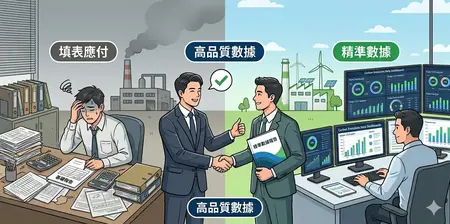
How SMEs Can Meet Customer Carbon Inventory Requirements: From 'Form-Filling' to 'Precise Data' — Delivering High-Quality Carbon Data
When small and medium enterprises face carbon inventory requests from their customers, the key is delivering high-quality, credible data. Strengthening data accuracy and completeness through on-site investigation lets SMEs effectively respond to customer expectations, stabilize order sources, and gradually build the trust foundation for long-term partnership. This article walks through supply chain carbon inventory practice, explains how on-site material surveys improve supplier data quality, and draws on real project results to show how SMEs can reinforce customer collaboration resilience and move toward more stable sustainable development.